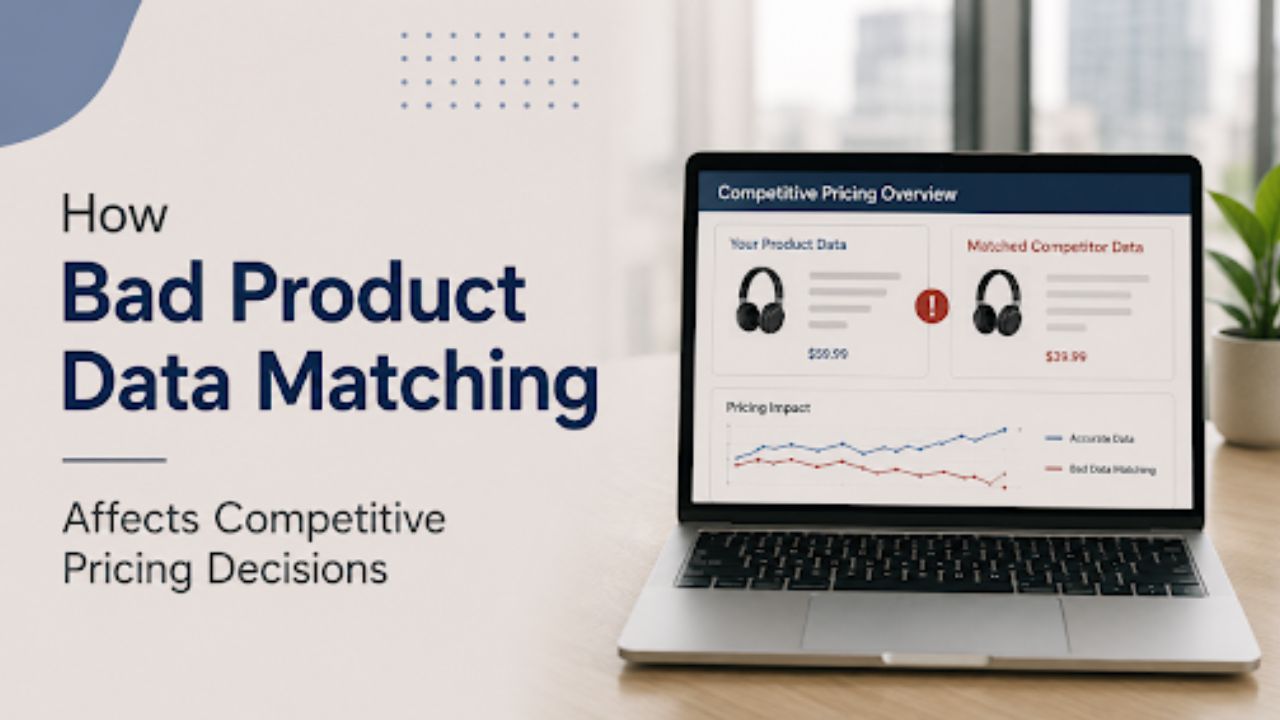
Competitor price tracking looks like a price-data problem, but one of its biggest hidden risks happens before the price comparison: matching the wrong products.
Competitive pricing only works when the products being compared are genuinely equivalent. A lower-priced competitor offer may actually be a smaller pack, refurbished unit, or older model. If that product enters the comparison set, the resulting price difference no longer represents a valid like-for-like benchmark. What looks like a competitive pricing signal is actually a product-matching error.
That distinction matters because pricing teams rarely use competitor data in isolation. They use it to decide whether a product is overpriced, whether a promotion is necessary, how aggressively to respond to the market, and when automated pricing rules should take action. When the underlying match is wrong, those decisions are built on a false benchmark.
This is why accurate eCommerce product data matching is a critical foundation of competitor price tracking. Before asking “How does our price compare?”, retailers first need to establish “Are we comparing the right products?”
The Root Cause: Where eCommerce Product Data Matching Breaks Down in Competitor Analysis
In competitor price tracking, product matching compares each retailer SKU with product data collected from competitor websites and marketplaces. The objective is to determine whether the competitor corresponds to the same underlying product and variant as the retailer SKU, or otherwise meets the defined criteria for a valid comparison.
When this matching process fails, the error generally appears in one of two ways:
- False Positive: A competitor product that differs from the retailer SKU is incorrectly identified as a match, introducing a non-comparable product into the competitive dataset.
- False Negative: A competitor product that should match the retailer SKU is not identified as a match, leaving relevant competitor data outside the competitive dataset.
The following conditions commonly lead to these incorrect or missed product matches
1. Variant-Level Differences
Products often share a brand and base model but differ in variant-defining attributes such as size, color, storage, material, or generation. When these attributes are missing or represented inconsistently between seller and competitor listings, the wrong variant can be matched to the retailer SKU.
For example, benchmarking a 256 GB model against a competitor’s 128 GB version produces a price difference driven by product specifications rather than competitive positioning.
2. Pack and Bundle Configuration
A single unit, multipack, and product bundled with accessories may share most identifying attributes while representing different offers. If pack configuration is not validated, a competitor multipack may be treated as equivalent to the retailer’s single-unit SKU.
For example, comparing the price of a two-pack against a single-unit SKU can create an apparent price difference that actually results from pack configuration rather than competitive pricing. The same issue can arise when retailers sell the same base product in different pack sizes or bundle configurations.
3. Condition and Regional Attributes
Products can share the same brand and base model but differ in condition or market-specific specifications. If fields such as condition, regional model code, voltage, plug type, or warranty coverage are missing or inconsistent, the competitor record may match the wrong retailer SKU.
For example, a refurbished laptop may be matched to the retailer’s new-condition SKU when both listings reference the same underlying model, but condition is not properly distinguished. Similarly, a US 120V appliance may match a UK 230V version when regional specifications are not captured separately.
4. Identifier Coverage and Consistency
Private-label products and own-brand products may lack widely used identifiers such as GTINs, while marketplace and regional listings may expose identifiers inconsistently. Seller-provided product data can also contain incomplete or inconsistent item specifics. In these cases, matching depends more heavily on attributes such as brand, model, size, dimensions, capacity, material, and technical specifications.
For example, when a Manufacturer Part Number (MPN) is unavailable and key attributes are incomplete, the corresponding competitor product may not match the retailer SKU, resulting in a false negative.
5. Taxonomy and Attribute Inconsistency
The retailer’s catalog and competitor sources may organize the same product information under different category structures or value formats, even when both records refer to the same product. Attribute mapping establishes the correspondence between equivalent fields across sources, while normalization standardizes the associated values so they can be compared consistently.
For example, one source may record volume as 500 ml, another as 0.5 L, while a third may include the value only within the product title.
6. Listing and Catalog Updates
Competitor listings and catalogs change over time as products are discontinued or relaunched, added under new variants, or sold with revised pack and bundle configurations. These changes can invalidate a match that was correct when it was first established.
For example, if a competitor relaunches the same product under a new listing, a tracking system that relies on the previous listing relationship may fail to capture the new offer, creating a false negative. Conversely, if a tracked listing’s variant or pack configuration changes but the existing match remains active, the retailer may keep comparing prices against a product that is no longer equivalent.
7. Fragmented and Inconsistent Catalog Data
Competitor matching uses the retailer’s catalog as the reference for determining which internal SKU corresponds to a competitor product. When product information is fragmented across duplicate records, incomplete SKU entries, or inconsistent attribute values, the matching process may not have a single reliable product record to compare against.
For example, model number, capacity, and pack information may be split across separate records for the same SKU, making it harder to match it consistently to the corresponding competitor product.
This can lead to incorrect matches, missed matches, or competitive data being associated with different internal records for the same product.
How Incorrect Product Data Matching in eCommerce Affects Pricing Decisions
1. Distorted Competitive Price Benchmarks
Competitor price benchmarking depends on matching each retailer SKU to the correct competitor products. Incorrect or missing matches can distort an individual SKU’s perceived price position and, when aggregated, affect category- and assortment-level pricing analysis.
As a result, a product may appear priced above or below comparable competitor offers when its actual competitive position is different. This can distort assessments of whether particular SKUs, categories, or product ranges are positioned at a premium, discount, or broadly in line with competing offers.
2. Inappropriate Price Adjustments
When competitor prices feed pricing rules or repricing systems, product matching errors can lead to inappropriate price adjustments. A false positive may introduce a lower competitor price that does not correspond to the retailer SKU, prompting an unnecessary price reduction. A false negative may exclude a relevant lower-priced competitor product, leaving the retailer without complete visibility into the competitive price difference.
In both cases, the resulting pricing decision is based on an inaccurate competitive set rather than an actual change in comparable market pricing.
3. Inaccurate Competitor Promotion Analysis
Competitor promotions matter for pricing analysis only when they apply to the correct comparable product.
An incorrect match may cause a discount, coupon, or temporary price reduction on a different competitor product to be treated as relevant to the retailer SKU. This can result in a promotional or pricing response to an offer that is not directly comparable. A false negative can have the reverse effect by excluding a relevant competitor promotion from the dataset used for pricing and promotional analysis.
4. Errors in Minimum Advertised Price Monitoring
For brands and manufacturers that use competitor or reseller data for MAP monitoring, product matching errors create a related compliance risk. A false positive can link a lower advertised price to the wrong product and incorrectly flag a MAP violation. A false negative can exclude an applicable reseller offer from monitoring and prevent the system from identifying an actual violation.
These errors can affect reseller assessments, enforcement decisions, and the accuracy of MAP compliance reporting.
When Incorrect Product Data Matches Feed Automated Repricing in eCommerce
Automated repricing engines use competitor pricing data alongside configured pricing rules or optimization logic to determine price adjustments. The effect of an incorrect match depends on how that competitor data is used within the repricing logic:
- Competitor Price Reference: Repricing engines may use a competitor reference such as the lowest comparable offer, a defined position above or below it, or a target price index.
- Incorrect Match as Input: If a competitor product with a different variant, condition, or pack configuration is incorrectly matched to the retailer SKU, its price may enter the repricing calculation as though the products were directly comparable.
- Resulting Price Impact: Where the repricing logic acts on the lowest or another selected competitor price, accurate matches elsewhere in the competitive set may not offset the incorrect one.
Why Pricing Guardrails May Not Detect It
Minimum price thresholds, margin requirements, and limits on price movements govern how far the retailer SKU can be repriced. They do not necessarily verify whether the competitor price used in the repricing calculation comes from a correctly matched product.
The Framework: How to Improve Product Data Matching in eCommerce for Better Pricing Decisions
1. Standardize the Product Data
Consolidate duplicate or fragmented product records, validate identifiers, and standardize attributes and units of measure before competitor matching begins. Maintain one consistent SKU-level reference for matching competitor products.
2. Define Match Criteria by Pricing Use Case
Set clear criteria for exact, like-for-like, variant, and non-matches based on how you will use the matched data. Apply stricter data comparability requirements to automated repricing than to category benchmarking or manual competitor analysis. Exclude differences in condition, pack size, capacity, model generation, or regional configuration where they invalidate direct price comparison.
3. Apply Confidence Thresholds and Exception Handling
Allow high-confidence matches that satisfy defined criteria to proceed into downstream workflows. Route ambiguous or partial matches for validation rather than treating them as confirmed comparisons. Use stricter confidence thresholds for repricing workflows than for reporting or exploratory analysis.
4. Revalidate Matches After Catalog Changes
Revalidate previously validated product matches when competitor listings relaunch, variants change, bundle configurations update, or key specifications change. Update or remove outdated matches before their pricing data continues to influence competitive analysis.
5. Maintain Human Oversight for Automated Repricing
Use automation to process validated matches at scale, but route ambiguous matches and higher-risk exceptions for analyst review before they influence automated price changes. Trigger revalidation when the competitor used as the pricing reference changes unexpectedly.
Product Data Matching for Pricing Intelligence: A Practical Case
The case demonstrates why pricing intelligence depends on more than automated SKU matching. When catalog data is inconsistent or fragmented, human validation helps confirm that competitor prices link to the correct product before pricing intelligence uses them.
|
6. Choose the Right Product Data Management Model
Assess whether eCommerce product data management can be handled reliably in-house based on catalog size, update frequency, attribute complexity, matching volume, and available specialist resources. Maintain internal control over pricing decisions and match governance, while considering external support for high-volume catalog cleansing, normalization, enrichment, competitor matching, and ongoing validation where internal capacity is limited.
The Key Takeaway for eCommerce Sellers
For eCommerce sellers, product matching should be treated as part of the pricing workflow, not as a separate catalog management task . Identify which pricing decisions rely on competitor matches, which SKUs carry the highest commercial risk, and where automated repricing acts without additional validation.
Validation efforts should focus on the products and categories where a false match could materially affect margin, competitive positioning, or pricing decisions. High-value products, frequently repriced SKUs, and categories with complex variants, bundles, or condition differences deserve particular attention.
Because competitor catalogs, listings, and product configurations change continuously, match quality also requires ongoing validation. The goal is not simply to maximize match coverage. It is to ensure that the competitor offers influencing pricing decisions are actually comparable, current, and commercially relevant.
Accurate competitor prices cannot produce reliable pricing intelligence when they are attached to the wrong products. Before trusting the price gap, retailers need to trust the match behind it.