When I see an entry-level job asking for a degree, several years of experience, and multiple certificates, I ask a simple question: did the work become more demanding, or did the hiring filter merely become stricter?
That question explains credential inflation. Employers want dependable ways to identify capable candidates, while workers feel pressure to collect more qualifications to remain visible. Digital badges may improve that system, but only if they represent skills employers understand and trust.
My short answer is that badges can help. They cannot fix credential inflation by themselves.
What Credential Inflation Really Means
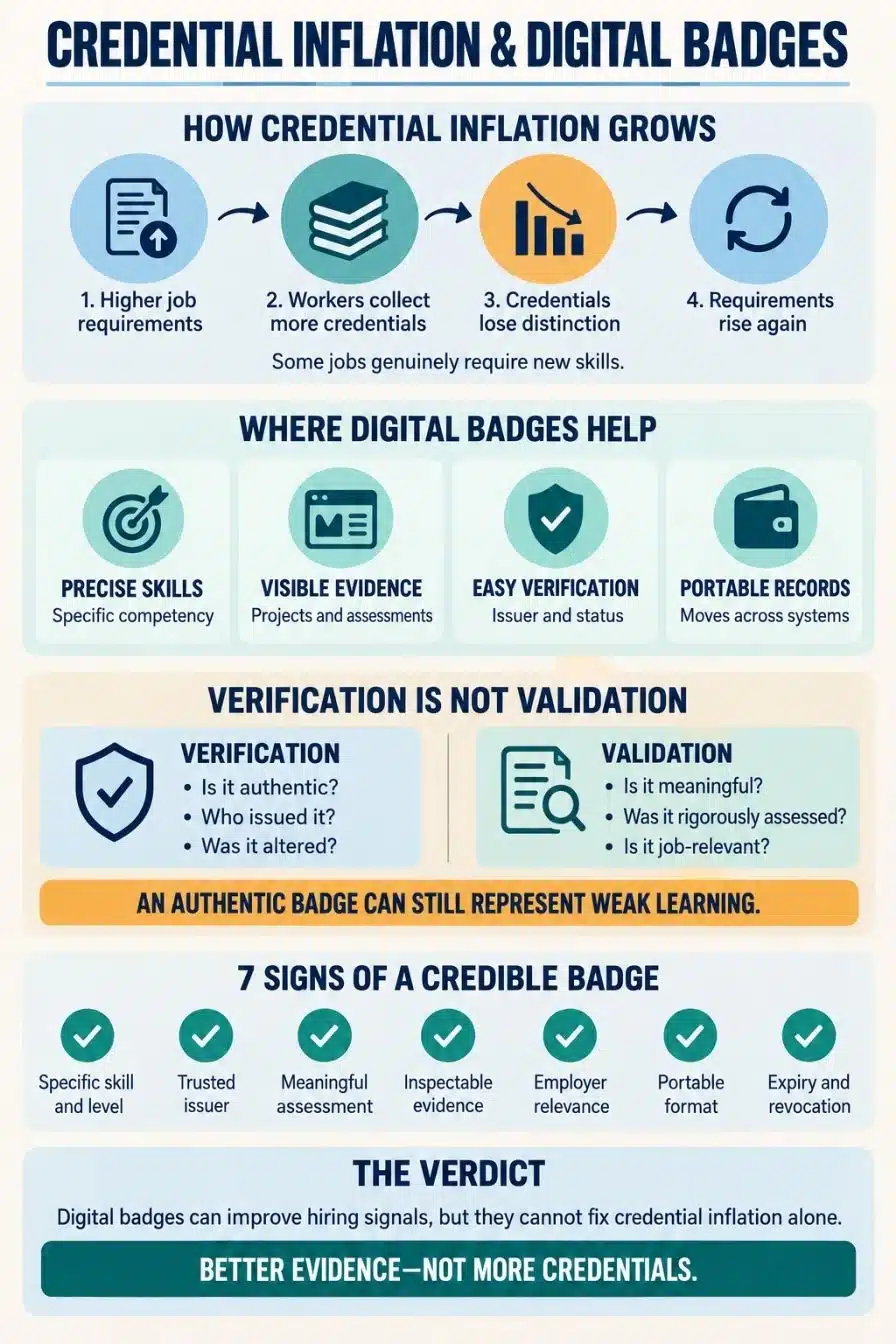
Credential inflation occurs when the qualifications expected for a job rise faster than the knowledge or ability genuinely needed to perform it.
It usually takes two related forms:
- Requirement inflation: A job begins requiring a higher degree, certificate, or license even though its core responsibilities have not changed substantially.
- Credential devaluation: As more people earn the same qualification, it becomes less useful for distinguishing candidates. Workers then pursue additional credentials to remain competitive.
This is not the same as genuine upskilling. New technology, regulations, safety standards, or expanded responsibilities may justify higher requirements. The relevant question is whether the work changed enough to require them.
Credential inflation also does not mean degrees are worthless. Degree holders, on average, continue to experience higher earnings and lower unemployment. The problem arises when a broadly valuable qualification becomes a mandatory filter for a specific job that does not require it.
Why Employers Raise Credential Requirements
Employers cannot fully understand an applicant from a résumé. A degree can become a convenient proxy for communication ability, technical knowledge, reliability, or the capacity to complete a long-term commitment.
That shortcut reduces uncertainty, but it is imprecise. A degree does not prove that someone can perform every task associated with a role. An experienced candidate without one may possess the necessary skills yet never pass the first screening stage.
Labor-market conditions also influence requirements. A peer-reviewed study of hiring around the Great Recession estimated that the growth in available workers accounted for roughly 18% to 25% of the increase in education and experience requirements between 2007 and 2010. Some employers raised their standards because more applicants were available, not because the jobs had fundamentally changed.
Those requirements can persist through:
- Applicant-tracking systems that automatically reject non-degree candidates
- Old job descriptions reused without review
- Recruiters relying on familiar qualifications to reduce perceived risk
- Employers announcing skills-based hiring without changing how candidates are evaluated
Workers bear the cost through tuition, examination fees, unpaid study time, and delayed entry into employment. Employers may also lose by shrinking their talent pool and overlooking capable people who learned through work, apprenticeships, military service, or independent training.
What Does a Digital Badge Actually Prove?
A digital badge is a shareable digital representation of an achievement. It may contain information about the recipient, issuer, skill, assessment criteria, supporting evidence, and issue or expiration date.
However, “digital badge” does not describe one consistent level of achievement. A badge might show that someone:
- Attended a webinar
- Completed an online course
- Passed an examination
- Produced an assessed project
- Demonstrated a professional competency
A microcredential normally represents a smaller unit of assessed learning than a traditional degree, although providers and countries do not use the term consistently. A digital badge is the format used to present an achievement; it is not automatically a microcredential or professional certification.
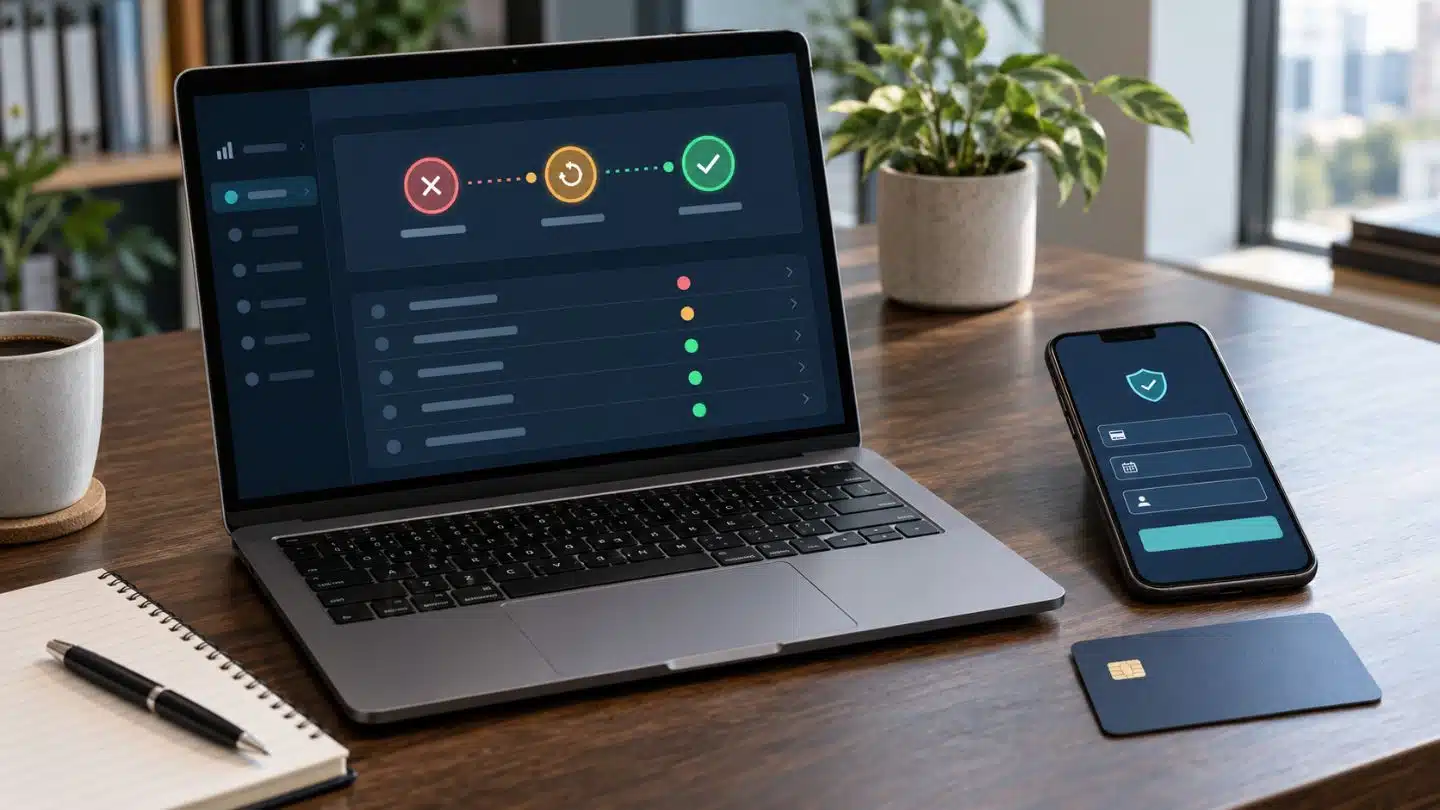
Badges following open technical standards can be digitally signed and independently verified. This helps an employer confirm who issued the credential and whether its information has been altered.
The distinction I find most important is between verification and validation.
Verification confirms that a credential is authentic. Validation asks whether its issuer, assessment, evidence, and skill level are trustworthy and relevant to the job. Technology can authenticate a claim, but it cannot turn a weak claim into meaningful proof of ability.
Where Digital Badges Can Help
Digital badges are most useful when they replace a broad qualification with specific evidence.
A well-designed badge can show precisely what someone knows, the level at which they can apply it, and how that ability was assessed. It can also recognize learning gained through employment, short courses, apprenticeships, and other routes that may not appear clearly on a traditional résumé.
Badges can strengthen skills-based hiring in several ways:
- Greater detail: They can identify a specific competency rather than a broad field of study.
- Visible evidence: They may link to a project, portfolio, assessment result, or scoring rubric.
- Portability: Open credentials can move between compatible platforms and digital wallets.
- Faster verification: Employers can confirm the issuer and credential status more efficiently.
- Stackable learning: Some badges can contribute toward a larger certificate or qualification.
A large randomized study of online certificate earners found that making credentials more visible produced a small but measurable improvement in employment outcomes. The gains were strongest among candidates who initially had weaker employment signals. This suggests that credible alternative credentials can reduce information gaps, although it does not prove that every badge improves someone’s job prospects.
How Badges Could Make Inflation Worse
Badges are relatively easy to create and distribute. That accessibility is useful, but it can also flood the market with overlapping or weak credentials.
A 2025 inventory counted more than 1.8 million credentials available in the United States, including over one million badges. This does not prove that the badges are unnecessary. It does show the scale of the comparison problem facing learners and employers.
If hiring managers cannot distinguish an assessed competency from a participation award, they may ignore both. They may also begin asking candidates for several badges instead of one, creating a new credential race.
Other concerns include inconsistent terminology, weak assessments, limited employer recognition, platform lock-in, identity fraud, privacy risks, and credentials that remain active after the underlying skill has become outdated.
Evidence about long-term employment and wage gains from microcredentials is still limited. Results vary by provider, subject, occupation, and learner. A respected technical certification may be valuable in one industry while carrying little weight elsewhere.
Badges are also not suitable replacements for every degree or license. Regulated and safety-critical professions may require extensive education, supervised practice, and legal authorization. A set of narrow badges cannot automatically reproduce the breadth of a well-designed degree program.
How to Judge Whether a Badge Has Real Value
I would not judge a badge by its visual design or the popularity of its platform. I would ask:
- What exact skill does it represent?
- Does it distinguish basic knowledge from practical proficiency?
- Who issued it, and do relevant employers recognize that issuer?
- Was an assessment required, or was the badge awarded for attendance?
- Can an employer inspect the criteria, evidence, or scoring rubric?
- Can the credential be independently verified and transferred?
- Does it expire or allow revocation when necessary?
- Is there evidence that employers use it in hiring or promotion?
The strongest badge does more than confirm that someone studied a subject. It explains what the person demonstrated, how performance was evaluated, and why the result deserves trust.
For jobseekers, employer recognition should come before collecting badges. A credential mentioned in relevant job advertisements or supported by an industry body is generally more useful than one promoted only by its training provider.
Employers Must Change the Hiring Process
Removing a degree requirement is only a beginning. A 2026 analysis of more than 1,000 major U.S. employers found that dropping degree requirements was associated with only a two-percentage-point increase in hires holding non-degree credentials.
That gap between policy and practice matters. Employers also need to define the tasks required for each role, name acceptable alternatives, configure recruitment systems to recognize them, and train hiring managers to evaluate evidence.
Credentials should then be combined with structured interviews, relevant work samples, or practical assessments. Employers should measure who receives interviews, who is hired, and how those employees perform. Otherwise, “skills-based hiring” may amount to little more than revised language in a job advertisement.
Better Evidence, Not a Bigger Credential Stack
Credential inflation is ultimately a problem of trust, information, and incentives. Digital badges can make skills more visible, portable, and verifiable, but their value comes from what stands behind them.
I do not think the goal should be to replace a stack of degrees with a larger stack of badges. The better goal is to use fewer, clearer signals connected to real skills, credible assessments, and genuine opportunities.
A badge is only the container. The evidence inside it is what should count.
Frequently Asked Questions on Credential Inflation
1. Is credential inflation the same as degree inflation?
Degree inflation specifically concerns rising academic degree requirements. Credential inflation is broader and may involve degrees, certificates, certifications, licenses, or digital badges.
2. Can digital badges replace a college degree?
A credible badge may replace a degree requirement for a narrow, demonstrable skill. It is less likely to replace the broad education or regulated professional preparation required for certain careers.
3. Do employers recognize digital badges?
Recognition varies considerably. Employers are more likely to value badges issued by respected universities, professional bodies, technology companies, or industry partnerships and supported by meaningful assessments.
4. Can a digital badge be faked?
A badge image can be copied. A properly issued verifiable badge allows an employer to check its recipient, issuer, criteria, and status. Verification still cannot guarantee that the assessment itself was rigorous.
5. How do I know whether a badge is worth earning?
Start with the jobs you want. Look for credentials requested in relevant job descriptions or recognized by employers in that industry. Then examine the issuer, assessment, evidence, portability, expiration policy, and total cost.