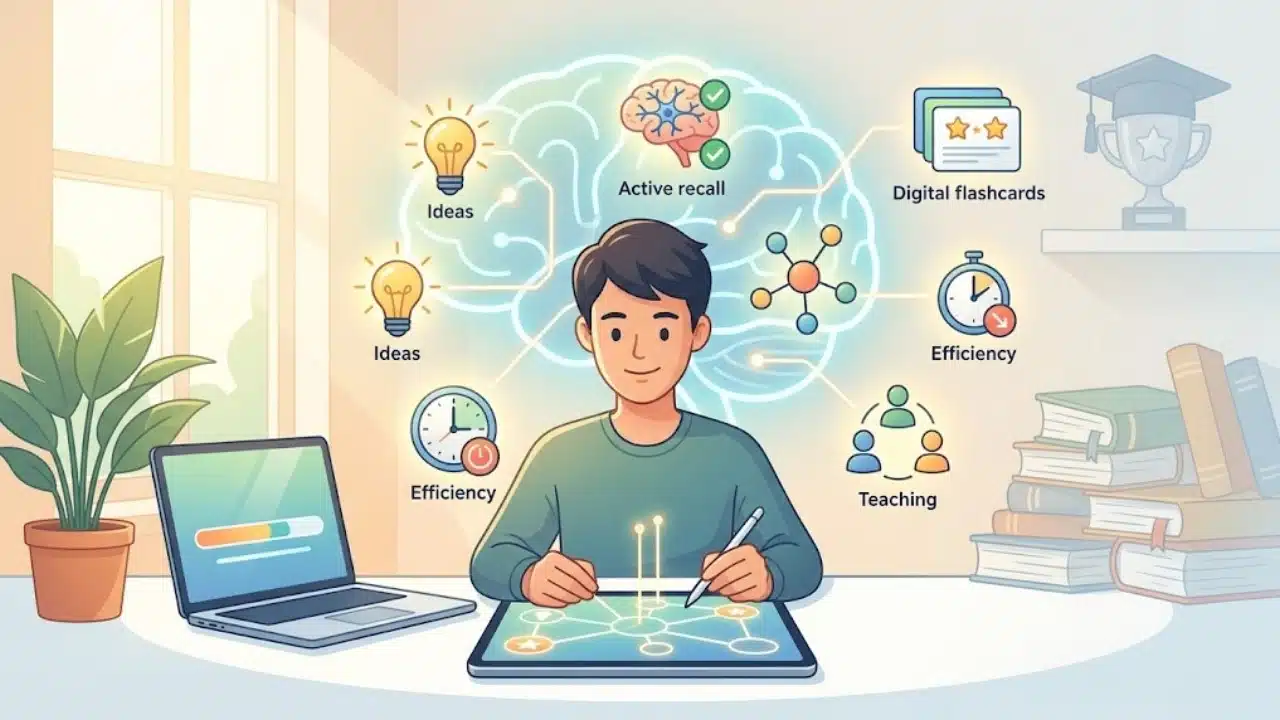
Spending consecutive hours staring at textbook pages creates a false sense of mastery without building lasting neural connections. Implementing proven cognitive strategies to study smarter not longer allows students to improve knowledge retention, reduce mental fatigue, and optimize study efficiency.
| Study Strategy | Core Cognitive Mechanism | Efficiency Level | Preparation Effort |
| 1. Spaced Active Recall | Retrieval practice with expanding time intervals | Very High | Low (flashcards or prompt lists) |
| 2. Concept Interleaving | Alternating related subjects within a single session | High | Low (shuffling topic order) |
| 3. Elaborative Interrogation | Asking “why” and “how” to link new data to prior knowledge | High | Low (verbal or written explanations) |
| 4. Dual Coding Technique | Combining verbal descriptions with visual representations | High | Medium (sketching diagrams and mind maps) |
| 5. The Protégé Effect | Teaching concepts to an audience or imaginary student | Very High | Low (verbal articulation) |
| 6. The Blurting Method | Timed free-recall dumping followed by targeted gap audits | High | Low (blank sheet of paper) |
| 7. Pre-Testing (Hypercorrection) | Attempting practice questions prior to reading new material | High | Low (chapter review quizzes) |
| 8. Environmental Context Shift | Varying physical study locations to strengthen memory traces | Medium | Low (moving rooms or study spaces) |
| 9. Structured Pomodoro Intervals | Time-boxed focused work paired with neurological rests | High | Low (standard timer) |
| 10. Metacognitive Self-Auditing | Evaluating understanding levels to eliminate familiarity bias | High | Low (self-rating tracking sheets) |
| 11. Sleep-Consolidated Memory | Leveraging slow-wave sleep cycles to lock in memory | Very High | Low (consistent sleep scheduling) |
11 Science-Backed Ways to Study Smarter, Not Longer
1. Spaced Active Recall
Active recall requires closing your textbook or notes and forcing your brain to retrieve information from memory without assistance. Pairing active recall with spaced repetition, which involves systematically increasing the time intervals between review sessions, creates powerful neurological pathways. Research shows that forcing the brain to work through cognitive friction during retrieval builds durable long-term memory far better than passive re-reading.
To implement this technique, convert lecture notes into self-testing prompts rather than long summary paragraphs. Test yourself one day after learning a concept, then three days later, then one week later. This structured spacing halts the natural forgetting curve and ensures that every minute spent studying directly increases long-term retention.
2. Concept Interleaving
Block practice involves studying a single topic for hours before moving to the next. Interleaving breaks this pattern by mixing related subjects or different problem-solving methods within a single study block. For example, instead of completing twenty physics problems using the exact same formula, mix three different problem types into one practice set.
Interleaving forces the brain to constantly categorize problems and select the correct analytical tool rather than executing memorized steps on autopilot. While interleaving feels more challenging during the study session, it significantly improves exam performance by mimicking the unpredictable format of actual tests.
3. Elaborative Interrogation
Elaborative interrogation requires asking explicit “why” and “how” questions about facts and concepts rather than accepting statements at face value. When reviewing a historical event, scientific process, or mathematical proof, push yourself to explain why a specific outcome occurred and how it connects to surrounding principles.
This practice forces the brain to integrate new information into existing mental frameworks. By transforming isolated facts into interconnected networks of knowledge, elaborative interrogation makes information far easier to retrieve during high-pressure testing environments.
4. Dual Coding Technique
The dual coding method combines verbal information with visual diagrams to store memory through two distinct neural channels. When processing textbook information, convert dense paragraphs into visual flowcharts, timeline diagrams, labeled sketches, or comparative matrix tables.
Simultaneously encoding information through text and imagery gives the brain two independent retrieval pathways. During exams, if the exact verbal definition slips your mind, the visual layout of the corresponding diagram can trigger complete recollection of the concept.
5. The Protégé Effect (Teaching to Learn)
The Protégé Effect demonstrates that explaining a concept to someone else dramatically accelerates personal understanding and memory retention. When you prepare to teach, your mind instinctively organizes information more logically, identifies gaps in logic, and simplifies complex jargon.
To apply this strategy, use the Feynman Technique. Select a complex concept, pretend you are explaining it to a middle school student, and speak the explanation out loud without looking at your notes. Whenever you hit a point where your explanation becomes confusing, return to your source material to refine your understanding.
6. The Blurting Method for Free Recall
The blurting method is a high-intensity retrieval exercise designed to audit knowledge gaps rapidly. Spend ten minutes reading a specific section of a textbook or guide. Then, close the book, take a blank sheet of paper, and write down every single fact, term, diagram, and equation you can remember without looking back.
Once you have exhausted your memory, open your textbook with a colored pen and compare your blurted sheet against the original text. Highlight missing facts and incorrectly recalled terms. This immediate feedback loop shows you exactly where to focus your remaining study time, eliminating time wasted on material you have already mastered.
7. Pre-Testing and the Hypercorrection Effect
Attempting practice questions before reading a new chapter or attending a lecture significantly boosts subsequent learning. Even if you guess incorrectly on every question, pre-testing primes the brain by generating curiosity and establishing a mental framework for what information matters most.
Furthermore, when you make an incorrect guess with high confidence and immediately receive the correct answer, your brain experiences the hypercorrection effect. The surprising error triggers heightened attention, making the correct answer almost permanently memorable.
8. Environmental Context Variation
Studying in the exact same corner of the exact same room every day can reduce mental flexibility. Modifying your study environment by switching between a library desk, a quiet park table, or a dining room workspace creates diverse sensory anchors for the material you are learning.
The brain subtly associates learned information with environmental cues like background sounds, lighting, and room layout. Varying these contexts forces the brain to detach the core concepts from external surroundings, resulting in abstract mental representations that are easily recalled anywhere, including a sterile exam hall.
9. Time-Boxed Pomodoro Intervals
Long, unstructured study sessions inevitably degrade focus, leading to passive scrolling and cognitive fatigue. Using structured Pomodoro intervals, such as 25 minutes of intense focus followed by a 5-minute break, maintains peak mental intensity throughout your study session.
During the focus window, eliminate all external distractions, including phone notifications and extra browser tabs. During the break, step away from screens entirely to give your prefrontal cortex time to process information. This rhythmic cycle prevents burnout and preserves focus over long days.
10. Metacognitive Self-Auditing
Metacognition refers to thinking about your own thinking. Passive learners read notes line by line, confusing visual familiarity with genuine understanding. Metacognitive learners continually audit their comprehension level by asking themselves objective evaluation questions.
Maintain a simple confidence-tracking sheet alongside your study material. Rate your ability to explain each topic on a scale from 1 to 5 without looking at your notes. Direct your limited time exclusively toward topics rated 1 and 2, skipping high-confidence areas until scheduled review intervals.
11. Sleep-Consolidated Memory
Sleep is an active cognitive state during which the brain reorganizes, clears metabolic waste, and moves short-term memory traces into long-term cortical storage. Pulling all-nighters degrades prefrontal cortex function, impairs reasoning, and reduces memory retention by up to 40 percent.
To maximize efficiency, review your most challenging or abstract material right before going to sleep. Slow-wave sleep immediately following a focused study session accelerates memory consolidation, allowing your brain to process and organize information naturally overnight.
Deconstructing Cognitive Load: Why Passive Rote Memorization Fails
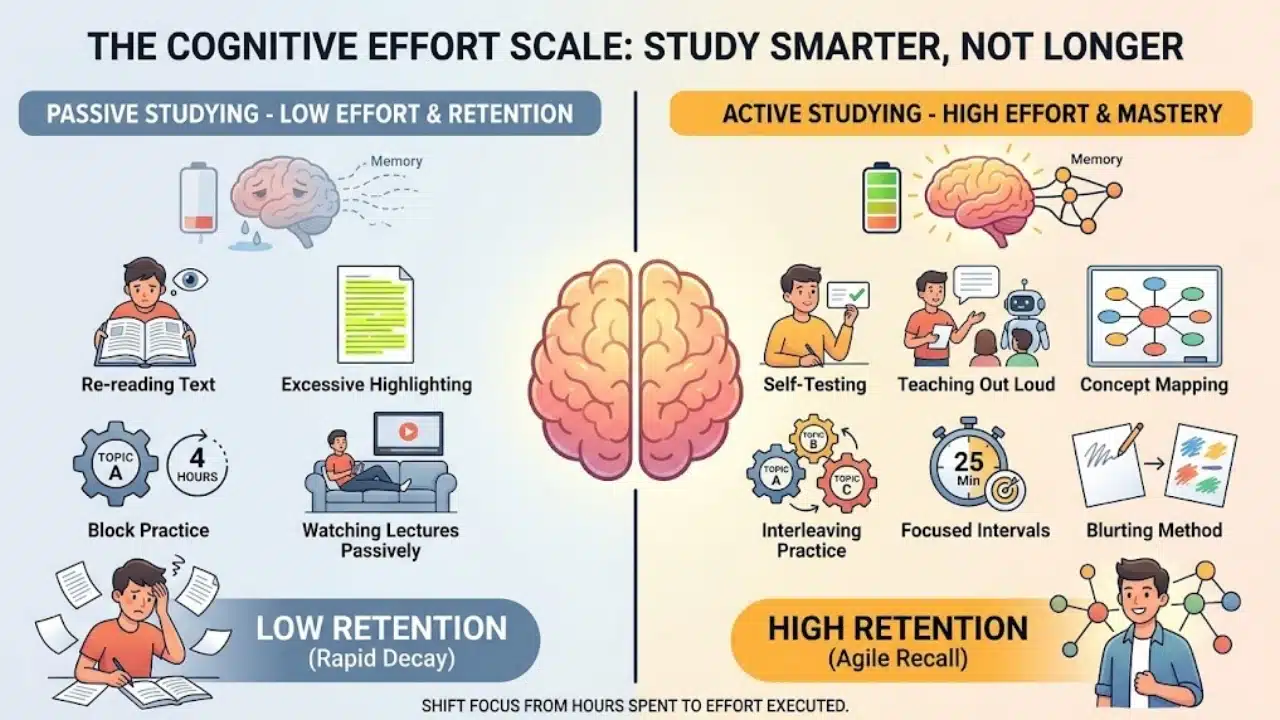
The fundamental mistake students make is measuring study productivity by total hours spent sitting at a desk rather than total cognitive processing executed. Passive habits like highlighting text, re-reading chapters, and copying verbatim notes require very little mental effort. Because the brain does not experience cognitive friction, it fails to build durable neural connections.
| Study Approach | Primary Actions Involved | Cognitive Effort Level | Retention Outcome | Long-Term Efficiency |
| Passive Studying | Re-reading text, highlighting lines, copying verbatim notes | Low | Low retention with rapid memory decay | Extremely Inefficient |
| Superficial Review | Block studying one topic for hours, passive video watching | Low to Medium | Creates an illusion of competence without true mastery | Inefficient |
| Active Practice | Self-testing with flashcards, concept mapping, drawing diagrams | High | High retention with durable memory paths | Highly Efficient |
| Synthetic Learning | Teaching concepts out loud, interleaving mixed problem sets | Very High | Deep conceptual understanding and agile recall | Maximum Efficiency |
Working through active retrieval practices imposes an optimal level of cognitive effort. When you force your brain to recall a definition or solve an interleaved problem without looking at the answer key, your nervous system interprets that information as essential for survival. Embracing active retrieval techniques allows you to reduce total study hours while achieving vastly superior academic performance.
Build Your Smarter Study System Today
Mastering the art of studying smarter comes down to replacing passive reading habits with high-leverage cognitive strategies. By shifting your focus from total hours logged at a desk to the depth of mental processing executed during each session, you retain more information in significantly less time.
Start by picking two or three techniques, such as active recall and Pomodoro time-boxing, to integrate into your daily routine. Over time, these evidence-based habits will transform your study sessions into an efficient, low-stress system that yields superior academic results.
Frequently Asked Questions (FAQs) About How to Study Smarter, Not Longer
How many hours a day should I study to maximize performance?
For most students, 2 to 4 hours of deliberate, highly focused active studying per day yields better results than 8 hours of passive reading. Beyond 4 hours of intense cognitive effort, mental efficiency diminishes significantly.
Is highlighting text completely useless for studying?
Highlighting is largely passive when used alone. However, if you restrict yourself to highlighting no more than one key phrase per page and immediately convert those highlighted phrases into active recall flashcard questions, highlighting can serve as a quick preliminary step.
How do I prevent burnout while studying for major exams?
Prevent burnout by time-boxing study sessions with strict Pomodoro breaks, varying your study topics through interleaving, maintaining consistent sleep schedules, and scheduling mandatory daily physical movement away from digital screens.
What is the difference between active recall and spaced repetition?
Active recall is the practice of retrieving information from memory without looking at notes. Spaced repetition is the scheduling system that dictates when you perform those active recall sessions over expanding time intervals.
Can listening to music help you study smarter?
Music without lyrics, such as classical, ambient, or binaural beats, can help block environmental noise and maintain focus. However, music with lyrics competes for language-processing bandwidth in the brain, reducing reading comprehension and memory encoding.