
Understanding the benefits of invented spelling helps parents and educators reframe early phonetic attempts not as careless mistakes, but as essential steps in child development. Invented spelling is a crucial cognitive milestone where young children begin applying their phonetic understanding of spoken language to written letters. It represents active learning, problem-solving, and growing phonemic awareness.
When a young writer produces “KAT” for “cat” or “PLAYNG” for “playing”, or even “A” for “a”, they demonstrate how they decompose spoken words into individual sounds. Far from being a random or bad habit, exploring the benefits of invented spelling reveals how phonetic experimentation functions as an essential bridge, helping children transition from spoken fluency to conventional reading skills.
| Literacy Dimension | Invented Spelling (Phonetic Experimentation) | Traditional Conventional Spelling |
| Primary Focus | Connecting sounds to letters | Memorizing standard spelling patterns |
| Cognitive Process | Active phonetic breakdown of spoken words | Visual pattern recall |
| Child Motivation | Confidence in writing and self-expression | Achieving accuracy, often prioritizing errors over content |
| Role in Learning | Diagnostic view of a child’s phonetic knowledge | Destination milestone for formal writing literacy |
| Adult Guidance Role | Affirm phonetic logic, model correct forms informally | Direct instruction, spelling lists, structural correction |
What Invented Spelling Reveals About Young Writers
Invented spelling occurs when young children construct spellings based on their current knowledge of letter sounds. Far from random guessing, these phonetic choices follow a clear internal logic that reveals the child’s understanding of language.
1. Growing Phonemic Awareness
Before children can blend sounds to read, they must learn to segment words. When a child spells “BPT” for “carpet” or “GRDN” for “garden”, they demonstrate their brain can successfully isolate major consonant sounds within spoken language.
2. Application of the Alphabetic Principle
Understanding that written letters (graphemes) represent specific spoken sounds (phonemes) is the foundation of reading and writing. One of the clearest structural benefits of invented spelling is that it provides concrete evidence that a child grasps this key concept. They are not drawing arbitrary shapes: they are using a symbolic system to encode speech.
3. Working Memory Engagement
Writing is a multi-step mental process. A child must hold a thought in working memory, break words into constituent sounds, match those sounds to specific letter symbols, and physically write them out. This process builds executive function skills in real time.
4. Active Problem-Solving in Real Time
As a child works, they must decide which letter best matches the sound they hear. This requires analyzing the spoken word, recalling letter sounds, and managing the sequential task. It represents active problem-solving applied directly to language learning.
The Five Progressive Stages of Spelling Mastery
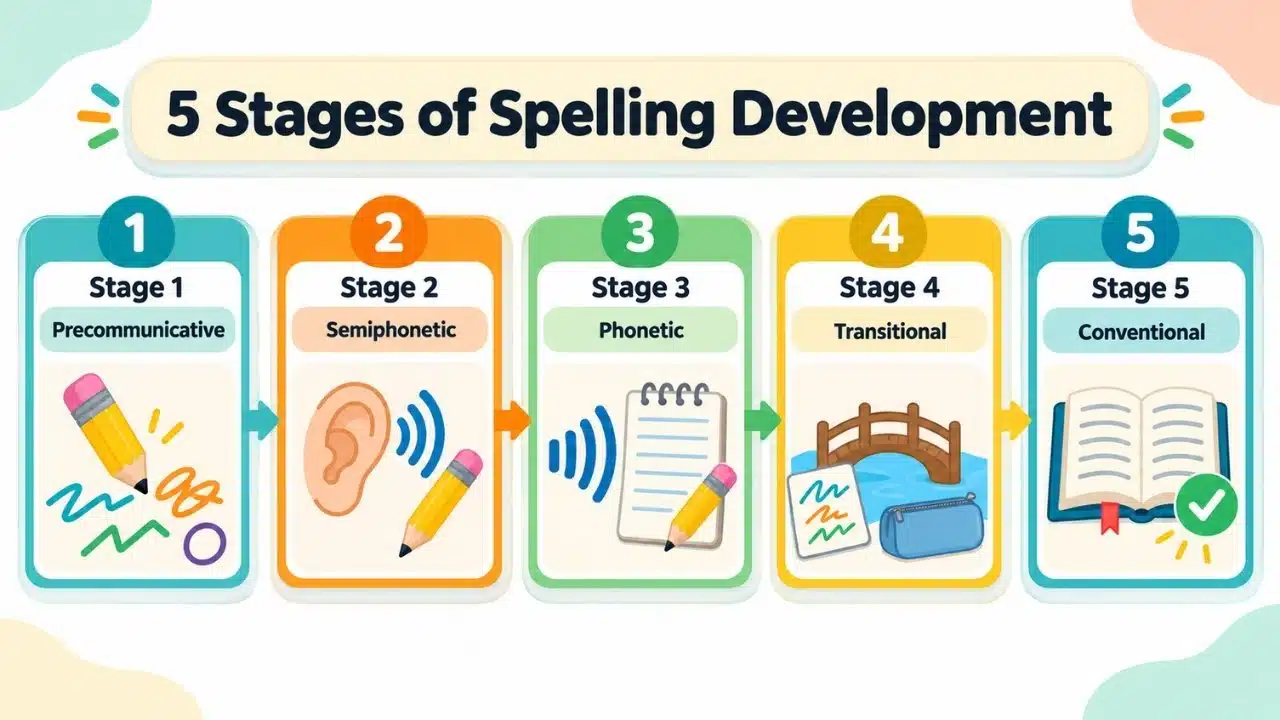
Literacy researcher Richard Gentry identified five clear stages children typically progress through as they develop written language skills. Phonetic experimentation, or invented spelling, spans the middle three phases of this progression.
| Developmental Stage | Typical Age Range | Observed Writing Behaviors | Example Words |
| 1. Precommunicative | Ages 3 to 5 | Uses letter-like shapes, numbers, or random letters with no sound-symbol connection. Often mixes capital and lowercase letters without left-to-right directionality. | “X7BTR” for dog |
| 2. Semiphonetic | Ages 4 to 6 | Shows partial awareness of letter sounds, using abbreviated spellings that represent initial or final consonant sounds. | “M” for mom, “U” for you, “NT” for night |
| 3. Phonetic | Ages 5 to 7 | Tries to map every sound using phonetic logic. Often mixes short vowels or confuses complex consonant blends. | “KOM” for come, “DRFT” for drift, “PEPL” for people |
| 4. Transitional | Ages 6 to 8 | Incorporates visual spelling patterns and silent letters, though mistakes still occur on complex irregular rules. | “HIGHK” for hike, “MOTER” for motor, “TEACHER” |
| 5. Conventional | Ages 8 and up | Masters standard English spelling patterns, root words, and applies irregular rules correctly. | Standard conventional spelling |
The Core Benefits of Invented Spelling for Young Learners
Allowing children to use phonetic spelling during early writing practice delivers several clear advantages for long-term literacy acquisition.
Direct Acceleration of Reading Acquisition
Among the primary benefits of invented spelling is its direct impact on reading comprehension and decoding skills. A strong, established link exists between early phonetic writing and later reading success. When children segment sounds to write, they practice the exact mental skill needed for blending sounds together during reading. Writing helps neural pathways mature, directly reinforcing reading readiness.
Removal of Barriers to Written Expression
When perfection is demanded immediately, a child’s writing speed slows down significantly. Fear of errors causes children to simplify sentences, sticking only to known, easy words. Highlighting the creative benefits of invented spelling allows children to express complex thoughts, tell elaborate stories, and expand their written vocabulary without hesitation.
Delivery of Critical Diagnostic Data to Adults
Phonetic writing provides a unique window into what a child understands about language mechanics. If a student writes “TRN” for “train”, an educator immediately sees understanding of consonant sounds while identifying a need for instruction on complex vowel patterns like “ai”.
Strengthening Memory for Irregular Words
When children attempt a word phonetically, they create an internal cognitive anchor. Later, when they observe the correct standard form, such as “said” instead of their earlier attempt “SED”, the contrast makes the correct conventional spelling far more memorable.
Finding the Essential Balance: Phonetic Exploration vs. Phonics Instruction
While the benefits of invented spelling are extensive, balancing phonetic writing with structured instruction is essential for long-term mastery. Effective literacy programs use both strategies in concert.
| Instructional Pillar | Core Focus | Primary Learning Function |
| Explicit Phonics Instruction | Direct teaching of letter-sound rules, vowel digraphs, morphology, and sight words | Provides the structural building blocks and spelling rules children need |
| Independent Phonetic Writing | Unassisted drafting, creative storytelling, and personal journaling | Allows children to actively apply phonics knowledge in real-world contexts |
The Critical Role of Explicit Phonics
Phonics instruction is vital. Children need direct, systematic lessons in letter sounds, syllable types, morphology, and irregular words. Direct instruction provides the rules and building blocks that children can later use when attempting independent writing.
The Role of Independent Writing Practice
Invented spelling is the necessary practice ground. Without opportunities to write independently and apply phonics lessons, instruction remains abstract drill. Daily phonetic writing allows children to integrate what they have learned actively.
Support Strategies for Home and the Classroom
To maximize the benefits of invented spelling, adults must find a balance between supporting free expression and guiding children toward conventional writing.
1. Separate Creative Drafting from Final Editing
When children write stories or journals, focus first on their ideas and their hard work mapping sounds. Avoid stopping the creative flow mid-sentence to correct spelling errors. Save standard spelling work for editing phases or dedicated vocabulary study.
2. Ask Children to Read Their Writing Aloud
If you cannot decipher a child’s phonetic work, ask them to read it back while pointing. This validates their effort and helps you assess whether their letter choices match the spoken sounds they are attempting to express.
3. Model Correct Spelling Naturalistically in Responses
Rather than using red ink on their work, model standard forms during meaningful communication. If a child writes “I LIK MY DOG”, respond warmly by writing: “I like your dog, too! What is your dog’s name?” They see conventional spelling modeled in context.
4. Affirm Phonetic Logic While Gently Introducing Rules
When a child spells “elephant” as “ELAFANT”, validate their thinking. Acknowledge that “F” makes the exact sound they heard. Then, gently add that some words use “PH” to achieve that sound. This encourages confidence while building new rules.
Recognizing When Additional Literacy Support Is Necessary
While the developmental benefits of invented spelling are clear from preschool through kindergarten and early first grade, prolonged reliance purely on phonetic rules past age eight can indicate learning challenges.
Seek additional literacy assessment if you observe:
-
A Lack of Progression: A child remains stuck in purely consonant sounds past early first grade, showing little sound segmentation or vowel awareness.
-
Inconsistent or Random Symbol Association: A child uses random letters that have no relationship to the spoken sound (such as “QXZ” for “cat”).
-
Severe Writing Anxiety: A child consistently refuses to write unless an adult dictates spelling, indicating significant stress over making phonetic mistakes.
-
Difficulty Reading Own Writing: A child cannot read their work back immediately after creating it, suggesting potential issues with working memory or sound segmentation.
Embracing Phonetic Exploration as a Bridge to Spelling Mastery
Ultimately, understanding the benefits of invented spelling transforms how parents and teachers view early writing attempts. Invented spelling is a crucial developmental bridge that nurtures a young writer’s confidence and analytical skills. By treating phonetic attempts as evidence of active, engaged learning, adults can support children as they build foundational reading skills, deepen phonemic awareness, and transition smoothly into fluent, conventional spellers.
Frequently Asked Questions (FAQs) About Invented Spelling
What are the primary benefits of invented spelling for early readers?
The main benefits of invented spelling include accelerated reading acquisition, improved phonemic awareness, greater writing confidence, and deeper retention of irregular words once standard spelling is introduced.
Will encouraging invented spelling cause my child to become a poor speller long-term?
No, extensive research consistently demonstrates that encouraging invented spelling does not lead to long-term spelling difficulties. As children receive structured, explicit phonics instruction and gain consistent reading experience, their spelling naturally moves from purely phonetic attempts into standard conventional patterns.
What is the ideal age for a child to start transitioning away from invented spelling?
Most children begin this transition actively during late first grade and early second grade, typically around ages seven to eight. At this developmental point, they have gained enough direct exposure to visual word patterns, silent letters, and irregular spelling rules to begin integrating them independently.
Should I correct my child’s invented spelling when they are journaling or writing at home?
It is generally best not to focus heavily on accuracy when children are journaling, story writing, or engaged in creative expression. Frequent corrections can discourage writing. Instead, praise their phonetic effort and model standard spelling naturalistically in your written or verbal responses. Reserve formal spelling lessons for dedicated practice times.
How does invented spelling differ from Whole Language learning?
Invented spelling is an active and necessary application of phonics knowledge. Children actively segment words into sounds and try to match them to letters, emphasizing a bottom-up phonetic approach. Conversely, traditional Whole Language approaches relied heavily on children memorizing the visual shapes of entire words. Invented spelling is fully compatible with structured phonics instruction.