A strong offer and a folder full of audience research do not automatically produce strong copy. The difficult part is deciding what to say first, what needs proof, and when to ask the reader to act. These copywriting formulas with examples provide a useful starting structure when that sequence is not obvious.
The frameworks are ordered by use, not quality. PAS, AIDA, and BAB cover most everyday marketing. Later entries handle product benefits, education, qualification, stories, skeptical buyers, and final editing.
How to Use Copywriting Formulas Without Sounding Formulaic
Choose the formula after identifying what the reader knows. A comparison shopper may need a clear benefit and proof. Someone unfamiliar with the problem needs context first.
Define the action, too. “Learn more,” “book a call,” and “buy now” require different levels of commitment. A long sequence will inflate a newsletter signup; a two-line pitch may leave an expensive service unexplained. Treat the formula as an outline. Combine stages when helpful and remove anything repetitive or forced.
What Neat Formula Lists Often Miss
A formula cannot repair a weak offer, vague research, or a promise the product cannot meet. Familiar acronyms do not guarantee more conversions. The offer, audience, price, and buying experience still carry most of the weight.
Within their jurisdictions, US and UK advertising rules require appropriate support for objective claims and prohibit materially misleading advertising. Significant limitations should not be buried. Better structure does not make exaggeration safer.
12 Copywriting Formulas With Examples
Copywriting formulas with examples show how marketers can organize ideas, build interest, answer objections, and guide readers toward action. Each framework suits a different task, from short advertisements and email openings to product pages and longer sales copy. The best choice depends on audience awareness, evidence, and desired response.
1. PAS: Problem, Agitation, Solution
PAS is the most immediately useful formula here. It identifies a familiar problem, shows its cost, and introduces a solution. It fits emails, advertisements, video scripts, and landing-page sections.
For example: “Client feedback is spread across email, chat, and documents. Every missed comment creates another revision round. Keep approvals, files, and decisions in one shared review space.” Agitation needs restraint. It should clarify the cost, not predict disaster from a minor inconvenience.
2. AIDA: Attention, Interest, Desire, Action
AIDA is more flexible than PAS. Attention earns the first look, interest sustains it, desire connects the offer with a valued outcome, and action gives the next step. Some versions begin with “awareness” rather than “attention.”
The part most drafts neglect is desire. An interesting headline followed by a feature list does not explain why the offer is worth choosing.
Example: “Your best campaign may be hiding in last quarter’s data. See which topics attracted qualified leads and use the findings to shape your next content plan. Download the reporting worksheet.”
3. BAB: Before, After, Bridge
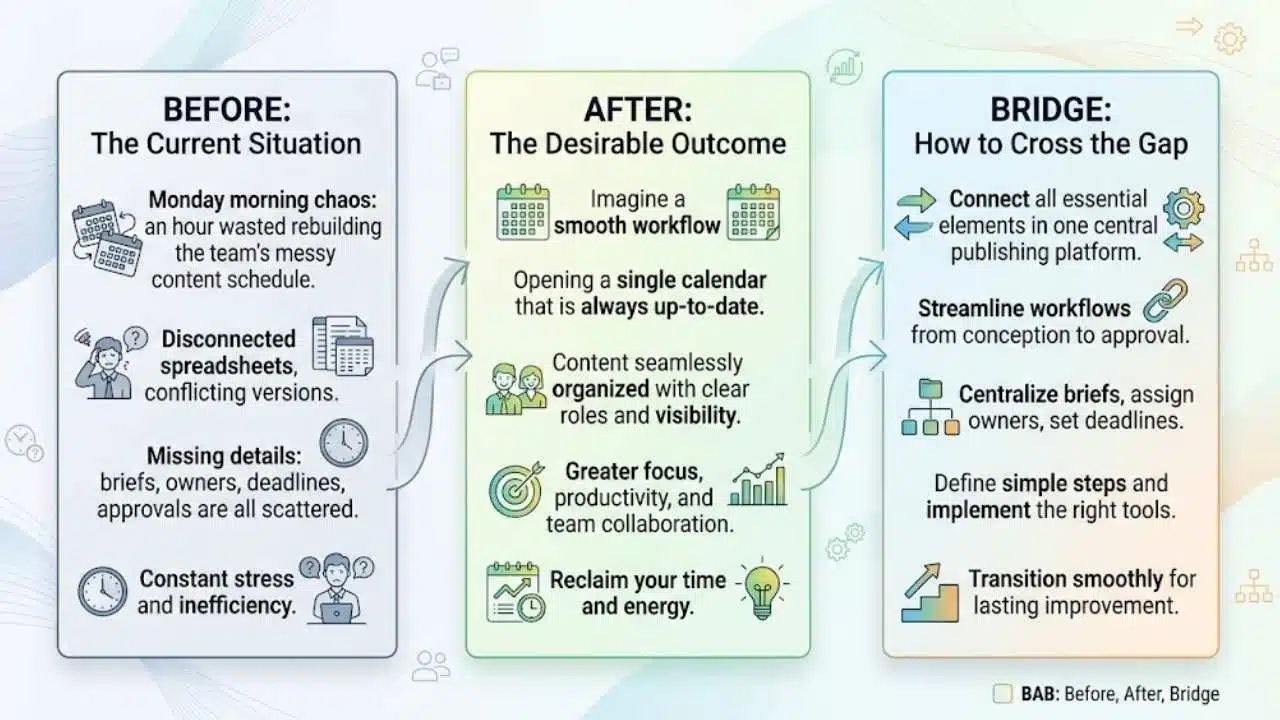
Before-After-Bridge contrasts the current situation with a desirable one, then explains how to cross the gap. It is cleaner than PAS when agitation is unnecessary and works well on service pages, emails, and case-study summaries.
“Monday begins with an hour of rebuilding the team’s content schedule. Imagine opening one calendar that is already current. Connect briefs, owners, deadlines, and approvals in one publishing workflow.” BAB is easy to overpromise with. Keep the “after” attainable and make the bridge credible.
4. FAB: Features, Advantages, Benefits
FAB is underrated on product and comparison pages. It translates a specification into a reason to care:
- Feature: Automatic speaker identification.
- Advantage: Comments are separated by participant.
- Benefit: The team can trace decisions without replaying the meeting.
The copy becomes: “Automatic speaker labels separate each participant, helping your team find decisions and assign follow-up work.” Generic benefits weaken the formula. If every feature ends with “save time” or “work smarter,” the writer has not finished the translation.
5. The 4 Ps: Picture, Promise, Prove, Push
The 4 Ps move from an imaginable situation to a supported offer: Picture, Promise, Prove, and Push. Another common version uses Problem, Promise, Proof, and Proposal, so teams should agree on the terminology.
Consider this sequence: “Picture a launch where every stakeholder sees the approved message before publication. Our checklist gives marketing, sales, and support one review path. Preview the template and sample approval record, then copy it for your next release.”
Use a demonstration, relevant case study, transparent method, or verified customer result as proof. Client logos alone cannot establish a specific performance claim.
6. ACCA: Awareness, Comprehension, Conviction, Action
ACCA works when readers must understand an issue before acting. It suits public-interest campaigns, change communications, nonprofit appeals, and unfamiliar B2B categories.
An employee security message could explain invoice phishing, establish the organization’s verification procedure, and direct staff to training: “An invoice email that appears to come from a known contact may still be fraudulent. Learn the team’s verification process, then complete the short phishing exercise.” For an audience already comparing known products, ACCA may add more education than the decision requires.
7. QUEST: Qualify, Understand, Educate, Stimulate, Transition
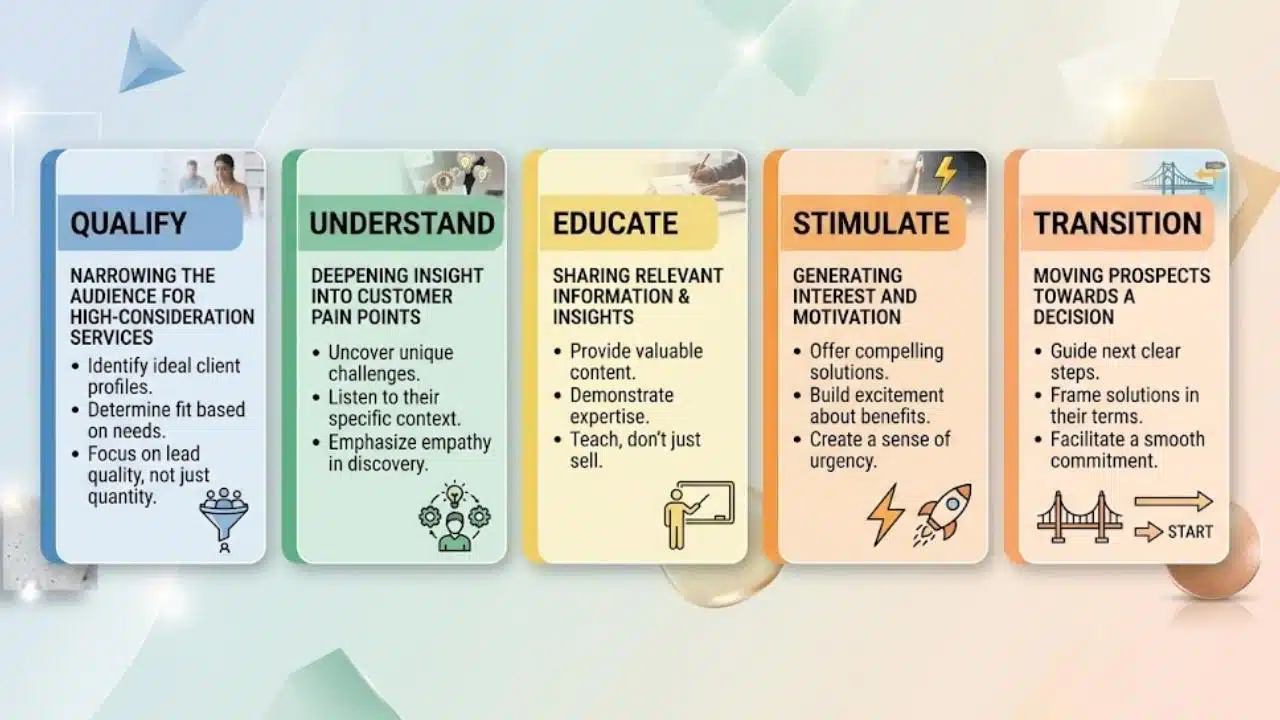
QUEST narrows the audience first. It is more useful for specialized services and higher-consideration software than mass-market promotions.
Example: “For content teams managing several brands, disconnected approvals make governance harder than publishing. A shared taxonomy and permission model can reduce that confusion without forcing every brand into the same workflow. See how the multi-brand setup works.”
Qualification may produce fewer clicks. Judge it using lead quality and downstream action, not click-through rate alone.
8. PASTOR: Person, Problem and Pain; Amplify; Story, Solution and System; Transformation and Testimony; Offer; Response
Ray Edwards’ PASTOR framework is the most involved option here. It identifies the reader and problem, develops the consequences, presents the story or solution, shows transformation through genuine testimony, explains the offer, and requests a response.
That scope suits a long sales page, webinar, or detailed email sequence. It is excessive for a banner or simple signup form. The framework also creates plenty of room for padding, especially when a writer invents a founder story or inserts a vague testimonial just to fill the “T” stage.
If genuine testimony is unavailable, use a demonstration, sample deliverable, or clear explanation of the method. For a strategy workshop, a sensible response would be: “Review the agenda, confirm the workshop fits your team, and request available dates.” Artificial scarcity would make the offer less credible.
9. Star, Story, Solution
This formula builds the message around a person, product, customer, or idea. It fits case studies, founder-led pages, fundraising appeals, and customer emails, but only when there is a real story worth telling.
Hypothetical example: “Maya managed campaign requests in five spreadsheets. When two launches collided, no one could see which approval was delaying production. Her team introduced one intake form and a weekly priority review, giving every request an owner and visible status.”
Maya is clearly fictional here. In published marketing, a composite must not be presented as a real customer. Testimonials should reflect genuine experiences, be verified, and be used with appropriate permission.
10. AIDCA: Attention, Interest, Desire, Conviction, Action
AIDCA is AIDA with an added conviction stage. Use it when readers want the outcome but remain unsure whether the provider, process, or offer deserves trust.
For an accounting-system migration service, conviction might come from a defined scope, documented migration and reconciliation process, security controls, relevant qualifications, and a realistic timeline. Popularity badges may look reassuring without answering the buyer’s real concern.
“Move your finance records without guessing what was lost. Review the migration map, reconciliation steps, access controls, and sample exception report before booking an assessment.” AIDCA earns its place on higher-consideration pages. For a newsletter signup, it is usually overbuilt.
11. The 4 Us: Useful, Urgent, Unique, Ultra-Specific
The 4 Us are primarily a headline and subject-line check. Useful means relevant to the reader. Unique identifies a meaningful distinction. Ultra-specific replaces vague language with a defined audience, problem, or deliverable. Urgent is the dangerous one: it should mean genuinely timely, not falsely scarce.
Compare “Improve Your Content Strategy Today” with “A 30-Minute Content Audit for Teams Publishing Across Three Channels.” The second headline is more useful and specific. There is no reason to force urgency into it unless a real deadline exists.
12. The 4 Cs: Clear, Concise, Compelling, Credible
The 4 Cs are best used after the draft exists. Check whether readers can understand the message, whether unnecessary words can go, whether the benefit deserves attention, and whether the claims deserve belief.
Concise does not mean extremely short. “View the Sample Report” may be clearer than a two-word button. Compelling copy without credibility becomes hype; credible copy without a relevant benefit becomes documentation.
One useful edit is to replace “Our innovative platform helps organizations optimize collaboration” with “Keep briefs, feedback, and final approvals attached to each campaign.” The revision is concrete and removes an unsupported performance promise.
Final Thoughts
Most marketers do not need to use all 12 frameworks regularly. Start with PAS, AIDA, or BAB for everyday campaigns, then use more specialized formulas when the audience needs education, qualification, or stronger proof. These copywriting formulas with examples are most useful as flexible outlines, not rigid scripts. Choose one based on the reader’s awareness and the action you want, write the message naturally, and use the 4 Cs to check its clarity, credibility, and relevance before publishing.