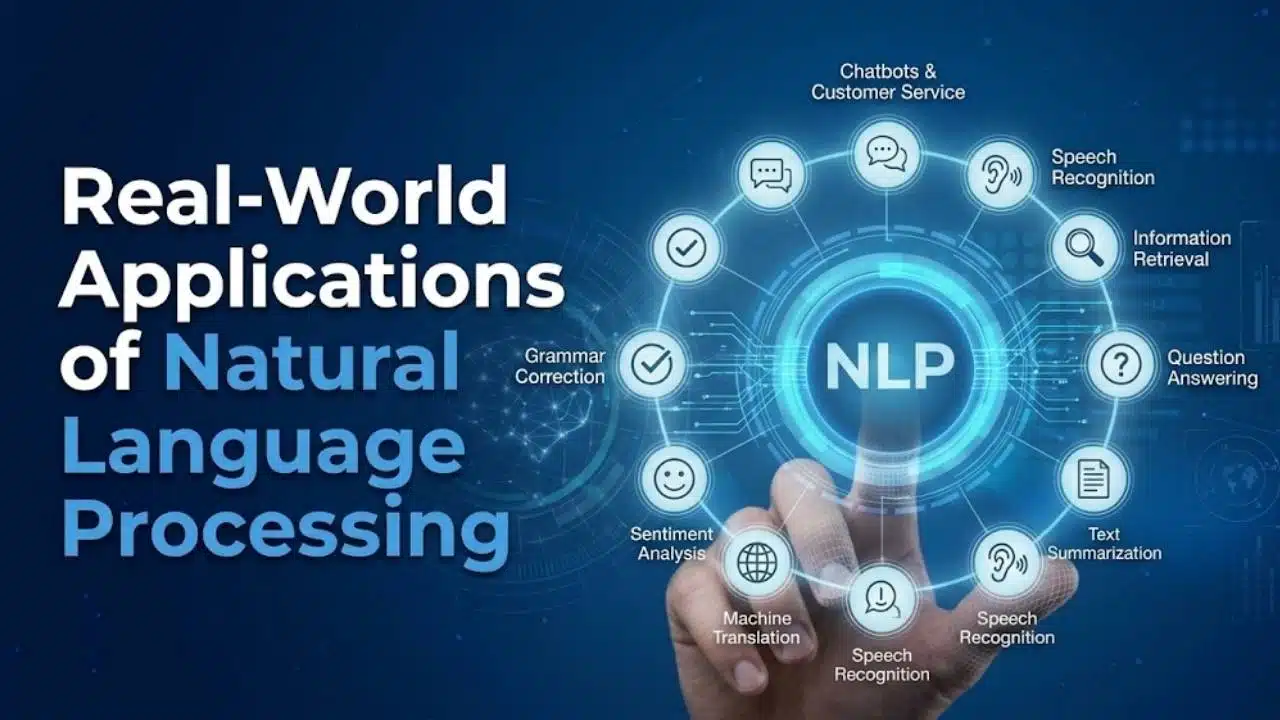
Real-world applications of Natural Language Processing (NLP) turn unstructured text into actionable business intelligence. From sentiment analysis and automated customer support to machine translation and document processing, NLP bridges human communication and machine execution.
Most organizations aren’t short on language data—they’re drowning in support tickets, contracts, and search queries. NLP operates quietly within existing workflows to route customer requests, extract critical data, and flags risks before human intervention is required. Rather than replacing systems, it makes enterprise data searchable, structured, and instantly actionable.
Below are 10 key NLP applications transforming business operations today, ordered from broad everyday tools to high-stakes, specialized industry solutions.
What Most NLP Application Lists Miss
A model that performs well in a demonstration can struggle with ordinary workplace language. Customers misspell product names. Employees combine languages in one message. Doctors use local abbreviations. Contracts hide obligations inside long clauses. Sarcasm can reverse the apparent meaning of an otherwise positive sentence.
Production systems therefore need representative data, confidence thresholds, privacy controls, escalation rules, and ongoing error review. Teams should also resist using a large language model for every task. A smaller classifier may be cheaper and easier to evaluate for ticket routing, while a fixed dictionary may be safer for recognizing approved product names or account-number formats.
Data handling deserves equal attention. Before sensitive text is sent to an external service, check where it is processed, how long it is retained, who can access it, and whether it may be used to improve the provider’s models.
10 Real-World Applications of Natural Language Processing
Natural language processing (NLP) bridges human communication and computational action. By parsing context, structure, and intent from unstructured data, NLP powers critical modern software—from everyday consumer tools like search algorithms and voice assistants to enterprise analytics, automated translation, and complex document processing. The following list breaks down its most impactful applications across industries.
1. Search and Information Retrieval
Search is probably the broadest and most underrated NLP application. Keyword matching works when users know the exact terms stored in a system. Real searches are messier. Someone may ask for “a light laptop for long work trips” even though the catalog uses fields such as weight, portability, and battery runtime.
Language-aware search can recognize entities, rewrite queries, connect related terminology, and rerank results by semantic relevance. That helps in e-commerce catalogs, support centers, legal databases, and internal knowledge systems. It should sit alongside exact filters for price, date, location, availability, and permissions. A result can be semantically relevant and still be unusable, out of stock, or off-limits to the person searching.
2. Customer Support and Conversational Systems
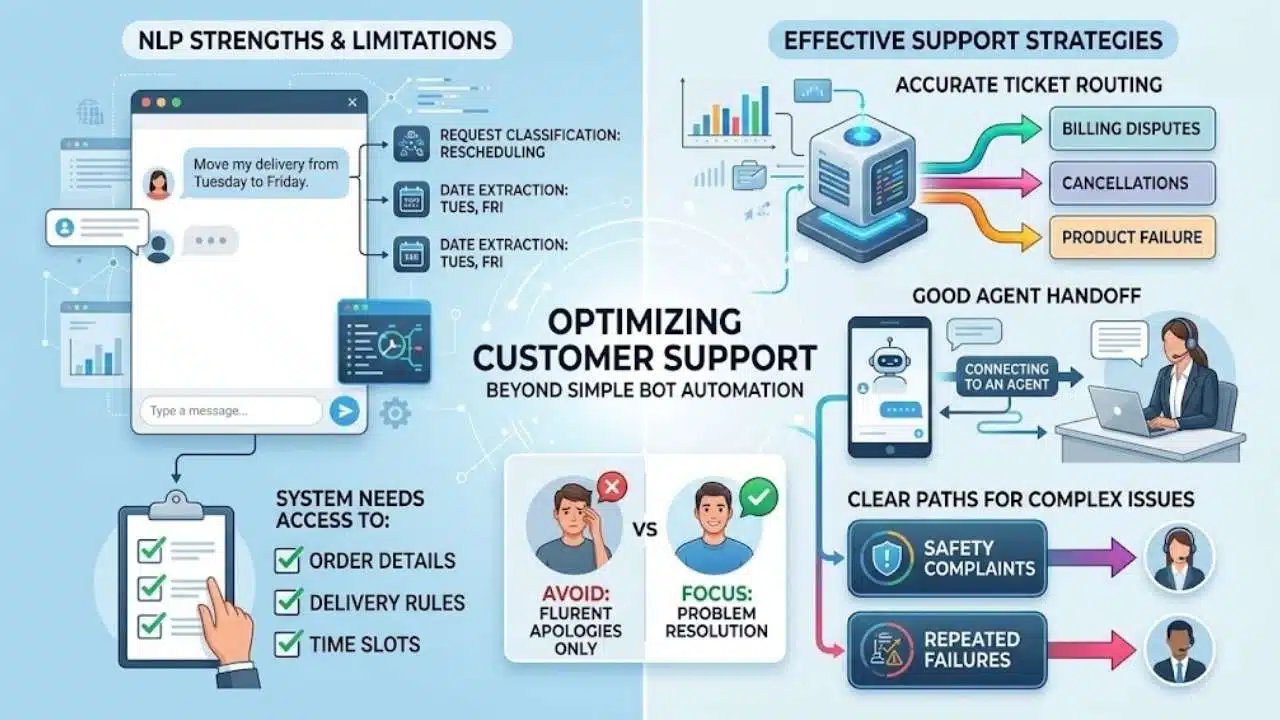
Customer support is where NLP’s strengths and its limits become obvious. Consider the message, “Move my delivery from Tuesday to Friday.” A system can classify the request as rescheduling and extract both dates. It still needs access to the order, delivery rules, and available time slots before it can complete the change.
Many support bots are designed to keep a conversation going rather than resolve the underlying problem. In practice, accurate ticket routing and good agent handoff can be more valuable than full automation. Billing disputes, cancellations, repeated failures, and safety complaints need a clear path to a person. When a bot cannot take the required action, another fluent apology only creates more work for the customer.
3. Machine Translation and Localization
Machine translation makes multilingual messages, product descriptions, websites, and internal documents easier to process at scale. Some platforms can translate formatted files while retaining much of their structure. Business localization, however, involves more than converting sentences from one language to another.
Brand names, legal terms, abbreviations, and interface labels may require approved translations. Glossaries can keep this terminology consistent or prevent a product name from being translated. Automated output is useful for first drafts, internal discovery, and lower-risk communication. Contracts, medical instructions, advertising claims, and safety information still require qualified review. Teams should test the language pairs and document types they will actually use.
4. Speech Transcription and Voice Interfaces
Meeting records, captions, call-center transcripts, dictation tools, and voice assistants begin with automatic speech recognition. NLP works on the resulting text to identify topics, pull out tasks, or create a summary. Keeping those stages separate helps explain why a polished summary can still contain the wrong medication name, account number, or deadline: the original transcription was wrong.
Speaker diarization detects changes between voices and assigns numbered speaker labels. It does not necessarily know anyone’s name. Overlapping speech, background noise, specialist vocabulary, accents, and code-switching all introduce friction. Transcripts are useful for search and recall, but they should be checked before becoming formal minutes, medical notes, legal records, or employment evidence.
5. Sentiment Analysis and Voice-of-Customer Research
Sentiment analysis helps teams organize opinions from reviews, surveys, tickets, emails, social posts, and call transcripts. Systems may classify text as positive, negative, neutral, or mixed. The useful question is rarely “Are customers happy?” It is “What are they happy or unhappy about?”
A review such as “The camera is excellent, but the battery barely lasts a day” contains two views about two different attributes. Targeted sentiment analysis attempts to connect each opinion with the relevant feature, product, or service. This can reveal growing confusion about pricing, complaints tied to an update, or praise for a support team.
The limitation is context. Sarcasm, polite complaints, cultural differences, and short replies are easy to misread. Sentiment dashboards are useful for triage and trend detection, not as a substitute for reading representative comments.
6. Document Classification and Information Extraction
Document processing is less visible than chatbots and often more commercially useful. Contracts, invoices, insurance claims, applications, reports, and scanned forms contain facts that staff otherwise copy into other systems by hand. NLP can classify the documents and extract names, dates, organizations, product codes, payment terms, or renewal clauses.
A claims department might separate incident reports from identity documents and medical records. Procurement teams can flag agreements approaching renewal. Legal teams can locate contracts containing a particular obligation, although the original wording still needs review.
Scanned files add another layer. Some platforms perform optical character recognition internally; other workflows require a separate OCR stage. Blurred pages, handwriting, tables, and unusual layouts can damage the result. A dependable workflow keeps the source passage, reports confidence, and sends uncertain cases to a review queue. Pushing extracted text into a payment or legal system without validation is a poor shortcut.
7. Healthcare Text Analysis
Clinical notes, discharge summaries, medical publications, and radiology reports contain information that may never reach a structured database field. Healthcare-focused NLP can identify diagnoses, symptoms, medications, treatments, dosage details, and relationships among those concepts.
Negation and uncertainty are critical. “No evidence of pneumonia,” “possible pneumonia,” and “history of pneumonia” are not interchangeable. A system that merely detects the word “pneumonia” can create a serious error.
These tools can support record search, research, coding assistance, document review, and data curation. They should not quietly become autonomous diagnostic systems. Medical language varies across institutions and specialties, while false positives and missed entities may affect care or billing. Any patient-level use needs local validation, privacy protection, access to the original record, and qualified human oversight.
8. Spam Detection and Content Moderation
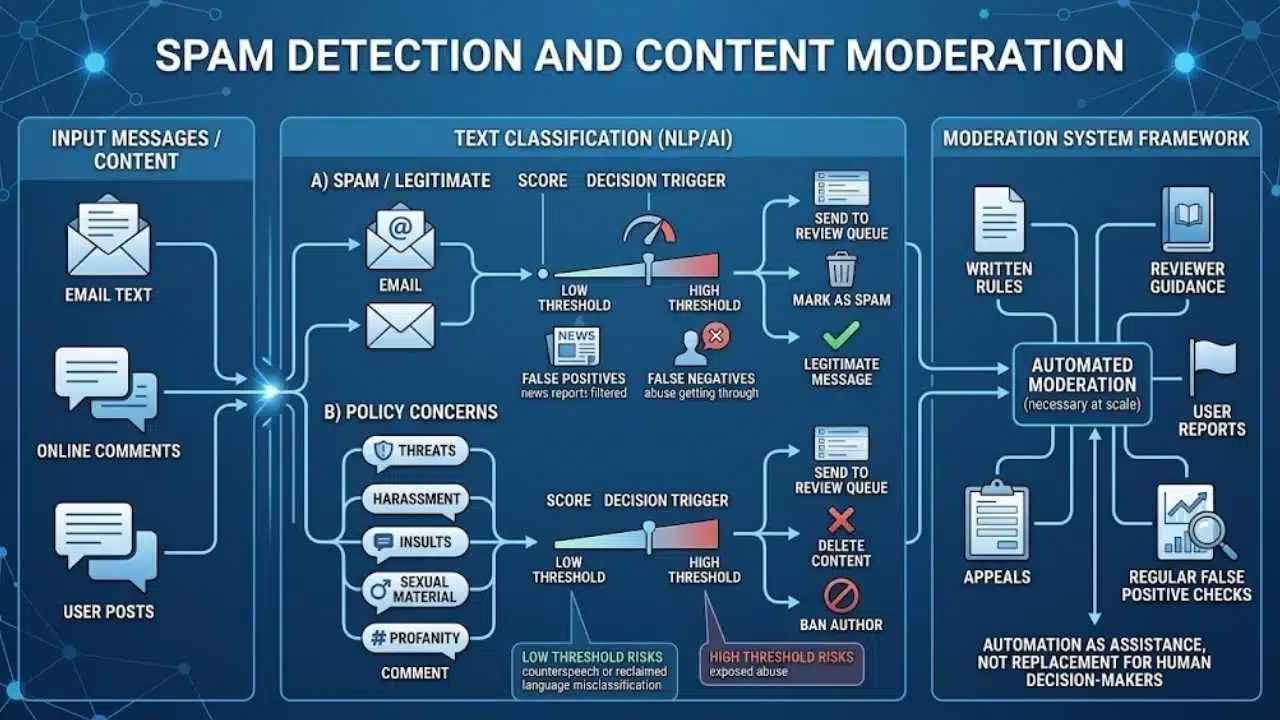
Email systems use text classification to help separate legitimate messages from spam. Online communities apply related methods to flag threats, harassment, insults, sexual material, profanity, and other policy concerns.
The difficult part is deciding what a score should trigger. A low threshold can hide news reporting, satire, counterspeech, or reclaimed language. A high threshold may leave people exposed to abuse. Sending a comment to a review queue is also very different from deleting it or banning its author.
Automated moderation is often necessary at scale, but it should not define the policy it enforces. Written rules, reviewer guidance, user reports, appeals, and regular checks for false positives remain part of the system. Even Perspective API’s documentation frames automation as assistance rather than a replacement for human decision-makers.
9. Financial and Regulatory Analysis
Financial and regulatory teams process filings, claims, disclosures, reports, and compliance records in volumes that make manual review difficult. NLP can classify these documents, extract entities, compare language across filings, and surface unusual passages for investigation.
In a 2016 speech, an official at the US Securities and Exchange Commission described using topic modeling and sentiment analysis to examine the tone of filings and connect those signals with known risk measures. The example shows the appropriate role of NLP: helping staff decide where to look more closely. Negative wording is not evidence of fraud, and the historical speech should not be treated as a description of the SEC’s current systems. Analysts still need the original document, its context, and an auditable reason for any risk flag.
10. Summarization and Workplace Knowledge Tools
Summarization is one of the most visible real-world applications of natural language processing, and one of the easiest to overtrust. NLP can condense meeting transcripts, policies, research papers, support histories, and document collections. It can also support question-answering tools connected to an approved knowledge base.
The strongest implementations have a defined source boundary. Summarizing one supplied policy is easier to audit than answering from an unknown mixture of websites and internal files. Extractive summaries reuse source passages. Abstractive systems create new wording, which may read better but can introduce statements the source does not support.
A useful workplace assistant shows where an answer came from, respects existing document permissions, and makes uncertainty visible. It must not expose a confidential HR file simply because that file was indexed. For contracts, policies, and research, users should be able to open the supporting passage and verify the answer themselves.
A Practical Starting Path
A first NLP project should solve one narrow problem with an observable result. Ticket routing, renewal-date extraction, document tagging, and internal search are usually easier to evaluate than a general-purpose assistant.
Before choosing a model, define:
- The input the system will receive and the output it must produce
- Which mistakes are inconvenient and which could cause real harm
- When the system must defer to a person
- How language, region, and user group may affect performance
- What will be logged, sampled, and reviewed after launch
Test with real examples from the intended workflow, including misspellings, abbreviations, mixed language, unusual documents, and ambiguous cases. Measure success at the workflow level. A ticket classifier is valuable when it reduces misrouting and resolution time, not simply when it posts an impressive score on a convenient test set.
The Practical Takeaway
The value of these real-world applications of natural language processing lies in reducing the work required to search, sort, interpret, and act on language. Start with one expensive or repetitive bottleneck, test the system against the language people actually use, and inspect the mistakes that carry the greatest cost.
Keep meaningful human control wherever the output affects health, money, employment, safety, or legal rights. NLP earns its place when the whole workflow becomes more dependable, not merely when the generated text sounds convincing.