When a SaaS vendor says your data will be hosted in Europe, that can be reassuring. It can also be useful. But SaaS data residency is not the same as GDPR compliance, and an “EU region” does not necessarily mean every backup, log, support interaction, AI request or integration remains inside the same boundary.
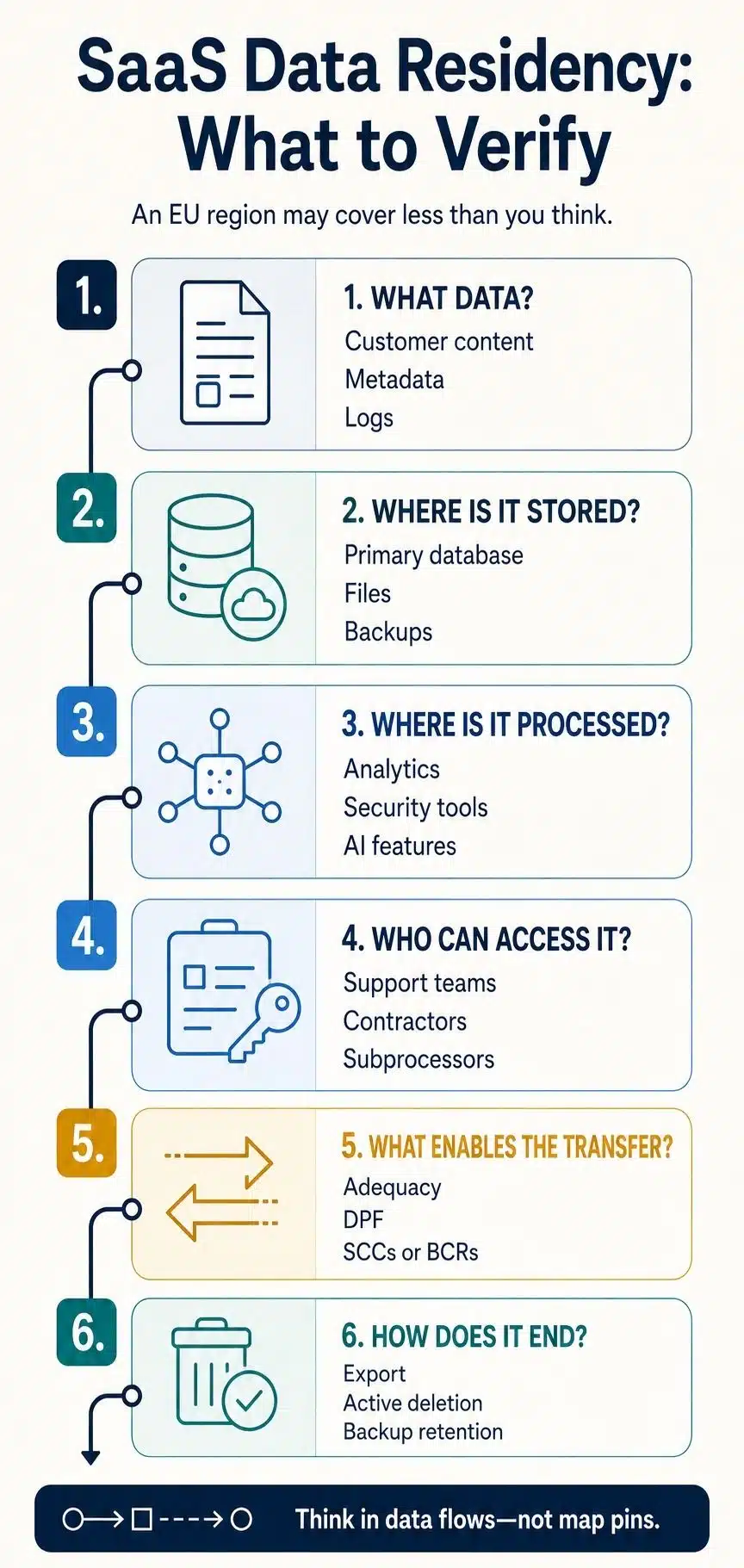
For founders, procurement teams, privacy professionals and security leads evaluating SaaS products, the practical question is not simply, “Where is the server?” The better questions are: Which data stays in the selected region? Where is it processed? Who can access it? Which legal entities and subprocessors are involved? What happens during an outage, support case, migration or deletion request?
Those answers reveal far more than a pin on a data-centre map.
Fact-checked on August 23, 2026. In this article I have provided general information, not legal advice. Transfer rules, adequacy decisions and country-specific requirements can change.
What Is SaaS Data Residency?
SaaS data residency usually describes the agreed geographic location in which specified customer data is stored.
The word “specified” matters. A vendor’s residency commitment may apply only to customer content in the primary application database. It may not automatically cover account details, backups, security logs, support records or data handled by connected services. Some contracts extend the commitment to processing and administrative access, but customers should not assume that unless the documentation says so.
A SaaS product may hold or generate data across:
- Primary databases
- File and object storage
- Backups and snapshots
- Disaster-recovery systems
- Search indexes and caches
- Security and application logs
- Support platforms
- Billing and account systems
- Analytics services
- AI processing services
- Connected third-party applications
“Your data is stored in Germany” is therefore a starting point, not a complete answer. Customers still need to know which data the promise covers, whether copies exist elsewhere, where processing occurs and whether people or systems outside Germany can access readable information.
The contractual definition and technical architecture matter more than the marketing phrase.
Data Residency, Localization and Sovereignty Are Different
These terms often appear together, but they address different concerns.
| Term | What it means | Simple example |
| Data residency | The agreed geographic location where specified data is stored | A customer selects an EU storage region |
| Data localization | A law or regulatory rule requires certain data to be stored or processed within a country or region | Covered payment-system data is subject to Indian storage requirements |
| Data sovereignty | The laws and governmental powers that may apply to the data, provider or access to it | A provider may be subject to laws where its relevant legal entities operate |
| International data transfer | Personal data is disclosed or made available to a separate recipient in a third country or international organization | A separate US support entity accesses an EU customer’s records |
Residency is mainly a location commitment. Localization is a legal or regulatory restriction. Sovereignty concerns jurisdiction and control.
A company can satisfy a contractual residency promise while still facing sovereignty questions. For example, data may be stored in France by a provider headquartered elsewhere. That does not automatically make the arrangement unlawful, but storage location alone does not settle which laws, entities or lawful-access procedures may be relevant.
Does GDPR Require Personal Data to Stay in Europe?
No. The GDPR does not impose a blanket rule requiring all personal data to remain within the European Union or European Economic Area.
Instead, Chapter V of the GDPR regulates transfers of personal data to third countries and international organizations. Data may be transferred outside the EEA when the transfer is covered by an applicable legal route and the required level of protection is maintained.
This means a SaaS application hosted outside the EEA can potentially comply with GDPR. It also means a product hosted entirely in the EU can still violate the regulation through unlawful processing, excessive collection, weak security, indefinite retention, missing transparency or failure to respect individual rights.
Location matters, but it cannot replace the rest of GDPR compliance.
When Does SaaS Activity Become an International Transfer?
Under European Data Protection Board guidance, three conditions generally need to be present for a GDPR Chapter V transfer:
- A controller or processor is subject to GDPR for the relevant processing.
- That organization discloses or otherwise makes personal data available to another controller or processor.
- The recipient is in a third country or is an international organization, whether or not that recipient is independently subject to GDPR.
In a SaaS environment, this can happen when:
- Customer data is hosted outside the EEA.
- A separate overseas support company can access the tenant.
- A subprocessor outside the EEA handles email, analytics, security or storage.
- Backups are replicated to another country.
- Logs or telemetry are sent to a global monitoring service.
- An AI provider outside the EEA receives prompts or other personal data.
- An integration sends records to a separate overseas provider.
The data does not need to be permanently relocated. Making it remotely accessible to a separate overseas recipient can be enough.
Remote Access Has an Important Nuance
Not every overseas login is automatically a Chapter V transfer. If an employee of the same EU legal entity travels abroad and remotely accesses that entity’s systems, there may be no separate recipient. The employer must still address security, confidentiality and any risks created by the location of access, but the situation does not necessarily meet the Chapter V transfer criteria.
The analysis changes when access is provided to a separate group company, support entity, contractor or subprocessor in another country. Companies within the same corporate group remain separate legal entities. Making data available to one of them may therefore be a transfer.
This is why “our team may access your data” is not specific enough. Customers need to know which entity employs that team, where it operates, when access is permitted and how the activity is controlled and recorded.
How GDPR International Transfers Work
GDPR provides several possible routes for transferring personal data outside the EEA. The appropriate route depends on the destination, recipient and processing arrangement.
Adequacy Decisions
The European Commission can recognize that a country, territory, specified sector or international organization provides an adequate level of data protection.
When an adequacy decision covers the transfer, an additional Article 46 safeguard such as transfer SCCs is generally unnecessary. The exporter must still meet the rest of its GDPR obligations, including transparency, purpose limitation, data minimization and security.
Adequacy decisions and their scope can change. The current official position should be checked before a company relies on one.
EU-US Data Privacy Framework
The EU-US Data Privacy Framework can support transfers to participating US organizations covered by the European Commission’s adequacy decision. It does not cover every US company. Before relying on it, a customer should verify that:
- The correct legal entity appears on the official participant list.
- Its certification is active.
- The relevant category of data is covered.
- The certification remains effective when the transfer occurs.
A parent company’s participation should not be assumed to cover every subsidiary, product or processing activity. The named entity and certification details matter.
Standard Contractual Clauses
The European Commission’s 2021 Standard Contractual Clauses, commonly called SCCs, provide contractual safeguards for many transfers outside the EEA.
The transfer SCCs use four modules:
- Controller to controller
- Controller to processor
- Processor to processor
- Processor to controller
They address matters including individual rights, security, breach notification, onward transfers and public-authority access.
Signing SCCs is not a paperwork shortcut that automatically makes every transfer acceptable. The parties must complete the correct module and annexes, describe the real transfer, and assess whether the destination country’s laws and practices could prevent the importer from complying with the clauses.
Binding Corporate Rules
Binding Corporate Rules can support recurring transfers between legal entities in the same multinational group.
They are usually more relevant to large organizations because they require a mature privacy program and regulatory approval. They are not simply internal policies that a group can adopt without oversight.
Limited Derogations
Article 49 permits transfers in certain limited situations, including explicit consent, contractual necessity, vital interests, legal claims and important public interests.
These derogations are generally not a sensible foundation for systematic SaaS processing built into normal service delivery. A consent checkbox should not be treated as an easy substitute for a durable transfer arrangement.
How a DPA and SCCs Fit Together
A Data Processing Agreement, or DPA, normally sets out the responsibilities between a controller and processor under Article 28. It covers issues such as processing instructions, confidentiality, security, subprocessors, assistance with individual rights and what happens to personal data when the service ends.
International-transfer SCCs are an Article 46 safeguard for covered transfers outside the EEA.
In practice, a SaaS vendor often uses a DPA that incorporates the relevant transfer SCCs. However, the controller-to-processor and processor-to-processor modules of the 2021 transfer SCCs already contain the applicable Article 28 requirements. When those clauses are correctly completed and cover the entire processing relationship, a separate DPA is not always legally necessary for the same activities.
The practical lesson is not to count documents. Check whether the agreement as a whole accurately covers:
- The parties and their legal roles
- The product and processing activities
- The categories of personal data and individuals
- The subprocessor chain
- The transfer destinations and legal routes
- The security measures
- Retention, return and deletion
A document stating “we comply with GDPR” is not enough. Neither is an unsigned SCC template with incomplete annexes.
Data Residency Beyond GDPR
The following examples are a high-level snapshot, not a complete survey of international law. Local counsel or a qualified privacy professional should confirm current requirements for a specific deployment.
United Kingdom
The UK operates its own international-transfer framework under UK data protection law.
Depending on the recipient and destination, organizations may rely on UK adequacy regulations, an appropriate safeguard or an applicable exception. Common contractual safeguards include the UK International Data Transfer Agreement and the UK Addendum to the EU SCCs. A transfer risk assessment may also be required.
An organization serving both UK and EEA customers may therefore need to manage two related but legally distinct transfer frameworks.
China
China can impose localization and cross-border-transfer requirements in situations involving critical information infrastructure, important data and specified volumes or types of personal information.
The applicable route may involve a security assessment, standard contract, certification or an exemption. Rules introduced in recent years have also created exemptions and adjusted thresholds for some lower-risk transfers.
The correct approach depends on data classification, volume, sensitivity, industry and where the organization operates. A global SaaS environment should not be assumed to satisfy the requirements of a customer with significant operations in China.
India
India’s digital personal data framework permits the central government to restrict transfers to specified countries or territories by notification. It also preserves stricter restrictions found in other Indian laws.
Sector-specific requirements are therefore important. Reserve Bank of India rules can require covered payment-system data to be stored in India, subject to the applicable processing and cross-border clarifications. Related rules may also apply to particular financial records or identification processes.
Checking only the general privacy statute can produce an incomplete answer.
Regulated Industries and Contracts
Financial services, healthcare, government, telecommunications, education and critical infrastructure may face additional requirements from regulators, procurement frameworks, professional duties or customer contracts.
Those requirements do not always demand strict localization. They may instead require:
- Disclosure of storage and processing locations
- Approval or notification of subprocessor changes
- Strong audit and inspection rights
- Tested regional disaster recovery
- Access restrictions and detailed logging
- Government-access safeguards
- A workable exit and deletion plan
A customer’s contract or internal risk policy can be stricter than the general privacy law. A financial institution, for example, may require EU-only processing even where GDPR would permit a properly safeguarded transfer elsewhere.
Think in Data Flows, Not Map Pins
A regional hosting option can be valuable. It may reduce certain transfers, simplify customer reviews, improve latency or help satisfy industry requirements. But it should never be treated as proof of compliance on its own.
Map the full lifecycle of the information: where it is stored, processed, copied, accessed, shared and eventually deleted. Then match every material data flow to the appropriate contractual promise, legal route and technical control.
That is what makes SaaS data residency defensible rather than decorative.
Frequently Asked Questions on SaaS Data Residency
1. Does GDPR require SaaS data to be stored in the EU?
No. GDPR allows personal data to be transferred outside the EEA when an appropriate legal route applies and the required protection is maintained. A regulator, customer contract or sector-specific rule may impose a stricter boundary.
2. Is an EU data centre enough for GDPR compliance?
No. Organizations must also examine processing purposes, access, subprocessors, security, retention, transparency, individual rights and international transfers.
3. What is the difference between data residency and data localization?
Data residency describes the agreed location where specified data is stored. Data localization is a legal or regulatory requirement to keep certain data within a defined country or region.
4. Can support staff outside Europe access EU-hosted data?
Possibly. It depends on the provider’s architecture and policies. If a separate overseas entity receives access to personal data, that access may constitute an international transfer even though the database remains in the EU.
5. Are Standard Contractual Clauses enough for international SaaS transfers?
Not automatically. The correct clauses and annexes must reflect the real transfer. The parties may also need a transfer assessment and effective technical or organizational safeguards.