Multi-tenancy in SaaS architecture allows one software platform to serve multiple customers while keeping each customer’s users, data, settings, and activity separated. Some resources may be shared across customers, while others may be dedicated to one customer.
The common definition, one application instance serving many customers, is now too narrow. A modern SaaS product may run across many services, databases, queues, and regional deployments and still be multi-tenant. What matters is where resources are shared and how the system prevents one customer from crossing into another customer’s space.
This is why I would not reduce multitenancy to a database decision. Shared tables versus a database per customer matters, but tenant data can also leak through an API, cache, file store, search index, background job, export, or support tool.
The right design is the simplest one whose tenant boundaries the team can enforce, monitor, test, and change as the product grows.
What Is a Tenant in SaaS?
A tenant is a customer or customer group with its own administrative and data boundary. It is often a company, but it could also be a department, franchise, school, clinic, or partner organization.
A tenant is not the same as a user. One company may have thousands of users, while one consultant may belong to several client tenants. The system therefore needs to answer three questions for every protected action:
- Who is making the request?
- Which tenant are they acting within?
- What are they allowed to do in that tenant?
If someone is an administrator for Company A and a viewer for Company B, the administrator role should apply only to the Company A membership. A permission granted in one tenant must not carry into another.
SaaS and multitenancy are also different concepts. SaaS describes how software is delivered and operated. Multitenancy describes how resources are shared and customers are separated. A SaaS provider can give certain customers dedicated infrastructure while keeping standard onboarding, releases, monitoring, and support.
How Multi-Tenant SaaS Architecture Works
At the center of the architecture is tenant context: verified information that tells the system which customer’s data, permissions, settings, limits, and resources apply to a request.
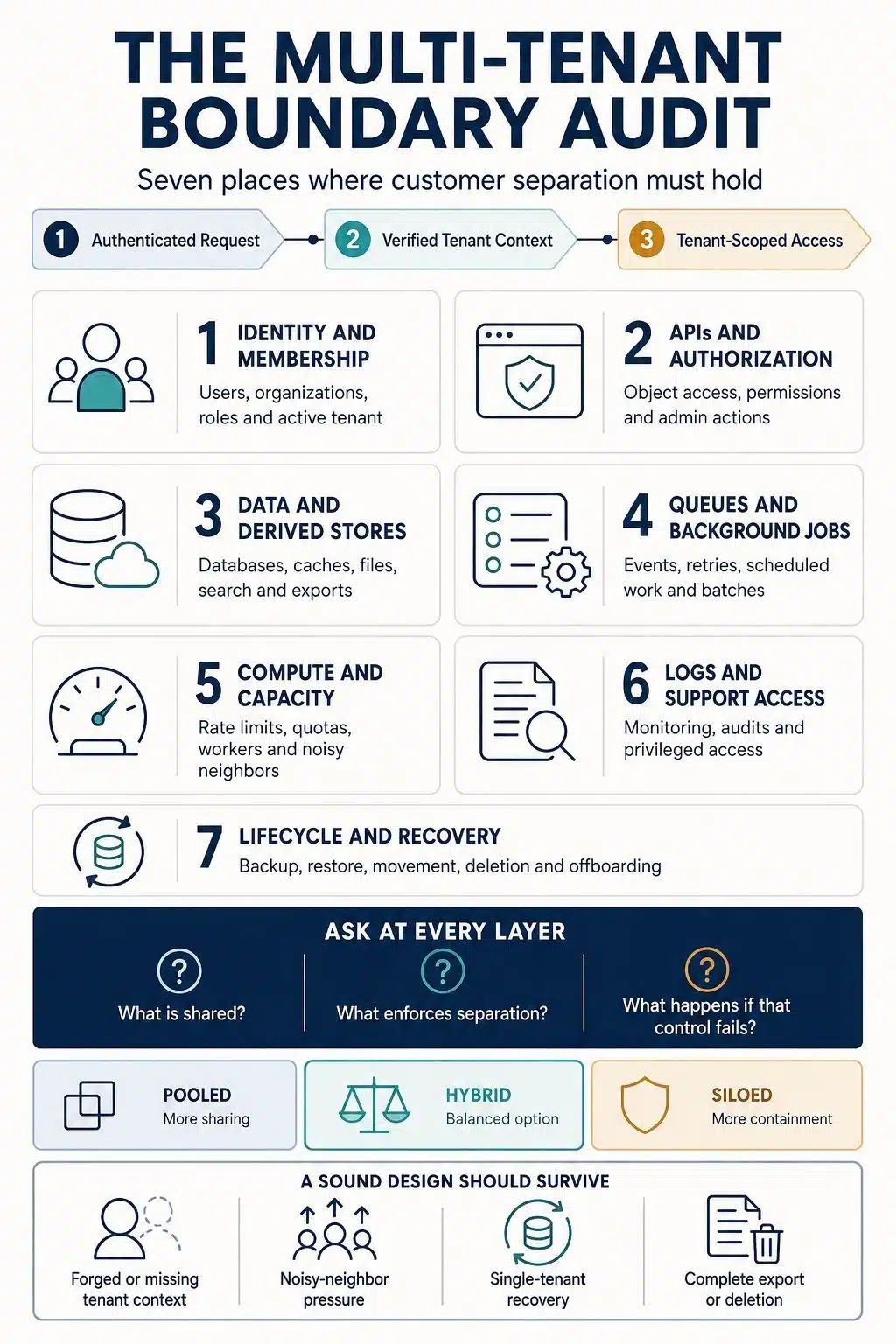
A typical request follows this path:
- The platform authenticates the user or service.
- It identifies the tenant in which that identity is trying to act.
- It confirms tenant membership and permissions.
- It attaches the verified tenant context to the request.
- Other services use that context for authorization, data access, configuration, rate limits, and logging.
- The operation fails if the required tenant context is missing or invalid.
A tenant ID in a URL, request header, or form is only input. It is not proof that the user belongs to that tenant. The application must confirm access before it reads or changes protected data.
Every layer then applies the boundary in its own way. A shared database may filter records by tenant ID. A database-per-tenant model selects the correct connection. Caches need tenant-aware keys, files need protected paths, and background jobs must retain the correct tenant context.
All of these controls have to agree. A secure database cannot compensate for an export service that accidentally combines two customers’ records.
Multi-Tenancy Is a Spectrum
I do not find the usual “single-tenant or multi-tenant” question very useful on its own. Most SaaS systems combine different levels of sharing.
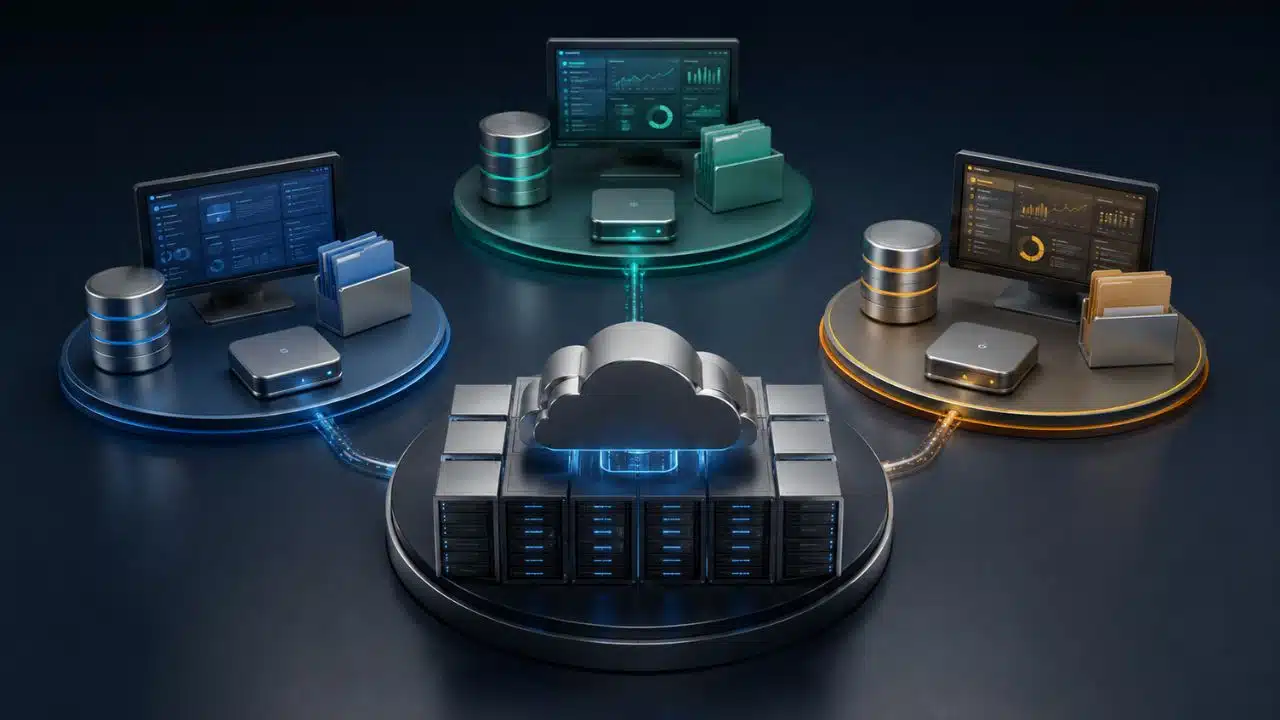
- Pooled architecture: Tenants share resources, and software controls enforce separation.
- Siloed architecture: A tenant receives dedicated resources or an environment.
- Hybrid architecture: The platform combines pooled and dedicated components.
A product might share application services, give regulated customers separate databases, and run expensive reporting jobs in isolated workers. It can still operate as one SaaS platform.
Pooling usually lowers infrastructure cost per customer and makes updates easier to manage. A siloed model may simplify tenant-specific recovery, placement, or network controls, but each environment needs provisioning, monitoring, spare capacity, and upgrades.
Neither approach is automatically more secure. The real questions are where the boundary sits, how it is enforced, and how far an incident can spread if a control fails.
The Main Multi-Tenant Database Models
The database is only one layer, but it carries important trade-offs.
| Database model | Main advantage | Main difficulty |
| Shared database and shared tables | High tenant density and fewer databases to operate | Every relevant query and write needs reliable tenant scoping |
| Shared database with separate schemas | Clearer logical separation inside one database | Provisioning and migrations become harder as the tenant count rises |
| Database per tenant | More control over tenant-level restore, deletion, placement, and performance | Connections, upgrades, monitoring, and reporting become fleet-wide work |
| Shards or deployment groups | Limits scale and failure impact without one environment per customer | Placement, routing, capacity, and tenant movement require automation |
Records normally carry a tenant identifier. This model is efficient, but every read, write, join, and report must stay within the correct tenant. Centralized data-access rules and automated cross-tenant tests are safer than relying on developers to remember a filter each time.
Separate Schemas
A schema for each tenant creates clearer logical organization. The operational cost appears as the product grows: schema creation, version tracking, upgrades, and recovery all need dependable automation.
Database Per Tenant
A separate database offers more control over backup, restore, encryption, location, and performance. It is a stronger data boundary, but it does not automatically isolate the whole application. Databases may still share an application tier, network, server, or support system.
Shards or Deployment Groups
Each shard serves a defined group of tenants. This limits failure impact without creating a complete stack for every customer. The platform must know where each tenant lives, route requests correctly, and move tenants when capacity or regional requirements change.
Where Multi-Tenant Systems Usually Fail
Cross-tenant exposure does not always begin with a dramatic security breach. It may come from a changed object ID, a missing report filter, an overly broad support query, or a background job that loses its tenant context during a retry.
Some failures never touch the primary database. Cache keys can collide. File paths can be predictable. Search, analytics, logs, and exports can combine records that the main application keeps apart. Missing context should always close the path rather than make the system more permissive.
Availability is another part of isolation. A large import, expensive query, or job flood can consume shared resources and slow the product for everyone else. One tenant does not need to see another tenant’s data to harm their experience.
Recovery can also expose weak design. Restoring or deleting one customer becomes difficult when its data has spread across files, search indexes, analytics stores, replicas, and backups.
A Seven-Layer Tenant Boundary Check
Before choosing an architecture, I would check the tenant boundary across seven layers. For each one, ask: What is shared? What enforces separation? What happens if that control fails?
| Layer | What to inspect |
| Identity and membership | Login, active tenant, invitations, roles, and service accounts |
| APIs and authorization | Object access, tenant permissions, integrations, and public links |
| Data and derived stores | Databases, caches, search, analytics, exports, and files |
| Background work | Events, scheduled jobs, retries, and batch processing |
| Compute and networking | Secrets, connections, quotas, workers, and network controls |
| Monitoring and support | Logs, metrics, alerts, dashboards, and privileged access |
| Lifecycle and recovery | Onboarding, backup, restore, migration, deletion, and offboarding |
This check prevents a convincing database diagram from hiding weaker boundaries elsewhere. A customer has not been fully removed if its files remain searchable, its scheduled jobs still run, or an old service credential continues to work.
Row-Level Security and Performance Isolation
Row-level security can enforce tenant filters inside a relational database. In a shared-table design, it is useful defense in depth because a database policy may block access even if application code misses a filter.
It is not a complete multitenancy solution. Database owners, privileged roles, migrations, and poorly designed policies can behave differently from ordinary application connections. Row-level rules also do nothing for files, queues, caches, search indexes, or logs. I would use them alongside application authorization, restricted database roles, tenant-scoped data access, and isolation tests.
Performance needs its own controls. Tenant-aware monitoring should show which customer is consuming requests, connections, storage, worker time, or queue capacity. Depending on the product, protection may include API limits, concurrency caps, fair queues, query timeouts, isolated workers, or moving a heavy tenant to another shard.
The controls should also fail clearly. A quota without an early warning or a rate limit without sensible retry behavior simply turns a shared-resource problem into a confusing customer failure.
How to Choose the Right Tenancy Model
I would start with the requirements that will be hardest to change later.
- Define the tenant boundary: Decide whether a tenant is a company, workspace, project, or another unit. Document whether users can belong to several tenants and whether intentional data sharing is allowed.
- Prioritize firm isolation requirements: Data residency, encryption keys, network controls, backup rules, regulation, and acceptable failure scope can rule out otherwise attractive options.
- Model extreme workloads: Estimate tenant count, data size, request rates, job patterns, and unusually heavy customers. Averages rarely expose the weaknesses of a pooled design.
- Plan recovery and movement: Ask how one tenant will be restored, exported, deleted, or moved without disrupting others.
- Count operational cost: Dedicated infrastructure costs more, but complicated pooling does too. Include engineering, monitoring, migration, support, compliance, and incident response.
My practical rule is to choose the simplest repeatable model that meets the hardest real requirement. A small SaaS product does not need complex global placement machinery on day one. It does need an architecture that will not block stronger isolation later.
How to Test Multi-Tenancy Before Launch
Tenant isolation should be a permanent test category, not a one-time security check.
Create at least two tenants with clearly different test data. While signed into one, try to read, change, delete, or reference objects belonging to the other. Change tenant and object IDs in URLs, forms, headers, tokens, and public links. Test people who hold different roles in multiple tenants.
Then remove or conflict the tenant context. Protected actions should fail closed. Repeat the checks outside the normal request path, including exports, search, reports, integrations, scheduled tasks, retries, logs, files, and support tools.
Performance and lifecycle tests matter too. Load one tenant heavily and measure the effect on another. Restore, move, and delete a test tenant, then confirm that credentials, jobs, files, indexes, and retained records follow the intended policy.
These tests should run again after meaningful changes to authorization, caching, queries, routing, or background processing.
When a Hybrid Model Makes Sense
For many established SaaS products, a hybrid model is the most practical answer. Standard customers may use pooled services and shared tables, while regulated or unusually demanding customers receive dedicated databases, workers, or regional deployments.
The danger is allowing “hybrid” to become a polite word for exceptions nobody can operate. A workable design has a small number of repeatable service classes. Each can be provisioned, monitored, updated, backed up, and supported consistently. Tenants can then move between those classes when their risk, workload, region, or contract changes.
Build Boundaries You Can Move
Multi-tenancy in SaaS architecture is not simply a way to make software cheaper. It is an operating model built around verified tenant context, consistent separation, controlled resource sharing, and repeatable lifecycle management.
The database matters, but so do identity, APIs, caches, files, queues, monitoring, support access, recovery, and tenant movement. Those are the places where an architecture proves whether its boundary is real.
The strongest design is not the one that shares everything or isolates everything. It is the simplest design that meets customer requirements now and gives the provider a safe way to restore, relocate, or isolate a tenant later.
Frequently Asked Questions on Multi-Tenancy in SaaS Architecture
1. Is Multi-Tenancy the Same as SaaS?
No. SaaS is a software delivery and operating model. Multitenancy describes how resources are shared and how customers are kept separate. A SaaS provider can use pooled, dedicated, or hybrid infrastructure.
2. Is Multi-Tenant SaaS Secure?
It can be. Security depends on enforcing tenant context and authorization across the whole platform, not simply adding a tenant ID to database records. Cross-tenant testing, monitoring, restricted access, and defense in depth are essential.
No. A multi-tenant SaaS product may use shared tables, separate schemas, a database per tenant, sharded databases, or a mixture of these models.
4. What Is the Noisy-Neighbor Problem in SaaS?
It occurs when one tenant consumes enough shared capacity to reduce performance or availability for others. Tenant-aware monitoring, limits, fair queues, workload controls, and isolated workers can reduce the risk.