
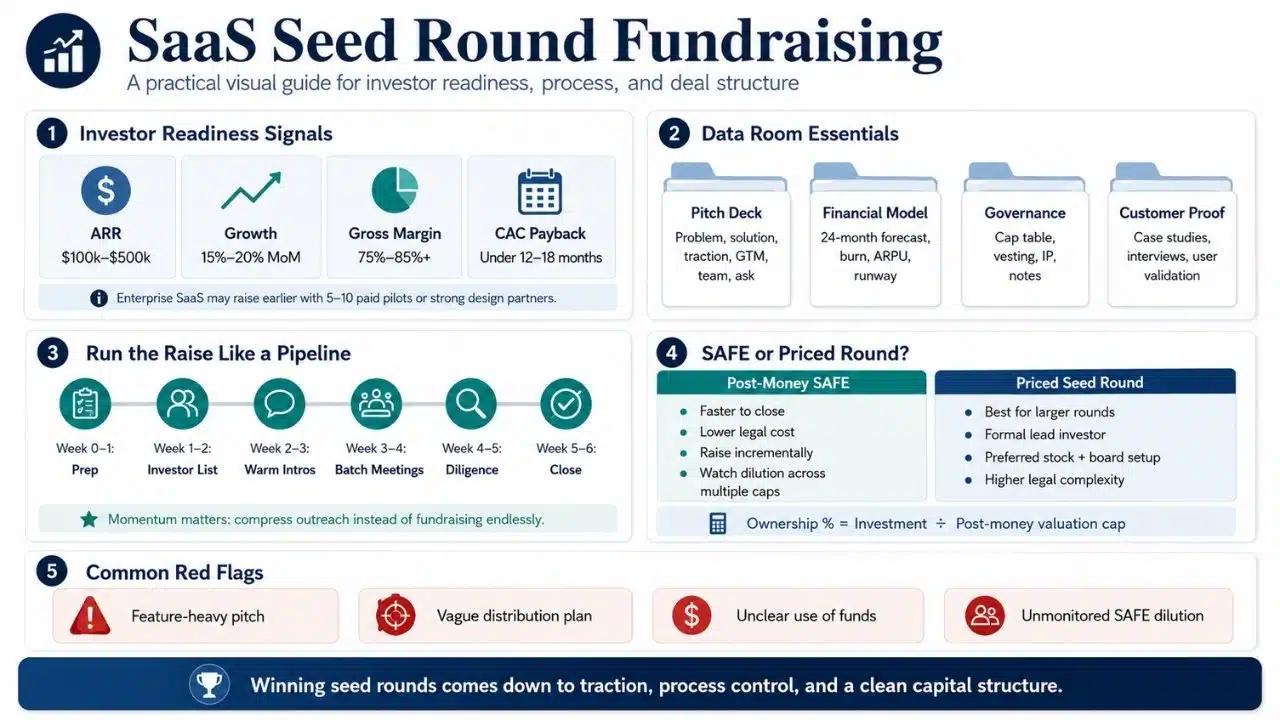
Pitching investors for early-stage software funding requires a clear shift in mindset. You are not just presenting a great product concept—you are demonstrating that your team can run a predictable business engine. Executing a successful approach to saas seed round fundraising comes down to building early traction, organizing your diligence materials beforehand, and running your investor meetings like a tight sales pipeline.
Investors at the seed stage understand that your startup is an evolving project. What they want to see is execution speed, a clear distribution model, and healthy unit economics.
Realistic Metrics and Benchmarks for Seed-Stage SaaS
While early-stage venture capital relies heavily on team quality and market size, key SaaS metrics act as hard proof of execution capability.
| Metric | Target Seed Range | What Investors Evaluate |
| Annual Recurring Revenue (ARR) | $100k – $500k ARR | Proof that customers find real economic value in your tool |
| Growth Velocity | 15% – 20% Month-over-Month | Signal of underlying organic pull and market demand |
| Gross Margin | 75% – 85%+ | Evidence of true software margins rather than high-touch service work |
| CAC Payback Period | Under 12–18 months | Indicator of sustainable customer acquisition efficiency |
| Target Dilution | 15% – 20% equity | Keeps founders properly incentivized for future funding rounds |
Nuances Across Business Models
These targets fluctuate depending on your sales motion:
-
Product-Led Growth (PLG): Investors want to see strong user activation rates, active weekly usage, and monthly churn hovering below 2%.
-
Enterprise B2B SaaS: For enterprise tools with $50k+ annual contract values, funds often accept lower ARR figures if you have 5 to 10 paid pilots or signed design-partner agreements with established brands.
Building an Investor-Ready Data Room
Do not reach out to venture funds or angels until your data room is structured. Having to draft financial models or scramble for legal documents mid-pitch stalls momentum and creates an impression of disorganization.
Structure your data room into four clear folders:
1. Pitch Deck (10–12 Slides)
Keep your deck focused and scannable:
-
The Problem: The economic pain point your buyers face today.
-
The Solution: Product demonstration and key workflow advantages.
-
Traction: MoM revenue growth, key account logos, or active usage stats.
-
Market Size: Total Addressable Market calculated using bottom-up math.
-
Go-To-Market (GTM): Specific customer acquisition channels and distribution plans.
-
Team: Domain expertise and unfair founder advantages.
-
The Ask: Capital target and the 18-month operating milestones it unlocks.
2. Financial Model
Include a 24-month financial forecast. It doesn’t need to predict the future perfectly, but it should outline monthly burn rates, hiring plans, acquisition costs, average revenue per user (ARPU), and runway assumptions.
3. Corporate Governance
Incorporate as a Delaware C-Corp. Include your clean cap table, founder vesting schedules, signed IP assignment contracts, and copies of any outstanding convertible notes.
4. Customer Validation
Provide anonymized survey feedback, case studies, or user interviews showing how customers rely on your software day-to-day.
Running Your Fundraise Like a Sales Pipeline
Dripping out pitch meetings over several months destroys urgency. When investors realize you have been fundraising for a quarter without closing lead capital, they tend to sit on the sidelines to wait for additional progress updates.
Running a effective process for saas seed round fundraising means compressing active outreach into a 4-to-6-week sprint.
1. Target Aligned Investors
Compile a list of 60 to 80 seed funds, micro-VCs, and active software angels. Focus specifically on investors who back companies in your specific vertical or adjacent software categories.
2. Source Warm Introductions
While cold outreach can occasionally work with strong traction, warm introductions convert at a significantly higher rate. Map your target list against your network. The best intro comes from a founder who previously made money for that specific investor.
3. Batch Your Meetings
Schedule initial pitch calls within a tight two-week window. Running 15 to 20 calls per week creates operational momentum and forces investors to adhere to faster internal diligence timelines.
Structuring Deal Terms: SAFEs vs. Priced Equity
Choosing how to structure your round impacts legal fees, speed, and long-term cap table management.
| Factor | Post-Money SAFE | Priced Seed Round |
| Speed | Closes continuously on rolling terms | Requires synchronous legal closing |
| Legal Costs | Typically $2,000 – $5,000 | Ranges from $20,000 to $40,000+ |
| Governance | No immediate board seat required | Usually requires formal board setup |
| Lead Requirement | Can raise check-by-check | Requires lead investor to price the round |
Post-Money SAFEs
Simple Agreements for Future Equity (SAFEs) are the standard option for early software rounds. They allow you to bring in capital incrementally from multiple investors without issuing physical stock immediately or incurring heavy legal bills.
Calculating equity ownership with a post-money SAFE is straightforward:
Ownership Percentage = Investment Amount / Post-Money Valuation Cap
Priced Equity Rounds
Institutional venture firms leading rounds above $3M often require a priced equity round. This involves issuing preferred stock, setting an explicit pre-money valuation, drafting investor rights agreements, and assigning formal board seats.
Four Common Mistakes That Derail Seed Rounds
-
Feature-focused pitches: Spending most of the call demoing minor UI tools rather than explaining customer acquisition strategy, unit economics, and market demand.
-
Vague distribution plans: Stating that you will rely on “content marketing and word of mouth” signals an undeveloped GTM strategy. Investors want concrete customer acquisition channels and expected payback periods.
-
Unclear use of funds: Explaining that capital will be used simply “to scale” lacks precision. Clearly define how the capital gives you 18 to 24 months of runway to reach Series A benchmarks.
-
Unmonitored SAFE dilution: Issuing multiple SAFEs at different valuation caps over time can quietly dilute founder equity well beyond your 20% target before Series A even begins.
Final Thoughts
Successfully navigating saas seed round fundraising comes down to process control. Prepare your data room early, target investors who know your sector, compress your pitch schedule to create genuine momentum, and keep your capital structure clean as you build toward your next growth stage.
Frequently Asked Questions(FAQs) on SaaS Seed Round Fundraising
How long does a SaaS seed round take?
Most well-managed raises take 6 to 12 weeks from initial investor outreach to cleared funds in the bank.
Can you raise seed funding with zero revenue?
Yes, but the burden of proof shifts entirely to founder credentials and qualitative validation, such as technical background, prior exits, or signed enterprise pilot agreements with major corporate accounts.
What valuation cap should a SaaS startup set?
Valuation caps depend on founder track record, growth rates, and prevailing market conditions, but most rounds target 15% to 20% dilution. For example, raising $1.5M typically corresponds to a post-money cap between $7.5M and $10M.