AI news has an inbox problem. Almost every newsletter promises to save time, yet subscribing to several of them can turn staying informed into another daily task.
The best AI newsletters and podcasts should do the opposite. They should help readers identify the developments that matter, understand why they matter, and ignore most of the surrounding noise.
That is how I approached this list. I did not choose ten sources that all summarize the same model launches and funding announcements. I selected five newsletters and five podcasts covering different needs: quick updates, independent reporting, research, engineering, business, policy, and the effects of AI on work.
Best AI Newsletters
A useful AI newsletter should save time without removing the context that makes an update meaningful. I chose the five below because they serve different needs, from quick daily summaries and technical research coverage to independent reporting and practical analysis of how AI is changing work.
1. The Rundown AI: The Easiest Daily Starting Point
Best for: Busy professionals who want practical AI updates
Publishing pattern: Weekdays, with issues designed as short reads
The Rundown AI is probably the most approachable choice for readers who need to follow AI but do not want research-level detail. It selects several major stories, briefly explains their relevance, and regularly includes tools, tutorials, and workplace applications.
That combination makes it particularly useful for marketers, managers, founders, educators, and other professionals trying to understand what they can actually do with a new development. The newsletter usually moves beyond announcing a product and offers some sense of its possible use.
The tradeoff is commercial influence. The Rundown is sponsor-supported and devotes considerable space to tools, so parts of it can feel closer to product discovery than independent reporting.
I would use it to notice important developments and find practical ideas. For controversial claims, consequential decisions, or unusually impressive product announcements, I would still check the original evidence.
2. TLDR AI: The Better Daily Option for Technical Readers
Best for: Developers, engineers, researchers, and technical professionals
Publishing pattern: Every weekday, usually readable in about five minutes
TLDR AI is more compressed and more technical than The Rundown. It covers model releases, research papers, developer tools, open-source projects, and wider industry news.
For an engineer who wants to scan the field before starting work, that density is useful. Each issue can point toward a relevant repository, benchmark, paper, or model announcement without requiring the reader to search several websites.
Its name also reveals its limitations. Summaries this short cannot preserve every qualification in a research paper. Details about evaluation design, hardware requirements, licensing, data quality, or real-world performance may disappear.
TLDR AI is strongest as a discovery tool, especially for readers who already understand the terminology. If a paper or model could affect a project, the short description should be the beginning of the research rather than the end.
3. The Algorithm: The Strongest Choice for Reported Context
Best for: Readers interested in AI’s social, scientific, and political effects
Publishing pattern: Monday mornings
MIT Technology Review’s The Algorithm feels noticeably different from the average AI digest. It is built around reporting rather than a roundup of every new tool released during the week.
Its coverage gives more room to questions about policy, labor, science, public institutions, safety, and the companies shaping AI development. That makes it useful for readers who want to understand the consequences of a story, not just know that it happened.
The weekly schedule is selective by design. Readers will not receive every model update, and some of the reporting linked from the newsletter may require a subscription.
I would not choose The Algorithm for daily product news. I would choose it as a slower source that can challenge or deepen the simplified version of a story found in a quick newsletter.
4. Import AI: Research and Policy With a Clear Point of View
Best for: AI research, policy, safety, and advanced capabilities
Publishing pattern: Usually weekly
Import AI, written by Jack Clark, is one of the more demanding newsletters on this list. Issues regularly examine research papers, benchmarks, government policy, security, and the direction of advanced AI systems.
Clark has the technical and policy background to explain why a new evaluation or research result deserves attention. His newsletter is particularly useful when it connects an individual paper to a larger change in capabilities, regulation, or geopolitical competition.
He is also a co-founder and policy leader at Anthropic. I do not consider that a reason to dismiss the newsletter, but it is important context. Import AI should be read as an informed industry perspective, not the view of a detached outside observer.
Issues can be long, assume prior knowledge, and move from evidence into personal forecasts. Beginners may find the density frustrating. Research and interpretation should also be kept separate, especially when the discussion turns to future capabilities.
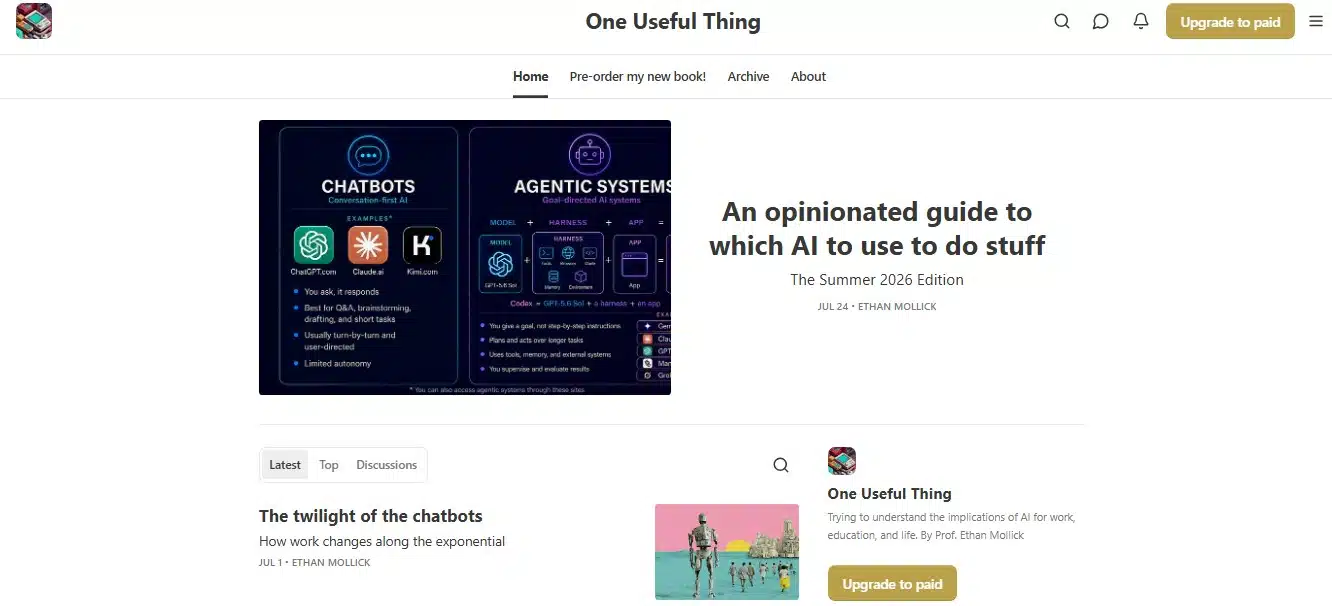
5. One Useful Thing: The Best Newsletter for Practical Interpretation
Best for: Understanding how AI affects work, management, and education
Publishing pattern: Irregular
One Useful Thing is not a comprehensive news digest. That is precisely why it belongs here.
Written by Wharton professor Ethan Mollick, the newsletter takes selected changes in AI and examines what they may mean for professional work, organizations, education, and everyday use. While a daily newsletter might announce that a new model has arrived, One Useful Thing is more likely to explore how that model changes a task or alters an existing assumption about AI.
The posts are research-based, but they also reflect Mollick’s editorial judgment and interest in practical experimentation. Readers who want a more skeptical or policy-heavy perspective may find some of the analysis comparatively optimistic.
The irregular schedule makes it unsuitable as a reader’s only news source. Paired with a daily or weekly digest, however, it provides the interpretation that short summaries often lack.
Best AI Podcasts
AI podcasts are most useful when they add explanation rather than simply read the day’s headlines. I chose the five below for their distinct strengths, from manageable daily updates and accessible reporting to technical discussions, founder interviews, and deeper debates about policy and safety.
6. The AI Daily Brief: The Most Manageable Daily Podcast
Best for: Listeners who prefer a daily audio update
Publishing pattern: Daily, with many episodes running under 30 minutes
The AI Daily Brief does more than read a collection of headlines. Episodes usually organize the day’s news around one main development, followed by analysis of why it matters and how it connects to wider industry changes.
Its length is realistic for commuting, walking, or listening before work. That gives it an advantage over AI podcasts that regularly demand an hour or more.
The analysis is shaped strongly by one editorial voice. This makes the show coherent, but it also means listeners receive one person’s selection and framing of the news.
For someone with limited time, The AI Daily Brief could serve as the only daily source. I would still verify any claim before using it in a report, article, investment decision, or business strategy.
7. Hard Fork: AI Reporting Without the Lecture
Best for: Accessible coverage of AI, technology, and internet culture
Publishing pattern: Usually weekly
Hard Fork is hosted by journalists Kevin Roose and Casey Newton. The show combines reporting, interviews, disagreement, and humor without treating every technology announcement as a historic breakthrough.
AI receives substantial attention, but the hosts also cover social platforms, regulation, online culture, media, and the technology industry. That broader scope is useful because AI stories rarely remain confined to model performance. They affect politics, employment, business, education, and public trust.
The two-host format gives the show some natural friction. Listeners can hear uncertainty or disagreement rather than receiving one polished conclusion.
Hard Fork is not an AI-only podcast, and episodes often last around an hour. Some older episodes may also sit behind subscription access. It is better suited to weekly context than to tracking every technical release.
8. No Priors: The Most Useful Founder and Investor Perspective
Best for: AI founders, product leaders, and investors
Publishing pattern: Typically weekly
Hosted by Sarah Guo and Elad Gil, No Priors features conversations with AI founders, researchers, engineers, and company leaders.
The podcast is particularly good at exploring how technical capabilities become products. Episodes often examine customer demand, infrastructure, company building, research commercialization, and the markets investors believe AI may change.
That access is valuable, but the perspective is not neutral. Both hosts are investors, and many guests have professional or financial interests in the success of AI companies. Discussions may naturally give more attention to growth, adoption, and future opportunities than to slower-moving social costs.
The investor viewpoint is useful when it is treated as a viewpoint. I would listen to No Priors for industry access and commercial reasoning, not as the final word on whether an AI market forecast will prove correct.
9. Latent Space: Technical Depth for People Building AI Products
Best for: AI engineers and experienced technical builders
Publishing pattern: Regular long-form episodes, often weekly
Latent Space calls itself a podcast for AI engineers, and its subject matter supports that description. It covers foundation models, agents, inference, infrastructure, developer tools, multimodal systems, and AI for science.
The hosts frequently speak with engineers, founders, and researchers directly involved in building the systems under discussion. That can reveal practical details about deployment, architecture, evaluations, cost, and engineering tradeoffs that general technology podcasts rarely reach.
It is also one of the least beginner-friendly recommendations here. Episodes can run well beyond an hour and often assume that listeners already understand current models, frameworks, and technical debates.
I would not try to hear every episode. Technical readers will get more value by choosing the conversations related to their current work rather than creating another unmanageable podcast backlog.
10. The Cognitive Revolution: Depth on Capabilities, Safety, and Policy
Best for: AI capabilities, evaluations, safety, policy, and long-term questions
Publishing pattern: Weekly
Hosted by Nathan Labenz, The Cognitive Revolution approaches AI through detailed interviews and analytical scouting reports. Its coverage moves between model capabilities, agent systems, research, security, policy, and the possible effects of more advanced AI.
The long-form format gives guests time to explain their assumptions instead of reducing every disagreement to a headline. That is particularly valuable in areas such as AI safety, where informed people may agree on the evidence but reach different conclusions about the risk.
Some conversations move from current research into predictions about advanced AI, geopolitics, or long-term social change. Those discussions can still be worthwhile, but they should not be confused with established findings.
This is a podcast for readers comfortable with uncertainty and competing arguments. Anyone looking for a quick summary of the week will find The AI Daily Brief easier to manage.
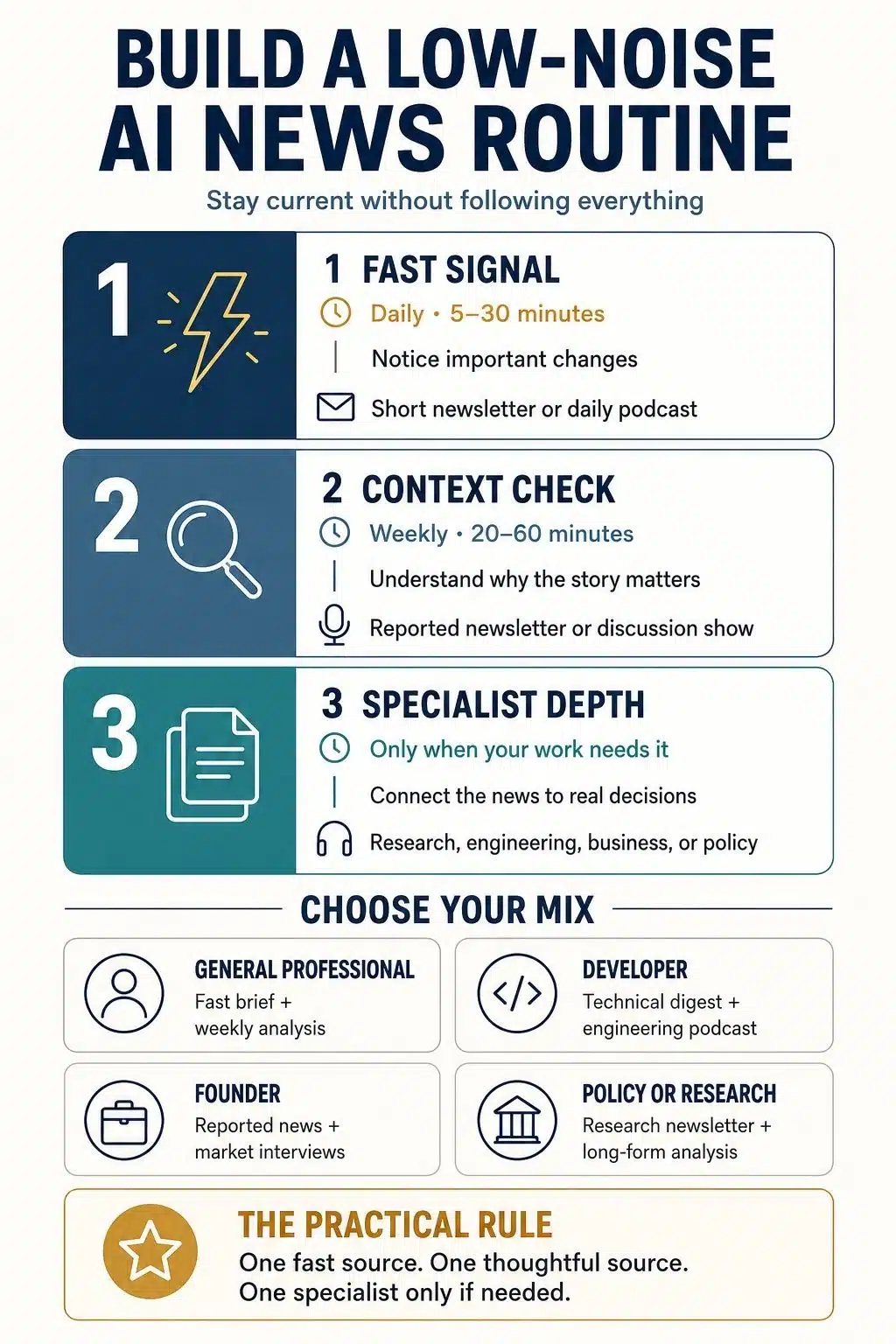
How I Would Build a Low-Noise AI News Routine
Subscribing to all ten sources would defeat the purpose of this list. The same major story would appear repeatedly, while the backlog of unread issues and unheard episodes continued to grow.
A useful routine needs no more than three layers:
- One fast source for noticing developments
- One slower source for context and interpretation
- One specialist source only when it supports the reader’s work
A general professional could pair The Rundown AI with The Algorithm. A developer might choose TLDR AI and select Latent Space episodes. A founder could combine The Algorithm with No Priors, while someone focused on research or policy might prefer Import AI and The Cognitive Revolution.
For a reader with only 20 or 30 minutes a day, The AI Daily Brief may be enough on its own.
After a month, I would remove any subscription that repeatedly covers the same stories without adding a different perspective. If three newsletters report the same product announcement in almost the same language, two of them are wasting the reader’s time.
Final Thoughts
Staying current with AI does not require knowing about every model, funding round, or new tool on the day it appears. The more useful goal is to notice changes that affect your work and understand them well enough to make a sensible decision.
The best AI newsletters and podcasts provide the right mix of speed, depth, and skepticism for a particular reader. Start with one fast source and one thoughtful source. Add a specialist only when you can name the gap it will fill.
A small information routine you consistently follow is far more valuable than an impressive subscription list you mostly ignore.
Frequently Asked Questions on the Best AI Newsletter and Podcasts
The Rundown AI is one of the easiest places to start because it explains major developments in short, practical language. Readers more interested in reporting and social context may prefer The Algorithm.
TLDR AI is the strongest quick-read option for developers because it covers models, papers, developer tools, and open-source projects. Latent Space adds deeper technical discussion for those who prefer podcasts.
3. What is the best daily AI podcast?
The AI Daily Brief is the most manageable daily option on this list. It combines news and commentary in episodes that are often shorter than a typical long-form technology show.
Many are useful, but free access does not guarantee accuracy or independence. Sponsorship, compressed summaries, and editorial preferences can shape coverage. Important claims should still be checked against the original research, documentation, or announcement.
Two or three are enough for most people: one fast update, one source for deeper interpretation, and a specialist source if the work requires it. Beyond that, readers often receive more duplication than insight.