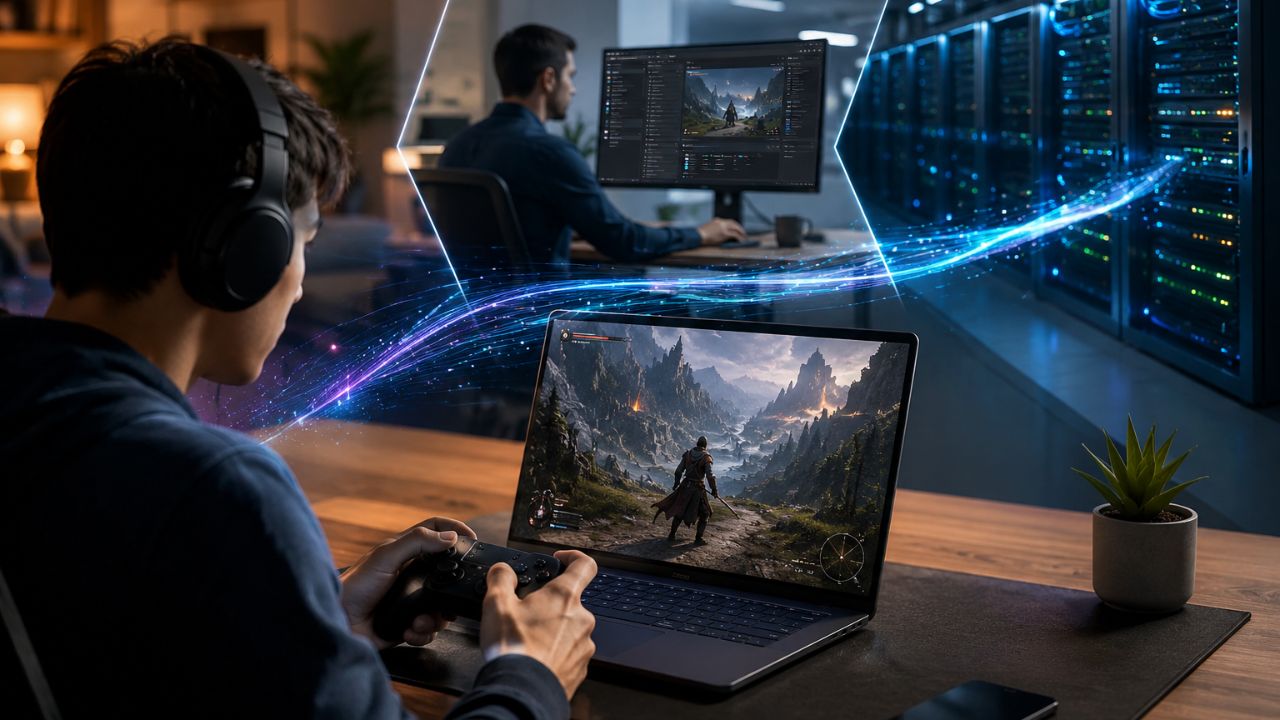
Cloud gaming is often classified in two completely different ways. One explanation says it is Software as a Service, or SaaS, because the player opens an app or browser and accesses a finished gaming service. Another says it is Infrastructure as a Service, or IaaS, because the game runs on remote GPU servers instead of the player’s own hardware.
Both descriptions notice something real. They are simply looking at different parts of the system. My answer to “Is cloud gaming SaaS, PaaS, or IaaS?” is this:
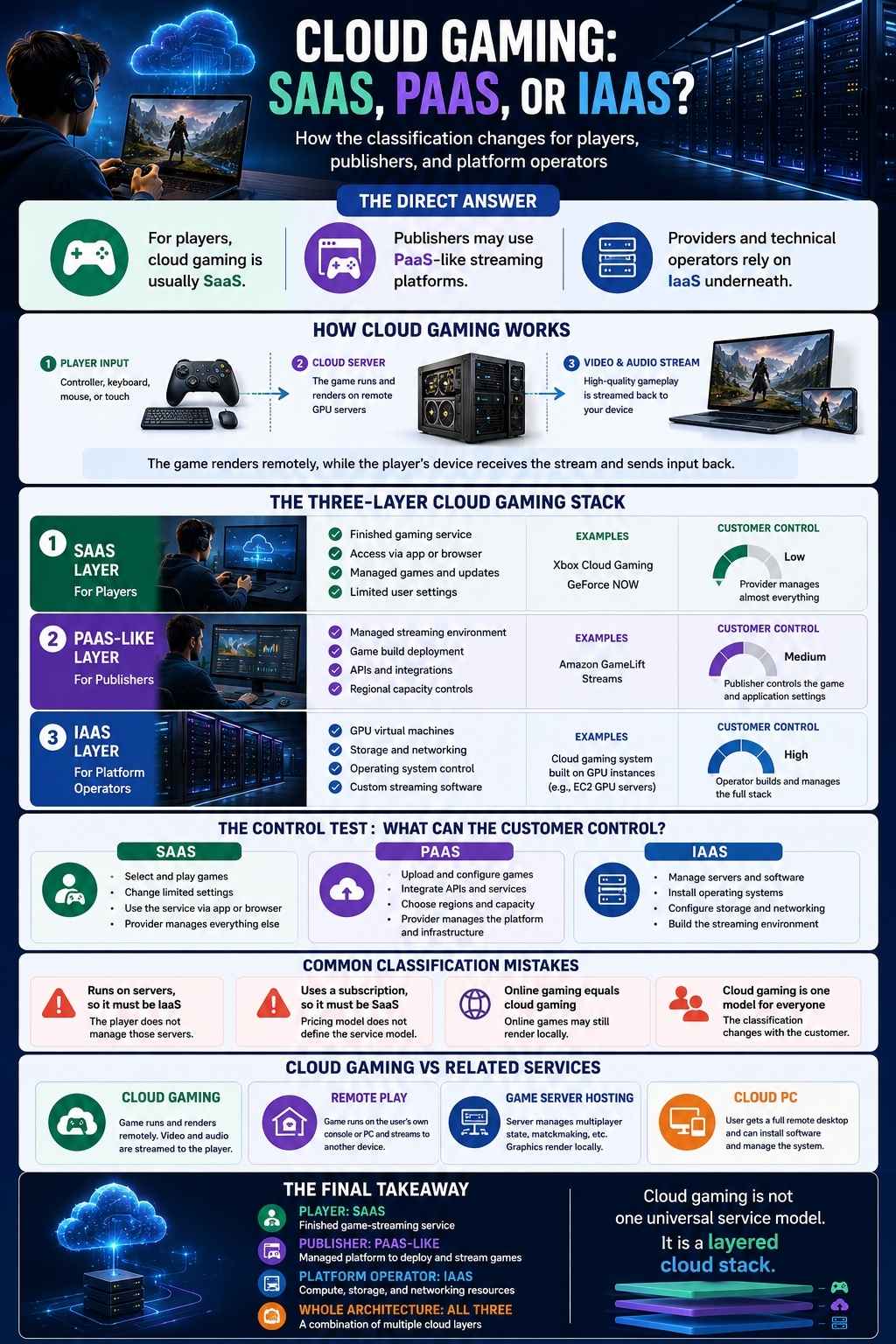
Cloud gaming is usually SaaS for the player. Publishers may use PaaS-like streaming platforms, while providers build and operate those services on IaaS resources such as GPU compute, storage, and networking.
The classification changes with the customer. A player using Xbox Cloud Gaming receives a managed game-streaming experience. A publisher using Amazon GameLift Streams deploys its own game onto a managed delivery platform. A company building a streaming service on Amazon EC2 controls virtual machines, operating systems, applications, storage, and networking.
Those are three different service relationships inside the same cloud gaming ecosystem.
Is Cloud Gaming SaaS?
For an ordinary player, cloud gaming is primarily SaaS. The user selects a game, starts a session, sends controller or keyboard input, and receives video and audio. The provider manages the remote hardware, operating environment, game deployment, streaming system, updates, and capacity.
At a lower level, the complete stack may also involve:
- PaaS-like services used by publishers to deploy and stream games
- IaaS resources used by platform operators to provide GPU computing, storage, and networking
So, “cloud gaming uses all three” can be correct at the architecture level. It is still a poor answer unless we say who consumes which layer.
What Is Cloud Gaming?
Cloud gaming runs and renders a game on remote infrastructure, then streams the resulting video and audio to a player’s device. The device sends control input back to the remote session through a browser or thin client. AWS describes game streaming in much the same way: the game is hosted and rendered remotely while the player connects through a browser or provider-supplied client.
The cloud side typically handles:
- Game execution
- Graphics rendering
- Session management
- Video and audio encoding
- Updates and patches
- Storage and saved data
- Capacity and regional delivery
The local device still has work to do. It must decode the stream, display it smoothly, capture the player’s input, and maintain a stable connection.
That is why cloud gaming can run demanding titles on phones, tablets, lower-powered laptops, smart TVs, and streaming devices. Xbox currently supports cloud gaming across several categories of PCs, consoles, mobile devices, TVs, and browsers, while GeForce NOW promotes cloud-streamed PC gaming across phones, computers, tablets, TVs, and handheld devices.
The difficult part is latency. In a cloud document, a short delay may barely matter. In a fast game, the player’s input must reach the server and the next rendered frame must return quickly enough to feel immediate.
SaaS, PaaS, and IaaS Explained Simply
The NIST cloud model defines SaaS, PaaS, and IaaS according to the capabilities offered to the consumer and the parts of the computing stack that consumer controls.
Software as a Service
With SaaS, the customer uses an application operated by the provider. The provider manages the servers, storage, networking, operating systems, and application environment. The user may change limited settings but does not administer the underlying infrastructure.
Platform as a Service
With PaaS, the customer deploys or manages an application on a provider-controlled platform.
The provider handles the infrastructure and runtime environment. The customer focuses on the application, data, configuration, and integrations.
Infrastructure as a Service
With IaaS, the customer receives fundamental computing resources such as virtual servers, processing capacity, storage, and networking.
The customer may install operating systems and applications and manage much more of the software stack. That control boundary matters more than the fact that remote servers are involved.
Almost every SaaS product runs on infrastructure somewhere. That does not mean the SaaS customer is consuming IaaS directly.
Why Cloud Gaming Is Usually SaaS for Players
From the player’s perspective, consumer cloud gaming closely follows the SaaS model.
The player normally:
- Opens an app or browser
- Signs in
- Selects a supported game
- Starts a stream
- Changes limited account or game settings
- Plays
The player does not normally:
- Select and provision a GPU instance
- Install the server operating system
- Update cloud graphics drivers
- Configure virtual networking
- Maintain the encoding system
- Scale server capacity
- Patch the streaming platform
The provider manages those responsibilities. That is the defining point. The service may run on complex cloud infrastructure, but the player receives a finished application experience rather than raw computing resources.
Is Xbox Cloud Gaming SaaS?
Yes. For the ordinary user, Xbox Cloud Gaming is best classified as SaaS. Players access supported games through managed Xbox applications and browsers on compatible devices. Microsoft controls the available gaming environment, server-side execution, service infrastructure, compatibility, and streaming delivery.
The player does not receive a general-purpose cloud computer. They cannot choose the remote operating system, install unrelated server software, or configure the underlying network and GPU environment.
They receive access to a controlled game service. Its internal architecture may contain infrastructure and platform layers, but that does not change the player-facing classification.
Is GeForce NOW SaaS?
GeForce NOW is also SaaS for its ordinary users. NVIDIA allows players to stream supported PC games through its cloud service, including games connected through supported digital stores. The service is available through dedicated applications and supported browsers.
The connection to external game stores can make GeForce NOW look more infrastructure-like than a fixed game library.
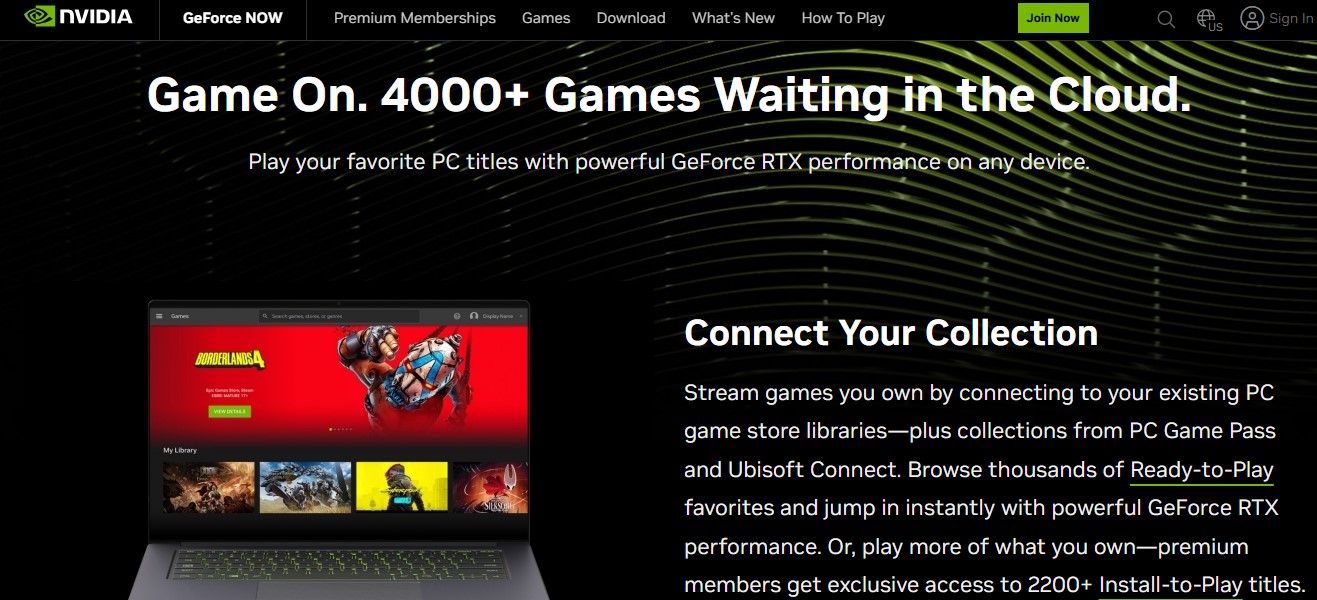
I still would not classify it as IaaS. The player does not control the cloud machine as an unrestricted virtual server. NVIDIA manages the gaming environment, supported applications, infrastructure, drivers, streaming stack, and session rules.
The user is accessing a provider-managed application service. Owning the game license does not mean owning or administering the cloud infrastructure running it.
When Cloud Gaming Becomes PaaS-Like
The classification changes when the customer is a game publisher rather than a player. Suppose a publisher wants to stream its game through browsers and low-powered devices. It does not want to build global GPU capacity, maintain the streaming protocol, manage regional infrastructure, or create its own session-delivery system. It can use a managed streaming platform instead.
The publisher may control:
- The game build
- Branding
- Player authentication
- Storefront integration
- Application configuration
- Regional capacity choices
- The relationship with the player
The provider manages:
- GPU infrastructure
- Application streaming
- Runtime environments
- Capacity provisioning
- Session operations
- Regional delivery
That resembles PaaS because the customer brings the application while the provider manages the platform beneath it.
Is Amazon GameLift Streams PaaS?
I would describe Amazon GameLift Streams as PaaS-like, not as a perfect textbook PaaS product.
AWS calls it a fully managed game-streaming capability. Publishers can upload game files, create an application, choose a supported runtime environment, provision streaming resources, and deliver the game to browsers while AWS operates and maintains the streaming technology and infrastructure.
That arrangement follows PaaS logic:
- The publisher provides the application.
- AWS manages the application-streaming platform and infrastructure.
- The publisher retains control over the game and its customer-facing experience.
I use “PaaS-like” because modern specialist cloud products often combine platform services, managed infrastructure, APIs, storage, and domain-specific tools.
The old three-layer model remains useful, but real products do not always stay inside perfectly clean borders.
When Cloud Gaming Is IaaS
Cloud gaming becomes IaaS when the customer provisions and manages the remote computing environment.
A company could build its own streaming platform using cloud GPU instances. It might choose the virtual machines, configure security and networking, install an operating system, add graphics drivers, install games, deploy encoding software, manage storage, and operate the session layer.
AWS describes EC2 as scalable cloud computing capacity that allows customers to launch virtual servers, configure networking and security, and manage storage. It also states that customers can configure their instances from the operating system through the applications.
That is a clear IaaS relationship. The cloud provider supplies the physical infrastructure and virtualization. The customer builds and operates the software environment above it.
Is a Personal Cloud Gaming PC IaaS?
Usually, yes, when the user directly manages the remote machine. A person might provision a GPU virtual server, install Windows, add drivers, install games, configure remote-streaming software, and manage storage and network access.
That user is not purchasing a finished gaming service. They are renting infrastructure and creating the gaming system themselves.
A more heavily managed cloud PC may fall closer to Desktop as a Service or a managed virtual-desktop offering. The exact label depends on how much control remains with the customer.
The practical distinction is simple:
- A locked game-streaming catalogue behaves like SaaS.
- A full remote computer with software-installation and system-control rights behaves more like IaaS or a managed desktop service.
How the Three Layers Fit Together
Cloud gaming makes more sense when viewed as a service stack.
| Layer | Typical customer | What the customer receives | Best classification |
| Consumer cloud gaming | Player | Finished playable game-streaming service | SaaS |
| Managed streaming platform | Publisher or developer | Environment for deploying and streaming a game | PaaS-like |
| GPU compute and virtual networking | Platform operator or technical customer | Fundamental computing resources | IaaS |
A single game session may touch every layer. The player interacts with SaaS. The publisher may use a managed platform. The streaming provider relies on computing, storage, networking, and regional infrastructure beneath it.
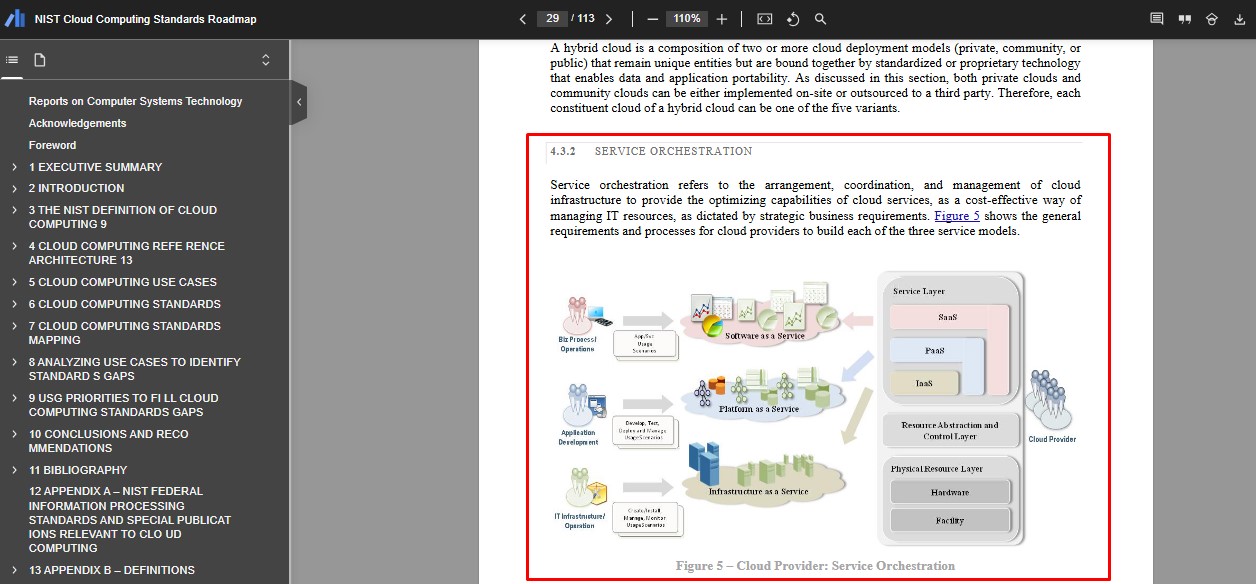
There is nothing unusual about this. NIST’s cloud architecture material recognizes that higher-level cloud services can be built on lower-level services, including SaaS built on PaaS and PaaS built on IaaS.
Cloud Gaming Is Not the Same as Game Server Hosting
A multiplayer game can use remote servers without being a cloud-streamed game.
Traditional game servers may handle:
- Matchmaking
- Player positions
- Shared game state
- Authentication
- Inventory
- Scores
- Multiplayer interactions
The player’s console or PC still renders the graphics locally.
In cloud gaming, the remote infrastructure also runs and renders the game before streaming the visual output to the player. AWS distinguishes game streaming from conventional server hosting by describing it as gameplay rendered remotely and delivered to a thin client.
A multiplayer server may calculate where a character stands. A cloud gaming system may calculate that position, render the scene, encode the resulting frame, and stream it to the user. Related technology, different workload.
Cloud Gaming Is Not the Same as Remote Play
Remote play also streams game video, but the host device usually belongs to the user. The game may run on the player’s own console or gaming PC and stream to a phone, laptop, or another screen.
Cloud gaming runs the game on provider-managed remote infrastructure. The receiving experience may look similar. The control and ownership model is not.
Remote play is therefore not automatically SaaS merely because video and input travel over a network.
Why “Cloud Gaming Is All Three” Is Correct but Weak
Saying cloud gaming is SaaS, PaaS, and IaaS is technically possible. It is also vague enough to hide the useful part of the answer. A service model should be discussed from the perspective of a particular consumer.
The player is not using the service in the same way as the publisher. The publisher is not controlling the same resources as the platform operator.
The clearer answer is:
- Player: SaaS
- Publisher using a managed streaming platform: PaaS-like
- Operator managing GPU virtual machines: IaaS
- Overall architecture: A combination of several layers
Once the customer is named, the classification stops being confusing.
The Service Model Depends on the Customer
The practical answer is simple: Cloud gaming is SaaS. That is what the ordinary player consumes. The user opens a managed service and plays while the provider operates the remote environment. The more complete answer is layered.
Publishers can use PaaS-like streaming products to deploy their own games. Platform builders can use IaaS compute and networking to create the underlying system.
I do not think cloud gaming needs one universal label from every viewpoint. It needs one clear label for each relationship: SaaS for players, PaaS-like for publishers using managed streaming platforms, and IaaS for operators managing the underlying cloud resources.
That answer is less tidy than choosing one category for the entire industry. It is also the one that holds up.
Frequently Asked Questions on Is Cloud Gaming SaaS?
1. Is Cloud Gaming SaaS?
Yes. For players, cloud gaming is usually SaaS because the provider manages the game environment, remote servers, updates, streaming software, and infrastructure.
2. Is Xbox Cloud Gaming SaaS or PaaS?
Xbox Cloud Gaming is SaaS for the player. Users access a finished managed service rather than deploying their own games onto a development or streaming platform.
3. Is GeForce NOW SaaS or IaaS?
GeForce NOW is SaaS for ordinary players. NVIDIA controls the cloud gaming environment and infrastructure even though players can connect supported game-store accounts.
4. Can Cloud Gaming Be PaaS?
Yes. A publisher using a managed service to upload, configure, and stream its own game is consuming something closer to PaaS.
5. When Is Cloud Gaming IaaS?
It is IaaS when the customer provisions virtual machines, installs the operating system and software, configures networking and storage, and builds the streaming stack.
6. Is a Cloud Gaming PC SaaS?
It depends on the control provided. A restricted gaming catalogue is usually SaaS. A general remote PC that permits system administration and arbitrary software installation is closer to IaaS or Desktop as a Service.
7. Is Cloud Gaming the Same as Online Gaming?
No. An online game may use remote multiplayer servers while rendering locally. Cloud gaming renders the game remotely and streams the resulting video and audio to the player.