When generative AI tools took off, finding the right prompt felt like guessing undocumented software commands. Swap a couple of words, and your output changed completely. Almost overnight, tech companies rushed to hire dedicated “prompt engineers”—offering wild salaries to anyone who knew how to nudge a model into giving reliable answers.
A few years later, that gold rush is over. Base models have gotten remarkably good at understanding messy human intent, and automated frameworks now optimize basic prompts behind the scenes.
So, what is prompt engineering today?
It isn’t chasing “magic phrases” or tweaking adjectives. Instead, prompt engineering has evolved into software system architecture. Today, it’s about context engineering: setting hard operational boundaries, structuring API inputs and JSON outputs, managing token memory, and directing autonomous agents.
While basic chat prompting is effortless now, enterprise prompt architecture—forcing probabilistic AI models to run consistently, cheaply, and securely within live production systems—remains essential infrastructure for modern software teams.
What Is Prompt Engineering in Modern AI Systems?
At a basic level, prompt engineering just means shaping inputs so an AI model gives you a reliable, predictable result.
Back in 2022, a lot of this was just trial and error. If you needed a product launch strategy, you’d tell the model to “act as a veteran CMO” to nudge it toward better vocabulary. That persona framing simply forced the model to pull from a specific subset of its training data.
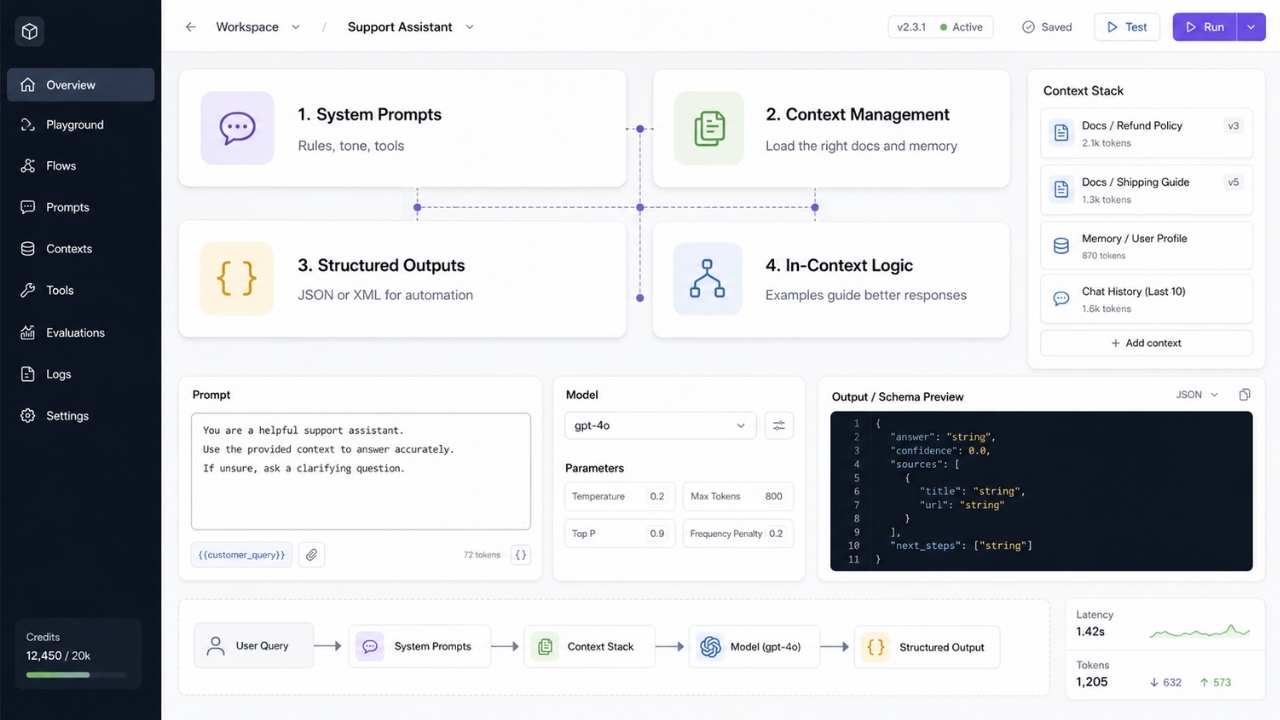
Today, prompting looks less like creative writing and more like writing software specs. It requires a mix of domain knowledge, system design, and strict logic across a few specific layers:
- System Prompts: The hidden master instructions that define a bot’s rules, tone, and allowed tools before a user ever sends a message.
- Context Management: Deciding exactly which documents, database records, or message logs get loaded into the model’s active memory.
- Structured Outputs: Forcing the model to reply in clean JSON or XML so other software systems can read the data automatically.
- In-Context Logic: Showing the model a few ideal examples (few-shot prompting) or forcing it to spell out its logic steps to prevent errors.
Why the “Prompt Engineering Is Dead” Narrative Took Hold
It’s easy to see why people thought the skill was disappearing. As base models got smarter, a lot of the manual sentence-tweaking became unnecessary.
First-generation LLMs broke easily over small things. A single typo or vague word could ruin an entire output or trigger a random refusal. Newer models are much better at figuring out what you actually mean. You can paste a messy, typo-filled meeting transcript into Claude or ChatGPT today, and it will pull out the action items without needing any special setup.
You also used to have to add “think step by step” to get an LLM through a math or logic problem. Newer reasoning models handle that internal logic step automatically now. They break down the problem behind the scenes before giving you an answer, so you don’t have to prompt for logic explicitly.
On top of that, tools like Stanford’s DSPy can now test and refine prompt instructions programmatically using real task data. Rather than a developer spending all afternoon tweaking wording by hand, an optimization algorithm handles the testing and selects the best version.
Where Prompt Engineering Still Matters
Where does that leave teams building actual products with AI?
While basic prompting in a chat box is easy, setting up prompts for production systems is a lot harder than it used to be. Once an LLM output feeds into a live production pipeline, a single bad response can break a feature or corrupt data.
Because LLMs are inherently non-deterministic, sending the exact same prompt twice can give you two different answers. In workflows like automated invoice processing, that kind of unpredictability causes major software bugs. At that level, prompt engineering is mostly about forcing the model to be consistent. Developers use strict JSON schemas and explicit fallbacks—like telling the model to return NULL if a date is missing—so the output doesn’t crash the database.
Cost and speed matter too. Every word you send to an API costs tokens and adds delay. Bloated prompts filled with unnecessary context quickly inflate your cloud bill and slow down response times for users. Modern prompting is heavily focused on context trimming—figuring out the bare minimum text the model needs to answer accurately.
As AI shifts toward autonomous agents that run database queries or trigger webhooks, prompts act as the agent’s core operating rules. You have to write strict rules so the agent doesn’t get stuck in infinite loops, touch sensitive data, or fail to hand off complex tasks to a real human. Building those operational guardrails is what modern prompt engineering actually looks like.
Simple Prompts vs System Context Engineering
To see the difference in practice, look at how casual prompting compares to a production-ready setup for handling support tickets:
- Casual Prompt: Typing “Categorize this email and tell me if the customer is mad” into a chat window. You’ll get a conversational paragraph back, but other software tools can’t parse or process that text automatically.
- System Specification: Passing a hidden prompt that defines exact category codes, provides three real examples of tricky tickets, mandates a clean JSON response, and flags uncertain cases for human review.
It’s less about finding secret words and more about writing clear software specs for a probabilistic system.
Practical Prompt Design: Core Principles for Teams
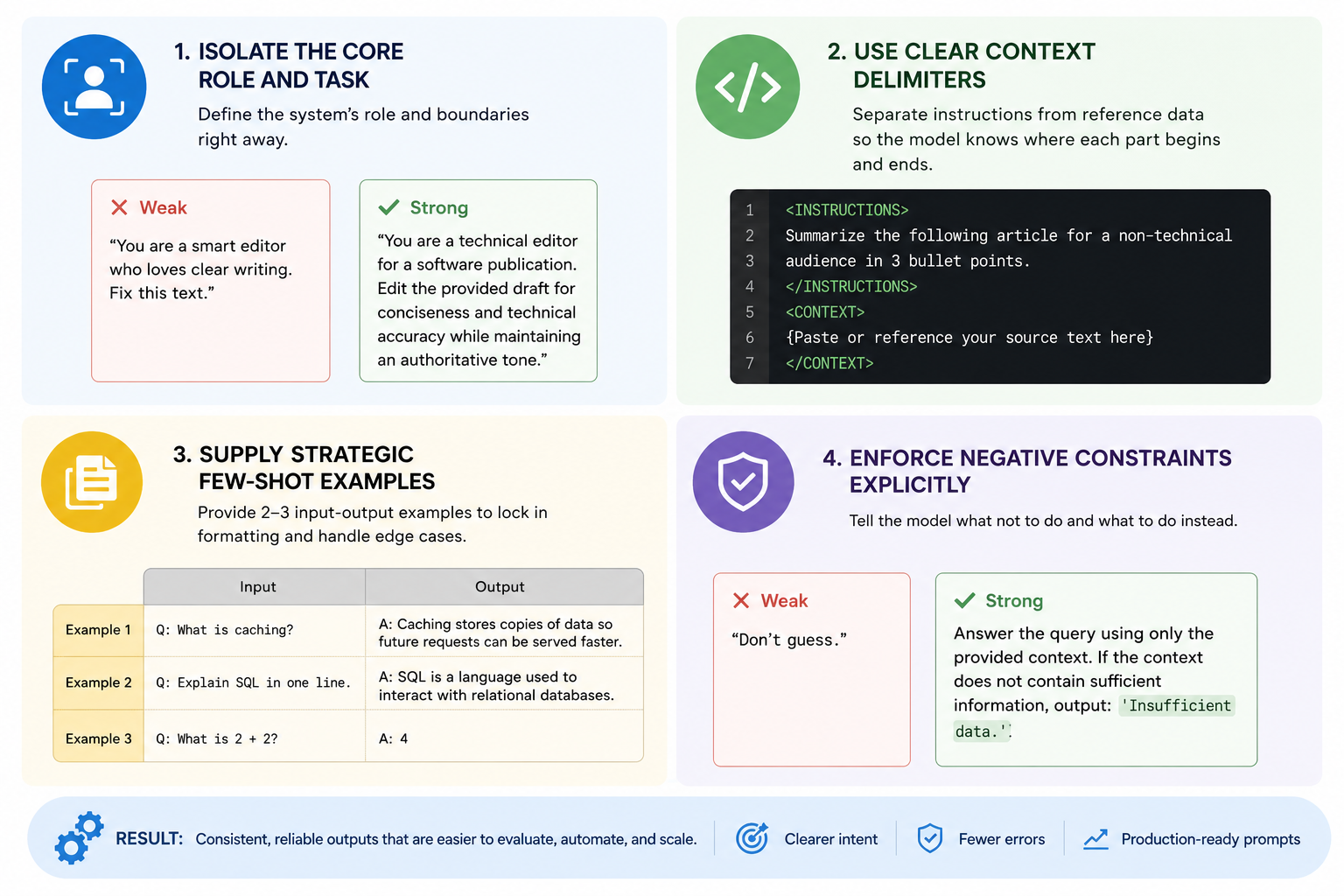
Guessing your way through prompts doesn’t work once you move to production. Here is a basic structural approach that keeps outputs consistent:
Isolate the Core Role and Task: Start by defining the system’s role and boundaries right away.
- Weak: “You are a smart editor who loves clear writing. Fix this text.”
- Strong: “You are a technical editor for a software publication. Edit the provided draft for conciseness and technical accuracy while maintaining an authoritative tone.”
Use Clear Context Delimiters: Models handle instructions much better when you separate your commands from the reference data. Use Markdown headers or XML tags so the model clearly sees where your instructions end and the raw text begins.
Supply Strategic “Few-Shot” Examples: Adding two or three real input-output examples directly in the prompt is still the best way to lock in formatting. Showing the model how to handle tricky edge cases in those examples prevents a ton of downstream errors.
Enforce Negative Constraints Explicitly: By default, language models tend to ramble. If there’s something the model shouldn’t do, tell it explicitly—and give it an alternative action to take instead.
- Weak: “Don’t guess.”
- Strong: “Answer the query using only the provided context. If the context does not contain sufficient information, output: ‘Insufficient data.'”
Practical Friction Points in Everyday Prompt Engineering
Even with smarter models, teams running prompts in production run into predictable headaches:
- Model Drift: A prompt that works perfectly today might break next month if your API provider updates the model’s underlying weights.
- Context Overload: Just because a model accepts massive token limits doesn’t mean it reads them all equally well. Important details placed in the middle of long contexts often get ignored.
- Over-Engineering: If you write rules that are too rigid, the model might get so focused on getting the formatting right that its core reasoning suffers.
- Evaluation Friction: Testing prompt updates is surprisingly difficult. Most engineering teams end up having to build dedicated test suites just to verify that a prompt tweak didn’t cause unexpected regressions.
Final Thoughts
Understanding prompt engineering today means looking past the early hype around magic phrases. As a standalone job title spent typing in chat boxes, prompt engineering was mostly a temporary phase. But as a practical skill, it’s now woven directly into software development, product management, and operations.
It’s no longer about finding secret words—it’s about setting boundaries, structuring context, and defining how automated systems should behave. For anyone building with AI, learning how to structure clear context and system rules is becoming as fundamental as writing good technical specifications. The models will keep getting smarter, but the need to clearly communicate rules and context to software isn’t going away.
Frequently Asked Questions About Prompt Engineering
Is prompt engineering a long-term career or a temporary skill?
Prompt engineering is shifting from a standalone job title to a core competency integrated into existing software, product, and content roles. Rather than hiring dedicated prompt engineers, organizations increasingly expect developers, product managers, and technical specialists to understand context design and system prompt architecture.
Do I need to learn coding to do prompt engineering?
Basic prompt design requires clear logic, structured thinking, and strong written communication. However, advanced prompt engineering—especially for enterprise applications—frequently involves working with REST APIs, JSON data structures, Python scripts, and automated evaluation frameworks.
How does Retrieval-Augmented Generation (RAG) relate to prompt engineering?
RAG is a system architecture where external documents are retrieved from a database and dynamically injected into a prompt before it is sent to an LLM. Prompt engineering dictates how that retrieved information is structured, prioritized, and referenced by the model to generate accurate, grounded responses.