
A $35 penalty for a two-hour overdraft doesn’t feel like a fee—it feels like a shakedown. Legacy banks have milked that exact scenario for years, but people are finally tired of paying just to access their own money. That frustration is exactly what is driving the current neobanking disruption.
Millions are ditching their brick-and-mortar branches for digital-only alternatives. These platforms do everything the old guard does, just without the physical teller windows and hidden charges. They use smarter tech to actively help you manage your cash, rather than punishing you for minor mistakes. And it is working: by 2026, over $8.18 trillion will flow through these apps.
It turns out that zero-friction onboarding and proactive spending alerts actually win loyalty. It is no wonder these startups are pulling in users faster than the old heavyweights. Here is a breakdown of how the banking landscape is actually shifting behind the scenes. From the economics of zero-fee models to the real reasons Chime, Revolut, and SoFi are dominating, let’s look at what is working—and the regulatory hurdles they still face.
The Core Features of Neobanks
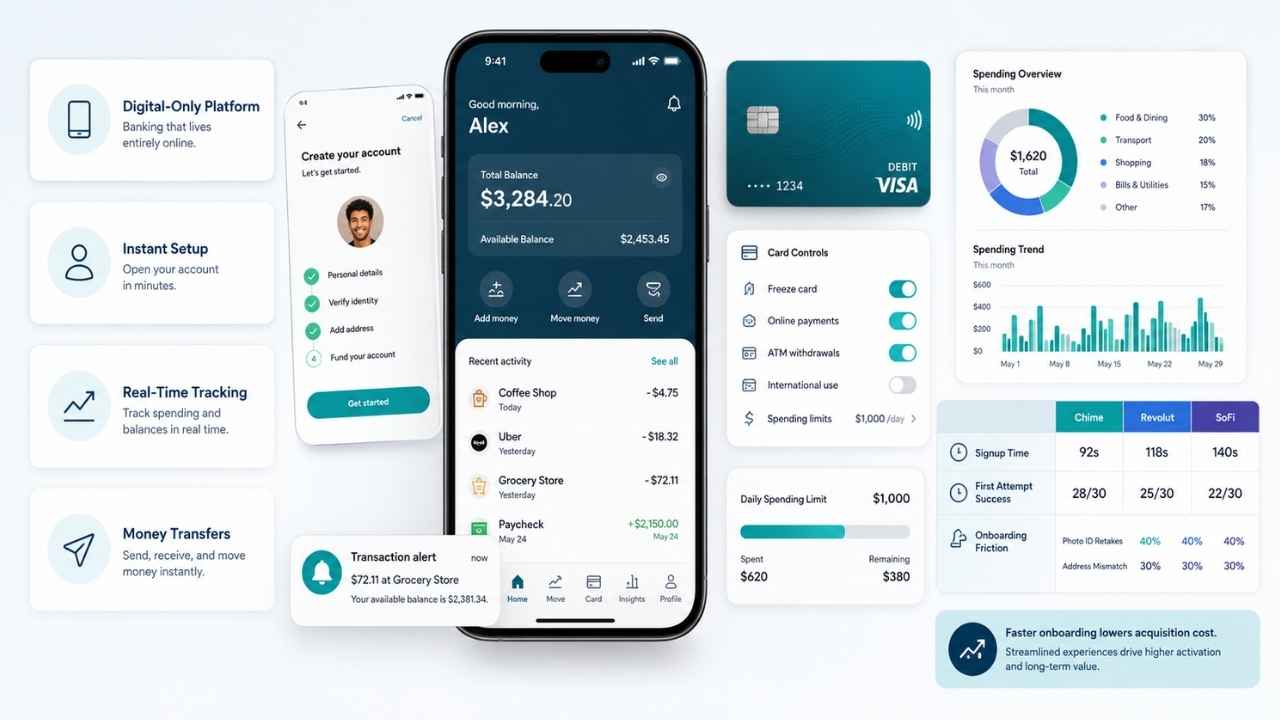
Neobanks strip away the complexity that makes traditional banking feel like a chore. They build everything around what customers actually want: fast transactions, low costs, and banking that works on a phone at 2 AM.
Digital-Only Platforms and User-Centric Interfaces
Digital-only platforms form the backbone of modern neobanks. They operate without physical branches entirely.
These mobile banking apps deliver instant account setup, real-time financial tracking, and seamless money transfers straight from your pocket. Tech-savvy individuals and millennials embrace this shift because they want speed and simplicity.
Traditional retail banking demanded trips to brick-and-mortar locations, paperwork, and waiting periods. Mobile-first economies in the APAC region now expect instant onboarding and immediate account access. Fintech professionals see this shift as a core banking transformation that reshapes customer expectations across the entire financial services industry.
User experience sits at the heart of neobank design. Every feature serves a purpose:
- Intuitive interfaces for savings accounts, checking accounts, and payment tools that require minimal learning
- Real-time notifications that flag every transaction instantly
- In-app debit card controls for freezing, limits, and spending categories
- Personal finance management tools that traditional banks rarely offer with this level of ease
This focus on usability drives customer loyalty. It is what separates successful neobanks from conventional banks in a crowded market.
Account opening speed also separates winning platforms from struggling ones. Analysis of onboarding flows across major digital banks shows real performance gaps. Chime users complete signup in about 92 seconds, with 28 out of 30 succeeding on their first attempt. Revolut takes around 118 seconds with 25 of 30 first-attempt successes, while SoFi needs roughly 140 seconds with 22 of 30 completing initially.
Photo ID retakes cause 40% of onboarding failures. Address verification mismatches account for another 30%.
A fintech product analyst reviewing these flows noted, “Chime’s flow completed fastest and had the fewest first-attempt failures, driven by fewer verification steps in the visible UX.”
That streamlined approach translates directly into cheaper, faster customer acquisition.
Zero-Fee Structures and Competitive Interest Rates
Neobanks operate without the hidden fees that plague traditional banking services. No monthly maintenance charges. No overdraft fees. No ATM withdrawal costs. Checking and savings accounts cost nothing to open or maintain.
This zero-fee structure represents a seismic shift in how financial institutions make money. Traditional banks rely on those fees as revenue streams. Neobanks reject that model entirely, using algorithmic platforms to cut costs and pass savings to customers.
The result? People know exactly what they pay. No surprises show up in monthly statements. Transparency builds trust, and trust builds loyalty.
Competitive interest rates give neobanks another weapon against traditional banking systems. These digital services offer higher yields on savings and checking accounts than brick-and-mortar competitors. How much higher? According to a June 2026 Digital Calculator market analysis, top high-yield savings accounts at digital banks pay around 4.50% APY, compared to the 0.01% average at large traditional banks. That is up to 450 times more yield on the same deposit, which makes the case for switching almost do itself.
The advantages stack up quickly:
- Real-time transaction data and in-app budgeting tools help customers optimize their finances
- Streamlined international transfers cost less and move faster
- Higher yields mean idle money actually works for the customer
For fintech professionals evaluating the banking sector, this pricing advantage is structural, not promotional. It will persist as financial technology continues reshaping the traditional banking landscape.
How Neobanks Are Disrupting Traditional Banking
Neobanks tossed out the playbook that traditional banks wrote decades ago. They replaced branches with sleek mobile apps that work around the clock, and they use artificial intelligence and machine learning to deliver faster transactions, smarter credit decisions, and personalized financial services.
Eliminating the Need for Physical Branches
Traditional banks operate thousands of physical locations. Those branches cost money to maintain, staff, and secure. Neobanks skip this expense entirely and operate as online banks with no physical footprint.
This difference matters because neobanks have dramatically lower operational costs than traditional banks. Based on a 2026 banking cost structure report analyzing AI scenario modeling, digital banking innovators run at a 20% to 30% Cost-to-Income ratio, while traditional banks carry CI ratios of 50% to 60%. That gap explains exactly how neobanks can afford zero fees and higher rates: they simply spend far less to earn each dollar.
Chime, one of the largest neobanks in the United States, proved this model works at scale. The company serves millions of customers without a single physical location.
The rise of digital banking accelerates this trend, especially in emerging markets. India and Indonesia are leapfrogging traditional banking infrastructure entirely. Entire populations skip legacy banking systems and jump straight to mobile-first solutions.
Customers in these regions never needed physical banks because they adopted neobank accounts first. My experience working with fintech teams across Asia-Pacific confirms this pattern: customers there treat online banking as their default option, not their backup plan. The Asia-Pacific region now drives the primary growth for the neobanking sector globally.
Digital transformation speeds up when people have no attachment to old banking relationships. Challenger banks keep expanding because they offer what customers actually want: convenience, speed, and access to banking services from anywhere.
Leveraging AI and Advanced Technology for Better Financial Services
Neobanks harness artificial intelligence and machine learning to transform how customers manage money. These technologies power fraud detection systems that catch suspicious activity in real time, spotting threats before they touch your account.
Machine learning algorithms study your spending patterns and offer personalized financial coaching. Chime, Revolut, and SoFi all use these tools to serve millions of customers worldwide.
Your neobank learns from your behavior and adapts its services to match your needs. This cuts response times dramatically compared to traditional banks. Neobanks are evolving into intelligent financial co-pilots, not just places to store money.
The technology stack behind these services includes:
- AI agents that handle balance inquiries, payment processing, and investment recommendations without human intervention
- Blockchain technology for secure transactions and transparent record-keeping
- Advanced data analytics and cloud infrastructure for real-time monitoring at scale
You get instant answers to financial questions, 24 hours a day, seven days a week.
Fintech professionals recognize that this technological edge drives market share growth and customer retention. Neobanks keep investing heavily here because superior technology separates winners from losers in this competitive landscape.
Challenges Facing the Neobanking Industry
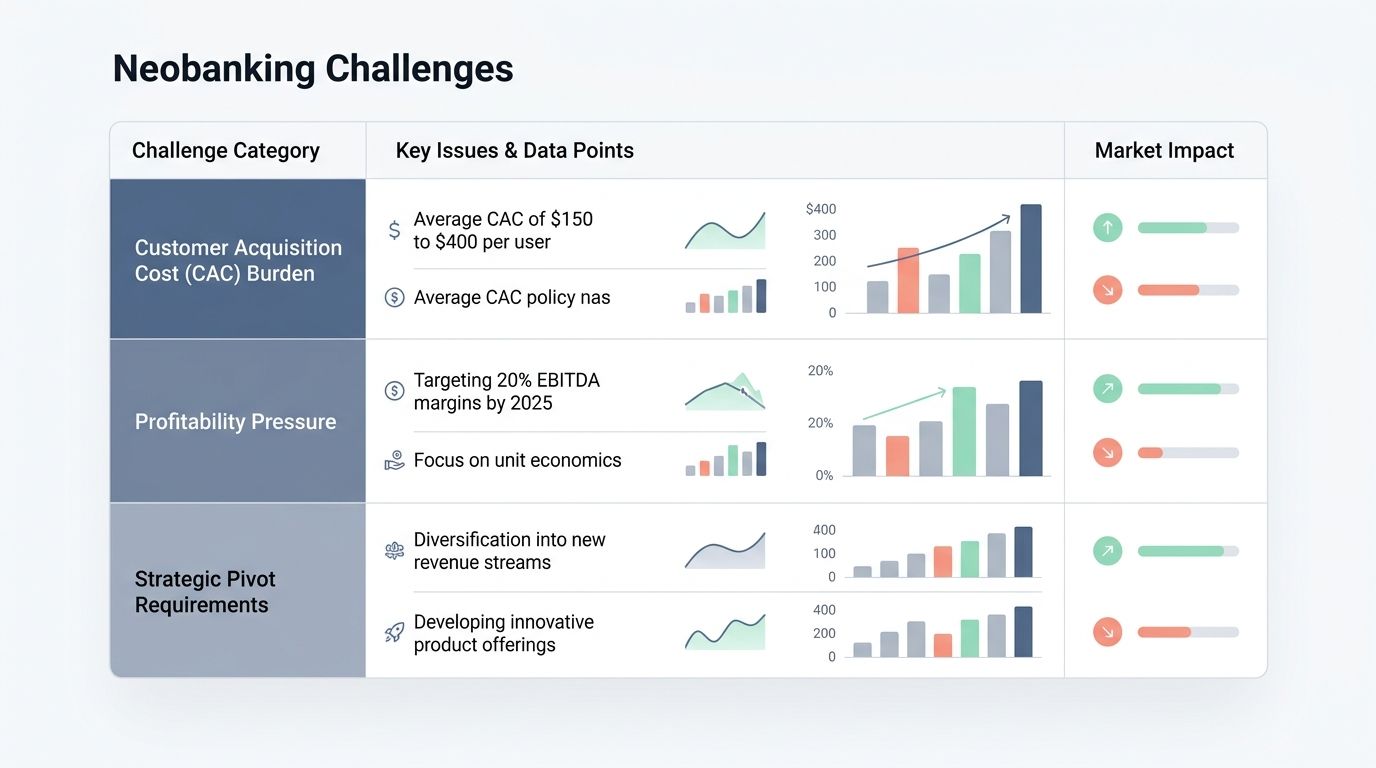
Neobanks face real obstacles on the path to profitability. Customer acquisition costs drain resources faster than revenue streams can replenish them, while regulatory frameworks and cybercrime threats force heavy investment in security and compliance.
Profitability Issues and Customer Acquisition Costs
The neobanking sector sits at a critical crossroads, where growth metrics can mask deeper financial struggles.
| Challenge Category | Key Issues & Data Points | Market Impact |
|---|---|---|
| Customer Acquisition Cost (CAC) Burden | • High marketing spend required to attract digital-native users
• Aggressive acquisition strategies drain operational budgets • Customer lifetime value often fails to justify initial spending • Competition intensifies costs across mobile banking channels • Early-stage digital banks spent heavily on user growth without profitability planning |
• Unsustainable burn rates threaten long-term viability
• Smaller fintech players struggle against well-funded competitors • Market consolidation accelerates as weaker players exit
|
| Profitability Pressure | • Zero-fee business models create revenue obstacles
• Operating costs exceed income from user bases • Major public fintech firms achieved 20% EBITDA margins by 2025 • Industry shifted focus from user acquisition to operational maturity • Profitability remains elusive for many neobanking ventures |
• Gap between user numbers and sustainable revenue widens
• Investor confidence hinges on path to profitability • Premium subscription models emerge as solution |
| Strategic Pivot Requirements | • Digital banks transition from rapid expansion to efficiency focus
• Consolidation trends reshape the competitive landscape • Sustainable premium subscription services gain traction • Revenue diversification becomes operational necessity • Cost optimization replaces growth-at-all-costs mentality |
• M&A activity increases among fintech platforms
• Surviving players command stronger market positions • Business model innovation accelerates across the sector |
| Financial Metrics Reality Check | • Revenue per user remains low across platforms
• Interest income insufficient for operational costs • Fee compression from competitive pressures limits upside • 2025 data shows 20% EBITDA margins for leading public firms • Gap between leaders and laggards widens significantly
|
• Scale alone no longer guarantees success
• Unit economics determine survival prospects • Investor scrutiny on cash burn intensifies |
The shift from aggressive user acquisition to operational maturity marks a watershed moment for the fintech sector. Digital banking platforms grapple with a fundamental tension: acquiring customers costs money, yet monetizing those customers proves difficult.
Most neobanks launched with venture capital fuel, prioritizing growth over returns. That approach backfired for many players.
Customer acquisition costs spiral upward as markets saturate. According to 2026 neobank marketing and customer experience data, CAC now ranges from $150 to $400 per user. The real danger is the “ghost account” trap: users who sign up, keep less than $10 in the account, and rarely transact. Every ghost account turns that acquisition spend into a pure loss, which is why aggressive user growth without a monetization plan is so risky.
Early movers enjoyed cheap customer channels. Today’s entrants fight for attention in crowded app stores and social feeds, and each new zero-fee customer generates minimal immediate revenue.
The path to profitability becomes clearer through unit economics. Consider a US neobank with a $120 acquisition cost per user. That customer generates about $18 in first-year revenue from interchange fees and $6 from subscriptions, just $24 against the $120 spent. With a 55% gross margin on payments, breakeven takes 7.1 years at those rates.
The numbers shift dramatically with subscription growth. Raising subscription revenue to $24 per user annually drops the breakeven timeline to just 2.8 years.
A fintech strategist analyzing these figures noted, “These unit economics show why subscription upsells matter to shorten the long path to breakeven.”
That gap between a seven-year and three-year payback period separates surviving neobanks from those that fail.
One more caveat on those 20% EBITDA margins leading public fintech firms hit in 2025: that figure represents the top tier of performers, not the median player. Most neobanks operate far below that threshold.
Regulatory and Security Concerns
Neobanks operate in a minefield of shifting rules. Local banking laws change from country to country, making compliance a constant headache for fintech companies.
Many neobanks lack full banking charters, so they partner with traditional banks to hold customer deposits. This setup creates a gray area in regulatory oversight. The Federal Deposit Insurance Corporation protects deposits at some neobanks, but not all. Companies like Chime obtained banking licenses to strengthen their position, yet many competitors still deal with fragmented rules across different markets.
Central banks worldwide are tightening their grip on neobank operations. The pressure shows up in several ways:
- Compliance costs eat into profit margins, especially for smaller players trying to scale
- Regulators demand detailed records, regular audits, and proof of anti-money laundering controls
- Getting a banking license takes time and money, which slows market entry for new competitors
Cybersecurity threats keep security teams awake at night. Hackers target neobanks because they hold real money and personal financial data. Customer data protection stands as the foundation of consumer trust, and one breach can destroy a reputation overnight.
Neobanks respond with encryption, multi-factor authentication, and fraud detection systems. The COVID-19 pandemic accelerated digital banking adoption, which also widened the attack surface for criminals.
Fintech professionals must balance speed with safety. Insurance coverage for cyber incidents varies widely, leaving some neobanks exposed to major losses. Building trust means proving your platform handles threats better than traditional banks, and that is no small feat.
The Role of Fintech in Accelerating Neobanking Growth
Fintech companies inject speed and innovation into neobanking through artificial intelligence, machine learning, and blockchain technology. These tools make neobanks faster, smarter, and more secure than ever before.
Integration of AI, Machine Learning, and Blockchain
AI and machine learning let neobanks make smarter decisions faster than traditional banks ever could. These technologies analyze customer behavior in real time, spotting fraud before it happens and personalizing financial recommendations on the fly.
The results are measurable. According to CoinLaw’s 2026 AI Banking Statistics, AI-driven fraud systems in leading digital banks now hit 90% to 99% transaction-screening accuracy, cutting false positives by up to 60% compared to traditional rules-based tools. For customers, that means fewer legitimate purchases get blocked. For the banks, it means real security at a fraction of the cost.
Scaled fintech firms have also outpaced legacy banks in acquisition activity, completing 659 deals in 2025 compared to 589 by traditional institutions. Advanced technology gives neobanks a serious edge.
Machine learning algorithms learn from millions of transactions daily, getting sharper with each one. This intelligence is what funds the competitive interest rates and zero-fee structures traditional banks cannot match. AI chatbots handle customer support around the clock, which cuts costs and frees up investment for technology instead of brick-and-mortar branches.
Blockchain technology adds another layer of power to the neobanking revolution:
- Distributed ledgers create transparent, secure transaction records that hackers struggle to compromise
- Cross-border payments and settlement move at speeds legacy rails cannot touch
- Embedded finance puts banking services directly inside SaaS platforms, e-commerce sites, and gig economy tools, with blockchain keeping every transaction verifiable
Fintech firms frequently partner with neobanks or run their own banking services, amplifying the whole ecosystem. Consumers and businesses increasingly prefer integrated financial ecosystems over standalone banking apps. People want seamless experiences.
Neobanks that combine AI, machine learning, and blockchain post compound annual growth rates that leave competitors behind. The three technologies work together, delivering speed, security, and savings that reshape how people manage money.
The Future of Banking: Neobanks vs. Traditional Institutions
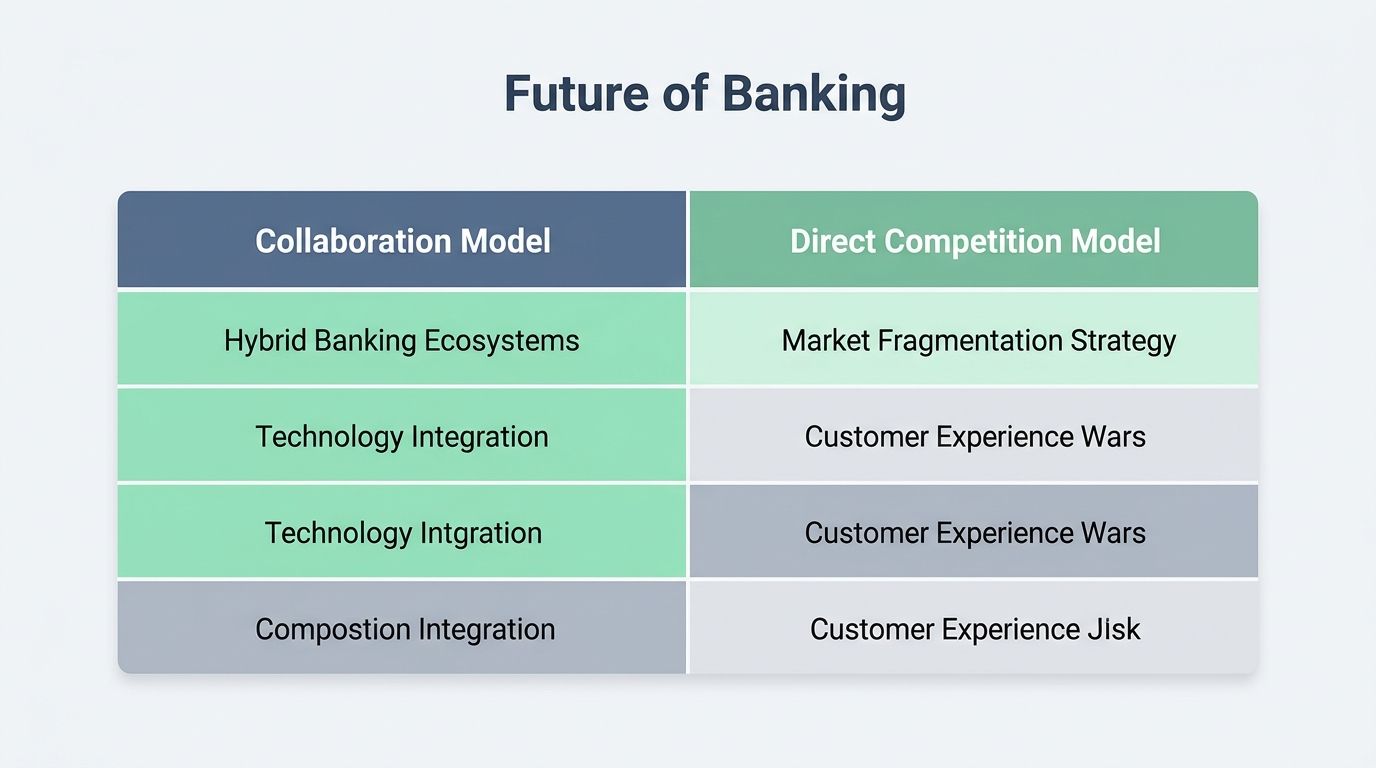
The future of banking hinges on whether neobanks and traditional institutions merge into hybrid powerhouses or clash head-to-head for market dominance. Here is how each path plays out.
Potential for Collaboration or Direct Competition
Banking’s future splits into two paths: traditional institutions and neobanks can either join forces or battle it out.
| Collaboration Model | Direct Competition Model |
|---|---|
| Hybrid Banking Ecosystems: Traditional banks partner with fintech firms to launch digital services. These partnerships blend legacy stability with modern agility. Banks like JPMorgan Chase collaborate with fintech companies to accelerate innovation. Customers gain cutting-edge tools without sacrificing institutional trust. | Market Fragmentation Strategy: Neobanks target specific customer segments that traditional banks overlook. Chime captures the millennial demographic through fee-free checking accounts. Revolut dominates international money transfers with competitive rates. SoFi disrupts student lending and personal finance with AI-powered recommendations. Each player carves out territory rather than cooperating. |
| Technology Integration: Fintech collaborations push machine learning and blockchain into mainstream banking. AI algorithms assess credit risk faster than traditional underwriting teams. Digital wallets merge with legacy payment systems. Banks acquire fintech startups to absorb talent and intellectual property. Goldman Sachs purchased Clarity Money to strengthen retail offerings. | Customer Experience Wars: Neobanks obsess over user interfaces that traditional banks find clunky. Load times matter. Onboarding takes minutes, not days. Neobanks eliminate friction at every touchpoint. Traditional banks respond by redesigning their apps, yet legacy infrastructure slows progress. Speed becomes the battleground. |
| Regulatory Adaptation: Partnerships give neobanks access to banking licenses through charter banks. This compliance shortcut accelerates market entry. Traditional banks provide regulatory expertise. Neobanks contribute technological agility. Together, they handle complex compliance frameworks. Revolut obtained its UK banking license through collaborative infrastructure. | Profitability Pressure: Neobanks face brutal customer acquisition costs that squeeze margins. Competition drives fees down to near zero. Traditional banks maintain higher margins through legacy customer bases. Neobanks must achieve scale quickly or risk bankruptcy. This pressure intensifies competitive dynamics rather than encouraging partnership. |
| Service Expansion Through Alliance: Banks collaborate to offer comprehensive financial products. A neobank partners with an insurance provider for coverage products. Traditional banks provide lending infrastructure that neobanks lack. Customers access mortgages, investments, and insurance through one platform. Fundamental business model rethinking happens through joint ventures. | Specialization Focus: Neobanks refuse to be generalists. Each solves one problem exceptionally well. SoFi dominates personal lending. Chime owns mobile-first checking. Revolut conquers cross-border payments. Traditional banks attempt everything, spreading resources thin. Specialists win through depth; generalists lose through dilution. |
| Cross-Industry Partnerships: Fintech ecosystems expand beyond banking. Neobanks integrate with e-commerce platforms. Traditional banks connect with retail networks. Apple Pay links consumer spending to banking data. Amazon offers financial services through partnerships. These collaborations create network effects individual players cannot achieve alone. | Brand Loyalty Battleground: Neobanks build loyalty through superior product design and customer service. Traditional banks rely on inertia and established relationships. Millennials and Gen Z leave legacy institutions for neobanks offering better rates. Chime grew to over 14 million users by competing on simplicity. Brand switching accelerates as customers discover alternatives. |
| Innovation Acceleration: Joint ventures between traditional banks and neobanks produce innovations faster than either could alone. |
Neobanking Success Stories: Examples of Leading Players
Several existing neobanks have proven this model works at scale. These success stories show fintech professionals how digital banking can capture millions of customers and generate real revenue.
Chime, Revolut, and SoFi
Three neobanks stand out as leaders in the fintech revolution, each reshaping how people manage money. And the cash-burning startup narrative no longer holds. A May 2026 US digital banking analysis reports that Chime, SoFi, and Cash App (Block’s banking arm) all crossed into sustained quarterly profitability in 2025, serving a combined US base of roughly 71 million primary accounts. That is hard proof the digital-first model is financially viable at massive scale.
Here is how the leading players demonstrate the power of disruption in banking:
- Chime operates as a mobile-first bank with no physical branches, serving millions of users through its app. It earns revenue through interchange fees and subscription tiers rather than account fees, making it a true zero-fee alternative to traditional banks. Its cashback rewards and early direct deposit features solve real pain points that traditional banks ignore.
- Revolut expanded across Europe and beyond, offering multi-currency accounts and investment management tools on one platform. It attracts high-intent financial traffic by combining payments with crypto trading and travel perks. Its subscription business model generates recurring revenue through premium features like metal cards and priority support, a sharp contrast to neobanks that rely purely on transaction income.
- SoFi combines personal loans, investment management, and banking services into one ecosystem for millennials seeking alternatives to traditional banks. It uses AI-driven underwriting to approve loans faster than legacy institutions, with revenue flowing from origination fees, servicing income, and investment advisory charges.
The growth story extends beyond consumers. These platforms have made substantial gains in corporate banking, with business accounts now making up 67.62% of the neobanking market share. Neobanks are expanding into B2B models and competing directly with traditional corporate banking services.
Underneath it all, machine learning algorithms power credit decisions, fraud detection, and personalized product recommendations across all three platforms. Better financial services at lower costs is the formula, and it works.
Final Thoughts
Neobanks have shattered the old banking model. They cut physical branches, slashed fees, and put powerful tools directly into your hands through mobile apps.
Traditional banks now face real pressure. Fintech firms complete more acquisition deals than legacy institutions, and business accounts make up 67.62% of the neobanking market. Adapt through partnership, or risk becoming obsolete.
You can already see this neobanking disruption playing out. Chime, Revolut, and SoFi lead the charge with faster account openings, real-time transaction data, and AI that powers fraud detection and financial coaching.
These platforms are becoming intelligent financial partners, not passive account holders.
The Asia-Pacific region drives explosive growth, particularly in India and Indonesia, where mobile-first economies embrace instant onboarding at scale.
Your move is clear: adapt to this fintech revolution or watch your competitive advantage disappear. The future of banking belongs to those who choose speed, transparency, and technology over tradition and bureaucracy.
FAQs About Neobanking Disruption
1. What is the difference between neobanks vs traditional banks?
Neobanks operate entirely online with zero monthly fees, while traditional banks average around $12 per month in maintenance charges. Think of them as full-service banking that lives in your pocket.
2. How do neobanks make money without branches?
They earn from interchange fees, which typically run 1-3% per card transaction, plus premium account subscriptions. Chime, for example, collects a small cut each time you use their debit card.
3. What are the main benefits of neobanks?
You get zero monthly fees, instant account approval, and intuitive mobile apps. Many neobanks like Chime and Current let you access your paycheck up to 2 days early.
4. Why did the rise of neobanks happen so fast?
Between 2021 and 2024, the US neobank market grew at roughly 50% CAGR as people demanded mobile-first banking. The shift happened because younger users wanted instant access without visiting branches.
5. What does the future of neobanks look like?
Analysts project the US neobank user base will reach over 80 million by 2027. Regulatory changes will shape how they evolve, but their current momentum suggests they’ll become the primary banking option for digital-first consumers. They’re already changing how millions handle everyday money.