
Trying to lock down AI data residency without slowing your business can feel like a moving target. One cloud setting says data stays in the United States, then a logging service, identity layer, or failover process quietly sends a copy somewhere else. If your team handles EU personal data, GDPR still follows that data, even when your office, vendors, and model endpoints are in the U.S.
I pulled together the architecture choices, contract terms, compliance checks, and security controls that matter most, so you can make cleaner decisions faster. Read on, and I’ll walk you through it step by step.
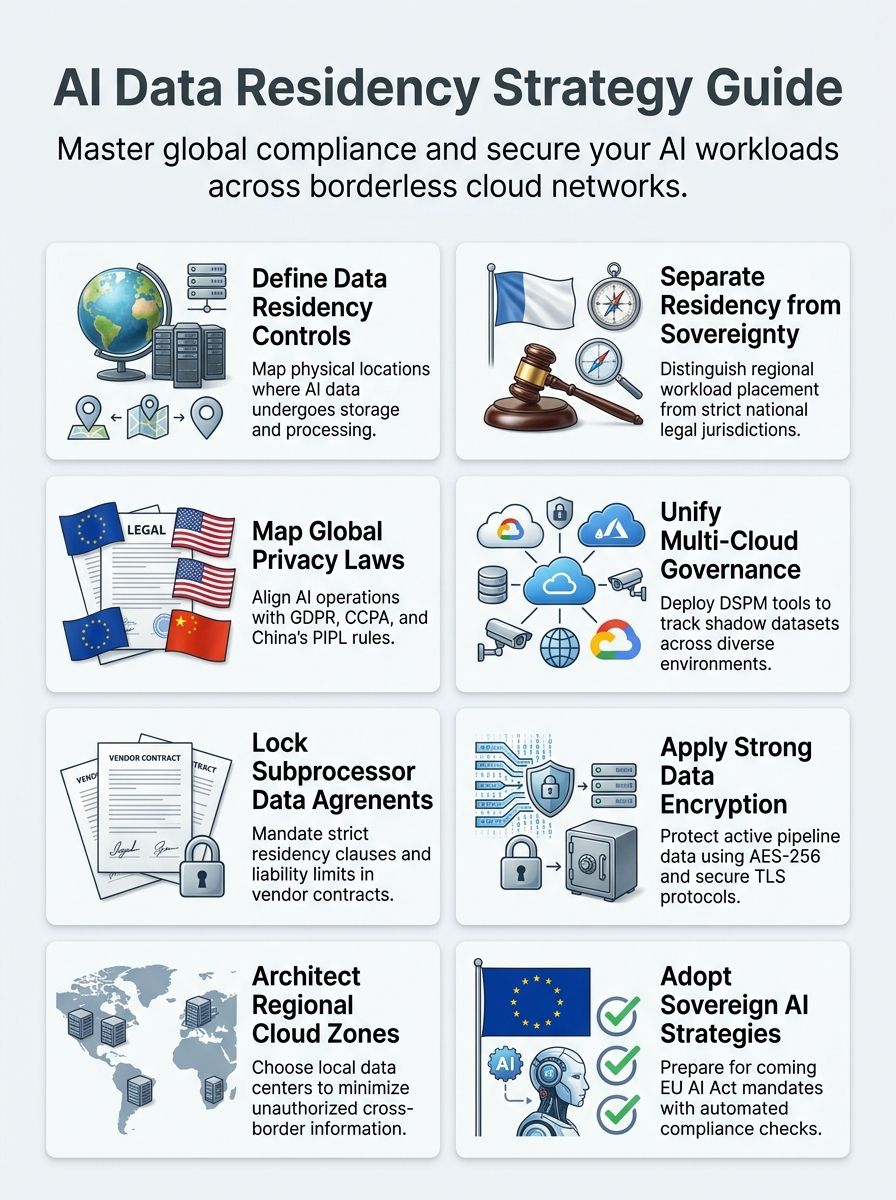
What is AI Data Residency?
I use AI data residency to mean the set of rules and technical controls that decide where AI data is stored, processed, backed up, and exposed to support teams or subprocessors. It sits next to data sovereignty, data localization, data protection, and data governance, but it is more operational than any of them on their own.
For U.S. teams, that means asking a simple question in a much deeper way: where does the data actually live at every step of the workflow, including prompts, embeddings, logs, identity records, and backups?
Definition and significance of data residency
Data residency means the physical place where AI data is stored and processed. In practice, I treat it as a control set for your whole AI infrastructure, not a storage checkbox.
Microsoft makes this point clear in its Azure residency guidance: most Azure services let customers choose a region, but some services have different location rules. That is why I never accept a vendor’s headline promise without checking each service that touches the workflow. Keep data where the law, the contract, and the architecture all agree it should stay.
Residency matters most when the data includes personal data, regulated records, or confidential business content used for training, validation, inference, or testing. A clean residency plan lowers legal exposure, tightens data security, and makes audits much easier.
- Prompt and response data: Check where live inference happens, not just where the account is billed.
- Training and fine-tuning files: Review whether uploads stay in one region or move for processing.
- Logs and telemetry: These often cause the first surprise in an audit.
- Backups and replicas: A compliant primary region can still fail if disaster recovery restores somewhere else.
How it differs from data sovereignty and localization
I map these terms separately because they drive different decisions in architecture, contracts, and compliance reviews.
| Concept | Core Focus | How It Differs from AI Data Residency |
| AI data residency | Where AI training, inference, storage, and support copies occur. | Centers on the actual geographic placement of AI workloads and the controls that keep data in approved regions. |
| Data localization | A legal requirement to keep certain data inside a country or region. | Localization is the rule. AI data residency is the system design that helps you obey the rule. |
| Data sovereignty | Which jurisdiction has legal authority over the data. | A dataset can be resident in one country but still raise sovereignty questions because of vendor ownership, remote admin access, or foreign legal reach. |
| Cross-border transfers | How data moves from one jurisdiction to another. | Transfers focus on movement. Residency focuses on where data rests and where processing is allowed to happen. |
| Cloud provisioning | How resources are deployed, scaled, and failed over. | Provisioning can shift workloads across regions unless you deliberately block that behavior. |
| Practical controls | Policies, contracts, and technical enforcement. | Residency depends on regional deployments, location policies, subprocessor limits, and logging that proves the controls are working. |
This distinction matters because a project can satisfy one idea and still fail another. I have seen teams choose a local data center, then miss a support log, a global identity service, or a contract clause that weakens the protection they thought they had.
Challenges in Ensuring AI Data Residency
The hard part is not understanding the rule. The hard part is spotting every place your AI data can travel once cloud services, subprocessors, replicas, and cross-border data transfers get involved.
Cross-border data transfers
I map data flows, not wishful diagrams. GDPR does not force all personal data to stay inside the EU, but it does restrict how that data can leave the EU. For a U.S. company, that usually means checking for an adequacy decision, Standard Contractual Clauses, Binding Corporate Rules, or an active certification under the EU-U.S. Data Privacy Framework.
The European Data Protection Board makes one point that is easy to miss: if a U.S. processor says it is covered by the EU-U.S. Data Privacy Framework, the exporter still has to verify that the certification is active and still needs a data processing agreement. That is why I treat transfer paperwork and residency controls as a matched pair, not separate workstreams.
Cloud setup matters just as much as legal paperwork. In Microsoft Foundry, a global deployment can process prompts and responses in any Azure region where the model is deployed, a data zone deployment keeps processing within the U.S. or EU zone, and a regional deployment keeps processing in the region tied to the deployment.
- Use regional inference when your contract promises one specific processing region.
- Use data zones only if your legal team is comfortable with zone-wide processing inside the U.S. or EU.
- Avoid global deployments for regulated AI workloads unless your review has explicitly approved worldwide processing behavior.
- Document the transfer path for prompts, responses, logs, training files, and support tickets.
Complex regulatory landscapes
U.S. businesses deal with a patchwork, not one master law. There is still no single federal data residency law for all commercial AI use, so teams often have to line up state privacy rules, sector rules, customer contracts, and foreign laws that apply because of the users they serve.
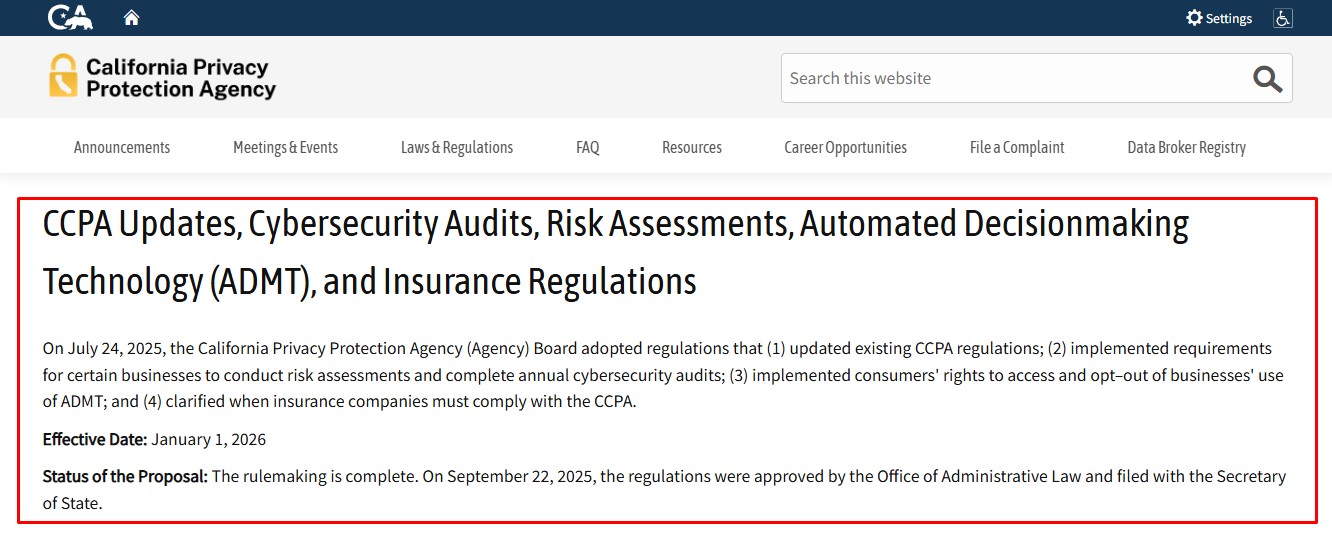
According to July 2026, the California Privacy Protection Agency lists its updated CCPA regulations, annual cybersecurity audit requirements for certain businesses, risk assessments, and automated decisionmaking rules as effective on January 1, 2026. That makes California more than a privacy-policy issue for AI teams. It affects design, documentation, and vendor oversight.
There is a second U.S. pressure point that many AI articles skip. The U.S. Department of Justice says its Data Security Program took effect on April 8, 2025 and restricts certain transactions that could give countries of concern access to bulk sensitive U.S. personal data or government-related data.
EU rules add another timeline. The AI Act entered into force on August 1, 2024, some provisions started applying on February 2, 2025, rules for general-purpose AI models started on August 2, 2025, and more obligations for high-risk systems apply from August 2, 2026.
- For U.S. customer data: review state privacy duties and any sector-specific limits.
- For EU personal data: check GDPR transfer rules and the AI Act timeline together.
- For sensitive U.S. data: include DOJ cross-border restrictions in your vendor review.
Data governance in multi-cloud environments
Multi-cloud AI looks flexible on paper, but it creates more places for data to drift. Good data governance starts with a full inventory of where data is collected, stored, processed, and copied, including the services your engineers do not think of as storage.
Microsoft’s own Azure residency guidance is a good reminder. Microsoft Entra ID is a non-regional service and may store directory data globally, Azure Machine Learning may store certain customer-provided asset names and experiment metadata in the United States for debugging, and Azure Databricks stores some identity data in the United States to support its global platform.
That means your audit cannot stop at storage buckets or model endpoints. In my reviews, the first surprises usually show up in identity, metadata, monitoring, and backup settings.
DSPM, short for data security posture management, helps here because it discovers, classifies, and monitors sensitive data across cloud environments and SaaS apps. Tools in this category are useful for finding shadow data, stale replicas, and workloads that break residency controls after a perfectly clean initial deployment.
- Map supporting services: identity, logging, monitoring, analytics, ticketing, and backup tools.
- Tag data by residency class: U.S.-only, EU-only, contract-restricted, or globally permitted.
- Scan for shadow data: copied datasets, old snapshots, cached prompts, and developer exports.
- Review subprocessor locations: especially for logging, support, and observability vendors.
If you want a practical benchmark, start with the question, “Can I prove where every copy of this dataset lives today?” If the answer is no, your governance program is still too loose for regulated AI.
AI Data Residency and Compliance
Compliance gets much easier once your technical design, vendor contracts, and data flow map say the same thing. This is where I translate legal obligations into checks a business can actually run.
Key regulations like GDPR and local data residency laws
I keep the main compliance picture simple for U.S. teams: know which law applies, what it restricts, and what evidence you need to show that your AI systems respect it.
| Regulation | Jurisdiction | Key Points | AI Impact |
| GDPR | European Union | Personal data needs a lawful basis for processing.
Transfers outside the EEA need a valid Chapter V mechanism. Controllers still need Article 28 processor contracts and security controls. |
Affects training data, prompts, logs, profiling, and model outputs tied to people.
Pushes teams to minimize data and document flows before launch. |
| CCPA and CPRA regulations | California, United States | Gives California residents rights over personal information.
Imposes separate duties on businesses, service providers, contractors, and third parties. Updated regulations took effect January 1, 2026. |
Forces cleaner vendor contracts, better retention rules, and AI-related risk documentation for covered businesses. |
| EU-U.S. Data Privacy Framework | EU to U.S. transfers | Adopted on July 10, 2023 for participating U.S. companies.
Certification must be active and cover the relevant data type. It does not replace the need for a processor agreement. |
Helps U.S. vendors receive EU personal data more cleanly, but does not solve residency promises by itself. |
| PIPEDA | Canada | Uses an accountability model rather than a blanket storage mandate.
Organizations stay responsible for data sent to third-party processors. Contracts must provide comparable protection. |
Supports cloud use, but only if processor oversight is real and documented. |
| EU AI Act | European Union | Entered into force on August 1, 2024.
Some provisions began on February 2, 2025, GPAI rules on August 2, 2025, and more high-risk obligations on August 2, 2026. Adds documentation, transparency, and risk-management duties. |
Makes AI compliance broader than privacy alone, especially for high-risk use cases and general-purpose AI providers. |
| DOJ Data Security Program | United States | Effective April 8, 2025.
Restricts certain transactions that could expose bulk sensitive U.S. personal data or government-related data to countries of concern. Works like a national security layer over data transfer planning. |
Raises the bar for vendor due diligence, support access controls, and offshore processing reviews. |
Role of contracts in ensuring compliance
Contracts turn your residency design into an enforceable rule. If the architecture says data must stay in a U.S. region, the contract should say the same thing in plain language.
For EU data, I still see Standard Contractual Clauses show up in real projects, and the modernized SCCs adopted on June 4, 2021 remain a core transfer tool. For internal group transfers, Binding Corporate Rules can do the same job when the company is large enough to support them.
The EDPB’s business guidance is especially useful here because it spells out what a U.S. processor still owes you even under the EU-U.S. Data Privacy Framework: processing only on instructions, confidentiality, security measures, subprocessor flow-down terms, and deletion or return of data at the end of the service.
If a residency promise is missing from the contract, I assume it will be hard to enforce later.
For U.S. businesses, California contract terms matter too. Service providers and contractors need obligations that keep the privacy protection level intact, and your AI vendor paperwork should mirror that structure instead of relying on a short order form and a sales promise.
Importance of subprocessors and data transfer agreements
Subprocessors are where clean compliance plans often get messy. I keep this review practical and clause-driven.
- Require a named subprocessor list: include hosting, logging, support, analytics, and model vendors.
- Set location limits in writing: define approved regions for storage, processing, backups, and support access.
- Flow obligations downstream: every subprocessor should be bound to the same security, privacy, and residency duties as the primary vendor.
- Control subprocessor changes: require notice before new subprocessors are added to a regulated workflow.
- Add deletion and return terms: make exit rights clear for customer data, fine-tuning files, and logs.
- Reserve audit rights: you do not always need an onsite audit, but you do need evidence, reports, and a path to verify claims.
For AI platforms, I add one more check: make sure the contract distinguishes between customer data, model training data, abuse-monitoring data, and product telemetry. Those categories often follow different residency and retention rules, and that is where vague vendor language causes trouble.

Security Implications of AI Data Residency
Security is what keeps residency controls real after launch. Without strong technical enforcement, even a very good contract turns into paperwork.
Encryption and data protection measures
I treat encryption, key control, and region-aware backups as one package. Splitting them into separate projects creates gaps that show up the first time a system fails over or a vendor engineer needs emergency access.
- Encrypt data at rest and in transit: use current enterprise-grade standards for storage, databases, APIs, and message queues.
- Separate keys by region: do not let one global key policy quietly flatten your residency boundaries.
- Apply least privilege: only the identities that need the data should reach it.
- Log every sensitive action: access, export, restore, replication change, and policy override.
- Test backup restores: a backup that restores into the wrong geography is a residency failure.
- Scan for policy drift: new cloud services and copied datasets can break compliance after a safe initial rollout.
The NIST AI Risk Management Framework and zero trust guidance point in the same direction here: treat privacy, security, and system design as connected risks. I have found that teams move faster once they stop treating residency as a legal exception and start treating it as part of baseline data protection.
Encryption protects data from one angle. Access control decides who can still misuse it from the inside.
IBM positions Guardium DSPM as a way to discover, classify, and monitor sensitive data across cloud environments and SaaS applications. I like tools in this category because they make hidden copies, exposed data stores, and weak permissions visible before an audit or incident forces the issue.
For Microsoft-heavy environments, Azure Policy is another useful control. Microsoft’s built-in Allowed Locations policy can deny new resource deployments outside approved regions, which is much better than spotting the mistake after the workload is already running.
- Use role-based access control: separate model operations, security administration, and data access.
- Require break-glass approval: emergency access should be rare, logged, and time-limited.
- Limit admin geography: decide which teams may support a regulated environment and from where.
- Monitor data egress: alerts should trigger on unusual exports, copies, or cross-region movement.
Addressing risks in AI pipelines and workloads
AI pipelines create extra residency risk because they generate more copies than people expect. Prompts get logged, embeddings land in vector stores, fine-tuning files get staged, and monitoring tools keep their own records.
This is where shadow data becomes a real problem. IBM describes shadow data as data that has been backed up, copied, or replicated into places that are not governed like the original source, and that is exactly the pattern that breaks data residency controls in modern AI systems.
A pattern I keep seeing in enterprise reviews is simple: teams trust the main model contract, then miss the retrieval layer, prompt cache, observability tool, or developer export. The fix is not exotic. You need data flow mapping, DLP or redaction before external calls, immutable audit trails, and frequent checks on replication paths.
- Classify every pipeline stage: ingestion, preprocessing, retrieval, inference, storage, and analytics.
- Reduce sensitive inputs: tokenize or mask personal data before it reaches the model when possible.
- Log lineage: know which source data trained, grounded, or enriched each workflow.
- Test region boundaries: run drills for failover, restore, and support access, not just production uptime.
Building an AI Data Residency Strategy
I build data residency into the design from day one because retrofitting it after procurement is slower and more expensive. A clear strategy gives architecture, legal, security, and operations one shared map.
Designing compliant AI architectures
I design AI architectures around data classes, region limits, and proof. That keeps the system easier to operate and much easier to defend in front of customers, auditors, and internal risk teams.
- Map every data flow, including prompts, outputs, training files, logs, metadata, and backups.
- Classify datasets by legal need, such as U.S.-only, EU personal data, customer-confidential, or globally permitted.
- Choose the right processing pattern up front, such as regional, data zone, or global, based on the workload’s compliance profile.
- Use cloud governance controls, such as allowed locations and region-scoped resource policies, to block bad deployments before they happen.
- Review non-obvious services, especially identity, monitoring, analytics, and support tooling, because these services often have separate location rules.
- Write residency terms into DPAs, master service agreements, subprocessor schedules, and exit clauses.
- Apply encryption, role-based access control, and tamper-resistant logging across the full pipeline.
- Test failover, restore, and vendor support scenarios so the architecture holds up under stress, not just in a diagram.
If a design cannot answer where data lives during normal operations, incident response, and disaster recovery, I do not call it residency-ready.
Selecting regional data centers and storage solutions
I choose regional data centers with both a legal checklist and a technical checklist. A provider can have a U.S. region on paper and still route support data, identity records, or telemetry in ways that change the real risk.
| Option | Best Fit | What I Like | What I Check Closely |
| Single-region cloud deployment | Many U.S. business workloads | Fast to deploy, lower latency, and simpler operations inside one approved region. | Backup destinations, support access, global identity services, and hidden metadata storage. |
| Data zone deployment | Teams that can allow U.S.-wide or EU-wide processing | More flexibility and scale than one strict region. | Whether zone-wide processing still fits your contract and customer promises. |
| In-country overlay, such as InCountry | Global apps that need local storage without rebuilding the full stack | InCountry uses secure digital twins, cloaked global fields, and a data firewall to help keep regulated records inside a country. | Latency, integration depth, and exactly which fields remain local versus global. |
| Dedicated sovereign or isolated environment | Highly regulated public sector, defense, or critical infrastructure use | Tighter control over admin access, infrastructure choices, and compliance boundaries. | Cost, feature availability, and whether the business can support the operational overhead. |
The practical rule is simple: pick the lightest architecture that still satisfies your legal and customer requirements. Overbuilding wastes money, but underbuilding creates a cleanup project you will feel in every contract renewal.
Ensuring data residency controls in AI platforms
I map controls to the exact places where data can move inside AI platforms, then I turn those controls into alerts, policies, and audit evidence.
- Choose deployment types intentionally, regional for strict residency, data zone for zone-level commitments, and global only for low-risk use cases.
- Apply allowed-location and policy controls so engineers cannot create resources outside approved regions.
- Track customer data, training files, embeddings, logs, and model outputs as separate data classes.
- Keep an immutable audit trail for access, export, replication changes, and administrative overrides.
- Review vendor settings for training use, abuse monitoring, telemetry, and retention before production launch.
- Require subprocessor schedules and processor agreements that match the platform’s technical behavior.
- Run recurring scans for drift so new services, copied datasets, and forgotten sandboxes do not break compliance months later.
The best residency control is the one that stops the wrong deployment before it starts. The second-best control is the one that tells you immediately when someone bypasses the rule.
Future Trends in AI Data Residency
Residency rules are getting tighter, and the market is responding with more region-aware AI services, more policy enforcement, and more pressure to prove where data goes in real time. I expect that trend to keep growing.
Rise of sovereign AI strategies
Sovereign AI is becoming a practical buying requirement, not just a policy phrase. Buyers want to know where inference happens, who can administer the platform, what data is used for model improvement, and which laws can still reach the system.
The EU AI Act is part of that shift because it adds a timed rollout that forces organizations to plan ahead instead of waiting for a last-minute compliance scramble. For U.S. companies serving European customers, the important takeaway is simple: data residency, model governance, and documentation are moving closer together.
NIST added to that momentum on April 7, 2026, when it released a concept note for an AI RMF profile for trustworthy AI in critical infrastructure. I read that as another sign that AI governance in the U.S. is moving toward more formal, sector-aware controls.
The next wave of AI buying questions will be about proof, not promises.
Advancements in residency enforcement technologies
The tooling is getting better fast. I now see stronger combinations of DSPM, DLP, policy-as-code, region-aware routing, and auditable logging baked directly into AI platforms and cloud stacks.
IBM Guardium DSPM is useful for finding sensitive data and shadow copies across cloud and SaaS environments. InCountry adds another layer with local storage patterns and a country-level data firewall. Azure Policy helps block out-of-region resource creation before it turns into a compliance issue.
| Technology | What It Helps Enforce | Why It Matters for AI Data Residency |
| DSPM | Discovery, classification, and continuous monitoring | Finds sensitive AI data, shadow copies, and misaligned storage quickly. |
| Policy-as-code | Approved regions and deployment rules | Stops accidental drift before a noncompliant resource is created. |
| Tokenization and masking | Reduced exposure of personal data | Lowers the amount of regulated data moving through prompts and pipelines. |
| Immutable audit logging | Proof of access, movement, and change | Gives compliance teams real evidence instead of screenshots and assumptions. |
I like this direction because it turns data residency from a policy document into something you can test, monitor, and prove.
Final Thoughts
Data residency works when architecture, contracts, compliance, and security all say the same thing.
I use region-aware design, tight subprocessor terms, and active monitoring because that is what keeps AI data useful without letting it drift into the wrong place. If you treat residency controls as a day-one design choice instead of a legal cleanup project, you cut risk, move faster, and protect the personal data your users trust you with.
Frequently Asked Questions on AI data residency
1. What is AI data residency?
AI data residency means rules about where AI keeps and uses data. It guides storage, processing, contracts, and helps when navigating data across borders.
2. Why does data residency matter?
It protects people, and it helps you meet laws and contract terms. Think of it like a home address for data, wrong address means lost mail, and that can be costly.
3. How do I handle architecture, contracts, compliance, and security for data residency?
Map data flows, from collection to deletion, and pick storage in allowed places. Add strong access controls, logging, and clear vendor contracts, test often. Keep a simple plan for navigating data when rules change.
4. Who owns AI data residency inside a company?
Legal, IT, security, and the business share the work, vendors and contracts join in.