Most AI brainstorming sessions end the same way: a list of ten obvious ideas you already thought of. The problem is not the language model itself. The problem is a lack of structural constraints.
When you ask an AI to “give me some ideas,” it defaults to the statistical average. It wants to provide the most likely, safest answer. To get past the obvious, you have to force the model into a specific way of thinking. Using structured prompts for brainstorming prevents the AI from defaulting to cliché answers and turns it into a serious tool for general problem-solving.
The Detail Readers Usually Miss Before Prompting
If you leave variables empty or vague, the AI will fill them with stereotypes. If you ask for a cross-industry comparison but do not specify the industry, the AI will almost always compare your idea to Apple, Uber, or Tesla.
Effective AI brainstorm prompts require you to define the friction. You have to tell the model exactly what it cannot do, what constraints it must operate under, or what specific perspective it must adopt.
Small Mistakes That Ruin AI Brainstorming
The quality of an AI brainstorm is completely dependent on the parameters you establish before you hit enter. Most people sabotage their own ideation sessions by making simple conversational errors with the model before they even get to the first idea.
Overloading the Prompt
Trying to accomplish too much at once will guarantee a bad result. If you ask an AI to generate an idea, write the marketing copy for it, estimate the budget, and code the landing page all in one prompt, the model will compromise on the quality of every single step. Brainstorming requires focus. Separate the ideation phase from the execution phase entirely.
Hiding Your Dead Ends
If you have already spent three weeks trying to solve a problem, you know what does not work. Yet, most people forget to tell the AI about their failures. If you do not explicitly list the ideas you have already tried and rejected, the AI will inevitably suggest them again because they are the most statistically common answers.
10 Effective Prompts for Brainstorming
Here are ten ways to structure your next ideation session to avoid those dead ends.
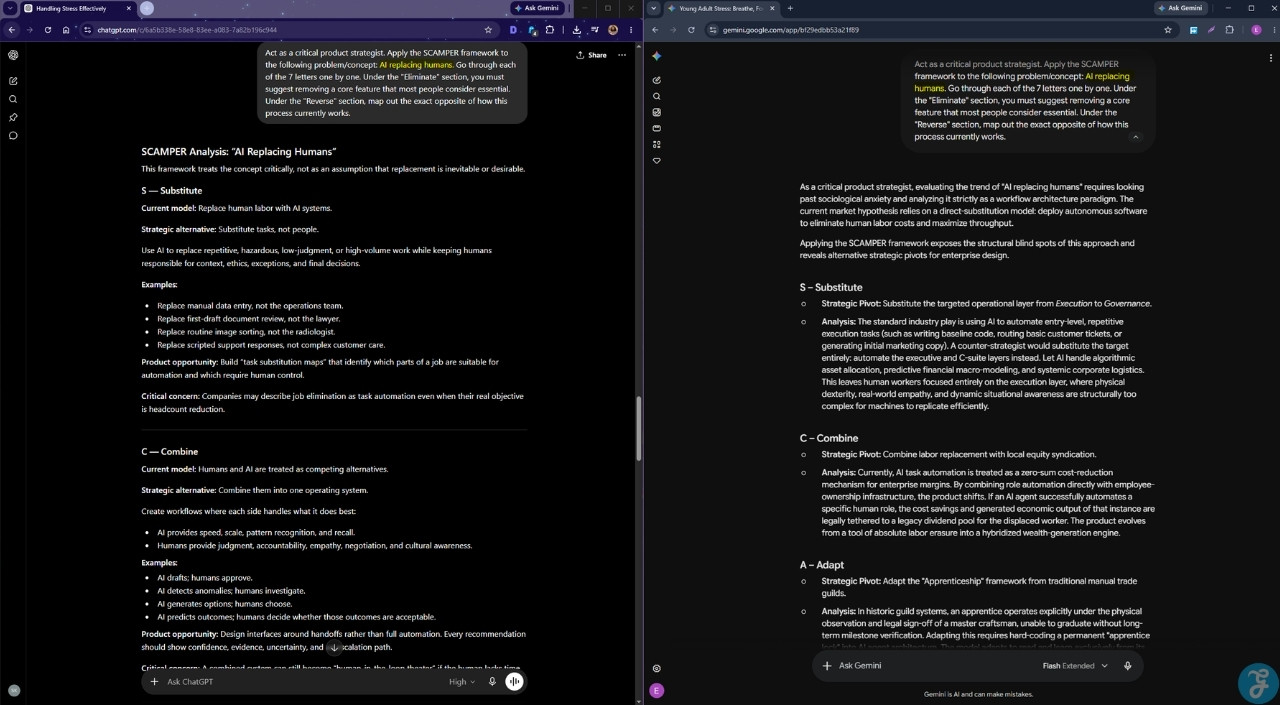
1. The SCAMPER Method Template
SCAMPER (Substitute, Combine, Adapt, Modify, Put to another use, Eliminate, Reverse) is a classic human ideation framework that works remarkably well for product and process problem-solving.
The main issue when running this through an AI is that the model naturally wants to add features rather than remove them. You have to explicitly instruct it to take things away during the “Eliminate” phase.
The Prompt:
Act as a critical product strategist. Apply the SCAMPER framework to the following problem/concept: [Insert Problem/Concept]. Go through each of the 7 letters one by one. Under the “Eliminate” section, you must suggest removing a core feature that most people consider essential. Under the “Reverse” section, map out the exact opposite of how this process currently works.
2. The Six Thinking Hats Simulator
If you are working solo, you lack the natural friction of a team disagreeing with you. Edward de Bono’s Six Thinking Hats forces the AI to look at your idea from entirely different emotional and logical angles.
This is one of the most reliable prompts for brainstorming when you need to stress-test a concept before pitching it to a real team.
The Prompt:
I am considering the following idea: [Insert Idea]. Analyze this using the Six Thinking Hats framework.
White Hat (Data and facts only)
Red Hat (Emotional reactions and gut feelings)
Black Hat (Strict risk analysis and fatal flaws)
Yellow Hat (Best-case scenario benefits)
Green Hat (Alternative creative offshoots)
Blue Hat (Next practical steps to manage the project) Provide a brief, highly specific paragraph for each hat.
3. The $0 Budget Constraint
Creativity usually thrives under tight restrictions. If you do not give an AI a budget limit, it will suggest building an app, hiring a team, or running a massive ad campaign.
The Prompt:
I need to solve this problem: [Insert Problem]. Generate 5 unconventional solutions. The absolute constraint is that the solution must cost $0, require no new software subscriptions, and must be executable by one person within 48 hours.
4. The Reverse Brainstorm (The Pre-Mortem)
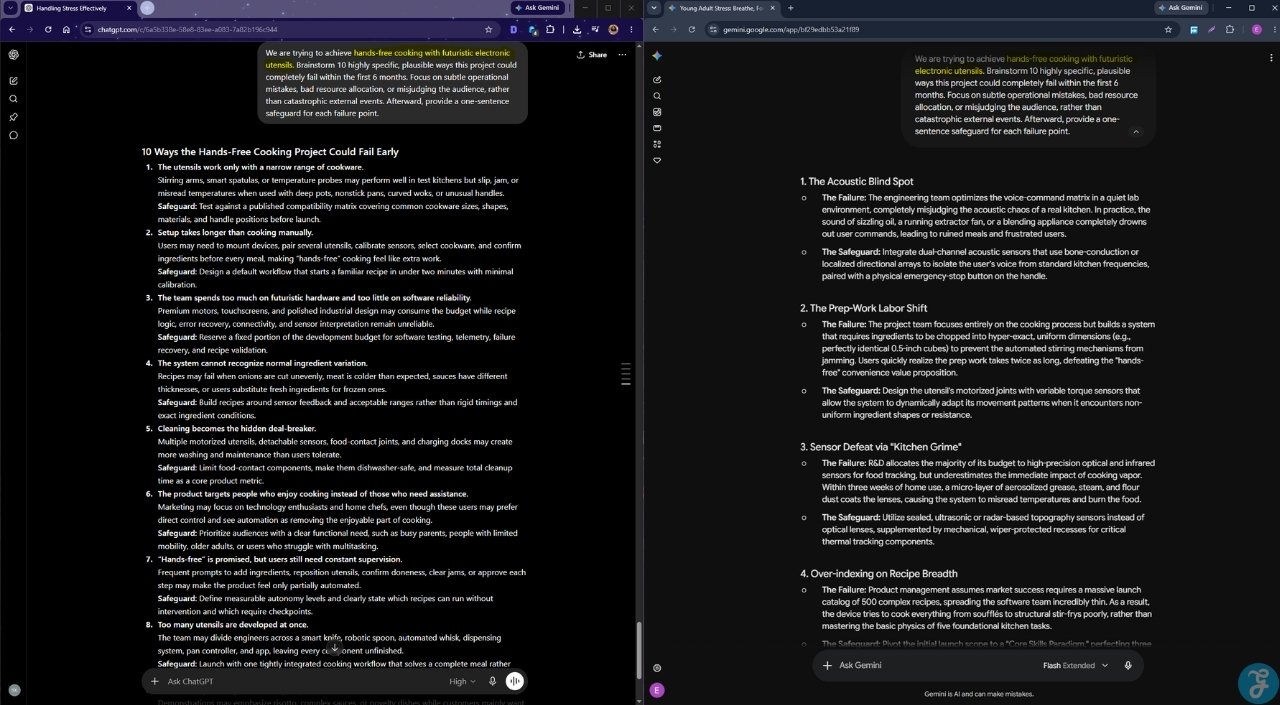
Most idea generation prompts ask the AI how to succeed. That usually generates generic motivational lists. Asking the AI how to guarantee failure is often much more practical, because it highlights the exact mistakes you are currently ignoring.
The Prompt:
We are trying to achieve [Insert Goal]. Brainstorm 10 highly specific, plausible ways this project could completely fail within the first 6 months. Focus on subtle operational mistakes, bad resource allocation, or misjudging the audience, rather than catastrophic external events. Afterward, provide a one-sentence safeguard for each failure point.
5. The Cross-Industry Transplant
This framework forces the AI to look at how different sectors solve similar logistical or communication issues.
A warning here: Do not let the AI pick the comparison industry. Pick a boring, traditional industry yourself to force a more interesting output.
The Prompt:
Look at the core mechanics of [Insert Your Niche/Concept]. Now, brainstorm how a veteran [Insert Unrelated Profession, e.g., commercial plumber, airline logistics manager, or restaurant chef] would approach this exact same problem using the tools and philosophies of their specific trade. Give me 3 actionable strategies based on their hypothetical approach.
6. The First Principles Deconstructor
Sometimes you do not need new ideas. You need to understand why the current ones are stuck. This prompt is useful for stripping a complex problem down to its undeniable facts.
The Prompt:
Break down the following concept into its absolute first principles: [Insert Concept]. Separate what is an undeniable, foundational fact from what is simply a shared industry assumption or habit. Once you have isolated the 2-3 foundational facts, build 3 entirely new approaches to the problem from scratch, ignoring all current industry standards.
7. The “Jobs to Be Done” Reframing
People do not buy products or adopt processes. They “hire” them to do a job. This prompt forces the AI to stop focusing on features and start focusing on human intent.
The Prompt:
My current offering/idea is [Insert Idea]. Stop focusing on the features. Brainstorm 5 different underlying “Jobs to Be Done” that a user is actually trying to hire this idea for. For each job, explain the emotional driver behind it, and suggest one tweak to the idea that would satisfy that specific emotion better.
8. The Beginner’s Mind Translation
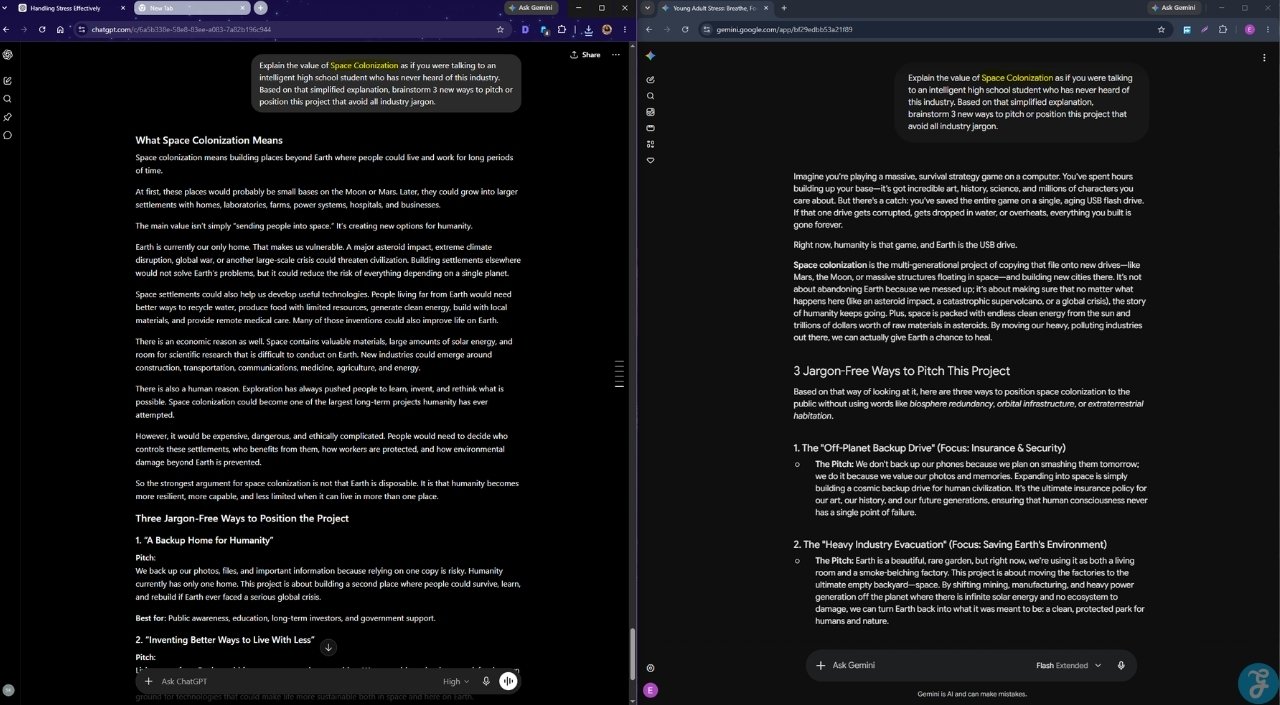
If you are too close to a project, your ideas become bloated with jargon. This is a great structural prompt to reset your perspective.
The Prompt:
Explain the value of [Insert Complex Idea/Project] as if you were talking to an intelligent high school student who has never heard of this industry. Based on that simplified explanation, brainstorm 3 new ways to pitch or position this project that avoid all industry jargon.
9. The Skeptic’s Audit
When you build prompts for brainstorming, it helps to dedicate one entirely to friction. The Skeptic’s Audit is designed to rip your idea apart before a client or manager can.
The Prompt:
Act as a highly cynical, easily bored industry veteran. I am presenting this idea: [Insert Idea]. Brainstorm the top 5 brutal, honest reasons why you would reject this proposal immediately. Do not sugarcoat the feedback. Point out exactly where the logic is weak, where the effort is too high, or where the idea is just unoriginal.
10. The Forced Random Word Association
This is a pure creative AI prompt. It forces the model to bridge two entirely unrelated concepts, which often jolts the user out of a mental block.
The Prompt:
The problem I am trying to solve is [Insert Problem]. Generate a list of 5 completely random, concrete nouns (e.g., a brick, a lighthouse, a wristwatch). Do not pick abstract concepts. For each noun, force a brainstorming connection: How could the physical properties or function of that specific object inspire a solution to my problem?
What to Do When the First Output Fails
Even with a highly structured prompt, the first output is rarely the final answer. Treat the initial AI response as raw material that needs to be refined. If the output feels dry or slightly off-target, do not start over with a brand-new framework immediately.
Instead, use these secondary tactics to force the AI deeper into the specific parts of the output that actually show promise.
The “Zoom In” Command
If the AI generates a list of five ideas and only one is interesting, tell it to ignore the rest entirely.
Copy the single good idea, paste it back into the chat
Now say: “Idea #3 is the only one that matters. Throw out the rest. Now, give me five highly specific variations of just Idea #3, focusing strictly on [insert your biggest constraint, e.g., reducing onboarding time].”
Forcing a Format Change
Sometimes the ideas are fine, but the formatting makes them impossible to evaluate. If the model gives you dense paragraphs, you will likely skim over the actual value.
Reply with: “Rewrite these exact concepts, but format them as a table. Column 1: The Idea. Column 2: The biggest financial risk. Column 3: What we can test by tomorrow morning.” Changing the visual structure often exposes how weak or strong the generated concepts actually are.
What to Try First
You do not need to use all 10 prompts for brainstorming at once. If your current ideas feel stale, start with the Reverse Brainstorm. It is usually the fastest way to break a mental block because identifying potential disasters is naturally easier and more entertaining than trying to force a perfect solution from a blank screen.
Once you have a list of practical things to avoid, the path forward usually becomes obvious.
Frequently Asked Questions (FAQs) About Prompts for Brainstorming
Which AI model is best for brainstorming?
It depends entirely on the framework you choose. GPT-4 is highly reliable at following formatting rules for logic-based frameworks like SCAMPER. If you need creative nuance or off-the-wall associations, Claude tends to provide less robotic pushback and better stylistic variation.
Can I combine these prompts into one giant prompt?
You can, but it usually ruins the output. Asking an AI to apply multiple complex frameworks at once causes the model to lose focus and deliver a shallow mess. Run them sequentially instead, feeding the best idea from one prompt into the next.
How do I stop the AI from returning ideas I have already tried?
Tell the model exactly what you have already done and what failed. Add a negative constraint line to your prompt explicitly listing the ideas it should not suggest. The more specific negative constraints you provide, the harder the AI has to work to find a genuinely new angle.
Do I need to be an expert prompt engineer to use these?
Not at all. These frameworks are designed to do the heavy lifting for you by enforcing structural constraints. You simply need to fill in the bracketed information with your specific problem, budget, or goal.
Why are my AI brainstorming results always so generic?
AI language models are designed to predict the most statistically likely response, which naturally leads to safe, average ideas. Unless you force the model into a specific perspective or apply harsh constraints, it will default to clichés. Using structured prompts breaks this cycle.