Have you ever watched retention slip in a mature SaaS product without any single feature actually breaking? I have, and that slow slide is exactly why churn gets expensive.
In older products, the problem is rarely one big flaw. It is usually a stack of smaller misses: slow onboarding, hidden value, messy workflows, and users who never quite reach the right habit.
So I pulled together the SaaS retention experiments I use most. I am going to walk you through what I test, which metric I trust, and how I improve retention without turning the product into a maze.
Importance of Retention in SaaS for Mature Products
For mature SaaS products, retention is the growth engine that keeps working after new logo growth slows down. A product can keep adding leads, but if active users fade after the first month or renewals start softening, revenue growth gets harder every quarter.
I have seen the biggest gains come from small fixes in the customer lifecycle: cleaning up a cluttered setup flow, surfacing one overlooked feature, or tightening billing follow-up before an account quietly drops. Those changes usually cost less than chasing another acquisition channel.
A 2014 Harvard Business Review piece citing Bain estimated that a 5% lift in retention can raise profits by 25% to 95%. That is why I treat user retention as a financial lever, not just a product metric.
Retention keeps revenue moving, even when new signups flatten out.
15 SaaS Retention Experiments
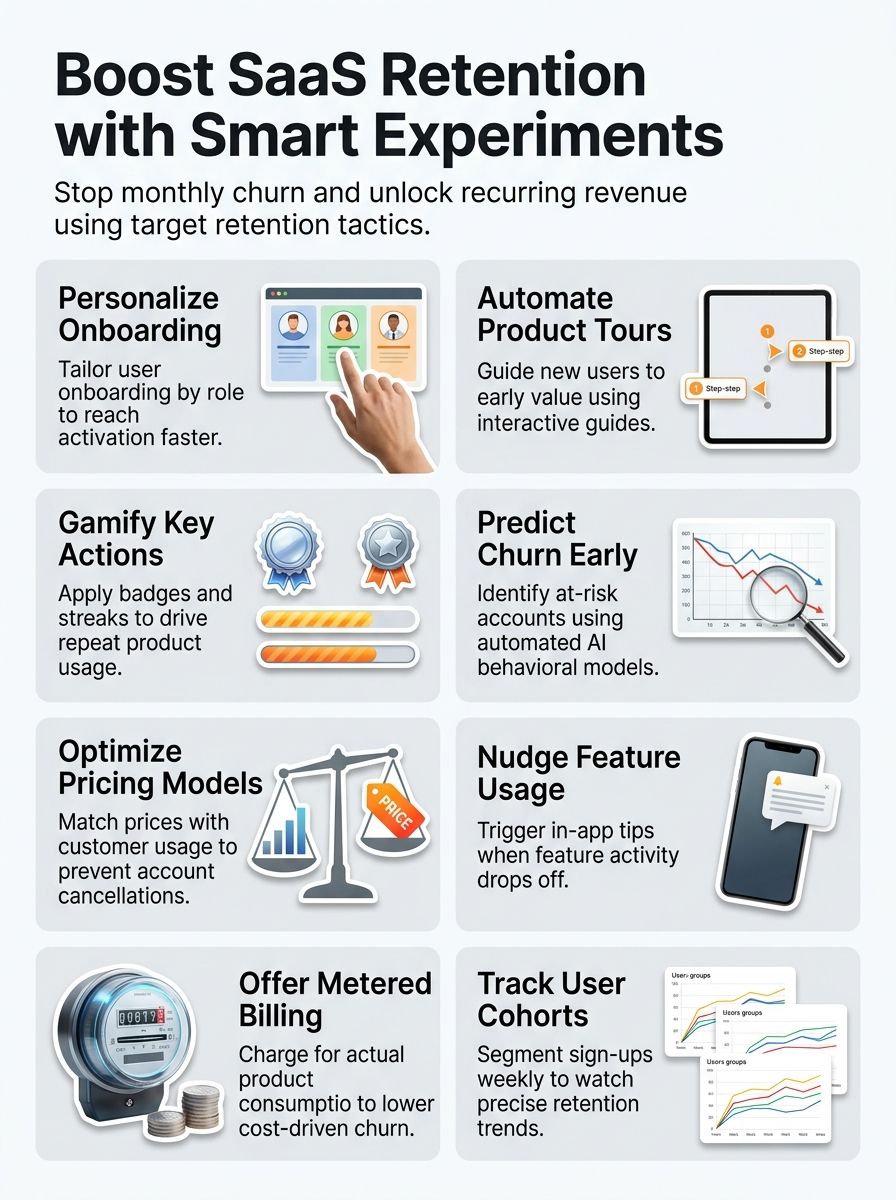
These are the retention strategies I like most for mature saas products because they are practical, measurable, and fast to ship. I use them to improve activation, reduce churn, lift product adoption, and protect recurring revenue without waiting for a full replatform or a major redesign.
1. Personalization in Onboarding
I made onboarding feel more relevant by asking users about role, goal, and use case before showing them the product. That one change helped new users reach activation faster because they saw a workflow that matched their job instead of a generic tour.
In one 8-week A/B test with 2,400 new users, the personalized onboarding cohort outperformed the standard flow at every early checkpoint. The control retained 62% at day 7 and 41% at day 30, while the personalized version held 71% at day 7 and 49% at day 30. Activation improved too: 58% of users in the personalized flow reached the milestone within 14 days, versus 45% in the generic flow.
- Personalize the opening path: Show admins setup tasks, end users a first workflow, and executives a quick value summary.
- Use tools that support segmentation: Appcues and Userpilot both let teams target in-app guidance by role, behavior, or lifecycle stage.
- Measure time to first meaningful action: That is the metric I trust most in early onboarding experiments.
2. Automated Product Tours
I use automated product tours for short, high-value actions, not for full product sightseeing. Appcues noted in a 2026 guide that the strongest tours usually stay within 3 to 5 steps, and I have found that to be true in practice.
Intercom makes a similar point in its help docs: tours are a poor fit for long tasks or complex integrations. So if the job takes real setup, I switch from a tour to an in-app message plus a short help article or video. That change alone usually improves completion.
3. Gamification for Engagement
Gamification works best when it rewards progress that already matters. I do not add badges just to make the product look lively. I add them when they reinforce a habit that predicts user retention, such as completing a weekly workflow, inviting a teammate, or using a sticky feature three times in a month.
- Progress checklists: These make activation feel visible and help users finish setup.
- Streaks: I use them only when the product truly benefits from repeated weekly or daily behavior.
- Milestone badges: These work well for advanced actions like first automation, first dashboard, or first integration.
- Team recognition: In b2b saas, public progress inside an account often works better than consumer-style rewards.
In one cohort, a light gamification layer cut churn by 8% because it nudged users back into a core workflow before that habit disappeared.
4. AI-Driven Churn Prediction Tools
I like AI churn models when they help my team act earlier, not when they produce a mysterious score no one trusts. The model has to tell me which accounts are drifting, which behavior changed, and what intervention should happen next.
HubSpot recommends starting predictive health scoring with no more than five criteria and checking those signals against the previous 12 months of churn data. That is smart advice. I usually start with usage frequency, feature breadth, support pain, renewal timing, and billing health, then refine from there.
Tools such as HubSpot Customer Success Workspace, Vitally, and Planhat are useful here because they combine health scoring with workflows, so a churn risk can trigger a real play instead of sitting in a dashboard.
5. Incentivized Feedback Collection
I use incentivized feedback when I need sharper signal on friction, pricing, or missing features. A small credit, account perk, or training upgrade can boost response rates, but the reward should be modest enough that it does not bias every answer.
- Ask one question first: Survey fatigue is real, so I start with a single in-app prompt and branch only if the answer is useful.
- Trigger after a real moment: I ask for feedback after setup, after first value, or right after a failed workflow.
- Close the loop fast: Feedback only helps retention if users see changes or get a response from success or product.
- Separate NPS from product friction: CustomerGauge is useful for relationship feedback, but workflow issues need product-specific questions.
6. Dynamic Pricing Models
Pricing experiments can improve retention fast because bad pricing creates silent churn even when the product is strong. I test packaging to reduce mismatch between value delivered and price paid, especially in mature products with very different customer types.
| Model | Best Use Case | What I Watch |
| Flat fee | Simple products with predictable usage and low admin overhead. | Upgrade demand, perceived fairness, and early churn from smaller accounts. |
| Tiered pricing | Products with clear packaging by seats, features, or support depth. | Plan fit, downgrade pressure, and expansion between tiers. |
| Usage-based pricing | Products where value scales with API calls, workflows, storage, or data processed. | Bill shock, revenue volatility, and whether usage actually tracks customer value. |
Chargebee is useful for this kind of experimentation because it supports tiered, flat-fee, and usage-based models in one billing stack. I also pay close attention to billing cadence. ChartMogul tied annual plans closely to reaching 100% net revenue retention, which is why I often test annual discounts for stable accounts.
7. Proactive Customer Support Systems
Reactive support saves tickets. Proactive support saves accounts. I would rather reach out after a failed import, a drop in usage, or a billing issue than wait for a cancellation notice.
The best proactive systems blend product data with human follow-up. Intercom, HubSpot, and similar tools make it easier to trigger chats, emails, or tasks from account signals, but the real win comes from using those signals early enough to prevent churn instead of documenting it.
For mature saas teams, I recommend one simple rule: every recurring problem needs both a support play and a product fix. If the issue keeps coming back, support alone is too expensive.
8. In-App Messaging Campaigns
In-app messaging works when it shows up at the exact moment a user needs the next step. I do not use it as a generic announcement channel. I use it to remove friction inside a live workflow.
- Launch message: Brief awareness for a new feature or change.
- Contextual education: Show the message only when the user reaches the related screen or behavior.
- Reinforcement: Follow up after success so the new behavior becomes repeatable.
That three-part pattern mirrors the feature-adoption playbook from Customer.io, and it is much stronger than one loud modal followed by silence.
9. Loyalty and Rewards Programs
I treat loyalty in SaaS as earned relevance, not a gimmick. The best programs reward behavior that deepens product adoption, like training completion, multi-seat rollout, integration setup, or annual renewal.
Good rewards in b2b saas are usually practical: extra seats for a pilot team, premium onboarding for an expansion group, early access to a feature, or credits tied to real usage. Cheap discounts can bring users back for the wrong reason and train them to wait for the next offer.
Reward milestones that create value inside the product, not empty clicks that look good in a dashboard.
10. Feature Usage Nudges
Feature usage nudges are one of my favorite ways to prevent silent churn because they target people who are drifting before they fully disengage. I usually trigger them after a meaningful drop, such as a 30% decline in weekly actions or missed use of a sticky workflow.
The nudge works best when it offers one clear next action. A short tooltip, an in-app banner, or a one-click email back into the product often beats a long explanation. In one test, action-focused copy plus a direct shortcut helped users resume a stalled workflow and improved retention in the at-risk cohort.
11. Educational Content for Advanced Features
Advanced features rarely retain users on their own. People stay when they understand how those features solve a real problem in their workflow.
For that reason, I build educational content around specific jobs, not product menus. Intercom’s guidance is helpful here: once a task becomes too long or too complex for a tour, pair an in-app message with supporting education instead.
- Short video demo: I keep it near five minutes and focused on one outcome.
- One-page cheat sheet: Great for admins and power users who want the steps fast.
- Live Q&A or office hour: Useful when a feature changes team process, not just clicks.
- Sample template or example dataset: This removes blank-page friction and speeds adoption.
12. Usage-Based Billing Options
Usage-based billing can reduce churn when customers experience lumpy or seasonal demand. It works especially well when the value metric is obvious, such as API calls, workflows executed, data processed, or storage used.
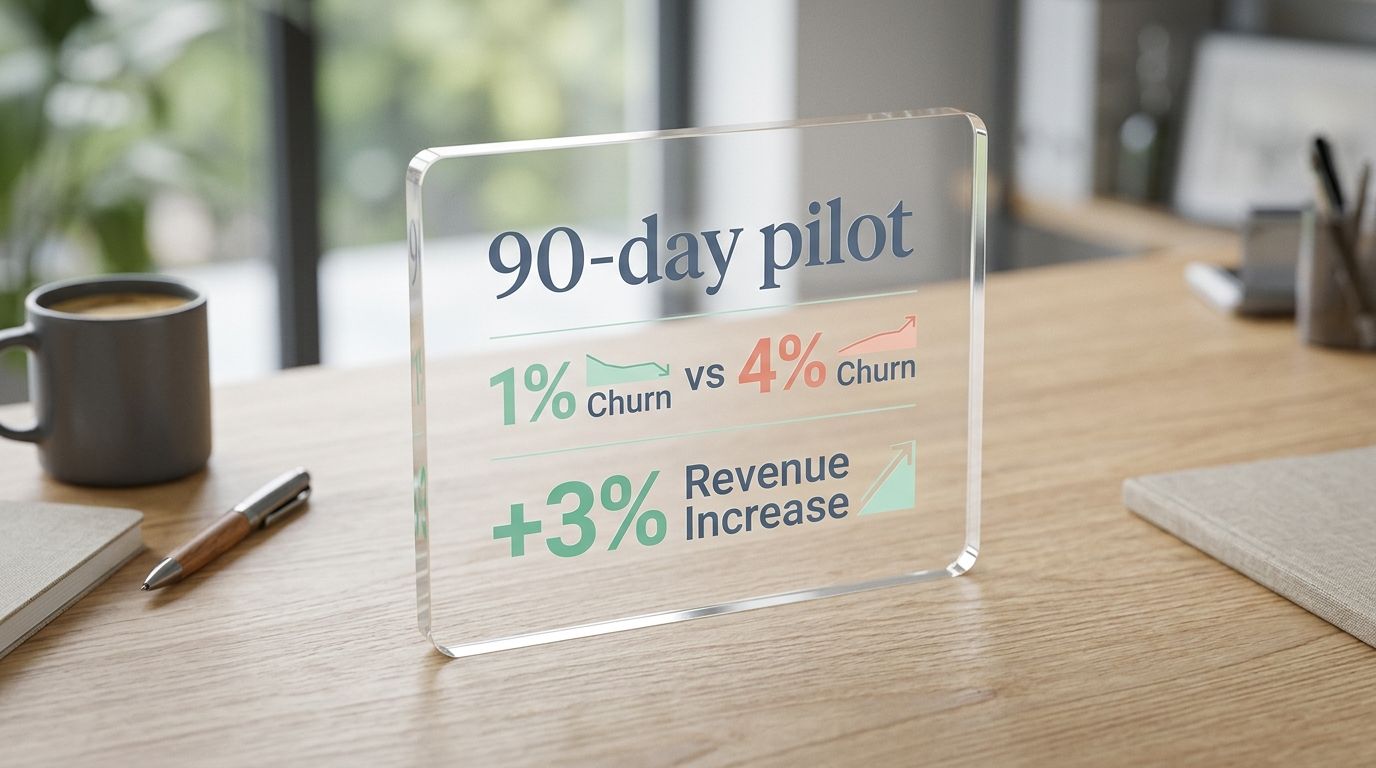
I ran a 90-day pilot with ten accounts and saw a promising early signal. Monthly churn among accounts on the usage-based option was 1%, compared with 4% for matched accounts that stayed on flat plans. Three pilot accounts also reduced downgrade requests versus prior billing cycles, and average monthly revenue per pilot account still rose by 3% after usage increased in month 2.
Chargebee’s current docs make this model easier to test because they support metered features such as API calls, data usage, and user counts. If you are operating at scale, the platform also documents thresholds of up to 50 metered features and 100 million usage events per month, which matters for mature products with heavy event volume.
13. Optimized Email Drip Campaigns
Email still plays a big role in saas retention, but only when it follows behavior. I do not send long nurture sequences just because the calendar says day 3 or day 10.
- Pick one behavioral goal per sequence: Customer.io’s 2026 onboarding guidance is clear on this, and I agree with it.
- Branch by role: Admins, champions, and end users should not receive the same emails.
- Exit the user the moment they complete the goal: Nothing hurts trust faster than getting reminder emails after the job is already done.
- Use win-back carefully: Re-engagement emails work better when they highlight a useful change, not just a discount.
14. Social Proof Integrations
I like placing social proof inside the product at moments of hesitation. That might be a short customer quote near setup, a verified review snippet near upgrade, or a quick case-study card beside a new feature.
Generic praise does very little. Specific proof works better: a recognizable customer logo, a sentence that mentions the use case, or a short result tied to time saved, adoption rate, or revenue impact. In one test, adding concise testimonials and case-study snippets produced a 7% lift in retention over three months because it lowered doubt right where adoption was stalling.
The best social proof answers a buyer’s quiet question: who else like me succeeded with this feature?
15. Community-Building Initiatives
A healthy user community can raise retention because it creates peer learning, faster support, and stronger product habits. I like community experiments most in mature products with advanced workflows, shared templates, or admin-heavy configuration.
- Use a platform with searchable depth: Discourse says it powers more than 22,000 communities, and it is a strong fit when you want durable, long-form product knowledge.
- Choose product-like community design when experience matters: Circle supports SSO, events, gamification, and customer spaces, with its Professional plan listed at $89 per month.
- Seed weekly behavior: I run Q&A threads, product office hours, and customer playbook swaps so the forum never feels empty.
- Track business outcomes: I look for support deflection, feature adoption, expansion interest, and customer success signals, not just post count.
Measuring Experiment Success
I measure experiments in layers. First I look at the immediate metric, such as activation rate or feature adoption. Then I check whether the effect holds at 30, 60, and 90 days. If the lift disappears after the first week, it was probably noise or novelty.
I also compare outcomes at both the user level and the account level. A win that creates more clicks but weaker renewals is not a retention win.
- Short-term: activation, time to first value, feature uptake, message engagement.
- Mid-term: 30-day retention, DAU/MAU, support volume, downgrade requests.
- Long-term: churn rate, gross revenue retention, net revenue retention, expansion revenue.
Chargebee’s docs say RevenueStory includes more than 150 ready-made reports for MRR, activations, churn, sales, and other KPIs, which is useful when I need fast reporting without building every dashboard from scratch. I also like keeping pricing experiments isolated with grandfathered plans so the comparison stays clean.
Wrapping Up
Retention in SaaS improves when I test the parts of the product that users feel every week: onboarding, messaging, pricing, billing, support, and advanced education.
I do not need all 15 experiments at once. I pick the one closest to the biggest leak, run it with a clean metric, and keep building from there. That is how I improve retention, reduce churn, and turn a mature saas product into a steadier subscription business model.
Frequently Asked Questions on SaaS Retention Experiment
1. What do the SaaS retention experiments aim to do?
They aim to stop users from leaving, and lift overall retention. Think of a leaky bucket, plug one hole at a time.
2. Which tests help mature products the most?
Try clearer start steps, faster help, smarter messages, and small price or plan tweaks, these often move the needle on overall retention.
3. How long should I run each test?
Run a test until results look steady, usually four to eight weeks, but shorter or longer works with more or less traffic.
4. How do I know a test worked?
Compare the group that saw the change to the group that did not, watch fewer users leave, and track overall retention. If more people stick, celebrate, if not, learn fast and try a new test.