Every purchase tells a company something. It says which price you accepted, which materials you valued, which business practices you were willing to support, and which claims were convincing enough to earn your money. That is the basic idea behind choosing to vote with your wallet. You deliberately direct spending toward products, services, and businesses that better reflect your values.
Sometimes that means buying from a responsible company. Just as often, it means buying less, repairing what you own, choosing secondhand, or refusing a product that cannot support its ethical claims.
The idea sounds simple until price, convenience, greenwashing, and incomplete supply-chain information enter the picture. PwC’s 2025 global consumer research found that 44% of respondents were willing to pay more for food supporting environmental sustainability, yet 82% did not routinely investigate food brands’ sustainability initiatives. When trade-offs became unavoidable, price usually won.
Effective conscious consumerism therefore cannot depend on perfect information or an unlimited budget. It needs practical habits that work during an ordinary week, not only when someone has time to research a company’s entire supply chain.
What Does It Really Mean to Vote With Your Wallet?
Voting with your wallet can take two forms. A “buycott” rewards a business or product that meets a desired standard. A boycott withholds spending from a company because of its practices, policies, ownership, or public conduct.
Neither action works like a political ballot. One receipt rarely changes a multinational company, and a private purchasing decision may be invisible unless the business knows why it gained or lost the sale. Repeated choices across many customers, however, can affect demand, strengthen alternative business models, and show companies which issues influence purchasing.
Consumer action also operates within larger systems. The IPCC estimates that demand-side measures could reduce global greenhouse-gas emissions in end-use sectors by 40% to 70% by 2050 compared with baseline scenarios. But those measures include infrastructure, technology, public services, policy, and social change alongside personal behavior.
Your spending matters, but it does not absolve businesses or governments of responsibility. Ethical spending works best as one part of a wider response.
10 Ways to Vote With Your Wallet Without Chasing Perfection
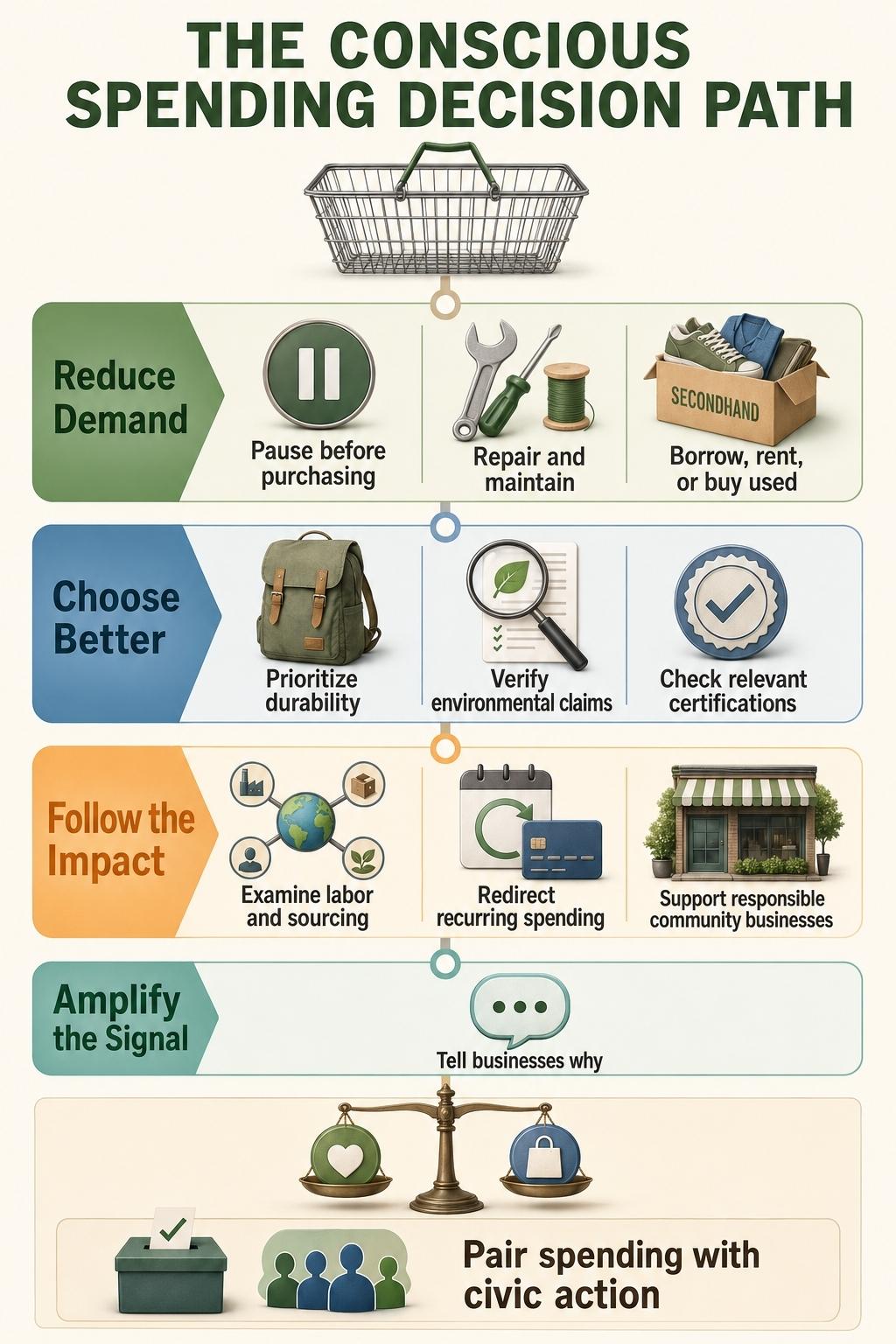
The most useful actions do not all involve purchasing premium “sustainable” products. Several can reduce spending while still sending a meaningful signal about durability, waste, labor, and transparency.
1. Buy Less Before Trying to Buy Better
The first question should not be, “Which sustainable version should I buy?” It should be, “Do I need to buy this at all?”
A product creates impacts through material extraction, manufacturing, packaging, transport, use, and disposal. Replacing unnecessary consumption with a slightly greener version may change the impact without addressing the volume of consumption behind it.
UNEP’s lifecycle guidance begins with reducing consumption, followed by reuse and repair before recycling. This matters because global resource extraction could rise by 60% between 2020 and 2060 without coordinated action.
Before purchasing, ask:
- Do I already own something that performs the same job?
- Can I borrow, rent, repair, or adapt an existing item?
- Would I still want this after waiting several days?
- How often will I realistically use it?
- Am I replacing something that still works?
A short waiting period is particularly useful for clothing, electronics, décor, and social-media-driven purchases. Avoiding one unnecessary order often saves more money and resources than agonizing over two nearly identical “eco” options.
2. Choose Products Designed to Last and Be Repaired
A cheap product can become expensive when it fails quickly and cannot be repaired. The better comparison is not always the purchase price. It is the cost of owning, maintaining, and eventually replacing the item.
Look for warranties that are long enough to mean something, accessible spare parts, replaceable batteries, repair instructions, standard fasteners, and customer reviews written after months of use. For clothing, examine seams, fabric weight, care requirements, and whether the design can survive repeated wear.
Deloitte’s UK consumer research found that 60% of respondents considered reparability or durability when purchasing, while 56% had repaired an item instead of replacing it. Price remained a significant barrier, showing why longevity must be evaluated alongside affordability rather than treated as a luxury concern.
A higher price does not guarantee better construction. Evidence of durability matters more than premium branding.
3. Use Secondhand, Refurbished, Rental, and Sharing Options
Not every demand needs a newly manufactured product. Secondhand markets, certified refurbished electronics, tool libraries, clothing rental, equipment hire, and neighborhood sharing groups can keep useful products in circulation.
This approach works especially well for items used occasionally: power tools, formal clothing, camping equipment, furniture, textbooks, children’s items, and specialist kitchen appliances. Refurbished electronics can also offer meaningful savings when they include a clear condition grade, return period, battery information, and warranty.
However, secondhand is not automatically the right choice for every category. Check recalls, hygiene, remaining lifespan, energy use, and safety. Used helmets, child car seats, damaged electrical products, and equipment with an unknown safety history may carry risks that outweigh the savings.
Sustainable purchasing should reduce waste without asking people to ignore product safety.
4. Make Companies Prove Their Environmental Claims
Words such as “green,” “clean,” “natural,” “planet-friendly,” and “conscious” can create an environmental impression without explaining what actually improved.
The U.S. Federal Trade Commission advises shoppers to check whether a claim applies to the product, its packaging, or both. Recycled-content claims should state the proportion involved when the item is not made entirely from recycled material.
Use a simple evidence test:
- Specificity: Does the company name the exact environmental benefit?
- Scope: Does the claim cover one material, one product, or the entire business?
- Measurement: Is there a percentage, baseline, date, or defined target?
- Verification: Has an independent organization checked it?
- Progress: Does the company report results, including missed targets or unresolved problems?
“Packaging made with 80% post-consumer recycled plastic” gives you something to assess. “Designed with the planet in mind” does not.
5. Use Certifications, but Understand What Each One Covers
A credible certification can reduce the research burden, but no label proves that a product or company is flawless. Each certification has a defined scope.
| Certification | What it can help verify |
| Fairtrade | Social, economic, and environmental requirements within covered supply chains |
| FSC | Certified or recycled forest-based materials |
| GOTS | Organic textile processing with environmental and social criteria |
| ENERGY STAR | Third-party-certified energy-efficiency performance for eligible products |
Fairtrade supply chains are checked by the independent auditor FLOCERT. FSC uses separate labels for products made with FSC-certified, mixed, or recycled forest materials. GOTS covers processing stages for eligible organic textiles, while ENERGY STAR focuses on energy efficiency rather than a product’s entire social or environmental record.
Check the certifier’s official database or website when a label looks unfamiliar. A green leaf designed by the company itself is branding, not independent verification.
6. Look Beyond the Values Page to the Supply Chain
Many companies describe themselves as ethical. Fewer explain where products are made, which suppliers they use, how risks are investigated, and what happens when abuse is found.
The U.S. Department of Labor currently lists 204 goods from 82 countries and areas that it has reason to believe are associated with child labor or forced labor. Frequently listed categories include garments, textiles, footwear, coffee, sugarcane, fish, gold, coal, and diamonds. The list is intended to support awareness and due diligence, not to encourage simplistic judgments about entire countries.
When evaluating a company, look for:
- Supplier or factory disclosure
- A dated labor-rights or due-diligence report
- Clear sourcing standards
- Worker grievance and remedy processes
- Purchasing practices that do not force suppliers into impossible prices or deadlines
- Evidence of problems found and corrected
A report that acknowledges unresolved risks may be more credible than a page claiming every supplier already meets the highest ethical standard. Complex supply chains rarely become perfect because a brand publishes a code of conduct.
7. Redirect Food Spending Toward Less Wasteful Choices
Food provides frequent opportunities to align spending with environmental and social priorities. The most practical place to begin is often not an expensive specialty product. It is buying the right amount.
UNEP estimates that 1.05 billion tonnes of food were wasted in 2022. Households produced 60% of that total, while food loss and waste contributed an estimated 8% to 10% of annual global greenhouse-gas emissions.
Useful changes include planning meals around food already at home, purchasing realistic quantities, freezing food before it spoils, understanding date labels, using leftovers, and choosing more plant-rich staples where appropriate.
Local food can support nearby producers and shorten some supply chains, but “local” is not an environmental guarantee. Production methods, refrigeration, seasonality, waste, land use, and transport mode all affect the final footprint. Buy locally when the product and farming practices make sense, not simply because the label lists a nearby place.
8. Review the Spending That Repeats Every Month
A one-time ethical purchase can feel satisfying, but recurring expenses often direct far more money over time. Review the businesses receiving automatic or habitual payments: supermarkets, delivery services, mobile providers, utilities, streaming platforms, insurers, banks, and subscription companies.
For each one, ask whether a credible alternative offers better labor practices, environmental policies, privacy protections, accessibility, or community benefits. Switching a recurring service can create a longer-lasting signal than purchasing one branded reusable item.
Financial providers deserve particular scrutiny because their impact includes lending and investment, not only office electricity or paper use. UNEP Finance Initiative guidance treats financed emissions and sector exposure as important parts of bank climate assessment.
Do not switch financial or essential services on values alone. Compare fees, deposit protection, coverage, reliability, customer access, contract terms, and practical risk. An ethical option still needs to perform its basic job safely.
9. Support Community-Rooted and Independent Businesses Thoughtfully
Spending with an independent shop, repair service, cooperative, worker-owned company, minority-owned business, or direct producer can help keep more economic activity connected to a community.
The key word is “can.” A small or local company is not automatically sustainable, fairly managed, or transparent. Judge it using relevant evidence: product quality, sourcing, employment practices, waste reduction, repair support, accessibility, and how it treats customers and workers.
Community spending can extend beyond products. Paying a local tailor to repair clothing, an independent technician to fix an appliance, or a neighborhood refill shop to reuse containers supports services built around keeping things in use.
This is one of the most practical forms of ethical spending because it can reward both responsible production and the infrastructure needed for repair and reuse.
10. Tell Businesses Why They Gained or Lost Your Money
A silent purchasing switch may register as a lost sale, but it does not tell the company what caused it. Make the signal clearer.
Send a concise email, answer a customer survey, leave a factual review, or contact the retailer. Explain which policy, material, certification, labor concern, repair option, or sourcing decision influenced you. When supporting a better alternative, say why you chose it.
Collective boycotts and buycotts can amplify this signal, but they work best when they have:
- A clearly identified target
- A specific and achievable demand
- Reliable supporting evidence
- A defined alternative for participants
- Consistent communication
- A way to assess whether conditions changed
Avoid joining campaigns based entirely on viral posts or cropped screenshots. Check the original claim, the organization coordinating the action, and whether the company has responded.
Most importantly, do not mistake consumer action for the whole democratic process. Ethical consumption can complement voting, workplace procurement, shareholder action, petitions, union activity, public consultation, and support for stronger consumer and labor protections.

How to Practice Conscious Consumerism on a Limited Budget
Conscious consumerism should not become a way to shame people for choosing what they can afford. In many markets, the responsible option remains more expensive, less accessible, or harder to verify. That is a business and policy failure, not a personal moral defect.
Start with actions that can reduce costs:
- Buy fewer nonessential products.
- Use what you already own for longer.
- Plan food purchases to reduce waste.
- Compare cost per use rather than branding.
- Buy secondhand where safety permits.
- Use repair, rental, borrowing, and sharing services.
- Focus on one or two spending categories instead of researching everything.
Consistency matters more than purity. A manageable habit continued for years sends a stronger signal than one expensive purchase followed by exhaustion.
Your Wallet Is a Signal, Not the Whole Ballot
Choosing to vote with your wallet is not about becoming a perfect shopper. Perfect information is unavailable, budgets are real, and even responsible businesses operate inside imperfect systems.
The useful goal is to become more deliberate. Buy less when buying adds little value. Choose durability over disposability. Verify claims before rewarding them. Move recurring spending when a credible alternative exists. Tell businesses why their decisions matter.
Your wallet cannot carry the entire burden of social and environmental change. It can, however, reinforce the kind of economy that broader public action is trying to build.
Frequently Asked Questions On Vote With Your Wallet
1. What does it mean to vote with your wallet?
To vote with your wallet means using purchasing and spending decisions to support or reject particular business practices, values, products, or policies. It can include buying from preferred companies, boycotting others, choosing secondhand, reducing consumption, or switching recurring services.
2. Does voting with your wallet actually work?
It can influence demand, strengthen alternative businesses, and draw attention to customer priorities, particularly when many people act consistently and communicate their reasons. However, individual purchasing alone cannot replace regulation, corporate accountability, labor protections, or political action.
3. How can I practice ethical spending without spending more?
Begin with buying less, repairing existing items, reducing food waste, borrowing, renting, and purchasing secondhand. When buying new, compare lifespan and cost per use rather than assuming the most expensive sustainable product is automatically the best option.
4. How can I recognize greenwashing?
Be cautious with broad claims such as “green,” “natural,” or “eco-friendly.” Look for a clearly defined benefit, measurable data, the scope of the claim, independent verification, and updated progress reporting. A credible claim should be specific enough to check.
5. Which ethical certifications should I trust?
Trust depends on the product and issue being evaluated. Fairtrade, FSC, GOTS, and ENERGY STAR address different parts of production or performance. Check the certification’s official criteria and database rather than treating any single logo as proof that the entire brand is ethical.
6. Is buying local always more sustainable?
No. Local purchasing can support nearby businesses and producers, but distance alone does not determine environmental or social impact. Production methods, energy use, labor practices, materials, storage, waste, and product durability also matter.