


Microlearning is easy to like. It fits on a phone, slips between meetings, and gives busy employees a way to complete training without surrendering an entire afternoon. For learning teams, it is easier to distribute, update, and track than a long conventional course. The format also produces reassuring numbers. Employees finish modules. Quiz scores appear. Completion dashboards turn green. Managers can see that training happened.
What those numbers cannot automatically show is whether anyone learned enough to perform differently. That is the tension at the heart of microlearning. It solves a real delivery problem, but organizations often treat that as proof that it has solved the learning problem too. So, is microlearning effective?
It can be. Research has linked well-designed microlearning with improvements in knowledge, recall, engagement, confidence, problem-solving, and task performance. A systematic review of 40 studies reported broadly positive outcomes across cognitive, behavioral, and emotional measures. It also made clear that results depend on the learner, subject, objective, level of interactivity, delivery method, and learning environment.
That qualification matters more than the headline. Short lessons tend to work when the objective is narrow, the content is relevant, the learner must think, and important knowledge returns over time. They are much less convincing when an organization cuts a complex course into smaller files and assumes the teaching has improved.
Microlearning is a format. Being short does not make it effective.
What Microlearning Actually Means
Microlearning delivers a focused learning experience in a small unit, usually built around one clearly defined outcome.
That unit might be a short demonstration of one procedure, a realistic decision scenario, a retrieval question, a flashcard or vocabulary prompt, a product or policy update, a checklist used during work, or a brief explanation followed by practice
A warehouse employee might review one equipment-safety check before beginning a shift. A salesperson might revisit a single objection-handling technique before a call. A software user might watch a two-minute demonstration while completing an unfamiliar task.
These are limited, practical goals. The lesson can be short because the objective is small. Problems begin when the objective is broad.
“Become a better leader” is not a microlearning objective. Neither is “understand cybersecurity,” “master negotiation,” or “learn the company’s software platform.” Each of those outcomes contains multiple concepts, decisions, behaviors, and exceptions.
They can be supported by microlearning, but they cannot be taught honestly through a handful of disconnected clips.
Imagine that a company has a one-hour customer-service presentation. The learning team divides it into twelve short videos. Employees still watch passively. The examples remain generic. There is no practice, meaningful feedback, or follow-up after completion.
The course is now easier to consume. The teaching method has barely changed. Good microlearning has a reason to be short. It removes material the learner does not need while preserving the context, thinking, practice, and feedback required for one useful outcome.
Why Microlearning Became So Popular
Its popularity is not mysterious. Microlearning addresses several genuine problems in workplace education.
It fits around real work
Most employees do not have a quiet half-day waiting to be filled with professional development.
Their calendars already contain customers, meetings, deadlines, messages, administrative tasks, and unfinished work. Frontline workers may not even have regular access to a desk or computer.
A five-minute activity is easier to start than a one-hour course. It can be completed before a task, between appointments, during a quiet period, or on a mobile device. That convenience matters. Training that nobody has time to open will not produce much learning.
The mistake is treating access and effectiveness as the same thing. Making a course easier to begin does not guarantee that it contains enough explanation or practice to change performance.
It can help at the moment of need
Some information is most useful immediately before action. A technician may need to confirm the order of a maintenance sequence. A support employee may need to check a revised refund rule. A manager may want a quick conversation prompt before conducting a performance review.
In these situations, microlearning behaves less like a course and more like performance support. The employee is not trying to develop broad expertise in five minutes. They need a precise answer that helps them complete a specific task correctly.
This is one of the format’s strongest uses because the lesson is tied directly to a real decision.
It gives managers visible activity
Microlearning platforms make participation easy to track. They can report completions, scores, attempts, streaks, logins, and time spent.
Those figures are useful. A training team needs to know whether employees can access the material and whether they are taking part. The trouble begins when participation data becomes the main evidence of learning.
Finding out whether behavior has changed takes more effort. It might require observations, delayed assessments, error data, call reviews, quality checks, manager interviews, or workplace performance measures.
A completion percentage appears immediately. That makes it tempting. Once completion becomes the easiest measure of success, teams may start designing courses that are easy to finish rather than experiences that are difficult enough to produce learning.
It is easier to update
A short module can be changed quickly when a product, policy, regulation, or software feature is updated.
A large course may require a costly rebuild, even when only one section is out of date. A modular system lets the training team correct a small part without asking everyone to repeat information they already understand. That flexibility has real operational value.
However, easier production creates its own risk. When organizations can make more content faster, they may produce modules before asking whether a learning intervention is needed at all.
The difficult question is not, “Can we turn this into a short video?” It is, “What must the learner be able to do, and what experience will help them do it?”
Microlearning Is Not a Cure for an Eight-Second Attention Span
One of the weakest arguments for microlearning is also one of the most repeated: adults supposedly have an attention span of only eight seconds. That is not an established scientific fact.
Research from King’s College London found that half of surveyed UK adults believed the eight-second claim, even though it had been widely debunked. The researchers also noted that the available long-term evidence does not justify confident claims that human attention spans have universally collapsed.
People undoubtedly face more digital interruptions. Notifications, messages, multiple screens, open browser tabs, and frequent task-switching can make sustained focus harder.
But attention is not a timer that automatically expires after a few seconds.
A person may abandon a dull 30-second training clip and then spend an hour learning how to repair a bicycle, understand a financial decision, improve a gaming strategy, or follow a detailed sports analysis.
The difference is not simply length. Relevance, motivation, difficulty, prior knowledge, environment, and perceived value all influence attention.
Microlearning should be short because the learning objective is focused and the format suits the task. It should not be short because adults are assumed to be incapable of concentration.
That assumption can become self-defeating. If every difficult subject is reduced to a stream of tiny fragments, learners receive fewer opportunities to practise sustained reasoning.
What the Research Really Says About Microlearning Effectiveness
The research is encouraging, but it does not support the idea that microlearning is automatically superior to longer instruction.
The review of 40 studies found positive outcomes across areas including knowledge acquisition, recall, application, engagement, motivation, satisfaction, self-efficacy, and task performance. Yet it also found that outcomes varied with the subject, learner characteristics, objective, personalization, interactivity, and delivery method.
That variation is not surprising because microlearning is not one standardized intervention.
A four-minute passive video, a mobile vocabulary exercise, a realistic branching scenario, and a checklist used during a repair task may all be described as microlearning. They are not educationally equivalent.
A meta-analysis of English-speaking instruction provides a useful example of strong but limited evidence. It examined 10 studies involving 743 learners and found a substantial advantage for microlearning over conventional lectures, reporting a standardized mean difference of 1.43. However, the analysis also found considerable variation among the studies, with heterogeneity of 66%.
That result supports microlearning in the setting studied. It does not prove that short lessons will outperform every longer format in every subject.
Research involving business-education learners reached a similarly practical conclusion. Satisfaction and effectiveness were not guaranteed. Outcomes were strongly connected to why people enrolled and whether they could apply the material to their current jobs.
This helps explain why the same module can feel valuable to one learner and forgettable to another.
A lesson on pricing objections may be immediately useful to a salesperson dealing with them every week. The same lesson will feel abstract to an employee who has no reason or opportunity to use it. Microlearning often works best when the distance between learning and application is short.

Where Microlearning Begins to Struggle
The limitations become more visible when the desired outcome requires integration, judgment, adaptation, or substantial practice.
Complex knowledge can become a pile of fragments
Breaking information into smaller units can make each part easier to process. The learner still has to understand how those parts connect.
A trainee doctor may memorize individual symptoms without developing sound diagnostic reasoning. A programmer may learn commands without understanding the architecture of the system. A new manager may remember several communication techniques but remain unsure which one to use when an employee becomes angry, defensive, or distressed.
Every individual lesson may be accurate while the learner’s overall understanding remains weak.
This often happens when modules are designed separately. One explains a principle. Another presents a process. A third covers an exception. Nobody helps the learner see how the principle, process, and exception interact.
A collection of correct facts is not the same as a coherent mental model. People need opportunities to compare ideas, see relationships, solve larger problems, and understand what changes when the context changes.
Short content can still be passive
Lesson duration says very little about the amount of thinking required. Consider two four-minute phishing modules. The first shows a polished video listing common warning signs. The learner watches, clicks “next,” and receives a completion mark.
The second displays a realistic email. The learner must inspect the sender information, identify suspicious details, choose a response, and read feedback explaining why the decision was safe or risky.
Both are short. Only one requires observation, retrieval, judgment, and feedback.
This distinction is easy to miss because passive content feels smooth. Learners recognize information as it appears on screen and may confuse familiarity with understanding. Later, when the warning signs appear in a different email, that sense of familiarity may not be enough.
Immediate quiz scores can create false confidence
Many microlearning quizzes appear seconds after the explanation. The answer is still active in working memory, so the learner performs well. The dashboard records a high score, and everyone feels reassured. But that score may show only that the learner can recognize information while it is fresh.
It does not tell us whether the person can retrieve it a week later, notice it in a different situation, explain the reasoning, or apply it while under pressure.
A better assessment introduces some distance. It revisits the idea later, changes the wording or setting, and asks the learner to use the principle rather than recognize the original answer. Learning that survives only until the end of the module is not especially useful.
Human skills require human messiness
Leadership, coaching, negotiation, clinical judgment, ethical reasoning, and conflict management rarely have one tidy answer.
A short lesson can remind a manager to ask open questions. It cannot demonstrate whether that manager can stay calm during a tense conversation, notice hesitation, respond to an unexpected disclosure, listen without becoming defensive, and adjust the discussion in real time.
Those abilities develop through cases, discussion, role-play, coaching, observation, reflection, and repeated practice. Microlearning can reinforce one part of that development. It should not be presented as the entire journey. A three-minute clip on empathy does not create an empathetic manager.
Sometimes the Training Is Not the Problem
Organizations do not always have a learning gap. Sometimes they have a work-design problem. A customer-service team may complete weekly lessons on careful listening while managers continue rewarding shorter call times.
A safety module may explain the correct procedure while employees lack the equipment, staffing, or time needed to follow it.
A leadership program may encourage regular coaching conversations while managers have too many direct reports to meet anyone properly.
In each case, the training message and operating environment point in opposite directions.
Creating another module may feel productive because it is easier than changing a workflow, incentive, policy, staffing level, or management practice.
The dashboard may improve. The job may not. Before building microlearning, ask why the performance gap exists. Do employees lack knowledge? Or do they already know what to do but lack the tools, authority, time, support, confidence, or incentive to do it?
Training can solve a genuine knowledge or skill problem. It cannot repair every organizational failure.
Completion Is a Starting Metric, Not a Learning Result
Completion rates are not useless. They can show that a course is accessible, that employees are participating, and that the delivery method fits into the working day. A low completion rate may reveal a technical, scheduling, relevance, or communication problem.
What completion cannot prove is competence. A stronger evaluation begins with the behavior or result the organization wants to change.
After training:
- Can employees complete the task with fewer errors?
- Can they recognize the issue in an unfamiliar scenario?
- Do they remember the key decision several weeks later?
- Are managers observing a meaningful behavior change?
- Can learners explain why a procedure works?
- Has quality, safety, speed, or customer experience improved?
The right measure depends on the objective. A software lesson might be evaluated through successful task completion. A safety intervention may require observation and incident data. A sales program may be assessed through call reviews. Leadership development may require manager feedback and evidence of changed workplace behavior.
These methods require more work than counting completed modules. They are also much closer to the reason the training was created.

Why Retrieval and Spacing Matter More Than Being Brief
Some of the strongest benefits associated with microlearning may come from learning principles that are not unique to short lessons. Two of the most important are retrieval practice and spacing.
Retrieval practice asks learners to bring information back from memory rather than merely reread or rewatch it. Spacing distributes those retrieval attempts over time instead of concentrating them in one sitting.
A meta-analytic review covering 29 studies found a strong retention advantage for spaced retrieval compared with massed retrieval.
This helps explain why two microlearning programs can produce completely different results. One program assigns five short videos in a single afternoon. Employees watch each clip once and move on.
Another introduces one concept, asks learners to retrieve it several days later, places it in a new scenario, explains mistakes, and revisits it again after a longer interval.
Both programs use short activities. Only the second uses forgetting and retrieval as part of the design. A short lesson is not automatically spaced learning. A quiz is not automatically useful retrieval practice. Timing, difficulty, repetition, and feedback determine whether the activity strengthens memory.
Where Microlearning Works Best
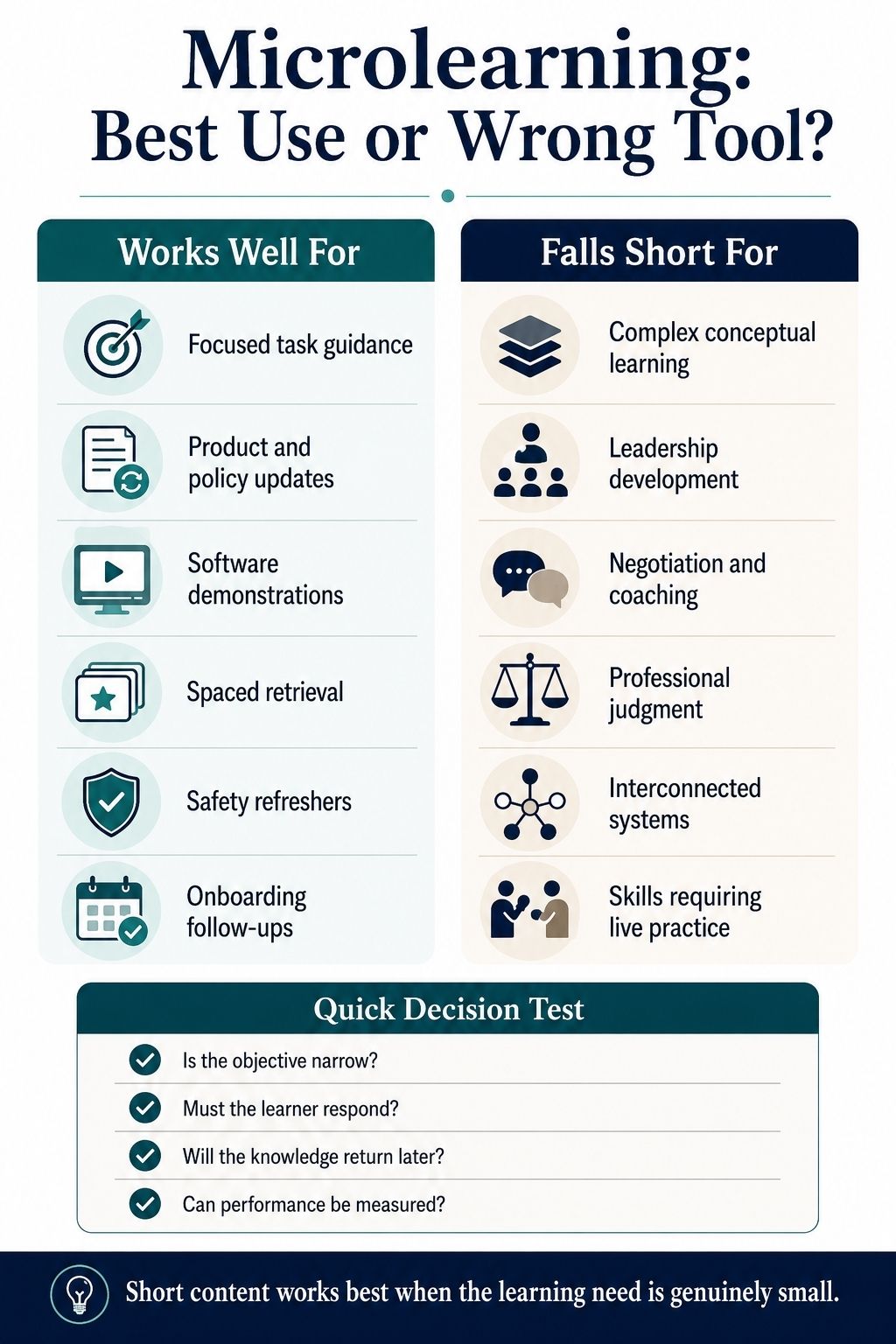
Microlearning is most persuasive when the learning need is naturally narrow or when the activity reinforces something taught in greater depth.
| Strong Use | Why It Fits |
| Just-in-time task guidance | The learner needs one precise answer during work. |
| Product or policy updates | Only the changed information needs to be introduced. |
| Software feature demonstrations | A visible, focused procedure can be shown quickly. |
| Safety and compliance refreshers | Important decisions can be revisited through scenarios. |
| Vocabulary and factual recall | Small items respond well to retrieval and spacing. |
| Post-workshop reinforcement | Short follow-ups help keep previous learning active. |
| Onboarding reminders | New employees can revisit key information as it becomes relevant. |
| Focused decision practice | One realistic choice can be explored with useful feedback. |
In these situations, the scope is controlled.
The module is not pretending to deliver mastery of an entire profession or complex subject in a few minutes. It is helping the learner perform one limited action, remember one important idea, or reinforce previous learning.
Where It Should Remain a Supporting Tool
Microlearning should not carry the whole learning journey when people need to:
- Build a strong conceptual foundation
- Connect many ideas into a larger system
- Practise interpersonal behavior
- Make decisions under uncertainty
- Receive detailed coaching
- Complete extended projects
- Develop professional judgment
- Perform physical skills under supervision
It can support learning in medicine, management, law, engineering, programming, teaching, and other complex fields. It cannot remove the need for explanation, discussion, supervised practice, projects, cases, simulations, and feedback.
A sensible blended program might use:
- Longer instruction to establish the broader model and explain how the parts fit together.
- Cases and simulations to develop judgment and expose learners to realistic variation.
- Coaching or supervised work to improve performance in context.
- Microlearning follow-ups to reinforce key decisions, correct common errors, and support recall.
These formats are not rivals. They do different jobs. The mistake is choosing the shortest format first and then forcing the objective to fit inside it.
Microlearning Is Useful, but It Is Not a Shortcut Around Teaching
So, is microlearning effective? Yes, when the learning need is focused and the design includes relevance, retrieval, feedback, repetition, and real application. It can reduce unnecessary training time, support employees while they work, reinforce earlier instruction, and make important knowledge easier to revisit.
It falls short when organizations use it to make complex subjects look simple, replace practice with passive content, or declare success because everyone finished.
The strongest rule is also the simplest:
Use microlearning when the learning need is small. Do not make the learning small because the platform prefers short content.
Good teaching is not defined by the number of minutes on a progress bar. It is defined by what learners can understand, remember, and do when the module is no longer open.
Frequently Asked Questions About Microlearning
1. Is microlearning effective for long-term retention?
It can support long-term retention when learners repeatedly retrieve the information over spaced intervals and apply it in changing contexts. A short lesson viewed once is less likely to produce durable recall.
2. What are the main disadvantages of microlearning?
Its main limitations include fragmented knowledge, shallow treatment of complex subjects, passive content, misleading immediate quiz scores, and excessive reliance on completion data.
3. How long should a microlearning lesson be?
There is no universal ideal duration. A lesson should be short enough to stay focused but long enough to provide the explanation, practice, and feedback required by its objective.
4. Which subjects are best suited to microlearning?
Microlearning works well for procedural reminders, software features, product updates, vocabulary, factual recall, safety refreshers, onboarding follow-ups, and focused decision scenarios.
5. Can microlearning replace longer training?
It can replace longer instruction when the objective is genuinely narrow. It should remain a supporting tool when learners need deep understanding, discussion, coaching, supervised practice, or professional judgment.
6. How should organizations measure microlearning effectiveness?
Start with the intended workplace outcome. Measure task accuracy, delayed recall, observed behavior, error rates, quality, safety, or another relevant performance indicator. Completion and immediate quiz scores should be treated as supporting data, not proof of learning.






















