Transportation is one of the hardest parts of personal climate action because movement is not optional. People need to get to work, school, medical appointments, grocery stores, family visits, airports, job sites, and daily errands. Not everyone lives beside a train station. Not everyone can bike safely. Not every job can be done remotely. Not every family can replace a car tomorrow.
That is why a useful guide to transportation choices that lower emissions has to be practical, not judgmental. The goal is not to tell everyone to abandon cars overnight. The goal is to reduce the highest-emission miles first, replace unnecessary trips where possible, choose cleaner modes when realistic, and make unavoidable travel less carbon-intensive.
Some changes are small but repeatable: walking a short errand, combining trips, taking a bus once a week, or carpooling to a regular event. Some require more planning: buying an e-bike, switching to an EV, using rail instead of a short flight, or reshaping a commute around hybrid work. Some depend heavily on where you live.
The best green transportation choice is not always the most dramatic one. It is the one you can repeat.
Why Transportation Choices Matter So Much
Transportation emissions are stubborn because they are tied to daily habits, infrastructure, fuel systems, and time pressure.
A person may want to drive less but live in a neighborhood without sidewalks. A parent may want to take transit but need to drop children at school first. A worker may want to bike but face unsafe roads. A traveler may want to avoid flying but have no usable rail option.
That is why sustainable commuting has to be discussed with real constraints in mind. Still, transportation choices matter because personal vehicles add up quickly. A daily solo car commute, frequent short car trips, inefficient driving, and avoidable flights can become a major part of a household footprint.
The most effective low-carbon travel strategy usually follows a simple order.
- Avoid unnecessary trips.Second, shift some trips to lower-emission modes.
- Share rides when solo travel is not necessary.
- Use cleaner vehicles for trips that still require driving.
- Improve driving habits, route planning, and travel timing.
This order matters because an electric car can be cleaner than a gasoline car, but walking, biking, transit, rail, carpooling, and fewer trips can reduce emissions without requiring every person to buy a new vehicle.
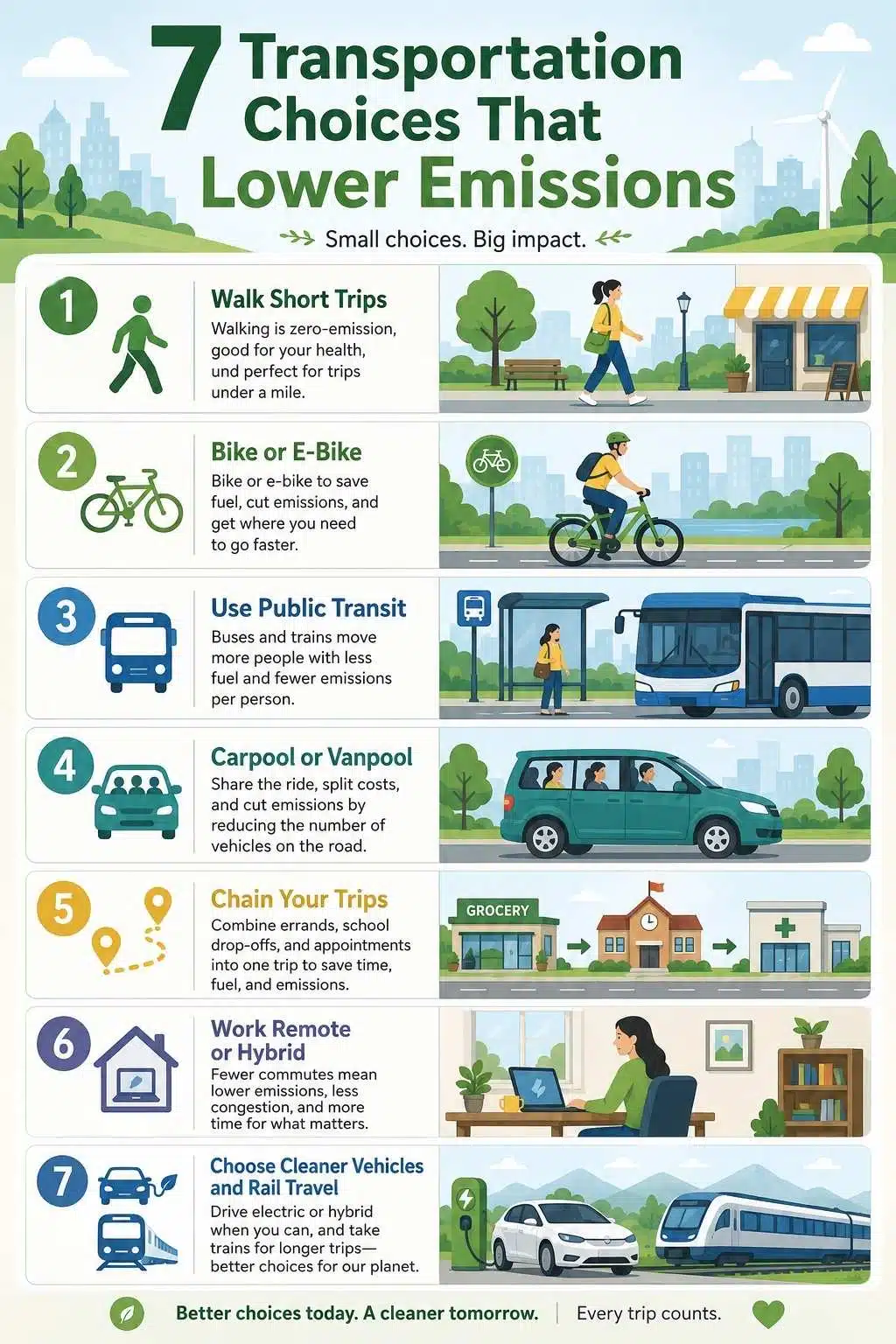
7 Transportation Choices That Lower Emissions
These choices are not ranked as moral instructions. They are ranked by practicality and impact for everyday households. The best option depends on distance, safety, budget, infrastructure, job type, family needs, local transit quality, and how much flexibility a person realistically has.
1. Walk Short Trips When the Route Is Safe
Walking is the cleanest transportation choice because it removes the vehicle from the trip entirely.
That does not mean everyone can walk everywhere. Distance, weather, disability, unsafe roads, poor lighting, lack of sidewalks, and time pressure all matter. But many car trips are short enough that walking can replace at least some of them, especially in neighborhoods with schools, shops, parks, pharmacies, libraries, or transit stops nearby.
Walking works best when it becomes attached to a repeated routine. A ten-minute walk to a local store once a week is more useful than an ambitious plan to “walk more” with no specific trip in mind. School drop-off, nearby coffee runs, small grocery top-ups, post office visits, and local appointments are often good starting points.
The climate benefit is direct. Every safe walking trip replaces a car trip that would have burned fuel or used electricity. It also reduces local air pollution, traffic congestion, noise, and parking demand.
The real challenge is not motivation. It is environment.
If your neighborhood lacks safe crossings, shade, lighting, sidewalks, or traffic calming, walking becomes harder than it should be. That is why individual walking choices and local advocacy fit together. Safer streets make green transportation available to more people.
Best fit: Short errands, school routes, transit access, and local trips under 15 to 25 minutes.
Worth considering: Safety, weather, accessibility, lighting, sidewalks, and whether the route feels comfortable for children or older adults.
2. Use a Bike or E-Bike for Repeatable Local Travel
Biking can replace more car trips than walking because it extends the practical range.
A regular bike works well for short commutes, local errands, campus travel, and exercise-friendly routes. An e-bike can make biking realistic for longer distances, hills, warmer weather, older riders, or people who do not want to arrive sweaty. Cargo bikes and bike trailers can even replace some school runs and grocery trips.
The key word is “repeatable.”
Buying a bike does not lower emissions if it sits unused. The best bike trips are the ones that fit your life: two-mile errands, a predictable commute, weekend shopping, school pickup, gym trips, local meetups, or a ride to a transit station.
E-bikes deserve special attention because they can replace car trips that many people would not realistically walk or pedal on a regular bike. They still use energy and materials, but their operating energy is tiny compared with a car, and they take up far less road and parking space.
The barrier is safety. Many people avoid biking not because they dislike it, but because roads feel hostile. Protected bike lanes, secure parking, traffic calming, and employer bike storage make a major difference.
Best fit: Local errands, short-to-medium commutes, campus travel, transit connections, and car-light households.
Worth considering: Helmet use, route safety, bike storage, theft risk, weather, cargo needs, and whether an e-bike would make the habit realistic.
3. Take Public Transit for Commutes and High-Traffic Trips
Public transit can lower emissions when it replaces solo driving, especially on repeated trips such as commuting.
Buses, metros, trams, commuter rail, and regional rail all perform differently depending on ridership, vehicle type, route efficiency, and electricity or fuel source. A crowded electric train has a very different emissions profile from an empty diesel bus.
Still, the basic advantage is simple: public transit moves more people with fewer vehicles and less road space.
Transit also changes the larger transportation system. Good transit supports walking, biking, denser neighborhoods, shorter trips, and less dependence on private cars. That is why transit is not only a personal choice. It is infrastructure.
For individuals, the best way to start is not necessarily replacing every trip. It may be replacing one repeatable trip. Try the bus or train for one commute day per week, one downtown trip, one airport connection, one event, or one day when parking is expensive.
Transit becomes more attractive when the full cost of driving is visible: fuel, parking, tolls, wear, stress, traffic time, and the need to own or maintain a second vehicle.
Best fit: Work commutes, city trips, school travel, event travel, airport connections, and routes where parking is expensive or traffic is heavy.
Worth considering: Reliability, first-mile and last-mile access, safety, travel time, service frequency, and whether biking or walking can connect you to a station.
4. Carpool or Vanpool When Driving Is Still Necessary
Not every trip can shift to walking, biking, or transit. That is where carpooling helps.
Carpooling does not eliminate the trip, but it reduces emissions per person by sharing the ride. Two people in one car are usually better than two people in two cars. A vanpool can be even more efficient when several people travel similar routes to work, school, events, or community activities.
This option is especially useful in suburbs, rural areas, business parks, schools, factories, healthcare shifts, and places where public transit is weak. It can also work for sports practices, religious gatherings, conferences, and recurring social trips.
The main challenge is coordination. People need similar schedules, trust, pickup points, and backup plans. But the payoff can be real: lower fuel costs, less parking pressure, fewer vehicles on the road, and less driving stress for each person.
Carpooling is also a good bridge strategy. It helps people lower emissions before they can move, buy a cleaner vehicle, change jobs, or access better transit.
Best fit: Regular commutes, school runs, recurring events, rural or suburban travel, and workplaces with shared schedules.
Worth considering: Schedule reliability, insurance, pickup locations, comfort, privacy, and what happens when one person is late or absent.
5. Combine Trips and Reduce Unnecessary Car Miles
Trip chaining is not glamorous, but it is one of the most realistic low-carbon travel habits.
Instead of driving separately to the grocery store, pharmacy, post office, gym, and school activity, you plan trips in a sequence. One route handles several errands. One outing replaces three. A weekly planning habit reduces repeated routes, cold starts, extra miles, and last-minute driving.
This matters because many people cannot change their main commute right away. But they can reduce scattered errand miles.
Trip reduction also includes choosing closer options when the quality is acceptable. A nearby store may be slightly less exciting than a big-box trip across town, but it may save fuel, time, and stress. Local services, delivery coordination, shared errands, and neighborhood shopping can all reduce travel demand.
There is one sustainability trap here: delivery is not automatically lower-carbon. A well-routed delivery truck serving many homes may reduce trips, but one rushed delivery for a single item can add packaging and logistics emissions. Use delivery thoughtfully, not as a default replacement for planning.
The most useful question is simple: “Can I avoid making this trip twice?”
Best fit: Grocery runs, school logistics, appointments, household errands, family schedules, and car-dependent neighborhoods.
Worth considering: Route planning, weekly lists, combining errands, avoiding unnecessary returns, and choosing closer destinations when possible.
6. Work Remotely or Hybrid When It Truly Replaces Commuting
Remote work can reduce commuting emissions, but the climate benefit depends on the details.
If someone avoids a long solo car commute and does not dramatically increase home energy use, remote work can help. If someone already walked, biked, or used low-carbon transit, the emissions benefit may be smaller. If working from home means heating or cooling a large home all day, the savings can shrink.
Hybrid work can still be useful because transportation emissions are tied to repetition. Avoiding one or two long car commutes per week can matter over a year. Remote meetings can also replace some business travel, especially short flights, long drives, and conference trips that do not truly require physical presence.
The best approach is to treat remote work as part of transportation planning, not just workplace convenience. If you work from home, cluster errands on commute days, avoid creating new short car trips, and manage home energy wisely. If your workplace allows flexible hours, shifting commute times can reduce time spent idling in traffic.
Remote work is not available to everyone, and it should not be presented as a universal solution. Healthcare workers, service workers, teachers, tradespeople, warehouse staff, delivery drivers, caregivers, and many others cannot simply log in from home.
But where it is available, it can be a meaningful sustainable commuting tool.
Best fit: Desk-based workers, long car commuters, hybrid teams, consultants, remote meetings, and business travel reduction.
Worth considering: Home energy use, commute distance, workplace expectations, household routines, and whether remote days truly replace driving.
7. Choose Cleaner Vehicles and Lower-Carbon Long-Distance Travel
Some travel will still require a vehicle. The goal is to make those miles cleaner.
For households that must drive, switching from an inefficient gasoline vehicle to a more efficient car, hybrid, plug-in hybrid, or battery electric vehicle can reduce emissions. Battery electric vehicles usually have lower climate impact than gasoline cars over time, especially as electricity grids get cleaner, but they are not magic.
Vehicle size, battery size, electricity source, driving distance, tire wear, and manufacturing all matter.
The cleanest vehicle is not always the biggest EV. A smaller efficient EV, a right-sized hybrid, or keeping a reliable car longer while driving less may be better than buying a large new vehicle without changing mileage habits.
For long-distance travel, mode choice matters too. Trains and coaches often have much lower emissions per passenger than solo driving or flying, especially for regional trips. Replacing a short flight with rail can be one of the strongest low-carbon travel choices where rail is available. When flying is unavoidable, nonstop flights can reduce takeoff and landing segments, and fewer total flights matter more than small onboard choices.
This section is where climate advice needs maturity. Not everyone can afford an EV. Not every region has rail. Not every trip can become a bus ride.
But when a vehicle purchase, vacation, business trip, or family visit is already being planned, emissions should be part of the decision.
Best fit: Car replacement decisions, unavoidable driving, regional travel, business trips, family visits, and longer-distance planning.
Worth considering: Total miles driven, vehicle size, local electricity mix, charging access, rail availability, budget, and whether avoiding or combining the trip would reduce more emissions than changing the vehicle.

Quick Comparison: 7 Transportation Choices That Lower Emissions
| Transportation Choice | Best For | Main Emissions Benefit |
| Walking for short trips | Local errands, school routes, nearby appointments | Replaces short car trips entirely |
| Biking or e-biking | Commutes, errands, local travel | Cuts car miles while staying flexible |
| Public transit | Urban and suburban commuting | Moves more people with fewer vehicles |
| Carpooling and vanpooling | Work trips, school runs, events | Shares emissions across passengers |
| Trip chaining and fewer car trips | Errands, weekly planning, family logistics | Reduces total vehicle miles |
| Remote or hybrid work | Commuters with flexible jobs | Avoids some commuting miles |
| Cleaner vehicles and lower-carbon travel | Longer trips and unavoidable driving | Cuts emissions from necessary travel |
Best Transportation Choice by Situation
| Situation | Lower-Emission Choice to Try First |
| Errand under 1 mile | Walk if the route is safe |
| Errand 1 to 5 miles | Bike, e-bike, or combine with another trip |
| Daily solo commute | Transit, carpool, hybrid work, or route change |
| Suburban school run | Carpool, walking school bus, bike train, or combined trips |
| Rural travel | Trip chaining, efficient vehicle, carpooling, and fewer unnecessary miles |
| City travel | Public transit, walking, biking, or bike-share |
| Airport trip | Transit, shared ride, or rail if available |
| Regional trip | Train or coach before driving alone or flying |
| New vehicle purchase | Smaller efficient car, hybrid, plug-in hybrid, or EV based on real use |
A Simple Low-Carbon Travel Hierarchy
The easiest way to think about green transportation is not “car versus no car.” It is a ladder of choices.
- Avoid the trip if it is unnecessary. Remote meetings, better planning, local options, and combined errands can reduce travel before mode choice even begins.
- Use human-powered transport where it is safe and realistic. Walking and biking are hard to beat for short trips.
- Use shared transport. Public transit, school buses, carpools, vanpools, and shared rides reduce emissions per person when they replace solo driving.
- Use cleaner vehicles for trips that still require a car. Efficiency matters. Vehicle size matters. Driving less still matters.
- Choose lower-carbon long-distance modes where available. Rail and coach travel can be strong alternatives to short flights and solo road trips.
This hierarchy keeps the article realistic. You do not need to be car-free to lower transportation emissions. You need to reduce the most avoidable high-emission miles.
Common Mistakes to Avoid
- Thinking the only meaningful choice is buying an EV. EVs are important, but many people can cut emissions before buying a new car by driving less, sharing rides, using transit, biking short trips, and combining errands.
- Ignoring safety. Walking and biking are excellent low-carbon options only when routes are reasonably safe. Better sidewalks, crossings, lighting, protected bike lanes, and slower traffic make sustainable commuting more realistic.
- Replacing every car trip with delivery. Delivery can help when it is consolidated and efficient, but it can also increase packaging, failed delivery attempts, and rushed logistics.
- Treating public transit as all-or-nothing. Even one transit commute per week can reduce car miles if it replaces solo driving.
- Focusing only on tailpipe emissions. Vehicle manufacturing, electricity generation, fuel production, tire wear, road space, parking, and total miles also matter.
- Making the perfect the enemy of the useful. A family that carpools twice a week, bikes one errand, and chooses rail for one regional trip is still making progress.
How to Build a Sustainable Commuting Plan
Start by mapping your real trips for one week.
- Write down commute miles, school trips, grocery runs, appointments, social trips, delivery orders, and long drives. Do not judge the list. Just see it clearly.
- Circle the short trips. These are the easiest candidates for walking, biking, e-biking, or combining.
- Circle the repeated trips. Repetition is where sustainable commuting has the biggest payoff. A commute, school run, weekly class, gym route, or recurring appointment can become a lower-emission habit if you redesign it once.
- Look at your car-dependent trips. Can any be shared? Can you carpool once a week? Can errands move to one route? Can you work remotely one day? Can you use transit for the most parking-heavy trip?
- Look at future decisions. If you are buying a vehicle, moving homes, choosing a school, changing jobs, or planning a vacation, transportation emissions should be part of the decision before habits lock in.
Final Takeaway
Transportation choices that lower emissions are not about living perfectly. They are about reducing unnecessary miles, replacing short car trips, sharing travel when possible, choosing cleaner vehicles when driving is unavoidable, and making long-distance travel decisions with emissions in mind.
Walk when the route is safe. Bike or e-bike when the distance fits. Use public transit where it works. Carpool when driving is still necessary. Combine errands so you do not make the same trip twice. Work remotely when it truly replaces commuting. Choose efficient vehicles, rail, coach travel, or fewer flights when longer trips come up.
A lower-emission transportation life is usually built one repeated trip at a time. That is where the real savings are.
Frequently Asked Questions About Transportation Choices That Lower Emissions
1. What transportation choices lower emissions the most?
The transportation choices that usually lower emissions the most are walking, biking, public transit, carpooling, trip reduction, remote work when it replaces car commuting, efficient vehicles, EVs, and choosing rail or coach travel over flights or solo driving when available.
2. Is public transit always greener than driving?
Public transit is often greener than solo driving, especially when ridership is strong and the route replaces car trips. However, emissions vary by vehicle type, occupancy, fuel source, electricity mix, and local service quality. It works best as part of a broader sustainable commuting plan.
3. Are electric vehicles enough to solve transportation emissions?
No. Electric vehicles can reduce emissions compared with gasoline cars, but they do not solve every transportation problem. Total driving, vehicle size, battery production, electricity source, tire wear, road space, and traffic still matter. Driving less and sharing trips remain important.
4. How can I lower transportation emissions without buying a new car?
You can lower transportation emissions without buying a new car by walking short trips, biking or e-biking, using transit, carpooling, combining errands, working remotely when possible, maintaining your vehicle, driving efficiently, and choosing closer destinations.
5. Is biking or e-biking better for low-carbon travel?
Both can be excellent low-carbon travel choices. A regular bike uses no fuel and works well for short trips. An e-bike uses a small amount of electricity but can replace longer or hillier car trips, making it more practical for many commuters and families.
6. What is the easiest sustainable commuting habit to start?
The easiest habit is replacing one repeated solo car trip each week. That could mean one transit commute, one carpool day, one bike errand, one remote workday, or one combined errand route. Repeated small changes usually work better than a dramatic plan you cannot maintain.