Live service killed creativity when publishers started treating a strong game idea as less important than a long-term content roadmap.
Look at the track record of big-budget gaming over the last few years, and it’s hard to argue otherwise. Studios that once built memorable worlds began chasing battle passes, daily logins, cosmetic shops, seasonal resets, engagement graphs, and post-launch monetization plans. Suddenly, making a great standalone game wasn’t enough. It had to be a platform capable of occupying a player’s time indefinitely, forcing it into a brutal turf war against established giants like Fortnite, Destiny, Apex Legends, Warframe, Roblox, GTA Online, and whatever else already owns people’s free time.
It’s easy to look at this landscape and assume critics just hate live service games out of principle. But the frustration doesn’t stem from post-launch updates. Some of the best multiplayer experiences of the last decade came from games that grew over time. The real danger, however, lies in how the model acts as a trap. Once every publisher wants the same endless engagement model, creativity becomes a business risk instead of the reason games exist.
The result is a market full of studios chasing the next forever game, even though players barely have time for the ones already dominating their routines.
How Live Service Killed Creativity Without Looking Like a Creative Crisis
The live service pitch sounds perfectly reasonable in a shareholder meeting.
The Design Problem Starts Before Launch
Why sell one game once when you can build a long-term relationship with players? Why depend on launch-week sales when recurring revenue can keep flowing through cosmetics, expansions, subscriptions, seasonal content, and premium currencies? Why release a complete product and move on when the same game can be extended for years?
A finance team can make the case easily. The damage starts when that logic begins shaping the actual design.
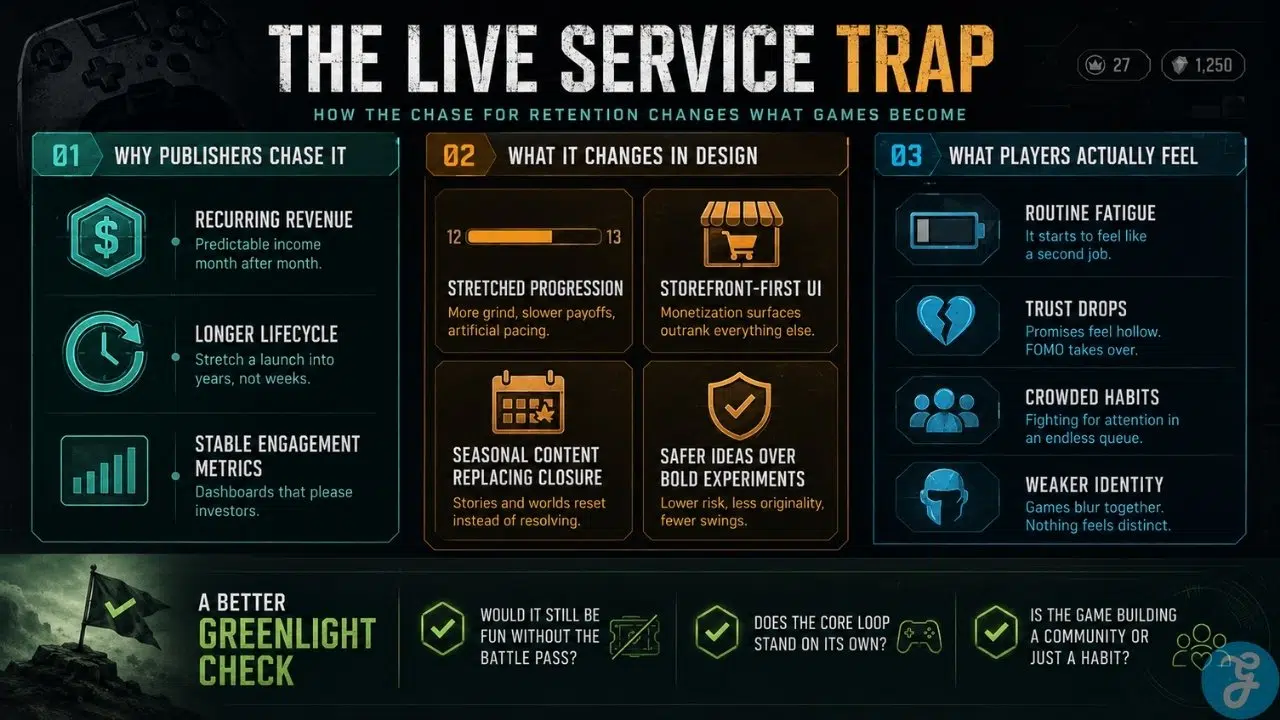
Traditional development focuses on the core experience a team is trying to build, whereas live-service design becomes hyper-fixated on daily retention metrics. That subtle shift in priority alters every single design choice down the line. Progression gets stretched. Rewards get rationed. Menus turn into storefronts. Storytelling gets chopped into seasons. Cosmetic identity becomes another monetization lane. Systems are designed not only to entertain, but to retain.
This is where the ongoing game model can quietly damage creativity. It rewards designs that are repeatable, trackable, update-friendly, and monetizable. That doesn’t automatically make a game bad, but it does narrow the imagination. A weird 12-hour game with a risky ending starts looking less attractive than a familiar multiplayer loop that can sell skins for five years.
The industry didn’t run out of ideas. It trained itself to undervalue ideas that don’t fit the service pipeline.
Players Know When a Game Is Managing Them
Players notice when a game starts treating their attention like inventory. The problem isn’t monetization by itself; it’s the feeling of being managed.
They’ll forgive a lot when the game feels alive. They’ll buy skins, expansions, battle passes, founders packs, deluxe editions, and weird little cosmetics if the core experience earns trust. Fortnite gets away with absurd crossover culture because the game itself is confident, fast, readable, and constantly refreshed. Warframe survived because it built a deep identity and gave players enough reason to stay. Helldivers 2 worked because it launched with a clear fantasy: chaotic co-op military satire where the community felt like part of the joke, not just part of the revenue plan.
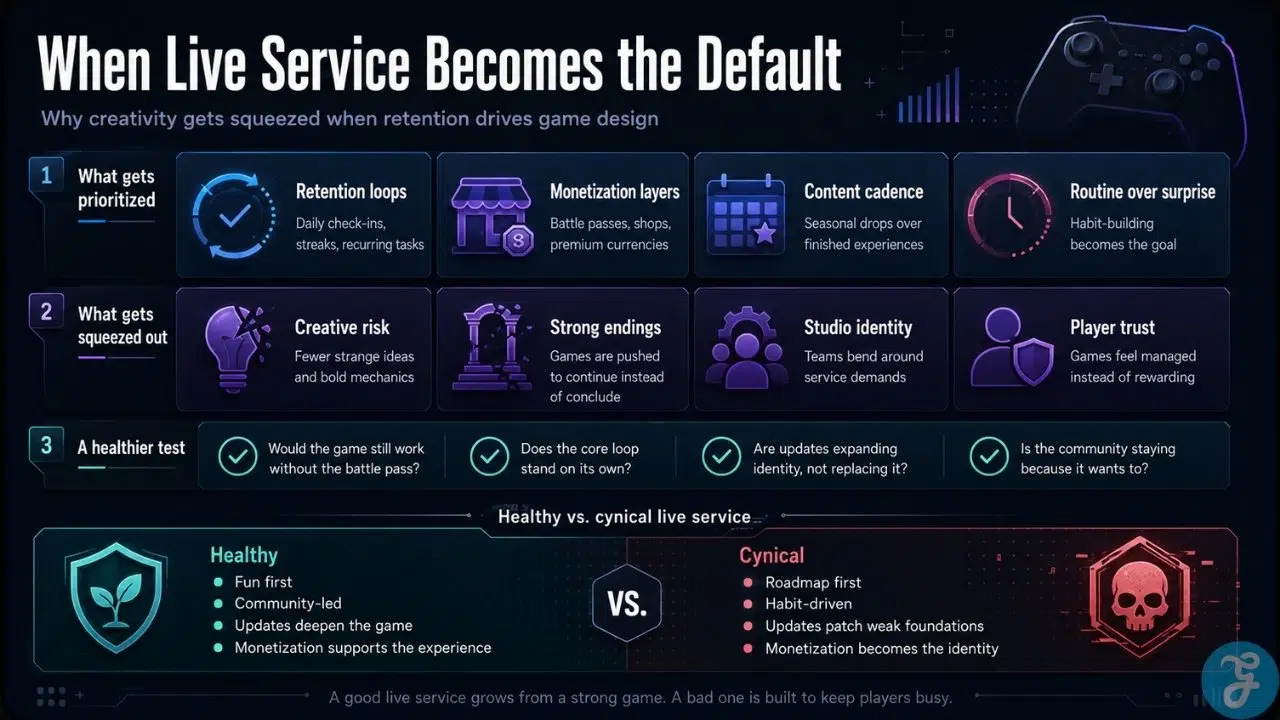
You can usually tell the difference within the first few hours. A healthy live service grows because players want to stay; a cynical one feels like a monetization system looking for a game to hide inside.
| Healthy Live Service | Cynical Live Service |
|---|---|
| The core loop is fun before the roadmap matters. | The roadmap feels more developed than the game. |
| Players return because the world, combat, or community has pull. | Players return because rewards are time-gated or fear-driven. |
| Monetization supports the game’s identity. | Monetization becomes the identity. |
| Updates expand what already works. | Updates try to compensate for a weak launch. |
A lot of these failures get blamed on servers, content cadence, or marketing. More often, they collapse because players don’t trust the pitch. Players know when a game is asking for a long-term commitment before it has earned a weekend.
Concord became the cleanest modern warning sign. Sony took the game offline in September 2024 only days after launch, then later closed Firewalk Studios. That kind of collapse doesn’t happen because players simply hate multiplayer shooters. It happens when a game enters a crowded market without a strong enough reason to exist.
XDefiant is another useful example. Ubisoft announced in December 2024 that the game would shut down, with servers staying online until June 2025. The shooter had an audience at launch, but in the free-to-play FPS market, a decent start isn’t enough. The game needed to rapidly transform into a daily habit, a hurdle it ultimately failed to clear.
That’s the brutal part of the model: a new live service game isn’t just asking for money. It’s asking to become part of someone’s routine.
The Creativity Cost Is Bigger Than Failed Games
Reducing this to “single-player good, live service bad” misses the point.
Some games absolutely make sense as live services. Competitive shooters, MMOs, co-op games, extraction games, card games, sports titles, and sandbox platforms can benefit from long-term support when the design is built for it. A great multiplayer game can become better with balance updates, new maps, new modes, events, and community feedback.
The damage begins when publishers treat live service as the safest default for almost everything.
The reality is that not every developer is wired to run a forever game, just as certain intellectual properties actively resist shoehorned loot systems. Audiences are getting tired of seasonal homework, and turning a historically brilliant single-player studio into a content treadmill rarely ends well.
Naughty Dog understood this before it was too late. When the studio canceled The Last of Us Online, it explained that supporting the project long-term would’ve demanded resources that could pull the studio away from its single-player narrative games. That wasn’t a small admission. That was one of the industry’s best story-driven studios saying the service model can reshape the whole studio around itself.
A live service game isn’t just a game. It’s an operating model. It needs moderation, events, analytics, balance patches, backend support, anti-cheat, monetization planning, customer support, community management, content cadence, and emergency fixes. Once a studio commits to that structure, it can’t simply “also” keep making the same games as before. Eventually, just keeping the gears turning consumes both the studio’s schedule and its original creative vision.
The Hidden Cost Is the Game That Never Gets Made
When a live service fails, people talk about lost money, layoffs, refunds, bad Steam reviews, and angry players. Those matter. But the quieter cost is the creative work that never gets made.
How many single-player concepts were buried because a publisher wanted another engagement platform? How many teams spent years building seasonal content systems instead of new mechanics? How many talented artists, quest designers, writers, animators, and combat designers got pulled into cosmetic pipelines and retention loops?
We usually see only the final wreckage. We don’t see the prototype that died in a pitch meeting because it didn’t have a five-year monetization plan.
That’s why the phrase GaaS killing games has stuck around, even when it’s messy and exaggerated. Players are reacting to a real pattern. They’re not saying every game-as-a-service title is worthless. They’re saying too many publishers chased the model at the expense of variety, finality, authorship, and risk.
A good game can end. That used to be normal.
Now, a game that ends is sometimes treated like a missed business opportunity. But endings are part of why games matter. A tight campaign, a strange mechanic, a handcrafted world, a bold narrative choice, a complete arc – these things are harder to measure on a monthly active user chart, but they’re what players remember.
No one looks back fondly on a corporate content calendar. What sticks with us are the definitive, handcrafted spaces: the unsettling awe of stepping into Rapture for the first time, or the quiet realization of what lay at the bottom of Dark Souls’ Ash Lake. Those finality-driven, authorial choices are what anchor a game in cultural memory, highlighting exactly why games need the structural room to actually be finished.
What the Industry Should Admit Before It Builds Another Forever Game
Live Service Works When the Game Earns It
The model itself isn’t automatically broken, and it isn’t always just corporate greed wearing a headset. When done right, live service offers genuine sustainability in an era where AAA development costs are spiraling out of control. A single high-budget flop can ruin a studio, and recurring revenue provides a financial safety net that allows teams to support communities, fund expansions, and refine a game over years. The culture built around great ongoing games, the late-night raids, the community-wide mysteries, the shared comebacks, is a completely valid form of modern gaming.
But problems emerge when the service layer becomes a mask for fundamentally weak design. You can’t just copy surface features from successful titles, slap a battle pass onto a generic shooter, and expect automatic loyalty. Helldivers 2 succeeded precisely because it prioritized creative direction over monetization matrices; it was a chaotic, satirical co-op game first, and a service second. Too many publishers reverse that equation, treating the player’s routine as something they’re entitled to before they’ve even delivered a compelling reason to log in.
Players are exhausted by launch screens that double as digital shopping malls and being introduced to three distinct premium currencies before completing a basic tutorial. They’re pushing back against the endless cycle of XP boosts, rotating storefronts, fake scarcity, and empty promises of “more content down the road” to fix a broken launch.
The industry shouldn’t be shocked when players reject this setup. In a market completely flooded with high-quality alternatives, a new live service title isn’t entering an empty room. It’s dropping directly into a war zone of deeply entrenched daily habits.
If someone already plays Fortnite with friends, checks in on Warframe, grinds Destiny, follows Apex, plays Roblox, and has a backlog full of premium games, why should they donate their limited time to another half-confident service game?
That’s the question publishers keep dodging. Not “How do we retain players?” but “Why should players let us retain them?”
Ironically, these games often end up feeling completely stagnant underneath a mountain of superficial content updates. They have events, skins, updates, factions, currencies, limited-time modes, progression tracks, and seasonal names that sound like rejected energy drink flavors. Yet beneath that frantic surface movement, these projects are creatively paralyzed. They’re terrified of alienating casual users, terrified of ending a narrative arc, and terrified of building anything that can’t be instantly converted into a recurring revenue stream. The result is a worst-of-both-worlds scenario: games that are astronomically expensive yet fundamentally cautious.
That’s how major franchises get bent into shapes they were never built for. Rocksteady made its reputation on tight superhero action and atmosphere. Suicide Squad: Kill the Justice League arrived as a live-service looter shooter and landed with the thud of a studio working against its strongest instincts. Warner Bros. Discovery later acknowledged the game’s disappointing performance, with reporting around its earnings call pointing to a major EBITDA hit tied to the release.
Rocksteady didn’t suddenly forget how to make games. Suicide Squad showed what happens when a studio’s strengths get bent around the wrong business model.
Live service doesn’t always kill creativity by making developers less talented. It kills creativity by forcing talented people to solve the wrong problem.
The Greenlight Test Publishers Keep Avoiding
Before greenlighting another live service project, publishers should be forced to answer a few uncomfortable questions:
- Does this game actually need to last for years, or does the business model need it to?
- What does it offer that players aren’t already getting from Fortnite, Destiny, Warframe, Apex, or GTA Online?
- Can the studio support it without sacrificing the creative identity that made the studio valuable?
- Would the core gameplay still hold up if the battle pass, roadmap, and cosmetic shop disappeared?
- Is the community fantasy strong enough to survive beyond launch-week curiosity?
If those answers are weak, the project isn’t a game with a live service plan. It’s just a monetization plan wearing a digital skin.
The industry doesn’t need to completely abandon online infrastructure, but it does need to stop pushing every promising idea toward the exact same retention funnel. Let multiplayer studios build long-term worlds when they have the actual design strength to support them, but leave structural breathing room for everything else.
We need an industry where a project is allowed to launch, deliver its point, and end decisively. There is immense value in a strange, divisive ten-hour campaign that leaves a player entirely satisfied without demanding they check back in for seasonal updates, daily log-in rewards, or arbitrary battle pass tracking. The industry talks endlessly about player choice while trying to herd every player into the same endless loop. Creativity needs escape routes. It needs studios that are allowed to make complete things. It needs publishers that understand not every success has to become a platform. It needs executives who can tell the difference between a game people love for years and a game people tolerate because it keeps dangling rewards.
Players aren’t rejecting ambition. They’re rejecting the smell of design by monetization committee.
Live service killed creativity when publishers started treating games less like authored experiences and more like attention farms. That doesn’t mean every live service game is bad. It means the model became too tempting, too dominant, and too often misapplied. The industry saw the money in forever games and forgot the simple truth that made those games work: players stay when the game deserves their time.
No amount of post-launch roadmaps can salvage a dull core idea, just as a flashy cosmetic shop will never fully cover up a lack of imagination at launch. The path forward isn’t about providing fewer updates; it’s about stopping the design of games that feel like secondary employment. The future of the medium relies on balance: letting multiplayer worlds thrive long-term when they have the creative stamina to back it up, while allowing standalone experiences to end with their dignity intact. Above all, it means greenlighting games because they’re worth playing, not because someone believes they can keep selling skins three years from now.