
Mental health habits matter because your mind has a daily workload, just like your body. Every decision, message, deadline, conflict, notification, worry, and unfinished task leaves a mark. For years, I treated mental wellness like something to fix only when stress became too loud. That approach does not work well. By the time burnout, irritability, poor sleep, or emotional exhaustion appears, the mind has usually been asking for support for a while.
The better approach is daily maintenance. Mental wellness habits do not need to be dramatic. A two-minute check-in, a short walk, a phone boundary, a small brain dump, or one honest conversation can shift the direction of a day.
For the corporate athlete, mental health is not separate from performance. Focus, patience, creativity, leadership, sleep, appetite, and decision-making all depend on the state of the nervous system.
These habits also connect with the best healthy habits because emotional health improves when sleep, movement, hydration, nutrition, recovery, and relationships work together. The goal is not constant happiness. The goal is steadier self-awareness, better recovery, and fewer days where stress runs the whole schedule.
Why Mental Health Habits Compound Over Time?
Mental health habits compound because the mind responds to repeated signals. One check-in may not change your whole life. One walk may not erase stress. One boundary may not solve burnout. But small actions repeated daily can change how quickly you notice pressure, how you respond to emotions, and how well you recover. Many people wait too long to care for their mental health. They wait until stress becomes panic, tiredness becomes resentment, or distraction becomes total shutdown. A better approach is to notice the early signs. Small habits help you catch the signal before it becomes a crisis.
Mental wellness habits are also powerful because they reduce emotional guesswork. When you check in with yourself daily, you stop saying vague things like “I feel bad” and start noticing patterns. Maybe you feel anxious after too much news. Maybe you feel low after poor sleep. Maybe you feel tense after certain meetings. That information helps. The compounding effect also shows up in relationships. One honest conversation, one message of appreciation, one boundary, or one moment of asking for help may seem small. Over time, those actions build emotional support.
For desk workers and busy professionals, this matters because mental pressure often hides behind productivity. You may still answer emails, finish tasks, and meet deadlines while quietly running on empty. Daily mental health habits help you stop ignoring the warning lights. These habits are not a replacement for therapy, medical care, or crisis support. They are everyday support systems. If symptoms feel intense, persistent, unsafe, or difficult to manage alone, professional help matters.
| Why Mental Health Habits Compound | What Changes Over Time | Practical Example |
| Better self-awareness | You notice stress earlier | Daily emotional check-in |
| Less mental clutter | Thoughts stop piling up | Brain dump before bed |
| Healthier stress response | You pause before reacting | Two minutes of breathing |
| Stronger boundaries | You protect energy earlier | No work messages after cutoff |
| Better emotional language | You name feelings clearly | “I am overwhelmed,” not “I am failing” |
| More support | You reach out sooner | One honest conversation |
| Improved recovery | The mind gets regular breaks | Walks, sleep routine, quiet time |
Mental health improves through repeated care, not occasional emergency repair.
What Makes a Mental Health Habit Actually Useful?
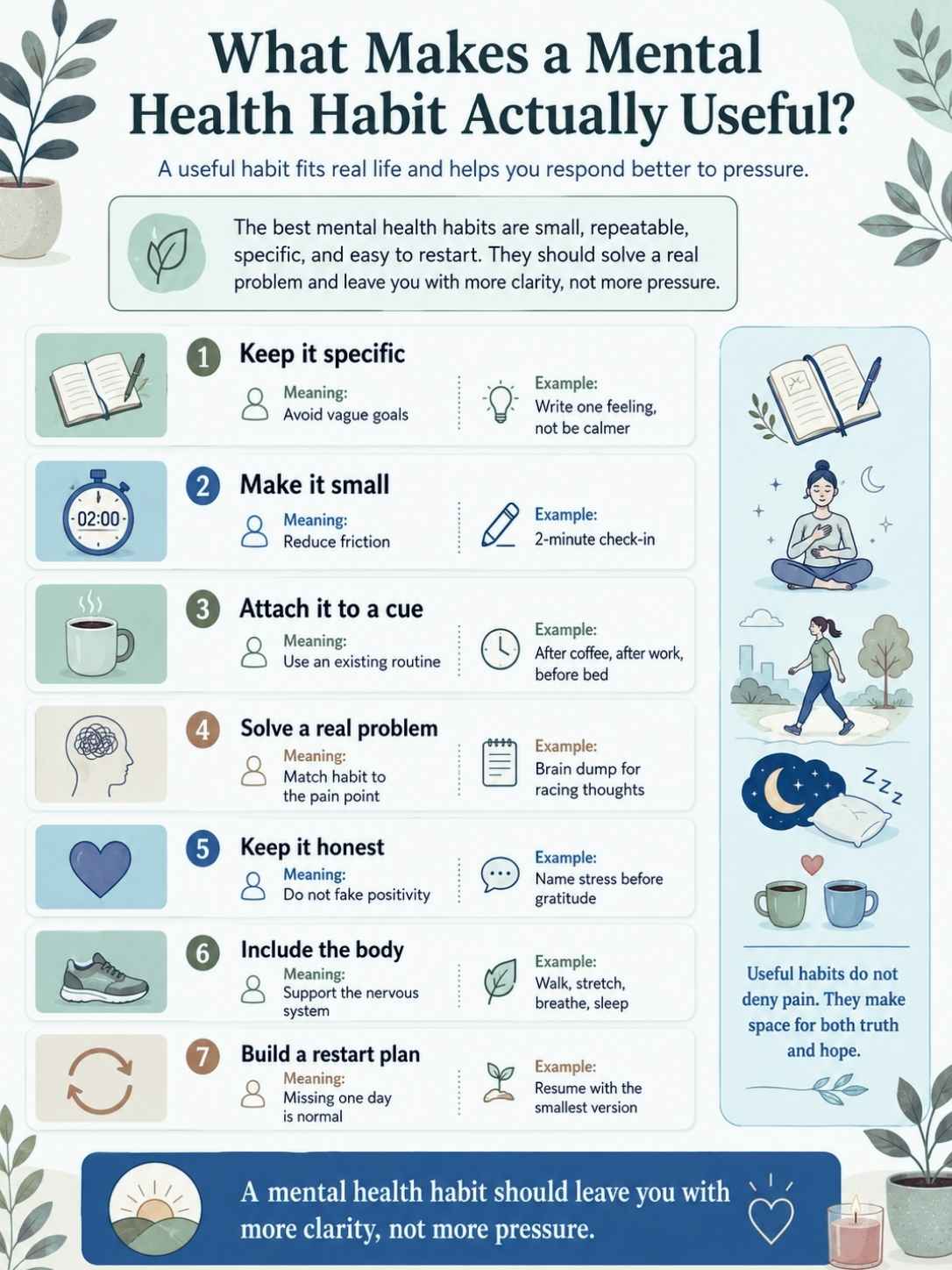
A mental health habit is useful when it fits your real life and helps you respond better to pressure. It should not feel like another task you are failing at. The best mind habits are small, repeatable, and specific. “Take care of my mental health” is too vague. “Write down what I feel after work” is clearer. “Stop stressing” is not realistic. “Take three slow breaths before replying to a tense message” is practical.
A useful habit should also solve a real problem. If your mind races at night, build a brain-dump habit. If you react quickly under stress, practice naming emotions before responding. If loneliness is growing, create a low-pressure connection habit. If work takes over your evenings, build a shutdown ritual. The habit should be easy to restart. Mental health routines often break during the exact moments we need them most. That is normal. The solution is not shame. The solution is a smaller version. If you cannot journal for 10 minutes, write one sentence. If you cannot walk 30 minutes, step outside for five.
Another important point is honesty. Mental wellness habits should not force fake positivity. Gratitude, reframing, and optimism can help, but not when they are used to deny pain. A useful habit makes space for both truth and hope. The best daily mental health routine also connects with the body. Sleep, movement, hydration, nutrition, and recovery affect mood and stress tolerance. The mind does not work in isolation.
| Useful Mental Health Habit Rule | What It Means | Practical Example |
| Keep it specific | Avoid vague goals | “Write one feeling,” not “be calmer” |
| Make it small | Reduce friction | Two-minute check-in |
| Attach it to a cue | Use an existing routine | After coffee, after work, before bed |
| Solve a real problem | Match habit to pain point | Brain dump for racing thoughts |
| Keep it honest | Do not fake positivity | Name stress before gratitude |
| Include the body | Support the nervous system | Walk, stretch, breathe, sleep |
| Build a restart plan | Missing one day is normal | Resume with the smallest version |
A mental health habit should leave you with more clarity, not more pressure.
8 Mental Health Habits That Compound
The following mental health habits are practical enough for busy life. They do not require a perfect morning, a silent house, expensive tools, or a major personality change. You do not need to add all eight today. Choose one that matches your current struggle. If your mind feels crowded, start with the brain dump. If you feel emotionally reactive, start with naming stress. If you feel isolated, start with one honest connection. If you feel scattered, start with attention boundaries.
These habits work best when repeated consistently. The first few days may feel ordinary. That is normal. The value appears through accumulation. You become more aware. You recover faster. You notice triggers earlier. You stop treating every stressful moment like an emergency. A daily mental health routine should be flexible. Some days you will do the full habit. Other days you will do the minimum version. The minimum version still counts because it keeps the pattern alive.
| Habit | Main Benefit | Best For |
| 1. Do a 2-minute emotional check-in | Self-awareness | People who feel mentally overloaded |
| 2. Name stress before reacting | Emotional control | Fast reactors and overthinkers |
| 3. Use a daily brain dump | Less mental clutter | Racing thoughts and busy minds |
| 4. Move your body for your mind | Mood and stress release | Desk workers and anxious energy |
| 5. Protect one attention boundary | Mental calm | Notification-heavy days |
| 6. Have one honest connection | Emotional support | Loneliness and remote work |
| 7. Practice grounded gratitude | Balanced perspective | Negative thought loops |
| 8. Create an evening mental reset | Recovery and sleep | Work stress and bedtime worry |
1. Do a 2-Minute Emotional Check-In
A two-minute emotional check-in is one of the simplest mental health habits because it gives your mind a place to speak before stress builds up. The goal is not to analyze everything. The goal is to notice what is happening. Ask yourself: What am I feeling? What do I need? What is one thing I can control today? That is enough to start.
Many busy people move through the day without checking in. They answer messages, attend meetings, write, manage, plan, edit, cook, commute, and care for others. Then they wonder why they feel heavy at night. The mind was carrying too much without being heard. This habit works best when attached to something you already do. After morning coffee. After lunch. After closing the laptop. Before bed. Keep the timing simple.
Do not judge the answer. If the answer is “I am tired,” that is useful. If the answer is “I feel ignored,” that is useful. If the answer is “I need quiet,” that is useful. Awareness is not weakness. It is information. Over time, check-ins reveal patterns. Maybe certain tasks drain you. Maybe certain people energize you. Maybe your mood drops when sleep is poor. These patterns help you make better choices.
| Check-In Question | Why It Helps | Example Answer |
| What am I feeling? | Builds emotional awareness | “I feel tense and tired.” |
| What do I need today? | Turns emotion into action | “I need a slower evening.” |
| What can I control? | Reduces helplessness | “I can finish one task first.” |
| What is draining me? | Reveals stress sources | “Too many open messages.” |
| What would help a little? | Makes support practical | “A walk after lunch.” |
This habit is small, but it teaches you to stop ignoring your own signals.
2. Name Stress Before Reacting
Stress gets harder to manage when it stays vague. Naming it gives you a few seconds of distance before you react. Instead of saying, “Everything is terrible,” try to be more specific. Are you overloaded, worried, angry, disappointed, lonely, tired, confused, or under pressure? Each one needs a different response.
This habit has helped me most during work-heavy days. When a message feels irritating, naming the stress before replying can prevent a careless response. Sometimes the problem is not the message. Sometimes I am hungry, tired, rushed, or carrying pressure from another task. Naming stress does not make the stress disappear. It makes it clearer. And clarity helps you choose a better next move.
For example, if the stress is overload, you may need prioritization. If it is confusion, you may need information. If it is loneliness, you may need connection. If it is tiredness, you may need rest instead of self-criticism.
This is one of the most useful mind habits because it interrupts automatic reactions. It gives your better judgment time to arrive.
| Stress Name | What It May Mean | Better Response |
| Overloaded | Too many demands | List and prioritize |
| Tired | Low recovery | Lower intensity and rest |
| Worried | Uncertainty is high | Get facts or make a plan |
| Angry | Boundary may be crossed | Pause before replying |
| Lonely | Connection is needed | Reach out to someone safe |
| Confused | Information is missing | Ask for clarity |
| Disappointed | Expectation was not met | Name the loss honestly |
| Burned out | Recovery is overdue | Reduce load and seek support |
Naming stress is not overthinking. It is emotional navigation.
3. Use a Daily Brain Dump
A brain dump is a simple way to empty mental clutter. It is especially useful for people whose minds keep running after work or before sleep. The process is easy. Write everything that is taking up space in your head. Tasks, worries, reminders, ideas, frustrations, decisions, errands, messages, and unfinished thoughts. Do not organize at first. Just get it out.
The benefit is immediate for many people. The mind stops trying to hold everything at once. Once thoughts are on paper, they feel less slippery. A brain dump works well at the end of the workday or before bed. It connects naturally with evening habits that improve sleep because racing thoughts often show up when the day finally gets quiet.
The mistake is trying to make the brain dump beautiful. It does not need to be neat. It does not need perfect grammar. It does not need a fancy notebook. It only needs to capture the mental noise. After writing, choose the next action for anything important. Some items become tasks. Some become calendar reminders. Some are just worries that need to be acknowledged.
| Brain Dump Category | What to Write | What to Do Next |
| Tasks | Emails, errands, deadlines | Add to task list |
| Worries | Money, work, family, health | Identify next controllable step |
| Ideas | Article ideas, business ideas, plans | Save in idea folder |
| Emotional clutter | Frustrations, disappointments | Name the feeling |
| Reminders | Calls, bills, appointments | Put on calendar |
| Open loops | Unfinished decisions | Choose review time |
A daily brain dump gives your mind a place to unload before it turns into stress.
4. Move Your Body for Your Mind
Movement is not only a fitness habit. It is also a mental health habit. A short walk, light stretching, mobility work, cycling, dancing, or a quick full-body routine can change how your mind feels. Not always dramatically, but often enough to matter.
For desk workers, movement is especially important because mental stress often sits inside the body. Tight shoulders, shallow breathing, clenched jaw, restless legs, and stiff hips are not just physical problems. They often come with mental pressure too.
The goal is not to use exercise as punishment. It is not “I feel bad, so I must destroy myself.” The goal is to move in a way that helps your nervous system discharge tension. On high-energy days, full body workouts busy schedules can handle may work well. On lower-energy days, a walk or gentle mobility may be better. Recovery day routines also help when the body is tired but still needs circulation. The best movement for mental health is the one you will actually do. Ten minutes counts. A walk around the block counts. Stretching between meetings counts.
| Movement Habit | Best For | Easy Version |
| Short walk | Stress and mental fog | 10 minutes after lunch |
| Gentle mobility | Desk tension | Neck, shoulders, hips |
| Full-body workout | Energy and strength | 20-minute bodyweight circuit |
| Light stretching | Evening calm | 5 minutes before bed |
| Dancing or music movement | Low mood | One song |
| Recovery walk | Soreness and stress | Easy pace outdoors |
| Breathing walk | Overthinking | Walk slowly without phone |
Movement gives the mind a physical exit from stress.
5. Protect One Attention Boundary
Mental health suffers when attention is constantly interrupted. Every notification, message, news alert, and app badge asks your brain to switch direction. One attention boundary can make the day feel calmer. It does not require quitting technology. It means choosing one protected space where your mind is not available to everything.
For example, no phone for the first 15 minutes after waking. No email during deep work. No social media before bed. No work messages during dinner. No news alerts on the home screen.
The biggest mistake is trying to fix all digital habits at once. Start with one boundary that would make your day noticeably better. This habit supports habits for better focus because attention and mental wellness are connected. A scattered day often becomes an emotionally heavier day. When your attention has no protection, stress enters constantly.
A good boundary should be clear enough to follow. “Use my phone less” is vague. “No social apps before breakfast” is clear.
| Attention Boundary | Best For | Practical Setup |
| No phone first 15 minutes | Calmer mornings | Keep phone away from bed |
| No email during deep work | Better focus | Close inbox tab |
| No news before breakfast | Lower stress | Check later in the day |
| No social apps before bed | Better sleep | Remove apps from home screen |
| No work messages at dinner | Better connection | Use do-not-disturb |
| One-task work block | Less mental switching | Set a timer for 30 minutes |
| Notification cleanup | Fewer interruptions | Turn off non-essential alerts |
Protecting attention is not selfish. It is mental hygiene.
6. Have One Honest Connection

Mental wellness is not only an individual project. Connection matters. One honest conversation can change the emotional tone of a day. It does not need to be long. It can be a voice note, a short call, a walk with someone, or a real answer when a trusted person asks how you are.
Many people are digitally connected but emotionally isolated. They reply to messages all day but never say anything real. They attend meetings but do not feel supported. They scroll through people’s lives but feel more alone afterward. A daily connection habit helps protect against that. Ask one real question. Share one honest thought. Thank someone. Check on a friend. Tell a family member what you appreciated. Ask for help when needed.
For remote workers and busy professionals, this habit matters because isolation can become normal. You may not notice it until your mood drops or stress feels heavier. Connection should feel low-pressure. You do not need a big social plan. Small, steady contact is enough to begin.
| Connection Habit | Time Needed | Why It Helps |
| Send a voice note | 2 minutes | Feels more personal than text |
| Ask a real question | 1 minute | Opens honest conversation |
| Call a friend | 5-10 minutes | Builds emotional support |
| Walk with someone | 10-20 minutes | Combines movement and connection |
| Thank someone | 30 seconds | Builds positive relationship signals |
| Share one honest update | 2 minutes | Reduces emotional isolation |
| Ask for help | As needed | Prevents silent overload |
Social wellness habits are mental health habits too.
7. Practice Grounded Gratitude
Gratitude can help, but only when it is honest. Forced positivity can feel fake, especially when life is genuinely hard. Grounded gratitude means noticing something good without denying what is difficult. You can be stressed and grateful. You can be tired and still appreciate one kind message. You can be worried and still notice a good meal, a quiet moment, or progress on one task.
The habit is simple. Write down one to three specific things you appreciate. Be concrete. “My life is good” may feel too broad. “The walk after lunch helped me breathe” is clearer. “My friend replied when I needed support” is real. This habit works best at the end of the day because the brain often reviews what went wrong. Gratitude does not erase problems, but it balances attention.
The mistake is using gratitude to silence pain. Do not write “I should be grateful” as a way to dismiss stress. Instead, write both truth and gratitude.
For example: “Today was heavy, and I am grateful I finished the hardest task.”
| Gratitude Style | Weak Version | Grounded Version |
| Too broad | “I am grateful for everything.” | “I am grateful for the quiet morning.” |
| Forced | “I should not complain.” | “This was hard, and one thing helped.” |
| Repetitive | “Family, health, work.” | “My brother checked on me today.” |
| Performative | “Everything is perfect.” | “I struggled, but I handled one thing well.” |
| Vague | “Good day.” | “The evening walk improved my mood.” |
Grounded gratitude trains the mind to notice support, progress, and small moments of relief without pretending life is easy.
8. Create an Evening Mental Reset
An evening mental reset helps the mind leave the day behind. It is especially useful if you carry work stress into bed. The reset can be short. Write tomorrow’s top three tasks. Do a brain dump. Close work tabs. Put the phone away. Stretch lightly. Take slow breaths. Read something calm. Prepare the next morning.
The point is to stop the day from ending in mental clutter. If you go to bed with every thought still open, your brain may keep working while you are trying to sleep. This habit connects directly with evening habits that improve sleep because mental closure is one of the biggest missing pieces in many nighttime routines.
A good reset also helps the next morning. When tomorrow is partially prepared, you wake with less pressure. That supports morning habits for better energy and daily mental health. The mistake is making the reset too long. Keep it realistic. Ten minutes is enough. If you are exhausted, do the smallest version: write three tasks, put the phone away, and breathe for one minute.
| Evening Reset Step | Time Needed | Why It Helps |
| Write tomorrow’s top 3 | 2 minutes | Clears open loops |
| Brain dump | 3 minutes | Unloads mental clutter |
| Close work tabs | 1 minute | Ends work visually |
| Put phone away | 1 minute | Reduces scrolling |
| Light stretch | 3 minutes | Releases body tension |
| Slow breathing | 2 minutes | Calms stress response |
| Prepare morning item | 2 minutes | Reduces next-day friction |
An evening reset is not about perfect peace. It is about giving your mind a cleaner ending.
Daily Mental Health Routine Example
A daily mental health routine does not need to take an hour. In fact, shorter routines usually work better because they are easier to repeat. The goal is to place small mental wellness habits across the day. Morning awareness, midday movement, afternoon attention protection, social connection, and evening reset all support different parts of mental health.
You can adjust the timing based on your schedule. A parent may need a shorter version. A student may need more focus boundaries. A remote worker may need stronger social connection. A founder may need decision cutoffs. The core idea stays the same: check in, move, protect attention, connect, and reset. A good daily routine should not feel like another performance score. It should help you notice and support yourself.
| Time of Day | Habit | Time Needed |
| Morning | Emotional check-in | 2 minutes |
| Before work | Choose one attention boundary | 1 minute |
| Midday | Walk or stretch | 10 minutes |
| Afternoon | Name stress before reacting | 30 seconds |
| Evening | Honest connection | 5 minutes |
| Before bed | Brain dump and reset | 5-10 minutes |
If this feels like too much, use the minimum version.
| Minimum Version | Action |
| Morning | Name one feeling |
| Midday | Step away from screen for 2 minutes |
| Evening | Write tomorrow’s top 3 |
| Night | Put phone away from bed |
Small routines compound because they are repeatable.
Beginner Mistakes That Make Mental Health Habits Harder
The first mistake is waiting until everything feels terrible before doing anything. Mental health habits work best as maintenance, not emergency repair. The second mistake is trying to overhaul your whole life at once. People decide to meditate, journal, exercise, quit social media, fix sleep, set boundaries, and become calm in one week. That creates pressure and usually fails.
Another mistake is using mental health habits to avoid real problems. Breathing can help you calm down, but it may not solve a workload problem, a boundary issue, a toxic environment, or a serious health concern. Sometimes the habit helps you see what needs to change. People also confuse positivity with mental wellness. Real mental health allows honest feelings. You do not need to turn every difficult emotion into a lesson immediately. Sometimes the healthiest first step is saying, “This is hard.”
Skipping support is another common mistake. Some struggles should not be carried alone. Friends, family, professionals, support groups, and healthcare providers all matter. The goal is not to become emotionally perfect. The goal is to build skills that help you respond with more awareness and less automatic stress.
| Mistake | Why It Hurts | Better Habit |
| Waiting too long | Stress builds silently | Use daily check-ins |
| Starting too many habits | Creates overwhelm | Choose one habit first |
| Forcing positivity | Denies real feelings | Use grounded gratitude |
| Avoiding real problems | Keeps stress source alive | Pair coping with action |
| Ignoring the body | Mood and body are connected | Move, sleep, hydrate, eat |
| Isolating | Reduces support | Build one honest connection |
| Tracking too much | Adds pressure | Keep habit tracking simple |
| Avoiding professional help | Delays needed care | Seek support when symptoms persist |
Mental health habits should make life more manageable, not more demanding.
Mental Health Habits by Lifestyle Type
Different people need different mental health habits. A remote worker may struggle with isolation. A student may struggle with comparison and focus. A founder may struggle with decision fatigue. A parent may struggle with emotional overload. A desk worker may carry stress physically through the neck, back, and shoulders. That is why generic advice often feels weak. “Just meditate” may not solve the real issue. The right habit should match the pressure point.
For busy professionals, attention boundaries are often powerful because notifications, messages, and deadlines keep the nervous system alert. For desk workers, movement is often the missing habit. For caregivers, small moments of recovery may matter more than long routines. A good mental health habit respects your current season of life. It should not require a perfect schedule or total quiet. It should fit into the day you already have.
| Lifestyle Type | Common Mental Load | Best Habit to Start |
| Desk worker | Stiffness and screen fatigue | Movement for the mind |
| Remote worker | Isolation and blurred boundaries | Honest connection and shutdown ritual |
| Student | Focus pressure and comparison | Attention boundary |
| Parent | Emotional overload | Two-minute check-in |
| Founder or manager | Decision fatigue | Name stress before reacting |
| Writer or creator | Mental clutter | Daily brain dump |
| Fitness beginner | Motivation swings | Movement without punishment |
| Shift worker | Irregular rhythm | Small reset after main sleep |
| Caregiver | Little personal space | Minimum daily check-in |
The best mental wellness habits are personal enough to fit your real stress.
How Mental Health Habits Support the Best Healthy Habits?
Mental health habits connect with the rest of health more than people realize. When your mind is overloaded, other habits become harder. You may skip workouts, eat randomly, sleep poorly, ignore water, isolate, or lose focus. Better mental health habits make those other routines easier. A brain dump supports evening habits that improve sleep. A short walk supports movement habits for sedentary lifestyles. An attention boundary supports habits for better focus. Honest connection supports social wellness habits. Naming stress supports habits that reduce stress long term.
Mental health also affects physical training. If stress is high and recovery is poor, full body workouts busy people can follow may feel harder. Recovery day routines become more important when the mind and body are both tired. Nutrition and hydration matter too. Skipped meals, too much caffeine, low water intake, and poor sleep can all make mood feel less stable. Daily mental health does not live only in the mind. It lives in the body’s daily rhythm.
This is why mental health habits belong inside the best healthy habits. They help the entire system work better.
| Mental Health Habit | Related Healthy Habit Topic |
| Morning check-in | Morning habits for better energy |
| Evening brain dump | Evening habits that improve sleep |
| Movement for mood | Movement habits for sedentary lifestyles |
| Recovery reset | Recovery day routines |
| Protein and steady meals | Nutrition habits that work long term |
| Water and caffeine awareness | Hydration habits |
| Deep work boundary | Habits for better focus |
| Breathing practice | Meditation aids and tools |
| Honest connection | Social wellness habits |
| Naming stress | Habits that reduce stress long term |
A calmer mind makes healthy routines easier to repeat.
When to Seek Extra Support?
Daily habits can help, but they are not a substitute for professional care when someone needs it. This is important to say clearly. If sadness, anxiety, panic, anger, sleep problems, hopelessness, substance use, or emotional distress lasts for a long time or interferes with daily life, it is worth speaking with a qualified mental health professional or healthcare provider.
If someone feels unsafe, at risk of self-harm, or worried they might harm someone else, urgent support is needed. Contact local emergency services, a crisis hotline, or a trusted person immediately. Getting help is not a failure of self-care. It is self-care. Mental health habits are useful, but support from trained professionals can be necessary and life-changing.
People often delay help because they think they should handle everything alone. That mindset can make suffering heavier. Support exists because humans are not designed to carry every burden privately. A healthy mental wellness plan can include daily habits, trusted relationships, workplace boundaries, medical care, therapy, rest, movement, and community support.
| Sign Extra Support May Help | Why It Matters |
| Distress lasts for weeks | Patterns may need deeper care |
| Sleep or appetite changes strongly | Daily functioning may be affected |
| Work or relationships suffer | Stress is spreading into life |
| Panic or intense anxiety occurs | Professional tools may help |
| Hopelessness appears | Support should not be delayed |
| Substance use increases | Coping may be becoming harmful |
| Self-harm thoughts appear | Urgent help is needed |
| You feel unable to cope alone | Support can reduce the load |
Strong people get support. Healthy people use help when they need it.
Final Thoughts
Mental health habits do not need to be dramatic to matter. A two-minute check-in can stop you from ignoring yourself. Naming stress can prevent a reactive reply. A brain dump can clear mental clutter. A walk can release pressure. One attention boundary can make the day feel quieter. One honest conversation can reduce isolation.
These habits compound because they teach your mind that it will not be neglected until things fall apart. Start with one habit. Make it small. Repeat it for a week. Notice what changes. Then add another. If your mind feels crowded, start with a brain dump. If stress controls your reactions, start naming it. If you feel isolated, build one honest connection. If sleep suffers, create an evening reset.
The goal is not to feel happy every hour. The goal is to build steadier mind habits that support focus, energy, recovery, relationships, and long-term wellness. That is why mental health habits belong among the best healthy habits for a stronger, calmer, more sustainable life.
Frequently Asked Questions (FAQs) About Mental Health Habits
What are mental health habits?
Mental health habits are small daily actions that support emotional awareness, stress management, focus, connection, and recovery. They can include check-ins, journaling, movement, breathing, social connection, attention boundaries, gratitude, and evening resets.
What are the best mental health habits to start with?
The best mental health habits to start with are a two-minute emotional check-in, naming stress before reacting, a daily brain dump, a short walk, and one honest connection. These habits are simple and practical for busy people.
How can I improve daily mental health?
You can improve daily mental health by checking in with your emotions, moving your body, protecting attention, sleeping better, staying connected, eating regularly, drinking enough water, and creating a calm end-of-day routine.
Do mental wellness habits replace therapy?
No. Mental wellness habits can support daily life, but they do not replace therapy, medical care, or crisis support when needed. If distress is persistent, intense, unsafe, or affecting daily functioning, professional support matters.
What are good mind habits for stress?
Good mind habits for stress include naming the stress clearly, taking slow breaths, writing a brain dump, setting attention boundaries, walking, asking for support, and separating what you can control from what you cannot.
How long does it take mental health habits to work?
Some habits can help in the moment, such as breathing or walking. Others compound slowly over weeks. The goal is not instant transformation. The goal is repeated support that makes stress easier to notice and manage.