Reducing SaaS churn is not about begging customers to stay after they have already decided to leave. By the time a user clicks “cancel,” the problem usually started weeks or months earlier. Maybe they never reached the first value moment. Maybe the product did not match the sales promise.
Maybe their team stopped using it after setup. Maybe support was slow. Maybe billing failed quietly. Maybe the product solved a problem once, but never became part of their regular workflow. That is why real SaaS churn reduction is not a cancellation-page trick. It is a full customer lifecycle discipline.
You reduce churn by attracting better-fit customers, setting honest expectations, onboarding users to value faster, tracking product adoption, spotting risk early, fixing billing failures, improving support, and proving value before renewal time.
In SaaS, growth is not just about adding new customers. It is about keeping the right ones long enough for the business model to work.
For the broader strategy behind acquisition, activation, retention, and expansion, read my SaaS Growth Marketing Guide.
What Is SaaS Churn?
SaaS churn is the rate at which customers or revenue leave your subscription business during a specific period. At the simplest level, churn happens when a customer cancels, downgrades, fails to renew, or stops paying. But that simple definition can hide a lot.
A SaaS company may lose 20 small customers and still grow revenue if larger customers expand. Another company may keep most of its customer logos but lose serious revenue because big accounts downgrade. A third company may think customers are unhappy when the real problem is failed payments.
That is why reducing SaaS churn starts with understanding which type of churn you are dealing with.
Types of SaaS Churn You Need to Separate
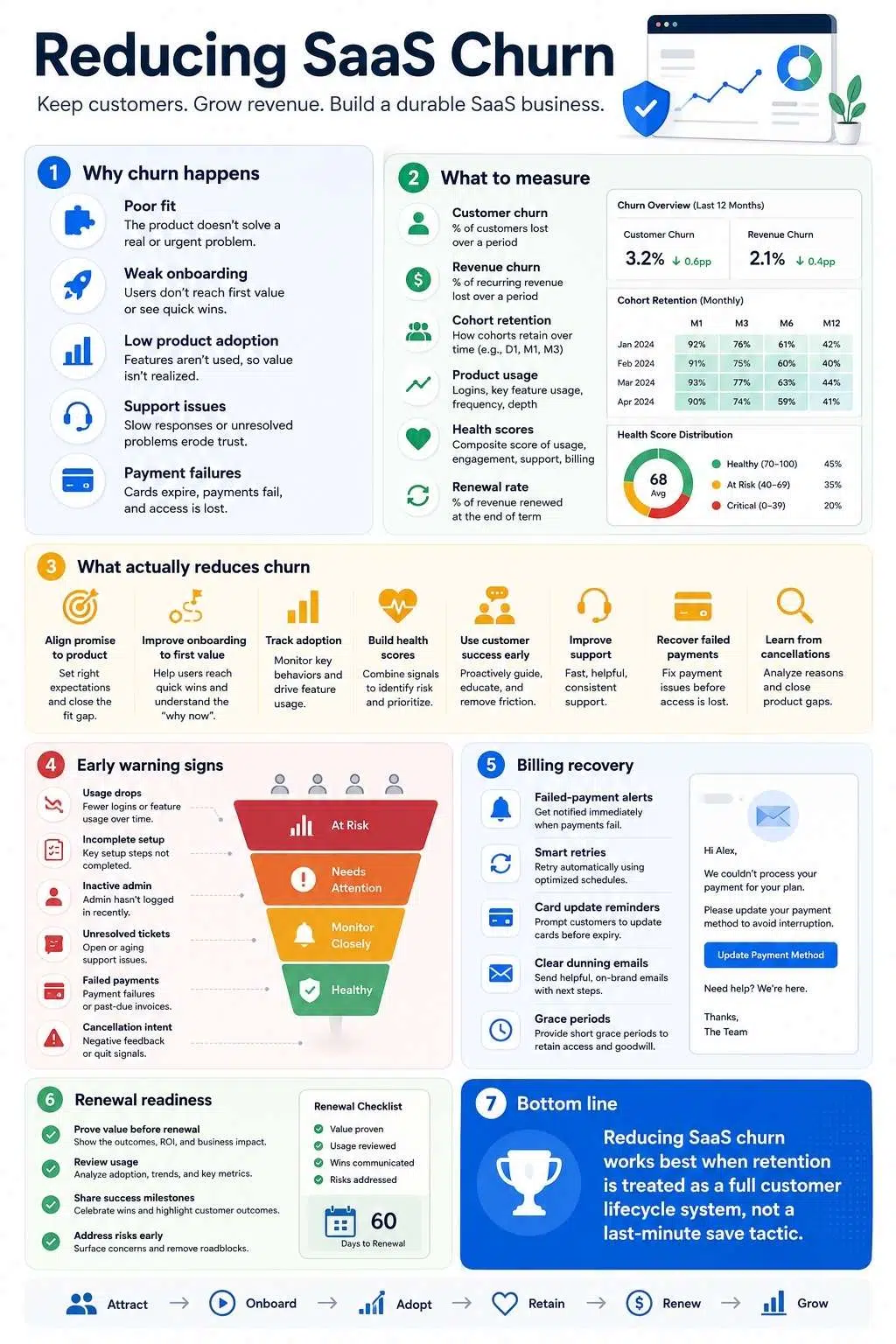
Not all churn has the same cause. Not all churn needs the same fix. Before building a churn prevention plan, separate the main types.
| Churn Type | What It Means | Common Cause |
| Customer churn | Customers cancel or do not renew | Poor fit, low value, weak adoption, support issues |
| Revenue churn | Recurring revenue is lost | Cancellations, downgrades, failed payments |
| Voluntary churn | Customer actively chooses to leave | Product mismatch, poor ROI, competitor switch |
| Involuntary churn | Customer leaves because payment fails | Expired cards, failed charges, billing errors |
| Logo churn | Number of customer accounts lost | Common in B2B SaaS reporting |
| Gross revenue churn | Revenue lost before expansion revenue | Useful for measuring retention quality |
| Net revenue churn | Revenue lost after upgrades and expansion | Shows whether expansion offsets losses |
This matters because each type points to a different problem.
- If churn comes from poor activation, improve onboarding.
- If churn comes from failed payments, fix billing recovery.
- If churn comes from low-fit customers, fix acquisition and qualification.
- If churn comes from downgrades, review pricing, packaging, and value delivery.
- If churn comes from enterprise renewals, improve customer success and executive alignment.
You cannot fix churn properly if you treat every lost customer the same.
Why Reducing SaaS Churn Matters So Much
SaaS businesses grow on recurring revenue. That sounds beautiful until churn enters the picture. When customers leave too quickly, every part of the business gets harder.
Marketing has to work harder because new customers only replace lost ones. Sales becomes more expensive because acquisition must outrun cancellations. Customer success becomes reactive. Product teams chase urgent complaints. Founders become obsessed with top-line growth while the base quietly leaks underneath.
High churn creates a treadmill business. You keep running, but the company does not move forward as fast as it should.
Reducing churn improves:
- Customer lifetime value
- Payback period
- Net revenue retention
- Forecasting confidence
- Product adoption
- Expansion opportunities
- Founder stress
- Investor confidence
- Team focus
Churn reduction is not just a customer success metric. It is a growth strategy.
Reducing SaaS Churn Starts Before the Customer Buys
Many SaaS teams make a painful mistake: they treat churn as a post-sale problem. It is not. Churn often begins in marketing and sales. If you attract the wrong audience, promise too much, hide limitations, oversell features, or target users who are not ready for your product, customer retention will suffer later.
A bad-fit customer may convert. They may even pay for a month or two. But they will not stay. To prevent this, your acquisition strategy should answer:
- Who gets the most value from this product?
- Who should not buy it yet?
- What problem do we solve best?
- What problem do we not solve?
- What setup work is required?
- What results are realistic?
- Which customers tend to stay longest?
- Which acquisition channels bring low-retention users?
- Which sales promises create later disappointment?
Reducing SaaS churn means improving customer fit before the signup.
A clean conversion rate means little if those customers leave quickly.
SaaS Churn Reduction Strategy: What Actually Works
The best churn prevention strategies are practical, measurable, and tied to customer behavior. Here are the strategies SaaS teams should prioritize.
1. Measure the Right Churn Metrics First
You cannot reduce churn if you are measuring the wrong thing. A single churn number is rarely enough. You need to know what is leaving, why it is leaving, and where it is happening.
Track these metrics:
| Metric | Why It Matters |
| Customer churn rate | Shows how many customers leave |
| Revenue churn rate | Shows how much recurring revenue is lost |
| Gross revenue retention | Shows how much revenue you keep before expansion |
| Net revenue retention | Shows whether expansion offsets churn and downgrades |
| Logo retention | Shows how many accounts stay |
| Product usage retention | Shows whether users continue using the product |
| Cohort retention | Shows retention by signup month, plan, segment, or channel |
| Involuntary churn rate | Shows revenue lost to failed payments |
| Downgrade rate | Shows pricing, packaging, or value pressure |
| Renewal rate | Shows retention at contract renewal points |
The goal is not to build a dashboard nobody uses. The goal is to see the real churn pattern.
For example:
- If free trial users churn fast, your activation path may be weak.
- If paid users churn after three months, the product may not become a habit.
- If annual customers churn at renewal, value proof may be missing.
- If small accounts churn but mid-market accounts stay, your ideal customer profile may need tightening.
- If payment failures are high, your billing recovery system needs work.
Start with measurement before jumping into fixes.
2. Segment Churn Instead of Averaging It
Average churn can mislead you. A 5% churn rate may look acceptable until you realize one customer segment is leaving at 15% while another is staying and expanding.
Break down churn by:
- Customer size
- Plan type
- Acquisition channel
- Industry
- Use case
- Geography
- Onboarding path
- Sales-assisted vs self-serve
- Monthly vs annual plans
- Feature usage
- Support history
- Time since signup
- Team size
- Payment method
This helps you identify where the real problem sits.
For example:
| Segment Pattern | What It May Mean |
| High churn from paid ads | Acquisition targeting may be too broad |
| High churn from low-priced plan | Plan may attract users with weak intent |
| High churn after trial | First value moment may be unclear |
| High churn after discount period | Price-value mismatch may exist |
| High churn in one industry | Product may not fit that workflow |
| High churn among solo users | Team features may be key to retention |
| High churn after support tickets | Support quality may affect loyalty |
Do not ask, “Why do customers churn?”
Ask, “Which customers churn, when, and after what behavior?”
That question is much more useful.
3. Fix the Gap Between Marketing Promise and Product Reality
One of the fastest ways to create churn is to sell a future version of the product. SaaS marketing often creates this problem without meaning to. The website sounds broad. The sales team wants to win deals. The product page highlights ideal outcomes. The demo shows a perfect use case. Then, customers enter the product and discover the truth is more limited. That gap damages trust.
To reduce churn, review your messaging honestly:
- Does the homepage describe what the product does today?
- Are feature claims accurate?
- Are integrations described clearly?
- Are limitations explained before purchase?
- Do sales and marketing target the same ideal customer?
- Are customers buying for the use case your product actually supports best?
- Are demos showing realistic workflows?
- Are pricing pages clear about limits?
- Are onboarding expectations explained before signup?
This does not mean your copy should be timid. It means your copy should be accurate. Strong positioning attracts the right customers. Overpromising attracts churn.
4. Improve Onboarding Around the First Value Moment
Onboarding is not a product tour. It is not a long checklist of every feature. It is not a pop-up parade. It is not a welcome email that says, “Explore the dashboard.” Good onboarding gets the customer to value as quickly and clearly as possible. First, define the first value moment.
Examples:
| SaaS Product Type | First Value Moment |
| Email marketing SaaS | User creates and sends or schedules a campaign |
| CRM SaaS | User imports contacts and manages first deal |
| Project management SaaS | User creates a project and assigns work |
| Analytics SaaS | User connects data and sees a useful dashboard |
| AI writing SaaS | User creates a usable draft or content asset |
| HR SaaS | User posts a job or creates an employee workflow |
| Finance SaaS | User imports transactions or generates a report |
Then design onboarding around that moment.
Ask:
- What does the user need to do first?
- Which steps can be removed?
- Which steps can wait until later?
- Where do users hesitate?
- Where do users abandon setup?
- Can templates or sample data help?
- Can the product show progress?
- Can contextual help appear only when needed?
- Does the user know what success looks like?
A user who reaches value quickly is more likely to return. A user who gets trapped in setup is already at risk.
5. Build Activation Triggers Based on Behavior
Not every new user needs the same message. A user who has not completed setup needs a different prompt from a user who completed setup but did not invite teammates. A user who invited teammates but never used the core feature needs another kind of help. Behavior-based activation is stronger than generic email sequences.
Trigger guidance based on actions such as:
- Signed up but did not verify email
- Verified email but did not create workspace
- Created workspace but did not complete setup
- Completed setup but did not use core feature
- Used core feature once but did not return
- Created project but did not invite team
- Added data but did not generate output
- Started trial but did not reach first value
- Hit usage limit but did not upgrade
Each trigger should help the user take the next useful step. Avoid nagging.
A good activation message is specific:
“You created your workspace but haven’t invited your team yet. Invite one teammate to test the workflow together.”
That is better than:
“Come back and explore more features.”
Specific guidance reduces friction. Generic reminders create inbox noise.
6. Track Product Adoption, Not Just Logins
Logins are not enough. A customer may log in because they are confused. Another may log in once a month and still get strong value. A third may have many users, but none of them use the feature that predicts retention. Product adoption means customers are using the product in ways connected to long-term value.
Track adoption signals such as:
- Core feature usage
- Frequency of meaningful actions
- Number of active users per account
- Team invite rate
- Workflow completion
- Integration usage
- Reports created
- Automations activated
- Projects completed
- Data imported
- Templates used
- Collaboration activity
- Repeat usage after the first value
The right adoption metric depends on the product.
- For a social scheduling SaaS, scheduled posts may matter more than dashboard visits.
- For a reporting SaaS, generated reports may matter more than login count.
- For a team collaboration SaaS, active seats may matter more than one admin using the account.
Find the behavior that predicts retention. Then help more customers do it.
7. Create Customer Health Scores That Are Actually Useful
A customer health score should not be a decorative number. It should help your team spot risk and take action.
A useful SaaS health score may include:
- Product usage
- Feature adoption
- Active users
- Admin engagement
- Support ticket history
- Billing status
- NPS or satisfaction feedback
- Onboarding completion
- Renewal date
- Account growth or contraction
- Executive sponsor activity
- Training attendance
- Integration usage
- Time since last meaningful action
Keep it simple at first.
For example:
| Signal | Healthy | At Risk |
| Core feature usage | Used weekly | Not used in 14+ days |
| Team adoption | Multiple active users | Only admin active |
| Onboarding | Completed key setup | Setup incomplete |
| Support | Few unresolved issues | Repeated unresolved tickets |
| Billing | Payments current | Failed payment or expired card |
| Renewal | Value reviewed | No recent success conversation |
The health score should trigger action. If an account becomes at risk, the team should know who follows up, what they check, and what message they send. A health score without a playbook is just a dashboard with anxiety.
8. Use Customer Success Before the Renewal Is in Danger
Customer success should not show up only when a customer is about to cancel. By then, the relationship may already be damaged. Strong customer retention SaaS programs focus on outcomes throughout the lifecycle.
For B2B SaaS, this may include:
- Kickoff calls
- Implementation planning
- Success milestones
- Training sessions
- Usage reviews
- Business reviews
- Adoption reports
- Renewal preparation
- Expansion planning
- Executive check-ins
For self-serve SaaS, customer success may be more automated:
- Smart onboarding
- Lifecycle emails
- In-app nudges
- Help center content
- Usage-based tips
- Customer webinars
- Office hours
- Product education
- Community support
- Automated risk alerts
The format can differ. The principle is the same. Help customers succeed before they wonder whether the product is worth paying for.
9. Make Support a Retention Channel
Support is not just a cost center. For many SaaS customers, support is where trust is either repaired or destroyed. A customer who gets fast, clear help may stay even after a bug. A customer who gets slow, vague help may churn even if the product is decent.
To reduce churn, improve support in areas that affect retention:
- First response time
- Time to resolution
- Quality of answer
- Escalation process
- Bug communication
- Help doc quality
- Support handoff to success
- Repeated issue tracking
- Billing question handling
- Tone and empathy
Also, look at support data as a churn signal. If many churning customers previously contacted support about the same issue, that issue is not just a support problem. It is a retention problem.
Create a regular review process:
- Top support issues this month
- Issues linked to cancellation
- Issues causing onboarding delay
- Issues causing payment confusion
- Issues causing low adoption
- Help docs that need improvement
- Product fixes that would reduce tickets
Support tickets are not interruptions from customers.
They are customers telling you where the product is leaking trust.

10. Reduce Involuntary Churn With Better Billing Recovery
Some customers do not churn because they dislike the product. They churn because the payment fails. Cards expire. Banks decline charges. Payment methods become outdated. Invoices get missed. Finance teams change. Admins leave the company. This is involuntary churn, and it is one of the most preventable forms of SaaS churn.
To reduce it:
- Send payment failure notifications quickly
- Use smart payment retries
- Offer card update links
- Remind users before cards expire
- Allow multiple payment methods when appropriate
- Notify both billing admins and account owners
- Make invoice access easy
- Use clear dunning emails
- Avoid threatening language too early
- Give grace periods for good customers
- Track recovered revenue
- Monitor failed payment reasons
The tone matters. A good failed payment email should be simple and helpful:
“We couldn’t process your latest payment. You can update your billing details here to keep your account active.”
A bad one sounds cold or aggressive. Billing recovery is part of customer experience. Treat it that way.
11. Offer Plan Flexibility Before Customers Cancel
Sometimes customers churn because the plan no longer fits. They may need fewer seats. They may be between projects. They may want to pause. They may need a lower tier. They may not be ready for the full package.
Before cancellation, offer reasonable alternatives:
- Downgrade plan
- Pause subscription
- Reduce seats
- Switch billing cycle
- Move to annual with discount
- Offer temporary retention plan
- Remove unused add-ons
- Provide startup or nonprofit plan if relevant
- Offer usage-based pricing where appropriate
Do not use this as a dark pattern. Do not hide cancellation. Do not trap users in confusing flows. The goal is to give customers an honest path that matches their current need.
A customer who downgrades may grow again later. A customer who feels trapped may leave forever and tell others.
12. Learn From Cancellation Without Making It Painful
Cancellation flows should collect useful feedback, but they should not punish the customer.
Ask one or two focused questions:
- What is the main reason you are canceling?
- What could have made the product more useful?
- Are you switching to another tool?
- Was pricing the main issue?
- Did you reach the value you expected?
- Can we contact you for feedback?
Use the answers to identify patterns.
Common churn reasons include:
| Cancellation Reason | Possible Fix |
| Too expensive | Review pricing, packaging, value communication |
| Not using it enough | Improve adoption and habit formation |
| Missing feature | Review roadmap and ideal customer fit |
| Too hard to use | Improve UX and onboarding |
| Chose competitor | Review positioning and differentiation |
| Poor support | Improve support quality and escalation |
| Project ended | Offer pause or lighter plan |
| Payment failed | Improve billing recovery |
Do not treat every cancellation reason as equally true. Sometimes users choose the easiest answer. Sometimes “too expensive” really means “not valuable enough.” Sometimes “missing feature” means the product was sold to the wrong customer. Look for patterns, not isolated comments.
13. Build Renewal Readiness Long Before Renewal Time
For annual SaaS contracts, churn often becomes visible at renewal. But the renewal decision starts much earlier. Customers renew when they can clearly see value. That means you need to document and communicate value during the contract period, not only at the end.
For B2B SaaS, create a renewal readiness process:
- Confirm success criteria during onboarding
- Track progress against those goals
- Share adoption reports
- Identify inactive teams or seats
- Review business outcomes
- Gather internal champions
- Prepare renewal conversations early
- Address unresolved issues before renewal
- Reconfirm executive value
- Discuss expansion only after the value is clear
Do not enter renewal season with this question:
“Do you want to renew?”
Enter with this:
“Here is what your team achieved, where adoption is strong, where there is still friction, and what we recommend next.”
That conversation is much stronger.
14. Turn Product Education Into Retention
Many customers churn because they never discover the features that would have made the product sticky. That is painful because the value already exists. The customer just never reached it.
Use product education to increase adoption:
- Use-case-based webinars
- Short tutorial videos
- In-app guidance
- Tooltips at the right moment
- Customer examples
- Feature announcement emails
- Template libraries
- Help center guides
- Checklists
- Interactive walkthroughs
- Community demos
- Lifecycle campaigns based on usage
But do not overwhelm customers. Feature education should be relevant to what the user is trying to do.
If a user has not completed basic setup, do not promote advanced automation. If a user has not invited their team, do not push enterprise reporting. If a user has not created one project, do not explain twenty integrations.
The right lesson at the right moment improves retention. The wrong lesson becomes noise.
15. Identify At-Risk Customers Early
Churn prevention works best when you act early. Build risk alerts around behavior.
Examples:
- No login in 14 days
- Drop in core feature usage
- Admin inactive
- Key user left the company
- Team seats unused
- Failed payment
- Multiple unresolved support tickets
- Negative feedback
- Renewal within 60 days and low adoption
- Feature usage dropped after onboarding
- No integration connected
- No report/project/campaign created
- Downgrade attempt
- Cancellation page visit
Once a risk signal appears, do not send the same message to everyone.
Match the response to the problem.
| Risk Signal | Better Response |
| Setup incomplete | Offer setup help or quick-start guide |
| Core feature unused | Send focused use-case walkthrough |
| Team inactive | Help admin invite or train users |
| Support frustration | Escalate and resolve quickly |
| Payment failed | Send helpful billing update link |
| Renewal near with low usage | Schedule success review |
| Cancellation page visit | Ask what is missing and offer options |
Early risk signals are only useful if someone acts on them.
16. Improve the Product, Not Just the Messaging
Some churn cannot be fixed with emails, discounts, or customer success calls. Sometimes the product is the problem.
Watch for product-level churn signals:
- Users repeatedly fail the same task
- A key feature is confusing
- Setup takes too long
- The product is slow
- Integrations break often
- Users need support for basic actions
- Reporting does not answer real questions
- Collaboration workflows are weak
- Mobile experience is poor
- Permissions are confusing
- The product creates more work than it removes
When these patterns appear, do not blame customers for “not getting it.” Fix the product experience.
The best churn reduction strategy is often removing friction from the core workflow.
17. Use Pricing and Packaging Carefully
Pricing can reduce or increase churn.
- If pricing is confusing, customers hesitate.
- If plan limits feel unfair, customers downgrade.
- If the cheapest plan attracts poor-fit users, churn rises.
- If the value is not clear, the product feels expensive even when it is affordable.
Review pricing through a retention lens:
- Do customers understand the plans?
- Does each plan match a real customer segment?
- Are limits tied to value?
- Are upgrade prompts timed well?
- Are customers forced into plans they do not need?
- Do high-retention customers prefer specific plans?
- Do low-retention customers cluster in one plan?
- Are discounts attracting weak-fit users?
- Are annual plans creating better retention or hiding adoption problems?
The goal is not always lower pricing.
Sometimes, better packaging reduces churn more than a discount.
18. Build a Customer Feedback Loop That Product Teams Actually Use
Feedback only reduces churn if it changes decisions.
Collect feedback from:
- Cancellation surveys
- Support tickets
- Sales calls
- Customer success notes
- User interviews
- Product analytics
- NPS or CSAT responses
- Review sites
- Community discussions
- Feature request boards
- Onboarding surveys
- Renewal conversations
Then organize it. Do not dump everything into one endless list.
Separate feedback by:
- Bug
- Usability issue
- Missing feature
- Pricing concern
- Onboarding confusion
- Integration request
- Performance issue
- Support problem
- Positioning mismatch
- Customer fit issue
Prioritize feedback based on:
- Frequency
- Revenue impact
- Customer segment
- Churn connection
- Strategic fit
- Development effort
- Severity
- Long-term value
A feature request from one poor-fit customer should not derail the roadmap.
A repeated blocker from your best-fit customers should get serious attention.
19. Build Retention Into the First 30, 60, and 90 Days
The early customer journey deserves special attention. Many churn problems are created early, even if cancellation happens later. Use a 30-60-90 day retention plan.
First 30 Days: Activation
Focus on:
- Setup completion
- First value moment
- Core workflow usage
- User confidence
- Basic training
- Removing friction
- Fast support
- Clear next steps
Main question:
Did the customer experience real value?
Days 31–60: Adoption
Focus on:
- Repeat usage
- Team adoption
- Advanced but relevant features
- Integrations
- Habit formation
- Use-case expansion
- Product education
- Early success proof
Main question:
Is the product becoming part of the customer’s workflow?
Days 61–90: Retention Foundation
Focus on:
- Measurable outcomes
- Account health
- Stakeholder alignment
- Usage consistency
- Expansion signals
- Risk signals
- Value communication
- Renewal readiness for annual accounts
Main question:
Does the customer have a strong reason to keep paying?
This simple framework helps teams stop treating retention as a last-minute renewal problem.
20. Create a SaaS Churn Reduction Playbook
A playbook turns churn prevention from guesswork into repeatable action.
Your churn reduction playbook should include:
- Churn definitions
- Key retention metrics
- Customer segments
- Health score rules
- Onboarding milestones
- Activation triggers
- Risk alerts
- Support escalation process
- Billing recovery process
- Cancellation feedback process
- Win-back process
- Renewal timeline
- Customer success ownership
- Product feedback workflow
- Monthly churn review format
Keep it practical.
SaaS Churn Prevention Checklist
Use this checklist to audit your current retention system.
| Area | Question |
| Customer fit | Are we attracting customers who truly need the product? |
| Messaging | Are we setting honest expectations before signup? |
| Onboarding | Can users reach first value quickly? |
| Activation | Do we track and improve key activation steps? |
| Adoption | Are customers using the features tied to retention? |
| Health scoring | Can we identify risk before cancellation? |
| Support | Are recurring issues being fixed or only answered? |
| Billing | Do we recover failed payments with helpful reminders? |
| Product | Are usability problems driving churn? |
| Pricing | Do plans match customer value and usage? |
| Renewal | Do customers see value before renewal conversations? |
| Cancellation | Are we learning from churn without creating frustration? |
| Feedback | Does feedback influence product and success priorities? |
If several answers are “no,” the churn problem is probably not one thing.
It is a system problem.
Best Metrics for Reducing SaaS Churn
A good churn dashboard should show both outcomes and leading indicators.
| Metric Type | Examples |
| Churn outcomes | Customer churn, revenue churn, logo churn |
| Revenue retention | Gross revenue retention, net revenue retention |
| Activation | Setup completion, first value moment, onboarding completion |
| Adoption | Core feature usage, active seats, workflow completion |
| Engagement | Repeat usage, session frequency, key action frequency |
| Support | Ticket volume, resolution time, repeated issues |
| Billing | Failed payments, recovered payments, involuntary churn |
| Satisfaction | NPS, CSAT, qualitative feedback |
| Renewal | Renewal rate, downgrade rate, expansion rate |
| Risk | Health score, inactivity, cancellation intent |
Do not try to optimize every metric at once. Pick the metrics that connect most clearly to your churn pattern.
Common Mistakes SaaS Teams Make When Trying to Reduce Churn
Only Acting When Customers Cancel
Cancellation is the end of the churn story, not the beginning. The work starts when usage drops, onboarding fails, or value becomes unclear.
Blaming Customer Success for Everything
Customer success matters, but churn can come from bad-fit acquisition, poor onboarding, weak product adoption, pricing confusion, billing failures, or product friction.
Measuring Churn Too Broadly
Average churn hides segment problems. Break down churn by plan, customer size, channel, use case, and lifecycle stage.
Overusing Discounts
Discounts may save some accounts temporarily, but they do not fix missing value. Use discounts carefully and only when the customer still has a real fit.
Making Cancellation Difficult
A frustrating cancellation flow may reduce visible cancellations in the short term, but it damages trust and brand reputation.
Ignoring Involuntary Churn
Failed payments are often recoverable. Treat billing recovery as part of retention, not an accounting afterthought.
Confusing Feature Usage With Value
A user may click around without getting value. Track meaningful actions, not shallow activity.
Waiting Too Long to Talk to Customers
If you only ask for feedback after churn, you are learning late. Talk to active, inactive, happy, frustrated, and recently canceled customers.
A 30-Day Plan for Reducing SaaS Churn
If your churn is already too high, do not try to fix everything at once. Start with a focused 30-day plan.
Week 1: Diagnose the Churn Pattern
- Calculate customer churn and revenue churn
- Segment churn by plan, channel, and customer type
- Review cancellation reasons
- Identify top churn timing windows
- Separate voluntary and involuntary churn
- Review support tickets from churned customers
Week 2: Fix Early Lifecycle Friction
- Review onboarding drop-offs
- Define or refine the first value moment
- Improve setup guidance
- Add templates or sample data
- Create behavior-based activation emails
- Contact stuck users manually if needed
Week 3: Build Risk and Recovery Systems
- Create a basic customer health score
- Set inactivity alerts
- Improve failed payment recovery
- Build support escalation rules
- Create at-risk customer playbooks
- Review low-adoption accounts
Week 4: Improve Long-Term Retention
- Run customer interviews
- Update help docs
- Review pricing and plan mismatch
- Prioritize product fixes tied to churn
- Build a renewal readiness process
- Create a monthly churn review meeting
This will not solve every retention problem in 30 days. But it will help you move from panic to control.
The Bottom Line on Reducing SaaS Churn
Reducing SaaS churn is not one tactic. It is not one email, not one discount, not one customer success call, or not one new feature.
It is the discipline of making sure the right customers reach the right value at the right time, with fewer obstacles, clearer support, better product adoption, and stronger proof that the subscription is worth keeping. The companies that reduce churn usually do the boring work well.
They measure honestly. They segment carefully. They onboard with purpose. They watch behavior. They recover failed payments. They support quickly. They fix product friction. They learn from cancellation. They prove value before renewal.
That is not glamorous. But in SaaS, retention is where growth becomes real. A company that keeps more of the right customers does not have to chase every new signup with desperation. It can build on a stronger base.
That is what churn prevention really does. It gives SaaS growth a foundation that does not keep leaking.
Frequently Asked Questions About Reducing SaaS Churn
1. What is the best way to start reducing SaaS churn?
Start by measuring churn correctly and segmenting it. Look at customer churn, revenue churn, voluntary churn, involuntary churn, and churn by plan, channel, and customer type. Once you know where churn is happening, you can fix the right problem instead of guessing.
2. What causes SaaS churn?
SaaS churn is usually caused by poor customer fit, weak onboarding, low product adoption, unclear value, bad support experiences, pricing mismatch, missing features, failed payments, or a gap between what was promised and what the product actually delivers.
3. How does onboarding help with SaaS churn reduction?
Onboarding helps reduce churn by guiding users to the first value moment faster. If users understand what to do, complete the setup, and experience a useful result early, they are more likely to return and keep using the product.
4. What is churn prevention in SaaS?
Churn prevention is the process of identifying and fixing churn risks before customers cancel. It includes tracking product usage, customer health, billing failures, support issues, onboarding drop-offs, renewal risks, and customer feedback.
5. How can SaaS companies reduce involuntary churn?
SaaS companies can reduce involuntary churn by improving payment recovery. This includes smart payment retries, failed-payment emails, card update links, expiring-card reminders, billing admin notifications, grace periods, and clear invoice access.
6. What metrics should SaaS teams track for customer retention?
SaaS teams should track customer churn, revenue churn, gross revenue retention, net revenue retention, activation rate, onboarding completion, core feature usage, active users per account, support issues, failed payments, downgrade rate, and renewal rate.