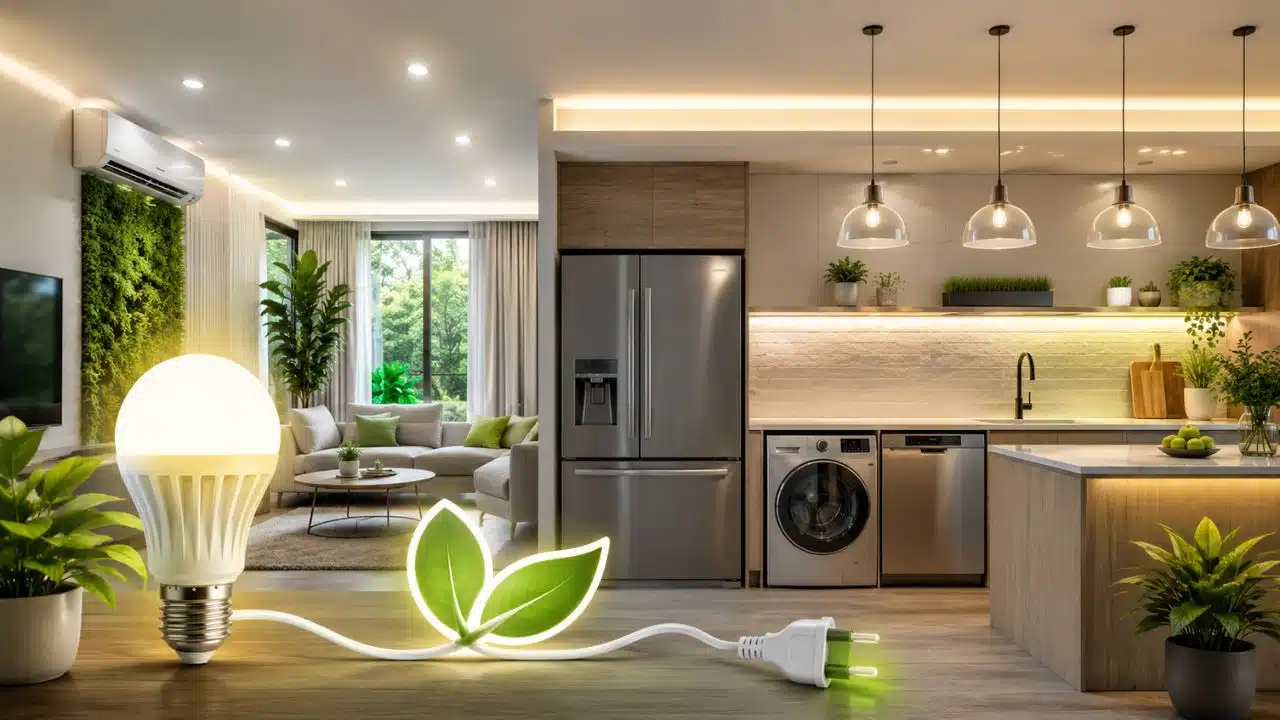
The benefits of using energy-efficient LED lights and appliances show up in a very real place: your monthly utility bill. Most people don’t waste electricity on purpose. It happens quietly. An old bulb stays on for hours. A refrigerator runs all day. A washer uses more water than needed. A TV, charger, or router keeps pulling power in the background.
At first, it doesn’t look like much. But over a full month, and then over a full year, those small habits and old devices can cost a lot.
That’s where modern LED lights and efficient appliances make sense. They don’t ask you to give up comfort. They simply use better technology to do the same job with less electricity.
A good LED bulb still lights the room. An efficient refrigerator still keeps food fresh. A smart washer still cleans clothes. The difference is that your home wastes less energy to get those jobs done.
That matters more now because electricity costs are rising in many places. In the United States, the average residential electricity price reached 18.83 cents per kilowatt-hour in March 2026, according to the U.S. Energy Information Administration.
So, saving energy is no longer just a “green” choice. It’s also a smart money decision.
Why Energy-Efficient LED Lights and Appliances Matter Today
Modern homes use a lot more electricity than they did a generation ago.
We now run laptops, phones, routers, smart TVs, kitchen gadgets, air conditioners, washing machines, security cameras, and chargers almost every day. Add old lights and outdated appliances to that list, and the electricity bill can rise fast.
The International Energy Agency reports that buildings account for around 30% of global energy demand. That means home energy use is not a small issue. It affects families, cities, power grids, and the environment.
Energy-efficient LED lights and appliances help because they cut waste without making daily life harder.
| Home Area | Common Energy Waste | Smarter Choice | Practical Benefit |
|---|---|---|---|
| Lighting | Incandescent or halogen bulbs | LED bulbs | Lower power use and longer life |
| Kitchen | Old refrigerator or freezer | ENERGY STAR certified model | Lower daily running cost |
| Laundry | Older washer and dryer | Efficient washer and sensor dryer | Less energy and water use |
| Cooling and heating | Manual temperature control | Smart thermostat | Less wasted heating and cooling |
| Entertainment | Inefficient TV and standby devices | Efficient TV and smart power strip | Lower active and standby power |
Electricity Costs Make Every Watt Count
When electricity is cheap, waste is easier to ignore.
But when prices rise, every wasted watt matters. A single old bulb may not look expensive. But if several old bulbs run for hours every day, the cost adds up.
The same is true for appliances. A refrigerator runs 24 hours a day. A dryer uses high heat. A washer uses water and electricity. These products quietly shape the monthly bill.
That’s why energy efficiency is no longer just a technical topic. It’s part of smart home budgeting.
You Don’t Have to Give Up Comfort
Energy efficiency doesn’t mean sitting in a dim room or washing dishes by hand.
A good LED bulb gives bright, clean light while using much less electricity. A modern dishwasher can clean dishes with less hot water. A smart thermostat can reduce waste while still keeping your home comfortable.
That’s the best part. You save energy without making life inconvenient.
The Biggest Savings Come From Daily Use
The most-used products deserve the most attention.
A porch light that stays on all night matters. A refrigerator that runs all day matters. A washer used several times a week matters.
The rule is simple: the longer something runs, the more important its efficiency becomes.
Benefits of Using Energy-Efficient LED Lights and Appliances
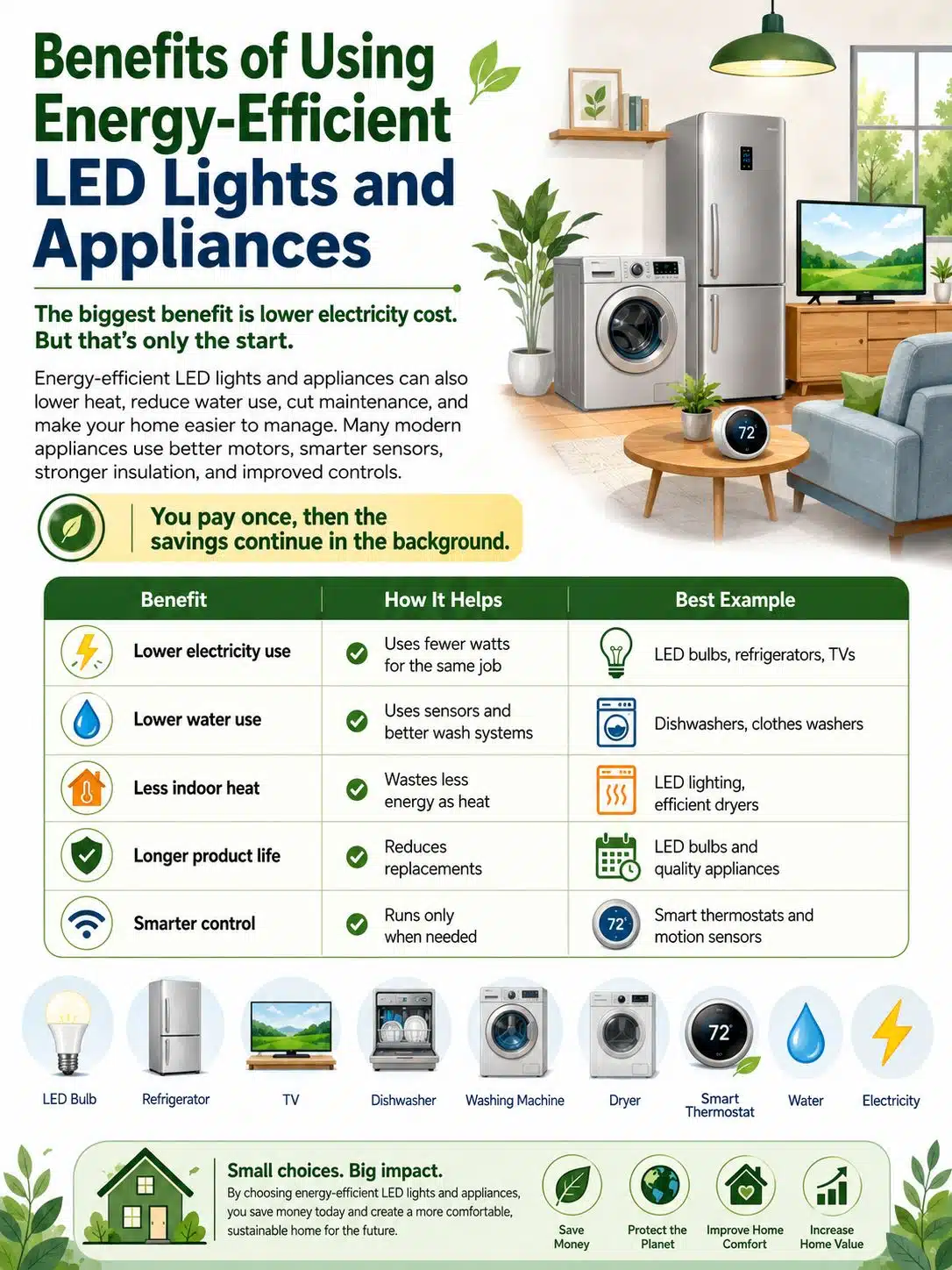
The biggest benefit is lower electricity cost. But that’s only the start.
Energy-efficient LED lights and appliances can also lower heat, reduce water use, cut maintenance, and make your home easier to manage. Many modern appliances use better motors, smarter sensors, stronger insulation, and improved controls.
You pay once, then the savings continue in the background.
| Benefit | How It Helps | Best Example |
|---|---|---|
| Lower electricity use | Uses fewer watts for the same job | LED bulbs, refrigerators, TVs |
| Lower water use | Uses sensors and better wash systems | Dishwashers, clothes washers |
| Less indoor heat | Wastes less energy as heat | LED lighting, efficient dryers |
| Longer product life | Reduces replacements | LED bulbs and quality appliances |
| Smarter control | Runs only when needed | Smart thermostats and motion sensors |
Lower Monthly Utility Bills
This is the benefit most people care about first.
LED bulbs use far less power than old incandescent bulbs. The U.S. Department of Energy says residential LEDs use at least 75% less energy and last up to 25 times longer than incandescent lighting.
That’s a big difference for something as simple as a light bulb.
Appliances work the same way. A better refrigerator, washer, dishwasher, dryer, or thermostat can reduce the energy used for daily tasks. The savings may look small each day, but they become meaningful over time.
Less Heat Inside the Home
Old incandescent bulbs waste a lot of electricity as heat.
That heat can make a room feel warmer, especially in small rooms or hot climates. LEDs stay much cooler. That makes them better for bedrooms, kitchens, offices, shops, and workspaces.
Efficient appliances also handle heat more wisely. For example, heat pump dryers reuse heat instead of constantly pushing hot air out.
Less wasted heat means more comfort and less pressure on cooling systems.
Fewer Replacements and Less Hassle
LED bulbs last much longer than old bulbs.
That means fewer trips to the store. Fewer ladder climbs. Fewer dead bulbs in ceiling fixtures. This matters even more for outdoor lights, stair lights, high ceilings, and commercial spaces.
Efficient appliances can also reduce wear when used correctly. A washer with a strong spin cycle can remove more water from clothes, which reduces dryer time. A dryer with moisture sensors can stop before clothes get over-dried.
Energy-Efficient LED Lights and Appliances for Lower Bills
The phrase energy-efficient LED lights and appliances may sound technical, but the idea is simple.
A product should use most of its energy for the job you actually want. A bulb should make light, not heat. A refrigerator should keep food cold without running too hard. A washer should clean clothes without wasting water.
That is what efficiency really means.
| Product Type | Old Problem | Efficient Solution | Result |
|---|---|---|---|
| Light bulb | Wastes energy as heat | LED technology | Same brightness with less power |
| Refrigerator | Runs too often | Better compressor and insulation | Lower 24/7 energy use |
| Washer | Uses too much water | Load sensing and efficient motor | Less water and energy waste |
| Dryer | Over-dries clothes | Moisture sensors or heat pump system | Lower heat waste |
| Thermostat | Runs HVAC when not needed | Smart schedule and sensors | Lower heating and cooling cost |
LEDs Use Less Power for the Same Brightness
Many people still judge bulbs by watts. That habit comes from the old incandescent days.
With LEDs, lumens matter more. Lumens tell you how bright the bulb is. Watts tell you how much electricity it uses.
A 9-watt LED can often replace a 60-watt incandescent bulb. The room still gets bright, but the energy use drops sharply.
Appliances Save Through Better Engineering
Efficient appliances don’t save energy by doing less work. They save energy by working smarter.
Refrigerators use better insulation and compressors. Washing machines use load sensors and efficient motors. Dishwashers use better spray patterns and soil sensors. Dryers use moisture sensors or heat pump technology.
These changes help the appliance avoid waste.
Smart Controls Add Another Layer of Savings
Smart controls help because people forget things.
We forget to turn off lights. We leave chargers plugged in. We keep heating or cooling running when nobody needs it.
Timers, smart plugs, sensors, and smart thermostats help reduce those small mistakes. They don’t need much attention, but they can quietly cut waste.
LED Lighting: The Easiest Upgrade for Most Homes
LED lighting is usually the best place to start.
It’s affordable. It’s simple. It doesn’t need major installation. In many cases, you just remove the old bulb and screw in the LED.
LED adoption is already high. The U.S. Energy Information Administration reported that 90% of U.S. households used LED bulbs in 2024, and 63% used mostly LEDs for indoor lighting.
That tells us something important. LEDs are no longer a fancy upgrade. They’re the normal lighting choice now.
| LED Buying Factor | What It Means | Why It Matters |
|---|---|---|
| Lumens | Brightness | Helps you choose the right light level |
| Watts | Energy use | Lower watts save power |
| Color temperature | Warm, neutral, or cool light | Changes the mood of the room |
| CRI | Color accuracy | Makes colors look more natural |
| Dimmable label | Works with dimmer switches | Useful for bedrooms and living rooms |
| Fixture rating | Safe for enclosed or outdoor use | Prevents early failure |
Choose Lumens, Not Watts
If you want the right brightness, check lumens first.
Watts only tell you how much power the bulb uses. Lumens tell you how much light it gives.
This small change helps you avoid buying bulbs that are too dim, too harsh, or too costly to run.
Match the Light Color to the Room
LEDs come in different shades of white.
Warm white feels soft and cozy. It works well in bedrooms, dining rooms, and living rooms.
Neutral white works well in kitchens and bathrooms.
Cool white can suit garages, offices, and task areas.
A home feels better when the light matches the room’s purpose.
Use Timers, Sensors, and Dimmers
LEDs save energy by themselves. Controls make them even better.
Motion sensors work well in hallways, staircases, bathrooms, garages, and outdoor spaces. Timers help porch lights turn off automatically. Dimmers let you reduce brightness when full light is not needed.
Smart bulbs can be useful too, but only if you actually use the smart features. For many rooms, a normal LED bulb is enough.
Which Appliances Save the Most Energy?
Not every appliance deserves the same priority.
The best targets are appliances that run often, use heat, or use water. Refrigerators, washers, dryers, dishwashers, air conditioners, and thermostats usually matter most.
Energy-efficient LED lights and appliances work best when you choose them based on real use, not just style or brand name.
| Appliance | Why It Matters | Verified Efficiency Point |
|---|---|---|
| Refrigerator | Runs all day and night | ENERGY STAR models are about 9% more efficient than the federal minimum standard |
| Clothes washer | Uses water and electricity | Certified models use about 20% less energy and 30% less water |
| Dishwasher | Uses hot water and electricity | Certified models can save water and energy compared with handwashing |
| Clothes dryer | Uses high heat | Certified dryers use sensors and lower-heat options |
| Smart thermostat | Controls HVAC runtime | Certified models save about 8% of heating and cooling bills on average |
| Television | Runs for long viewing hours | Certified TVs are about 34% more efficient on average than conventional models |
Refrigerators and Freezers
A refrigerator is one of the most important appliances in the home because it never really stops working.
ENERGY STAR says certified refrigerators are about 9% more efficient than models that only meet the federal minimum standard. It also notes that an old refrigerator may use about 20% more energy than an ENERGY STAR model.
Size matters too. A huge refrigerator can waste energy if your household doesn’t need that much space.
Buying the right size is just as important as buying the right label.
Clothes Washers and Dryers
Laundry can waste more energy than people think.
ENERGY STAR says certified clothes washers use about 20% less energy and 30% less water than regular washers. That helps with both the electricity bill and the water bill.
Dryers deserve extra attention because heat takes a lot of energy. Moisture sensors help because they stop the cycle when clothes are dry. That prevents over-drying and saves power.
Heat pump dryers can save even more energy, though they may take longer to dry clothes.
Dishwashers
Handwashing dishes is not always the cheaper option.
ENERGY STAR says a new certified dishwasher uses less than half as much energy as washing dishes by hand and can save 8,400 gallons of water each year.
The best way to save is simple:
- Run full loads.
- Scrape food instead of heavy pre-rinsing.
- Use eco mode when possible.
- Air dry dishes when you can.
These habits help the dishwasher work as efficiently as possible.
How Much Money Can You Save?
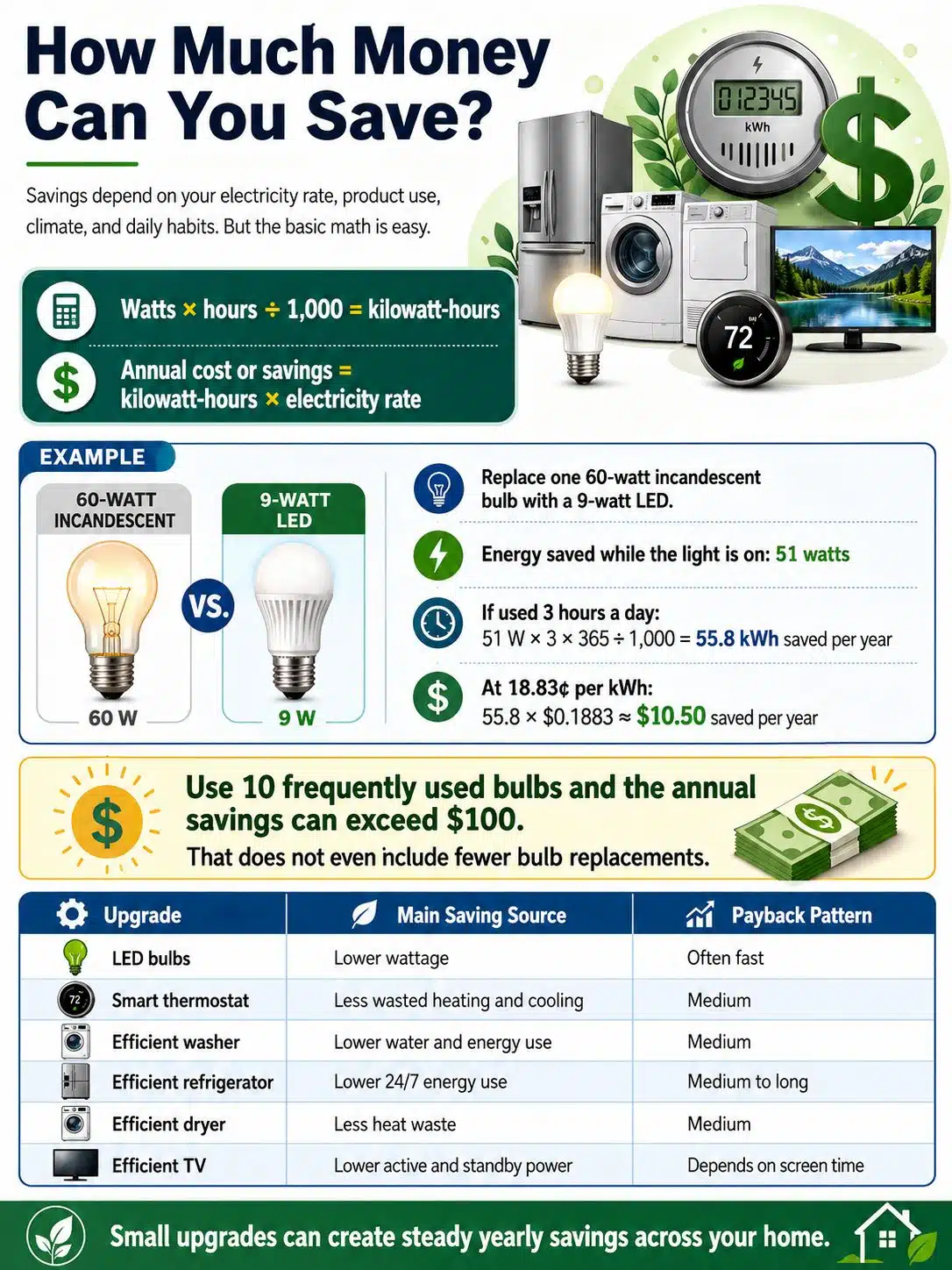
Savings depend on your electricity rate, product use, climate, and daily habits.
But the basic math is easy.
Watts × hours ÷ 1,000 = kilowatt-hours.
Then multiply kilowatt-hours by your electricity rate.
Let’s say you replace one 60-watt incandescent bulb with a 9-watt LED. That saves 51 watts while the light is on.
If that bulb runs three hours a day, it saves about 55.8 kWh per year. At 18.83 cents per kWh, that is about $10.50 per year for one bulb.
Now think about 10 frequently used bulbs. The annual savings can pass $100. That doesn’t even include fewer bulb replacements.
| Upgrade | Main Saving Source | Payback Pattern |
|---|---|---|
| LED bulbs | Lower wattage | Often fast |
| Smart thermostat | Less wasted heating and cooling | Medium |
| Efficient washer | Lower water and energy use | Medium |
| Efficient refrigerator | Lower 24/7 energy use | Medium to long |
| Efficient dryer | Less heat waste | Medium |
| Efficient TV | Lower active and standby power | Depends on screen time |
Payback Period Matters
The payback period tells you how long it takes for savings to cover the extra cost.
LED bulbs often pay back quickly because they are cheap and used often.
Large appliances take longer. But they can keep saving money for many years.
Before buying a major appliance, compare:
- Purchase price
- Estimated yearly energy use
- Warranty
- Repair support
- Expected lifespan
- Available rebates
The cheapest product is not always the best deal.
Local Electricity Prices Change the Result
The same appliance can save different amounts in different places.
If electricity is expensive in your area, efficient products pay back faster. If electricity is cheaper, the payback may take longer.
That’s why it’s smart to calculate savings using your own local electricity rate.
Habits Still Matter
Efficient products help, but they don’t fix everything.
If you install LEDs but leave every light on all night, you lose part of the benefit. If you run half-empty washers or dishwashers, you waste cycles. If you keep an old second fridge plugged in for no real reason, it may eat up your savings.
Good technology works best with good habits.
Smart Controls Make Energy Savings Easier
Smart controls are useful because they handle small mistakes.
They turn things off. They adjust settings. They reduce waste when nobody is paying attention.
That makes them practical for busy homes.
| Smart Control | Best Location | Main Benefit |
|---|---|---|
| Smart thermostat | Heating and cooling system | Reduces unnecessary HVAC runtime |
| Motion sensor | Hallways, stairs, bathrooms | Stops forgotten lights |
| Smart plug | TV area or office desk | Cuts standby power |
| Timer | Outdoor lighting | Prevents lights staying on too long |
| Energy monitor | Appliances and electronics | Shows real power use |
Smart Thermostats
Heating and cooling can take a large part of the energy bill.
ENERGY STAR says certified smart thermostats save about 8% of heating and cooling bills on average, or about $50 per year.
The exact number depends on your climate, home insulation, HVAC system, and settings.
A smart thermostat works best when you let it do its job. If you override it all day, the savings shrink.
Smart Plugs and Power Strips
Many devices use electricity even when they look turned off.
TV boxes, game consoles, printers, speakers, chargers, and computer accessories can all draw standby power.
This is often called phantom load.
A smart plug or switched power strip can cut power fully when the device is not needed. This works well for entertainment areas, office desks, and charging stations.
Energy Monitors
Energy monitors help you stop guessing.
A small plug-in meter can show how much power a device uses. This is useful for old refrigerators, dehumidifiers, office equipment, and entertainment systems.
Once you see the numbers, decisions become easier. You know what to unplug, replace, repair, or use less often.
Environmental Benefits Beyond the Utility Bill
Saving energy helps your wallet first. But it also helps beyond your home.
Lower electricity use reduces pressure on power plants and power grids. In places where electricity still comes from fossil fuels, using less power can also reduce emissions.
Energy-efficient LED lights and appliances also reduce waste because they last longer and use fewer resources over time.
| Environmental Benefit | How Efficiency Helps |
|---|---|
| Lower electricity demand | Reduces total power needed |
| Lower emissions | Cuts energy-related pollution where fossil fuels are used |
| Less water waste | Efficient washers and dishwashers use less water |
| Less product waste | Long-life LEDs need fewer replacements |
| Lower grid pressure | Helps during high-demand hours |
Lower Energy Demand at Scale
One home may not change the power grid alone.
But millions of homes can.
When many households use LEDs, efficient refrigerators, smart thermostats, and better washers, the combined savings become meaningful.
This is why governments, utilities, and energy experts pay attention to efficiency standards.
Less Water Waste
Energy-efficient appliances often save more than electricity.
Certified clothes washers use less water. Certified dishwashers can also save large amounts of water compared with common handwashing habits.
That matters in cities where water is expensive, limited, or under pressure from rising demand.
Less Heat and Product Waste
LEDs last much longer than old bulbs.
That means fewer bulbs thrown away and fewer replacements bought.
Efficient appliances with better controls can also reduce over-drying, extra washing, and unnecessary cycles. This helps clothes last longer and reduces waste in small but useful ways.
How to Choose the Right Energy-Efficient Products
The best product is not always the most expensive one.
The best product is the one that fits your home, your budget, your energy price, and your real usage.
A huge refrigerator may look impressive, but it can waste energy if your family doesn’t need that much space. A powerful air conditioner may cool quickly, but it may also cycle poorly if it is too large for the room.
Right-sized products save more.
| Buying Step | What to Check | Why It Matters |
|---|---|---|
| Read the label | ENERGY STAR or trusted local rating | Confirms efficiency level |
| Compare kWh | Annual energy use | Shows running cost |
| Choose the right size | Capacity and room fit | Prevents waste |
| Check features | Sensors, eco mode, inverter, heat pump | Improves real-world savings |
| Review warranty | Parts and service support | Protects long-term value |
| Look for rebates | Utility or government offers | Lowers upfront cost |
Read the Energy Label
Energy labels make comparison easier.
In the U.S., ENERGY STAR products meet strict efficiency requirements set by the EPA. Other countries use their own labels, often with stars, grades, or annual energy-use figures.
Compare products of the same size and type. Don’t compare a small fridge with a large fridge and judge only the total energy use.
Check the Annual Energy Use
The annual kWh number is one of the most useful figures on an appliance label.
To estimate yearly cost, multiply annual kWh by your local electricity rate.
This simple calculation can show whether a cheaper appliance is really cheaper in the long run.
Think About Repair and Lifespan
A product that fails early is not a smart buy.
Check the warranty. Check service support. Look at parts availability. For large appliances, this matters a lot.
A slightly more expensive model can be the better deal if it lasts longer, uses less energy, and has good repair support.
Common Mistakes to Avoid
Many people lose savings because they buy the wrong product or use it the wrong way.
A pretty appliance may still waste power. A cheap LED may flicker or fail early. A huge refrigerator may use more energy than your household needs.
The goal is not to buy blindly. The goal is to buy smart.
| Mistake | Why It Costs Money | Better Choice |
|---|---|---|
| Buying bulbs by watts | May choose the wrong brightness | Buy by lumens |
| Oversizing appliances | Uses more power than needed | Match size to your use |
| Keeping an old backup fridge | Runs 24/7 for little value | Recycle or unplug it |
| Ignoring standby power | Small loads add up | Use smart plugs or power strips |
| Running half-loads | Wastes cycles | Wait for full loads |
| Skipping maintenance | Appliances work harder | Clean filters, vents, seals, and coils |
Buying the Wrong LED Bulb
Not every LED bulb fits every place.
Some LEDs are not made for enclosed fixtures. Some do not work with dimmer switches. Some have poor color quality.
Before buying, check:
- Lumens
- Color temperature
- Fixture rating
- Dimmable label
- Warranty
- Brand reliability
A better bulb usually pays off over time.
Keeping Old Appliances Plugged In
Many homes keep an old refrigerator in the garage “just in case.”
That backup fridge may quietly cost money every single day.
If it is mostly empty, unplugging or recycling it may save more than you expect.
Ignoring Simple Maintenance
Maintenance protects efficiency.
Clean dryer lint filters after every load. Keep dryer vents clear. Check refrigerator door seals. Replace HVAC filters. Avoid blocking vents around appliances.
A dirty or blocked appliance has to work harder. That means higher energy use.
Practical Upgrade Plan for Your Home
You don’t need to replace everything at once.
Start small. Focus on the products that run the most. Then replace bigger appliances when they get old, expensive to repair, or inefficient.
This keeps the cost manageable.
| Priority | Upgrade | Why It Works |
|---|---|---|
| 1 | Replace high-use bulbs with LEDs | Low cost and fast savings |
| 2 | Use smart plugs or power strips | Cuts standby power |
| 3 | Check old refrigerators | Runs all day and can waste power |
| 4 | Improve thermostat control | Reduces heating and cooling waste |
| 5 | Upgrade washer or dishwasher | Saves energy and water |
| 6 | Consider efficient dryer or AC | Helps with high-energy loads |
Start With High-Use Lights
Replace the bulbs you use most.
Start with the kitchen, living room, porch, hallway, bedroom, and work desk. These lights run often, so they give quicker savings.
Outdoor lights should be weather-rated. If they run at night, pair them with timers or motion sensors.
Measure Before You Replace
A plug-in energy meter can show real power use for many devices.
Use it on old refrigerators, entertainment systems, office equipment, and dehumidifiers. You may be surprised by what uses the most power.
Good decisions start with real numbers.
Replace Big Appliances at the Right Time
You don’t have to throw away every working appliance.
But when an appliance is old, noisy, expensive to run, or close to a costly repair, compare replacement options.
Sometimes repair makes sense. Sometimes replacement saves more over the next several years.
Final Thoughts
The benefits of using energy-efficient LED lights and appliances are simple, practical, and easy to feel over time.
They can lower electricity bills. They can reduce water use. They can make rooms cooler. They can reduce waste. They can also make your home easier to manage.
The smartest path is not complicated.
Start with high-use LED bulbs. Check old appliances. Read energy labels. Compare annual kWh. Choose the right size. Use smart plugs and timers where they make sense. Keep filters, vents, seals, and coils clean.
Energy efficiency is not about giving up comfort.
It’s about getting the same comfort with less waste.
And for most homes, that’s a better deal every month.
FAQs about Energy-Efficient LED Lights and Appliances
Are LED lights worth it if I already turn lights off?
Yes. Turning lights off helps, but LEDs save power every time the light is on. The savings are bigger in rooms where lights run for hours.
Do LED bulbs make rooms hotter?
No. LEDs produce much less waste heat than incandescent bulbs. That can help rooms feel cooler, especially in warm climates.
Should I replace every appliance at once?
No. Start with the oldest and most-used appliances. Refrigerators, washers, dryers, and HVAC controls are good places to check first.
Is handwashing dishes cheaper than using a dishwasher?
Not always. A modern ENERGY STAR certified dishwasher can use less energy and far less water than common handwashing habits, especially with full loads.
Do smart thermostats save money in every home?
They can help, but savings vary. Climate, insulation, HVAC type, settings, and daily routines all affect the result.
What is phantom load?
Phantom load is the electricity used by plugged-in devices that are not actively being used. TV boxes, chargers, printers, speakers, and game consoles can all draw standby power.