A beginners fitness guide should not make you feel guilty before you even start. That is where most fitness advice gets beginners wrong. It jumps straight into six-day workout plans, strict diets, expensive gear, calorie targets, complex gym machines, and motivational quotes that sound powerful but do not help when your legs are sore, your schedule is full, and your confidence is low.
I want to be clear from the beginning: I am not a fitness coach, certified trainer, nutritionist, or medical expert. I am writing this guide from my personal understanding, research, and experience while working around health, wellness, and fitness-related content for HappinessFit.com, a sister concern of Editorialge Media LLC.
Starting fitness is not about becoming a different person overnight. It is about building a body that feels stronger, moves better, sleeps better, and can handle daily life with more energy. For many beginners, especially desk workers and busy professionals, the real challenge is not just exercise. It is stiffness from sitting, low daily movement, poor sleep, irregular meals, stress, and the pressure to “get fit fast.”
That is why this guide is not built around extreme routines or unrealistic promises. It is written for beginners who want simple, safe, and practical direction. My goal is to share what I have understood through research, expert-backed fitness advice, and real-life observation, especially for people who work long hours, sit at desks, feel stiff, struggle with consistency, or do not know where to begin.
Please treat this article as a practical beginner’s guide, not as personal medical advice. If you have any health condition, injury, chest pain, breathing difficulty, serious joint pain, recent surgery, or ongoing medical concern, it is always better to speak with a qualified doctor, physiotherapist, or certified fitness professional before starting a new workout routine.
Before anything else, remember this: your first fitness plan should be easy enough to repeat and useful enough to matter. That is the sweet spot.
Why Most Beginners Struggle Before Fitness Even Gets Hard?
Most beginners do not quit because they are lazy. They quit because their first plan is too aggressive, too confusing, or too disconnected from their real life. A person who has not exercised consistently for years cannot suddenly train like someone who already has strong joints, good mobility, great sleep, gym confidence, and years of workout experience. That gap is where frustration begins.
One common beginner mistake is trying to fix everything at once. They start intense workouts, cut calories, remove favorite foods, wake up earlier, buy supplements, and expect visible results within two weeks. The body does not adapt well to chaos. It adapts better to repeated signals. If the signal is simple, consistent, and recoverable, progress becomes much easier.
Another issue is that beginners often confuse exhaustion with success. They think a workout only counts if they are dripping sweat, gasping for air, or sore for three days. That mindset is dangerous because it makes fitness feel like punishment. A good beginner workout should challenge you, but it should also leave you capable of showing up again.
The early stage of fitness is really about learning. You are learning how your body responds to exercise, how much recovery you need, which movements feel natural, what foods give you energy, and what schedule you can actually maintain. That learning phase is valuable. Skipping it usually leads to injury, burnout, or another restart.
| Beginner Struggle | Why It Happens | Better Approach |
| Doing too much too soon | Motivation is high at the start, so beginners overload the body | Start with fewer sessions and build slowly |
| Copying advanced routines | Social media workouts are often made for experienced people | Use simple full-body beginner workouts |
| Expecting fast results | Beginners often focus only on weight or appearance | Track energy, strength, sleep, and consistency too |
| Ignoring recovery | Rest feels like laziness to many beginners | Treat rest as part of the training plan |
| Quitting after soreness | New movement causes normal muscle soreness | Reduce volume and keep moving gently |
| Changing plans weekly | Beginners panic when results are not instant | Follow one plan for at least 4 weeks |
The best mindset is simple: the first month is not about proving how hard you can train. It is about proving that you can return.
What Fitness for Beginners Actually Means?

Personally, I have always loved fitness advice from trusted experts. I follow practical guidance from professionals, compare different viewpoints, and try to understand what actually works for real people with busy lives. My perspective is not from the position of a trainer standing inside a gym. It is from the position of a regular person who reads, researches, observes, learns, and tries to apply fitness advice in a realistic way.
Fitness for beginners is not just cardio, weight loss, or gym workouts. It is a combination of movement skills, strength, stamina, flexibility, balance, recovery, and daily habits. When beginners understand this, they stop chasing one magic solution and start building a stronger foundation.
Cardio helps your heart and lungs work better. Strength training helps your muscles, bones, joints, and posture. Mobility helps you move with less stiffness. Recovery helps your body repair after effort. Nutrition gives you the energy and materials needed to train and rebuild. Daily movement keeps your body from feeling trapped in one position all day.
This is especially important for office workers. A person can do a 40-minute workout and still feel stiff, tired, and unhealthy if they sit for ten hours without breaks, sleep poorly, and eat randomly. Fitness is not only what happens during the workout. It is the full pattern of how you move, eat, rest, and recover.
A practical beginners fitness guide should help you improve all of these areas slowly. You do not need to master everything at once. But you should understand that real fitness is bigger than one workout routine.
| Fitness Area | What It Means | Beginner-Friendly Example |
| Cardio fitness | Your heart and lungs handle effort better | Brisk walking, cycling, swimming, light jogging |
| Strength | Your muscles can produce force and support joints | Squats, rows, push-ups, deadlifts, carries |
| Mobility | Your joints move comfortably through useful ranges | Hip circles, shoulder rotations, ankle drills |
| Balance | Your body controls movement and position | Step-ups, single-leg stands, slow lunges |
| Recovery | Your body repairs after training | Sleep, rest days, stretching, easy walks |
| Nutrition | Food supports energy and progress | Protein, carbs, vegetables, water |
| Daily movement | Activity outside formal workouts | Walking breaks, stairs, standing intervals |
| Body awareness | You understand effort, pain, and fatigue | Knowing when to push and when to stop |
For beginners, the goal is not to become perfect in all areas. The goal is to stop ignoring any one area completely. A little strength, a little cardio, better sleep, and smarter food choices can create a powerful starting foundation.
Before You Start: Build a Simple Fitness Baseline
Before starting your fitness journey, take a realistic look at where you are today. This is not about shame. It is about choosing the right starting point. A beginner who can comfortably walk 30 minutes has a different starting point than someone who gets tired after five minutes. Both can improve, but they should not use the exact same plan.
Your baseline should include movement, energy, sleep, discomfort, and daily schedule. Many beginners only ask, “How much weight do I want to lose?” That question is too narrow. A better question is, “What can my body comfortably do right now, and what needs support first?”
For example, if your lower back feels tight after sitting, your plan should include hip mobility, glute strength, walking, and desk breaks. If stairs make you breathless, cardio should start gently. If your knees hurt during squats, you may need chair squats, shorter range of motion, better footwear, or professional guidance.
A baseline also helps you avoid overtraining. If your sleep is already poor, your stress is high, and your body is stiff, jumping into intense workouts may make things worse. Fitness should add capacity to your life, not steal the little energy you already have.
| Baseline Area | Beginner Question to Ask | What It Tells You |
| Walking capacity | Can I walk 10–30 minutes comfortably? | Shows basic cardio starting point |
| Stairs | Do I feel slightly winded or completely exhausted? | Shows current aerobic fitness |
| Strength | Can I stand from a chair without using my hands? | Shows lower-body control |
| Mobility | Do my hips, shoulders, or back feel restricted? | Shows where warm-ups should focus |
| Pain | Do I feel sharp, joint, or recurring pain? | Shows where caution is needed |
| Sleep | Am I sleeping 7 hours most nights? | Shows recovery capacity |
| Work schedule | When can I realistically train? | Shows what routine can survive |
| Energy | When do I feel most alert? | Helps choose workout timing |
If you have chest pain, dizziness, serious shortness of breath, heart concerns, recent surgery, uncontrolled blood pressure, or a medical condition, speak with a qualified healthcare professional before starting. Beginner fitness should be safe, gradual, and suitable for your actual body.
Setting Realistic Fitness Goals
Setting realistic fitness goals is one of the most important parts of any beginner workout guide. Without realistic goals, beginners often swing between excitement and disappointment. They expect dramatic change quickly, then feel like they failed when the body responds at a normal pace.
A strong beginner goal should be specific, measurable, and repeatable. “I want to get fit” is too vague. “I will complete three 30-minute workouts every week for one month” is much better. It gives you something clear to do. It also builds confidence because you can measure success by action, not only by body weight.
There are two main types of goals: outcome goals and process goals. Outcome goals include losing weight, gaining muscle, lowering blood pressure, or improving appearance. These goals matter, but they take time and depend on many factors. Process goals are the daily and weekly actions that move you toward the outcome. Beginners should focus more on process goals at first.
A practical 30-day goal could be completing 12 workouts, walking four days per week, sleeping earlier on work nights, and eating protein at breakfast. That may not sound dramatic, but it creates the base for long-term progress. Once the habit is stable, you can increase difficulty.
| Goal Type | Example | Why It Matters |
| Outcome goal | Lose 5 kg | Gives direction but takes time |
| Performance goal | Do 10 clean push-ups | Tracks physical ability |
| Process goal | Train 3 days per week | Builds consistency |
| Nutrition goal | Eat protein at 2–3 meals daily | Supports recovery and fullness |
| Recovery goal | Sleep 7 hours on most nights | Improves energy and adaptation |
| Movement goal | Walk 6,000–8,000 steps daily | Reduces sedentary lifestyle |
| Mobility goal | Stretch or mobilize for 5 minutes daily | Helps stiffness and movement quality |
The best beginner goal is not the most exciting one. It is the one you can repeat even during a normal busy week. Fitness becomes easier when your plan respects your life instead of fighting it.
Cardio vs Strength for Beginners: Which Should Come First?
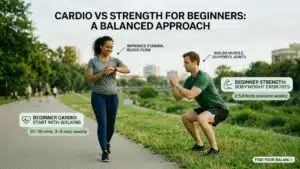
The cardio vs strength beginners question comes up all the time. Some people think cardio is the only way to lose weight. Others think strength training is all that matters. In reality, beginners benefit most from using both in a simple, balanced way.
Cardio improves your heart, lungs, stamina, blood flow, and ability to handle daily activity. Walking faster, climbing stairs, playing with kids, carrying groceries, or moving through a busy day all become easier when your cardio improves. For beginners, walking is often the best starting point because it is low-cost, low-skill, and easier to recover from.
Strength training is equally important. It builds muscle, supports joints, improves posture, protects bone health, and makes daily tasks easier. For desk workers, strength training can help counter some of the weakness and stiffness caused by long sitting. Movements like rows, squats, hip hinges, and carries are especially useful because they train muscles used in real life.
If you are a complete beginner, do not worry about choosing one over the other. Start with two full-body strength sessions per week and two or three light cardio sessions. That combination is enough to build momentum without overwhelming recovery.
| Training Type | Main Benefit | Beginner Starting Point | Common Mistake |
| Walking | Builds basic stamina and habit | 20–30 minutes, 3–5 days weekly | Walking too fast too soon |
| Cycling | Low-impact cardio | 15–25 minutes at easy pace | Setting resistance too high |
| Strength training | Builds muscle and joint support | 2 full-body sessions weekly | Using too much weight |
| Mobility | Improves movement comfort | 5–10 minutes before workouts | Only stretching, never strengthening |
| Core training | Supports trunk control | Dead bugs, planks, carries | Doing endless crunches |
| Recovery work | Reduces stiffness and fatigue | Light walks, stretching, sleep | Treating rest as wasted time |
If your main goal is fat loss, you still need both. Cardio helps increase energy use and stamina. Strength training helps protect muscle while you lose weight. If your main goal is energy and posture, you still need both. Cardio helps endurance, while strength supports your body structure.
Beginner Workout Guide: Your First 4-Week Routine
A beginners workout routine should be simple enough to remember and balanced enough to train the whole body. You do not need ten exercises per session. You need the basic movement patterns: squat, hinge, push, pull, carry, and core control. These patterns show up in daily life, so training them has practical value.
The first four weeks should focus on form, consistency, and recovery. Do not chase heavy weights immediately. Do not turn every session into a test. Your body needs time to learn movement, build coordination, and strengthen connective tissues. Muscles may adapt faster than joints and tendons, so patience matters.
A good beginner plan usually includes two strength workouts per week and two or three cardio sessions. The cardio can be walking, cycling, swimming, or any low-impact activity you enjoy. The strength workouts should be full-body because beginners do not need complicated body-part splits yet.
Keep the sessions short at first. A 30-minute workout done consistently is far better than a 90-minute workout you dread. The goal is to finish feeling trained, not destroyed.
| Week | Main Focus | What to Do |
| Week 1 | Learn movement | Use light effort and practice form |
| Week 2 | Repeat consistently | Keep the same exercises and improve control |
| Week 3 | Add small progress | Add reps, time, or one extra set |
| Week 4 | Build confidence | Keep form clean and increase effort slightly |
Simple Weekly Plan
| Day | Plan |
| Monday | Full-Body Strength A |
| Tuesday | 20–30 Minute Walk |
| Wednesday | Rest or Mobility |
| Thursday | Full-Body Strength B |
| Friday | 20–30 Minute Walk |
| Saturday | Optional Light Cardio or Stretching |
| Sunday | Rest |
Full-Body Strength A
| Exercise | Sets | Reps | Practical Tip |
| Chair Squat | 2–3 | 8–12 | Sit back, stand tall, keep control |
| Incline Push-Up | 2–3 | 6–10 | Use a wall, desk, or bench |
| Glute Bridge | 2–3 | 10–15 | Squeeze glutes, not lower back |
| Band Row | 2–3 | 8–12 | Pull elbows back and keep chest open |
| Dead Bug | 2 | 6–8 per side | Move slowly and control breathing |
| Farmer Carry | 2 | 30 seconds | Carry dumbbells or grocery bags |
Full-Body Strength B
| Exercise | Sets | Reps | Practical Tip |
| Step-Up | 2–3 | 8 per leg | Start with a low step |
| Hip Hinge Drill | 2–3 | 8–12 | Push hips back, keep spine neutral |
| Dumbbell Floor Press | 2–3 | 8–12 | Lower slowly and press smoothly |
| Assisted Split Squat | 2 | 6–8 per leg | Hold a chair for balance |
| Side Plank | 2 | 15–25 seconds | Keep hips lifted and body straight |
| Calf Raise | 2–3 | 10–15 | Pause briefly at the top |
Most sets should end with a little energy left. You should not collapse after every set. If your form breaks, the set is over. Quality movement builds better long-term fitness than sloppy effort.
Warm-Up and Cool-Down Essentials
Warm-up and cool-down essentials are often ignored because they do not look exciting. But for beginners, they can make the difference between a smooth workout and a painful one. A warm-up prepares your body for movement. A cool-down helps your body return to a calmer state afterward.
A good warm-up should raise body temperature, move joints through comfortable ranges, and practice the movement patterns you will use in the workout. It should not exhaust you. If your warm-up feels harder than the workout, it is too much.
Static stretching before a workout is not always the best choice for beginners, especially if you are about to strength train. Dynamic movement usually works better because it wakes up the muscles and joints. Save longer relaxed stretching for after training or separate mobility sessions.
Cool-downs are useful because they help you slow breathing, reduce tension, and notice how your body feels. They also create a mental ending to the workout, which can be helpful for consistency.
| Warm-Up Step | Time | Purpose |
| Easy walk or march | 1–2 minutes | Raises body temperature |
| Shoulder circles | 45 seconds | Prepares upper body |
| Hip circles | 45 seconds | Loosens hips |
| Bodyweight good mornings | 1 minute | Teaches hip hinge |
| Chair squats | 1 minute | Prepares legs |
| Wall push-ups | 1 minute | Prepares chest and shoulders |
| Light cardio build-up | 1–2 minutes | Prepares breathing and heart rate |
| Cool-Down Step | Time | Purpose |
| Slow walking | 2–3 minutes | Lowers intensity gradually |
| Deep breathing | 1–2 minutes | Calms nervous system |
| Gentle stretching | 3–5 minutes | Reduces tightness |
| Hydration | After workout | Supports recovery |
| Body check-in | 1 minute | Helps notice pain or fatigue |
A beginner should never treat warm-ups as optional. If you sit for long hours, your hips, shoulders, spine, and ankles may need a few minutes before they move well. Those few minutes are not wasted. They are protection.
Nutrition Basics Fitness Beginners Should Actually Follow
Nutrition basics fitness beginners need should be simple, realistic, and repeatable. You do not need to start with complicated macro tracking, strict meal timing, or expensive supplements. Most beginners improve quickly by eating more balanced meals, drinking more water, and getting enough protein.
Protein matters because it supports muscle repair and keeps you fuller. Carbohydrates matter because they fuel workouts and daily activity. Healthy fats support hormones and overall health. Vegetables and fruits provide fiber, vitamins, minerals, and digestion support. Water keeps your body functioning properly.
One of the biggest mistakes beginners make is eating too little while starting exercise. They want fast fat loss, so they cut food aggressively. Then workouts feel terrible, cravings increase, sleep gets worse, and motivation drops. Fitness requires fuel. You can still lose fat without starving yourself.
A simple plate method works well. Build meals around protein, carbs, vegetables, and a small amount of healthy fat. This is easier than counting everything from day one and works for most beginners.
| Nutrition Area | Beginner Goal | Easy Examples |
| Protein | Include at most meals | Eggs, fish, chicken, lentils, tofu, yogurt |
| Carbohydrates | Use for energy | Rice, oats, potatoes, fruit, whole grains |
| Vegetables | Add fiber and nutrients | Leafy greens, carrots, beans, mixed vegetables |
| Healthy fats | Support fullness and health | Nuts, olive oil, avocado, seeds |
| Hydration | Drink regularly | Water, lemon water, low-sugar drinks |
| Pre-workout food | Avoid training empty if energy is low | Banana, toast, yogurt |
| Post-workout food | Support recovery | Rice and protein, yogurt and fruit, eggs |
Simple Meal Examples for Beginners
| Meal Time | Example |
| Breakfast | Oats with yogurt and fruit |
| Lunch | Rice, chicken or lentils, vegetables |
| Snack | Banana, boiled eggs, or nuts |
| Dinner | Fish or tofu, potatoes, salad |
| Pre-workout | Toast, fruit, or yogurt |
| Post-workout | Protein-rich meal with carbs |
Do not try to build the perfect diet overnight. Start with one upgrade. Add protein to breakfast. Drink more water. Prepare one simple lunch. Eat vegetables at dinner. Small nutrition wins stack up faster than extreme diet rules.
Sleep and Recovery for Beginners

Sleep recovery beginners advice is usually ignored because it does not look exciting on social media. But recovery is where fitness actually becomes fitness.
Training gives your body a reason to adapt. Recovery gives it the chance. Adults generally need at least 7 hours of sleep per night, and insufficient sleep is commonly defined as less than 7 hours for adults.
Beginner Recovery Priorities
| Priority | Why It Matters |
| Sleep | Supports energy, hormones, focus, repair |
| Rest days | Reduces overuse and burnout |
| Protein and carbs | Helps repair and refill energy |
| Light walking | Improves circulation without heavy stress |
| Mobility | Keeps joints moving comfortably |
| Stress control | Helps consistency and recovery |
Delayed-onset muscle soreness, or DOMS, often appears one to three days after a new or harder workout. Cleveland Clinic notes that DOMS usually happens after unfamiliar or more intense activity, and a productive workout does not require soreness.
That last point matters. Soreness is not a trophy. It is feedback.
For desk professionals, recovery is also about how you spend the other 23 hours of the day. If you train for 30 minutes but sit locked in one posture for nine hours, your hips, neck, shoulders, and lower back still pay the bill. This is where ergonomic gear, walking breaks, standing intervals, foot support, and simple recovery tools can help. That is exactly the kind of practical wellness overlap where Editorialge’s Corporate Athlete idea and HappinessFit.com make sense.
Reading Body Signals During Workout
Reading body signals during workout sessions is one of the most valuable beginner skills. It helps you know when to push, when to slow down, and when to stop. Beginners often struggle here because they do not yet know the difference between normal effort and warning pain.
Normal workout effort feels like working muscles, faster breathing, warmth, and controlled fatigue. Warning signs feel different. Sharp pain, dizziness, chest pressure, joint pain, sudden weakness, or pain that changes your movement should not be ignored.
The goal is not to fear discomfort. Exercise should feel like effort. But the right kind of effort is controlled and repeatable. If you finish a session feeling challenged but stable, that is good. If you finish feeling broken, shaky, or scared to move, that is not good beginner training.
A simple scale can help. On a 1–10 effort scale, most beginner workouts should feel like a 5–7. Easy warm-ups may feel like a 3–4. Very hard efforts near 9–10 are not necessary in the first month.
| Body Signal | Usually Fine | Be Careful If |
| Breathing | Faster but controlled | You feel dizzy or unable to speak |
| Muscle burn | Happens near end of set | It becomes sharp or sudden |
| Soreness | Mild next-day muscle soreness | Severe pain lasts several days |
| Joint feeling | Mild pressure or effort | Sharp knee, shoulder, or back pain |
| Fatigue | Tired after workout | Exhausted for days |
| Heart rate | Increases during cardio | Chest pain or irregular symptoms |
| Form | Slight challenge | Technique collapses completely |
Beginners should learn to respect pain without becoming afraid of effort. That balance builds confidence. Your body gives feedback every session. Listen early, adjust quickly, and you will avoid many common setbacks.
Beginner Mistakes That Quietly Kill Progress
Beginner mistakes are often small, but they add up. The problem is that many of them feel productive at first. Training too hard feels committed. Cutting lots of food feels disciplined. Changing routines feels exciting. Buying supplements feels serious. But none of these guarantee progress.
The most damaging mistake is inconsistency. Beginners often think missing one workout ruins everything. It does not. What hurts progress is turning one missed workout into two weeks off. Fitness is built through returning, not through never slipping.
Another mistake is ignoring technique. A beginner does not need perfect form, but they do need safe and controlled movement. Squats, hinges, rows, presses, and lunges should feel stable. If an exercise feels awkward, reduce range, slow down, or choose an easier version.
Beginners also overfocus on motivation. Motivation comes and goes. Systems are more reliable. Schedule workouts, keep gear visible, use short sessions, and make the first step easy. A 20-minute workout you actually do is more valuable than a perfect 60-minute workout you avoid.
| Mistake | Why It Hurts Progress | Better Choice |
| Training too hard | Causes soreness and burnout | Start moderate and progress slowly |
| Skipping warm-ups | Increases stiffness and poor movement | Warm up for 5–8 minutes |
| Ignoring strength | Limits muscle and posture improvement | Strength train twice weekly |
| Only doing machines randomly | No structure or progression | Follow a simple routine |
| Eating too little | Reduces energy and recovery | Eat balanced meals |
| Not sleeping enough | Slows adaptation | Treat sleep as training support |
| Program hopping | Makes progress hard to track | Stick to one plan for 4 weeks |
| Expecting perfection | Creates guilt and quitting | Focus on returning quickly |
The beginner who makes slow, steady progress for six months will always beat the beginner who trains perfectly for six days and quits.
Practical Fitness Workflows for Different Beginners
Not every beginner needs the same plan. A busy office worker, an overweight beginner, a parent, a student, and someone returning after years away from exercise all have different needs. A good beginners fitness guide should offer flexible workflows instead of pretending one plan fits everyone.
The busy professional usually needs short workouts, walking breaks, and posture support. The overweight beginner may need low-impact cardio and joint-friendly strength work. The no-gym beginner needs bodyweight and resistance band options. The returning beginner needs patience because their mind may remember old fitness levels, but the body needs time to rebuild.
This is where beginner fitness becomes practical. You choose the version that fits your current life. You do not force your life into a routine that only works for someone with unlimited time, perfect sleep, and no responsibilities.
Workflow for Busy Desk Professionals
| Day | Simple Plan |
| Monday | 25-minute full-body strength workout |
| Tuesday | 20-minute walk after lunch |
| Wednesday | 5-minute mobility + walking breaks |
| Thursday | 25-minute full-body strength workout |
| Friday | 20-minute walk |
| Saturday | Optional longer walk or cycling |
| Sunday | Rest and meal prep |
This workflow works because it respects time. Short strength sessions maintain consistency, while walking breaks reduce stiffness and support cardio fitness.
Workflow for Overweight Beginners
| Priority | Smart Starting Point |
| Cardio | Walking, cycling, swimming, or low-impact machines |
| Strength | Chair squats, wall push-ups, band rows |
| Joint care | Supportive shoes and gradual volume |
| Nutrition | Protein, fiber, water, balanced meals |
| Progression | Add time before adding intensity |
This workflow avoids unnecessary joint stress. The goal is to build confidence, not punish the body.
Workflow for No-Gym Beginners
| Movement Pattern | Home Exercise |
| Squat | Chair squat |
| Push | Wall push-up or incline push-up |
| Pull | Resistance band row |
| Hinge | Glute bridge or hip hinge drill |
| Core | Dead bug or plank |
| Carry | Grocery bag carry |
This workflow proves that a gym is useful but not required. Beginners can build a strong foundation at home.
Workflow for Returning Beginners
| Week | Focus |
| Week 1 | Do less than you think you can |
| Week 2 | Repeat and improve control |
| Week 3 | Add small volume |
| Week 4 | Increase effort slightly |
| Week 5+ | Start structured progression |
Returning beginners need humility. Old memories can make you overestimate current capacity. Respect the rebuild.
Simple Fitness Tools Worth Using
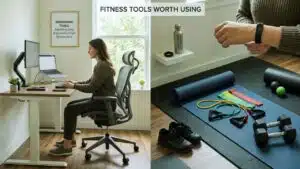
Fitness tools should make training easier, safer, or more consistent. Beginners do not need expensive equipment at the start. In fact, too much equipment can create confusion. A few simple tools are enough for most people.
Good shoes matter if you walk often. A yoga mat makes floor work more comfortable. Resistance bands are excellent for rows, presses, mobility, and warm-ups. Dumbbells help with progression. A water bottle helps hydration. A basic fitness tracker can help you notice daily movement patterns.
For professionals, ergonomic tools also matter. If your chair, desk, monitor, and keyboard setup create daily discomfort, workouts may feel harder than necessary. Fitness does not happen only during exercise. Your work environment can either support your body or constantly drain it.
Recovery tools can help too, but they should not replace sleep, nutrition, and proper training. A foam roller, massage ball, or stretching strap can be useful for body awareness and light recovery. They are tools, not magic fixes.
| Tool | Why It Helps Beginners | Best Use |
| Walking shoes | Reduces foot and joint discomfort | Daily walks and light cardio |
| Resistance bands | Affordable and beginner-friendly | Rows, warm-ups, mobility |
| Dumbbells | Easy strength progression | Full-body home workouts |
| Yoga mat | Improves comfort | Core work, stretching, mobility |
| Water bottle | Encourages hydration | Workday and workouts |
| Foam roller | Helps with tight areas | Light recovery work |
| Fitness tracker | Shows activity patterns | Steps, heart rate, consistency |
| Ergonomic chair | Supports long work hours | Desk posture and comfort |
| Standing desk | Reduces long sitting periods | Alternating positions |
| Massage ball | Targets small tight areas | Feet, shoulders, glutes |
The best tool is the one you actually use. Beginners should buy for consistency, not aesthetics.
How to Know Your Fitness Plan Is Working?
A beginner fitness plan is working before the mirror shows dramatic changes. That is important to understand. If you only judge progress by weight, you may miss early wins that matter a lot.
In the first few weeks, you may notice better energy, improved mood, easier walking, better sleep, less stiffness, and more confidence. These are real signs of progress. Strength improvements may show up as more reps, better balance, cleaner form, or less fatigue during daily tasks.
Body composition changes usually take longer. That does not mean nothing is happening. Your nervous system may be learning movements. Your muscles may be adapting. Your heart and lungs may be becoming more efficient. Your habits may be stabilizing. These changes create the foundation for visible results later.
Tracking helps. You do not need complicated data. Write down workouts completed, exercises, sets, reps, walking time, sleep quality, and energy. This gives you evidence when motivation drops.
| Progress Signal | What It Means |
| Workouts feel smoother | Your coordination is improving |
| You can walk longer | Cardio fitness is improving |
| You lift more or do more reps | Strength is increasing |
| Less stiffness after sitting | Mobility and movement are helping |
| Better sleep | Recovery habits may be improving |
| More stable mood | Exercise may be supporting stress control |
| Better posture awareness | Body awareness is improving |
| Fewer skipped workouts | Your routine is becoming realistic |
Beginner Progress Timeline
| Timeframe | Realistic Changes |
| Week 1–2 | Learning, mild soreness, better awareness |
| Week 3–4 | Better consistency and cleaner form |
| Week 5–8 | Noticeable stamina and strength gains |
| Week 9–12 | More visible body and performance changes |
| 3+ months | Fitness starts becoming part of identity |
Progress is not always loud. Sometimes it looks like choosing the stairs without thinking. Sometimes it looks like sleeping better. Sometimes it looks like not quitting after a bad week.
Actionable Takeaways for Starting Fitness Journey
Starting fitness journey successfully depends on making the first steps clear. Beginners do not need more noise. They need a simple direction they can follow even when life gets busy.
Start with two full-body strength workouts each week. Add walking or light cardio three days per week. Warm up before workouts. Eat balanced meals with protein. Sleep as consistently as possible. Track what you do. Repeat the plan for four weeks before making big changes.
Do not chase perfection. If you miss one workout, do the next one. If you eat poorly at lunch, make dinner better. If you sleep badly, reduce workout intensity instead of quitting. Beginner fitness is not about never making mistakes. It is about learning how to recover from them quickly.
The most successful beginners usually keep things boring for a while. They repeat the same exercises, improve slowly, and build confidence. That boring consistency creates exciting results later.
| Beginner Rule | Why It Works |
| Start with 3 workout days | Prevents overload |
| Strength train twice weekly | Builds muscle and confidence |
| Walk often | Improves cardio with low stress |
| Warm up every session | Helps movement quality |
| Keep workouts short | Makes consistency easier |
| Eat enough protein | Supports recovery |
| Sleep seriously | Improves adaptation |
| Track simple progress | Builds motivation from evidence |
| Avoid extreme diets | Protects energy |
| Repeat the basics | Creates long-term results |
Simple Weekly Checklist
| Habit | Beginner Target |
| Strength training | 2 days |
| Walking or cardio | 3–5 days |
| Warm-up | Before every workout |
| Mobility | 5 minutes on stiff days |
| Protein | Most meals |
| Water | Throughout the day |
| Sleep | 7+ hours when possible |
| Rest | 1–2 easier days weekly |
| Tracking | Workouts, reps, walks, energy |
| Reflection | Adjust weekly without panic |
This is the foundation. Once it feels normal, you can increase intensity, add exercises, improve nutrition, or set more specific goals.
Frequently Asked Questions (FAQs) About Beginners Fitness Guide
How many days a week should beginners work out?
Most beginners should start with three structured workout days per week. Two days can focus on strength training, and one day can focus on cardio or a mixed light workout. Walking can be added on other days because it is easier to recover from and helps build the habit of daily movement.
Should beginners do cardio or strength first?
Beginners should include both. If you do both in the same session, strength training usually comes first when your goal is building muscle or learning good form. Cardio can come first if the session is mainly for endurance. For most beginners, separate days are even easier.
How long should a beginner workout be?
A beginner workout can be 20–40 minutes. The workout does not need to be long to be effective. A short session with good form, clear exercises, and steady effort is better than a long session filled with random movements.
Is soreness required for progress?
No. Soreness is not required. Mild soreness can happen when you try new exercises, but it is not the main sign of progress. Strength, stamina, better movement, and consistency are better progress markers.
What should beginners eat before working out?
If you have not eaten for several hours, try something light and easy to digest. A banana, yogurt, toast, oats, or fruit can work well. For longer workouts, a meal with carbs and protein one to two hours before training may feel better.
Can I get fit without a gym?
Yes. You can build fitness at home with walking, bodyweight exercises, resistance bands, dumbbells, and simple routines. A gym offers more equipment, but it is not required for building a beginner foundation.
What is the biggest mistake beginners make?
The biggest mistake is doing too much too soon. Beginners often confuse intensity with commitment. A plan that you can repeat for months is more powerful than a plan that destroys you in one week.
How soon will I see results?
You may feel better within two to four weeks if you stay consistent. Visible body changes often take longer, usually several months. Early results may show up as better energy, easier movement, improved sleep, and more confidence.
The Real Starting Line
A good beginners fitness guide should not scare you into action. It should help you start with confidence. Fitness does not need to begin with punishment, extreme diets, or complicated routines. It can begin with a walk, a chair squat, a glass of water, a better bedtime, and the decision to repeat small actions until they become normal.
The beginning is where patience matters most. Your body is learning. Your schedule is adjusting. Your habits are forming. Some days will feel easy, and some days will feel messy. That is normal. The goal is not to become perfect. The goal is to keep returning.
For busy professionals, fitness is not separate from work and life. Stronger muscles help posture. Better cardio supports energy. Better sleep improves focus. Smarter recovery reduces burnout. Better daily movement makes long desk hours less damaging. This is the real Corporate Athlete approach: train, work, recover, and live in a way that supports long-term performance.
Start small. Stay consistent. Build slowly. Fitness becomes easier when you stop treating it like a punishment and start treating it like a skill.