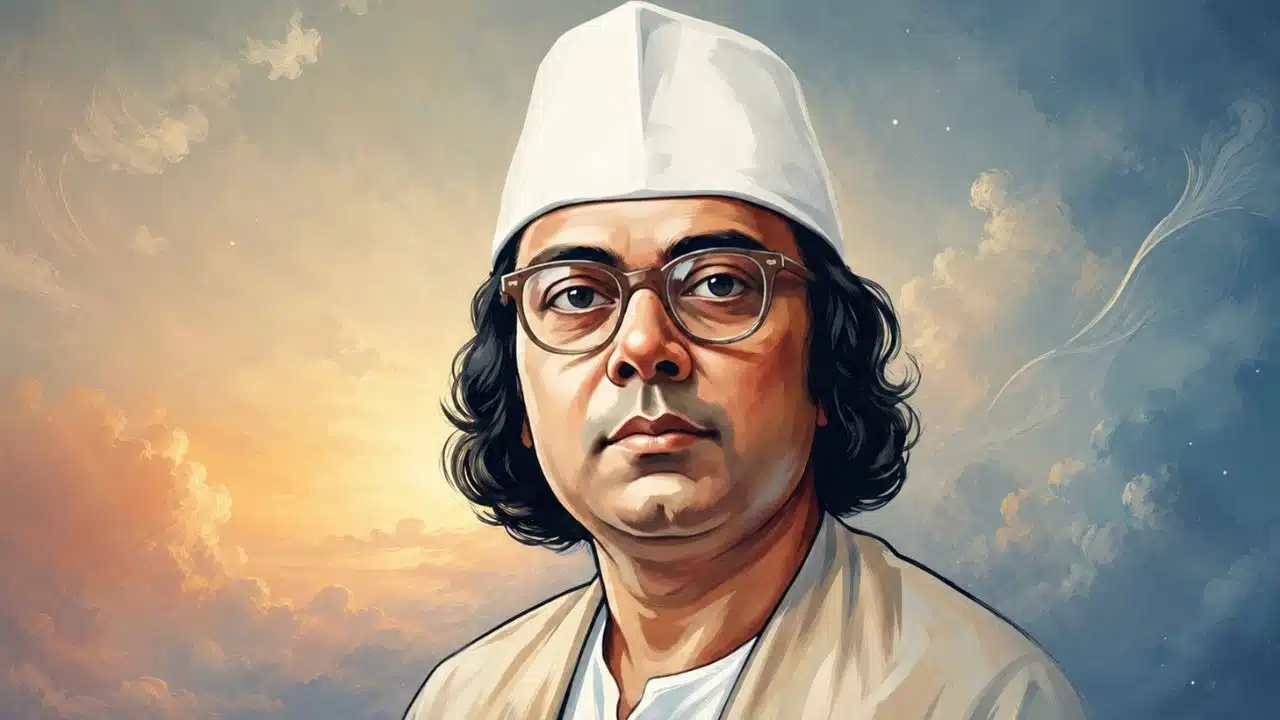
There are some writers we read for literature, and there are some writers we return to when life itself becomes difficult to understand. For me, Kazi Nazrul Islam belongs to the second group. Today, 11th of Jaistha (Bengali month) marks his 127th birth anniversary.
As a Bangladeshi, I did not grow up knowing Nazrul only as a poet from textbooks. I grew up hearing his name with respect, emotion, and pride. He is our National Poet. He is our Rebel Poet. But the more I read his poems, novels, essays, and songs, the more I realize that these titles are not just honorary names. They are the truth of his life.
Nazrul gave language to people who were ignored. He gave fire to people who were afraid. He gave dignity to people who were oppressed by poverty, colonial rule, religious division, social injustice, and human cruelty. Banglapedia describes him as the national poet of Bangladesh and the “rebel poet” because of his resistance to all forms of repression.
When I read Nazrul today, I do not feel that I am reading a poet from the past. I feel that I am listening to a living voice that still questions us: Are we truly free? Are we truly equal? Are we truly human to one another?
My First Realization: Nazrul Was Not Rebellion for the Sake of Rebellion
Many people remember Nazrul mainly through his famous poem “Bidrohi”. That poem is, of course, one of the strongest expressions of rebellion in Bengali literature. But when I read Nazrul deeply, I realize that his rebellion was not empty anger. It was not destruction for the sake of destruction.
His rebellion came from love.
He rebelled because he loved human freedom. He rebelled because he could not tolerate injustice. He rebelled because he saw how the poor, the weak, the colonized, the workers, the women, and the voiceless were pushed to the margins of society.
This is why Nazrul’s rebellion still feels so human. He does not teach us to hate people. He teaches us to hate oppression. He does not ask us to destroy humanity. He asks us to destroy the chains that make people less than human.
That is why I find him so powerful. His words do not simply attack the oppressor; they awaken the oppressed.
Reading Nazrul as a Bangladeshi
Living in Bangladesh, I feel a special connection with Nazrul. His presence is everywhere in our national memory. We hear his songs in cultural programs, on television, in schools, during religious occasions, and in moments of national reflection. His grave is in Dhaka University, one of the most symbolic places in our national life.
After the independence of Bangladesh, the founder and the president of Bangladesh, Bangabandhu Sheikh Mujibur Rahman, took the initiative to bring Nazrul from Kolkata to Dhaka. Nazrul came to Bangladesh on May 24, 1972, with his family and the poet was given a house at Dhanmondi in the capital, Dhaka. Bangladesh received him not just as a poet but as a spiritual voice of the nation.
This part of history always moves me. A newly independent country, still carrying the wounds of war, welcomed the Rebel Poet as one of its own. Bangabandhu understood what Nazrul meant to the Bengali soul. The poet who had spoken against oppression long before 1971 naturally belonged to a country born through sacrifice, resistance, and the dream of freedom.
The government later granted Nazrul Bangladeshi citizenship in 1976 and awarded him the Ekushey Padak the same year. For me, these are not just official recognitions. They show how deeply Bangladesh embraced Nazrul as part of its own identity.
The Poet of the Oppressed
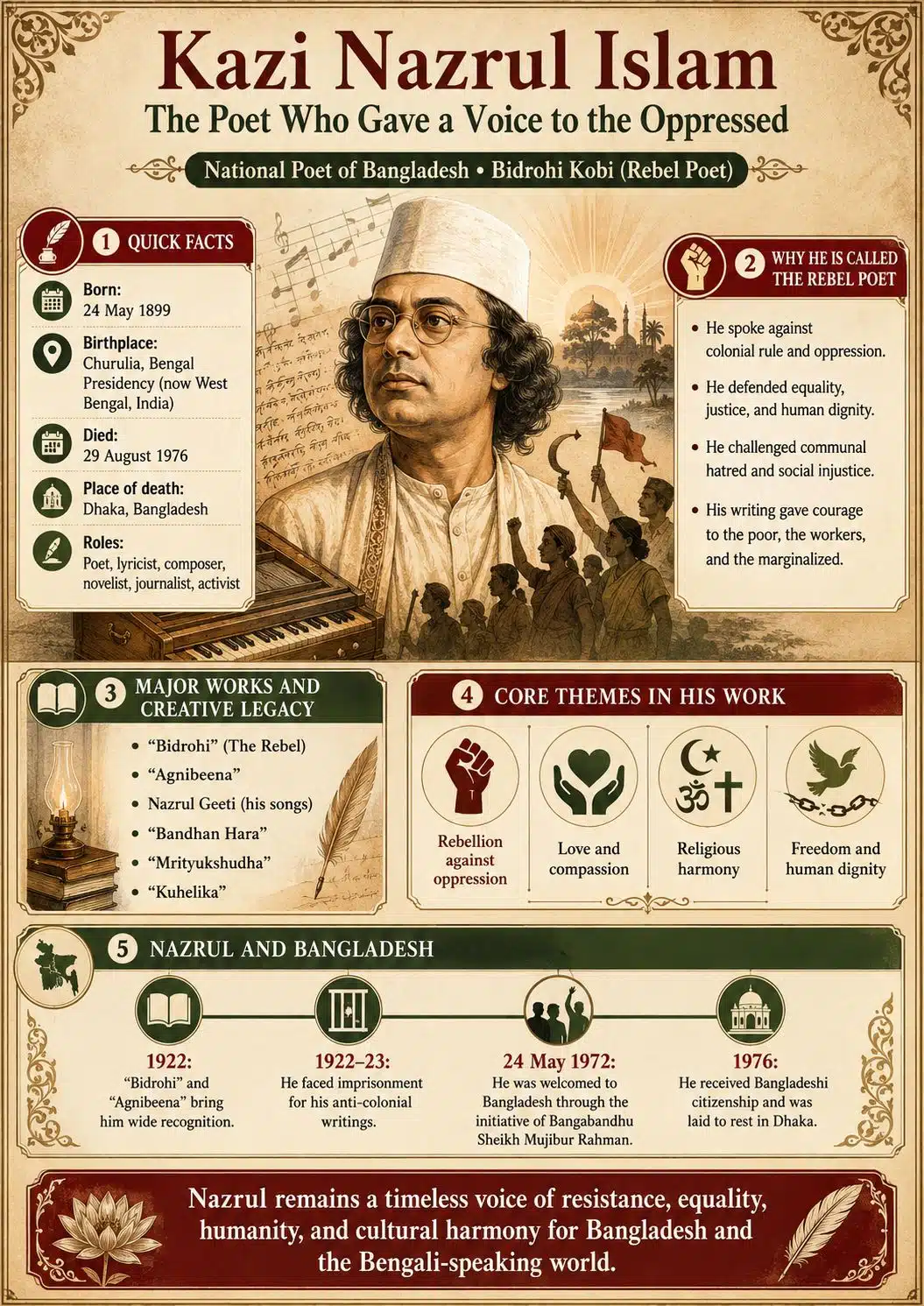
The title of this article comes from my deepest feeling about Nazrul: he gave a voice to the oppressed.
When I read his poems on poverty, equality, workers, peasants, and common people, I feel that Nazrul was never writing from a comfortable distance. He knew hardship. He knew hunger. He knew loss. He knew social humiliation. His childhood was not easy, and his life was full of struggle.
That is why his sympathy for the poor does not feel artificial. It feels lived.
In his writings, the poor are not weak characters waiting for pity. They are human beings with dignity. The laborer, the farmer, the prisoner, the hungry child, the neglected woman, the religious minority, the colonized citizen—all of them find a place in Nazrul’s imagination.
This is where Nazrul becomes more than a literary figure. He becomes a moral force.
He reminds us that literature should not only decorate language. Literature should also disturb injustice. It should stand beside those who cannot stand alone. It should challenge power when power becomes cruel.
What His Poems Taught Me
Nazrul’s poems gave me a new way to understand courage.
Before reading him closely, I used to think courage meant loudness, strength, or victory. But Nazrul taught me that courage can also mean speaking the truth when silence is safer. It can mean standing with the weak when society stands with the powerful. It can mean refusing to accept injustice as normal.
His poems are full of movement. They do not sit quietly on the page. They march. They sing. They break walls. They call people to wake up.
In poems like “Bidrohi,” “Samyabadi,” “Daridro,” “Nari,” “Kandari Hushiar,” and many others, I find different faces of the same Nazrul. Sometimes he is a revolutionary. Sometimes he is a humanist. Sometimes he is a spiritual seeker. Sometimes he is a lover of beauty. But in every form, he remains deeply committed to human dignity.
This is why Nazrul never feels one-dimensional to me. He is not only angry. He is also tender. He is not only political. He is also deeply emotional. He is not only a poet of revolt. He is also a poet of compassion.
What His Novels Made Me Feel
Nazrul’s novels often receive less attention than his poems and songs, but they also reveal an important part of his mind.
When I read works such as “Bandhan Hara,” “Mrityukshudha,” and “Kuhelika,” I see Nazrul exploring human struggle in another form. Banglapedia notes that Bandhan Hara was published as an epistolary novel, while Mrityukshudha and Kuhelika also appeared during important periods of his literary life.
His fiction shows that oppression is not only political. It is also emotional, social, and psychological. People can be trapped by class, gender, family expectations, poverty, and fear. Through his novels, Nazrul looks at the human heart inside these struggles.
That is what touched me most. His characters are not just symbols. They are people with wounds, desires, weaknesses, and dreams. Through them, Nazrul reminds us that freedom is not only about a nation becoming independent. Freedom is also about the individual soul being able to breathe.
Listening to Nazrul’s Songs
If his poems are fire, his songs are both fire and water.
Nazrul’s songs have always felt different to me. Some songs carry the energy of revolution. Some carry the pain of love. Some are devotional. Some are deeply spiritual. Some feel like a prayer rising from the hearts of ordinary people.
Banglapedia says Nazrul nourished almost all streams of Bangla songs and connected the folk base of Bengali music with the classical tradition of the subcontinent. That explains why his music feels so vast. His songs do not belong to one mood, one religion, one class, or one occasion.
As a Muslim, I feel a deep emotional connection with his Islamic songs. Songs like “O Mon Romzaner Oi Rozar Sheshe” are part of our cultural and religious memory. But what makes Nazrul extraordinary is that he also wrote Shyama Sangeet and devotional songs rooted in Hindu spiritual traditions.
This is one of the greatest lessons I receive from him.
Nazrul did not see faith as a weapon to divide people. He saw faith as a path to beauty, love, and truth. He wrote from the soul of Islam, and he also wrote with deep respect for Hindu devotional imagination. He used Arabic, Persian, Sanskrit, and Bengali cultural references in a way that created unity instead of division.
At a time when societies still suffer from religious hatred, Nazrul’s voice feels urgently necessary.
Nazrul and Religious Harmony
One of the strongest reasons Nazrul matters today is his belief in human unity.
He challenged religious fanaticism. He challenged communal hatred. He challenged the idea that one group of people could claim God against another group of people.
For a country like Bangladesh, where religion, culture, language, and national identity are deeply connected, Nazrul’s message is very important. He teaches us that being rooted in one’s own faith does not mean disrespecting another’s faith. He teaches us that culture becomes richer when it opens its doors instead of building walls.
This is why I see Nazrul not only as a Muslim poet, not only as a Bengali poet, and not only as a Bangladeshi national poet. I see him as a universal human voice.
His dream was larger than any narrow identity. His dream was a world where people would be judged by their humanity, not by their birth, religion, wealth, or social position.
The Pain Behind the Voice
Nazrul’s life was not only full of creative brilliance. It was also full of suffering.
He faced poverty from childhood. He lost his father early. He worked in different roles to survive. He joined the British Indian Army. He became a journalist and political voice. He was imprisoned by the British colonial government for his writings and activism. Banglapedia notes that through literature, journalism, and political activism, Nazrul fought against foreign rule, communalism, imperialism, colonialism, fundamentalism, and exploitation.
Perhaps this is why his words carry so much truth. He did not write from a protected life. He wrote from the battlefield of experience.
Later, his illness and silence became one of the most heartbreaking chapters of Bengali cultural history. A poet whose voice had awakened millions gradually lost his own voice and memory. Banglapedia records that from 1942 until his death in 1976, Nazrul lived through a long period of illness and silence.
Whenever I think about this, I feel a strange sadness. The man who gave voice to the oppressed became silent himself. But perhaps that silence also made his earlier voice even more powerful. His body became weak, but his words never became weak. His songs never became silent in the hearts of people.
Why Nazrul Still Matters Today
Sometimes we celebrate great people only through formal programs, flowers, posters, and speeches. But Nazrul deserves more than ceremonial respect. He deserves to be read, heard, questioned, and carried into our present life.
We need Nazrul today because oppression still exists.
Poverty still exists. Inequality still exists. Religious hatred still exists. Women still face injustice. Workers are still exploited. Many people still remain voiceless in society. The world has changed, but the struggles Nazrul wrote about have not disappeared.
This is why his message remains alive.
When I read him now, I feel he is asking us not to become comfortable with injustice. He is asking us not to accept silence as wisdom when people are suffering. He is asking us to keep our humanity awake.
For me, Nazrul is not only a subject of literary admiration. He is a test of conscience.
If we praise him but ignore the oppressed, we have not understood him. If we sing his songs but spread hatred, we have not understood him. If we call him the Rebel Poet but remain silent before injustice, we have not understood him.
To honor Nazrul, we must carry his courage into our own time.
My Personal Realization
The more I read Nazrul, the more I realize that he was not writing for one generation. He was writing for every generation that would face injustice.
As a Bangladeshi, I feel proud that he is our National Poet. But I also feel responsible. Because claiming Nazrul means claiming his values. It means standing for equality, justice, religious harmony, freedom, and human dignity.
Nazrul teaches me that poetry can be a weapon, but not a weapon of hatred. It can be a weapon of awakening. Music can be devotion, but not devotion that excludes others. It can be devotion that expands the heart. Literature can be beauty, but not beauty that ignores suffering. It can be beauty that stands beside pain.
That is the Nazrul I have discovered through his novels, poems, and songs.
He is not only the poet who wrote about rebellion. He is the poet who made rebellion moral. He is not only the poet who sang of freedom. He is the poet who made freedom personal, social, spiritual, and national.
Final Thoughts: The Voice That Still Speaks
Kazi Nazrul Islam gave a voice to the oppressed because he listened to them first. He listened to the poor, the hungry, the imprisoned, the humiliated, the colonized, the heartbroken, and the spiritually restless. Then he transformed their pain into poetry, songs, stories, and courage.
That is why he still belongs to us.
He belongs to Bangladesh. He belongs to Bengal. He belongs to every person who believes that injustice should not be accepted as fate. He belongs to every human being who has ever felt voiceless and still dreamed of dignity.
On his 127th birth anniversary, I remember him not only with respect but also with gratitude. Because Nazrul did not simply write literature. He gave us a way to stand upright in front of oppression.
And that is why Kazi Nazrul Islam will always remain the Rebel Poet of our hearts—the poet who gave a voice to the oppressed.