AI-Powered Playtesting is no longer a shiny experiment that game studios can politely ignore until “later.” Testing games has always been slow, repetitive, expensive, and somehow still full of surprises when launch week arrives with a bug report and a baseball bat. Manual QA, real-player feedback, and human judgment still matter, obviously. But expecting humans to repeat the same test paths forever, review endless gameplay footage, and catch every broken interaction in modern games is not strategy. It is workplace punishment with a build number attached.
The United States leads this space because it has the right mix of game development demand, AI startup funding, developer-tool culture, and studios desperate to test faster without turning QA teams into sleep-deprived bug archaeologists. U.S.-based companies are now building AI agents that play games, automated QA systems that catch regressions, player insight platforms that summarize feedback, and behavioral tools that help teams understand where players get confused, bored, frustrated, or delighted.
This list focuses only on verified U.S.-based SMEs and startups working in or around AI-powered playtesting, game QA automation, AI-player simulation, and player insight analysis. That means no global padding, no suspicious “AI-powered” fluff, and no companies included just because their homepage learned the word “automation.” The goal is simple: identify the U.S. companies actually helping studios test smarter, move faster, and avoid those beautiful launch-day disasters everyone later pretends were “unexpected edge cases.”
Our Selection Criteria
Before ranking the companies, I separated real AI-powered playtesting and game QA tools from generic playtesting platforms, traditional QA services, and companies that only use “AI” as landing-page perfume.
The selection focused on:
- Verified U.S. headquarters or clear U.S.-based company identity.
- Publicly confirmable product relevance.
- Direct connection to AI-Powered Playtesting, automated game QA, AI player simulation, or AI-assisted player feedback analysis.
- SME/startup-style profile where possible.
- Publicly available founder, leadership, location, website, and product details.
- Clear usefulness for game studios, QA teams, developers, or player research teams.
- No fictional entries, no invented emails, no global filler, and no “sounds close enough” nonsense.
Some of these companies use AI agents to test games. Some focus on AI-assisted feedback analysis. Some automate regression testing. Some use psychology and behavioral AI to help studios understand players. That mix reflects the real U.S. market. It is not perfectly tidy, because real markets rarely are. Very rude of them.
Why Are AI-Powered Playtesting SMEs Booming In The United States?
AI-Powered Playtesting SMEs are booming in the United States because game development has become too complex for old testing models to carry alone. Modern studios deal with live-service updates, multiplayer systems, open-world logic, procedural content, user-generated behavior, monetization loops, onboarding funnels, and player expectations that change faster than a patch note comment section can become hostile.
The United States also has the right ecosystem for this category: major game studios, AI infrastructure companies, startup accelerators, gaming venture capital, cloud platforms, and a large developer-tool market. Companies like nunu.ai, Live Aware Labs, GameDriver, Regression Games, Agentic, NodeMori, and Solsten are not all solving the same exact problem, but they are responding to the same pain: studios need faster testing, better player insight, and fewer “how did nobody catch this?” moments after release.
The rise of AI agents also matters. Google Cloud described nunu.ai as using AI agents that play games like humans, catch bugs other testing solutions miss, work around the clock, and help studios reduce repetitive manual QA work. That is exactly why this category is growing. Studios are not buying AI because it sounds futuristic. They are buying it because manual repetition is expensive, and launch disasters are even more expensive.
What’s Special About AI-Powered Playtesting SMEs?
The special sauce is not simply “AI,” because every company says AI now. A stapler could launch tomorrow as an AI-powered document alignment assistant and someone on LinkedIn would applaud it.
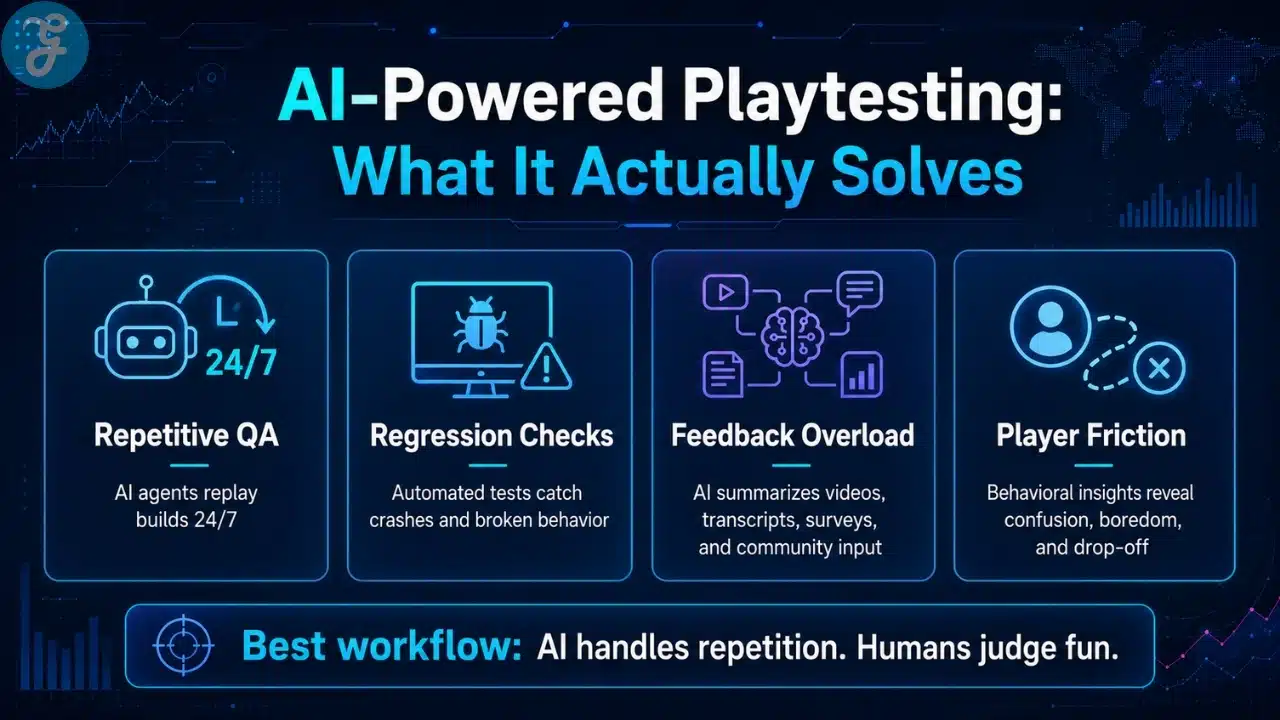
The real value is how these companies reduce testing friction:
- AI agents can play builds repeatedly and catch bugs that humans may miss.
- Automated QA tools can test Unity, Unreal, XR, and live builds more consistently.
- AI feedback platforms can turn playtest recordings into searchable insights.
- Player simulation tools can reduce the pain of finding enough testers.
- Behavioral AI can reveal audience motivations, friction, and engagement patterns.
- Bug reports can include logs, video, reproduction steps, and prioritization.
- Human teams can spend less time repeating the same test path and more time judging whether the game is actually fun.
That last part matters. AI can catch issues. It cannot fully understand fun. Not yet. And honestly, some human executives struggle with that too, so let’s not blame the robots alone.
The 7 Best SMEs Specializing In AI-Powered Playtesting In USA
The following companies are ranked by verification strength, U.S. fit, relevance to AI-powered playtesting, practical usefulness for studios, and product focus.
1. nunu.ai
Founder: Jan Schnyder, Kyrill Hux, Nicolas Muntwyler
Headquarters: San Francisco, California
Website: nunu.ai
Email: team@nunu.ai
Core Services: Multimodal AI agents, automated game testing, game QA, player simulation, natural-language testing tasks
Target Market: Game studios, QA teams, developers, AI-first production teams
Track Record: Y Combinator describes nunu.ai as building multimodal agents to test and play games, starting with QA and player simulation.
nunu.ai is the cleanest U.S.-based fit for AI-Powered Playtesting because its entire product direction is built around AI agents that can play and test games. Its AI agents observe games through the screen and interact through touch, keyboard, or mouse, creating a black-box testing experience that does not require deep integration before teams can start.
Best for:
- Studios exploring AI agents for game QA
- Teams that want natural-language game testing workflows
Why We Chose It:
- It directly focuses on AI agents for game testing.
- Its YC profile verifies the company, founders, and product direction.
- It targets QA and player simulation, not vague “AI gaming.”
- It fits the U.S.-based AI-Powered Playtesting category better than almost anyone else.
Things to consider:
- AI agents can help with repetition and coverage, but they cannot fully judge fun, pacing, or emotional friction.
- Studios should test it on their own game genre before assuming broad coverage.
2. Live Aware Labs
Founder: Sean Vesce, David Berger, Nathan Wheeler
Headquarters: Seattle, Washington
Website: liveaware.io
Email: sales@liveawarelabs.com
Core Services: AI-powered player insights, playtest feedback capture, player experience analysis, video/transcript analysis, community feedback workflows
Target Market: Game studios, product teams, user researchers, developers
Track Record: GeekWire reported that Seattle-based Live Aware Labs raised $4.8 million to build its AI-powered game developer feedback system.
Live Aware Labs focuses on the player-insight side of AI-Powered Playtesting. It helps studios capture and organize player feedback, then use AI to make that feedback easier to act on. The company’s own story says it was founded by game industry veterans who wanted to make it easier for developers to understand and act on player experiences throughout development.
Best for:
- Studios that want AI-assisted analysis of real-player feedback
- Teams are trying to turn playtest recordings, transcripts, and community feedback into usable insights
Why We Chose It:
- It is U.S.-based and clearly tied to AI-powered player insight workflows.
- The founders have strong game development backgrounds.
- It solves the “too much feedback, not enough synthesis” problem.
- It fits user research and playtesting better than pure bug-detection tools.
Things to consider:
- It is not an autonomous AI-agent QA platform like nunu.ai.
- Teams looking only for automated regression testing may need another tool alongside it.
3. GameDriver
Founder: Robert Gutierrez, Shane Evans, Phillip Mayhew
Headquarters: Martinez, California
Website: gamedriver.ai
Email: support@gamedriver.io
Core Services: Game test automation, Unity and Unreal testing, AI-assisted QA, automated regression testing, QA-as-a-service
Target Market: Game developers, QA teams, XR teams, studios, publishers
Track Record: GameDriver positions itself as a Quality-as-a-Service provider for game studios, with experts authoring tests while AI helps keep those tests alive as the game changes.
GameDriver is more automated QA than classic playtesting, but it belongs in this list because it is game-specific and directly supports modern testing workflows. Its current positioning is built around automating game QA across real builds and real hardware, which is useful for studios that need repeatable test coverage instead of yet another manual regression nightmare.
Best for:
- Unity, Unreal, and XR teams that need structured automated testing
- Studios that want repeatable QA workflows instead of manual regression chaos
Why We Chose It:
- It is U.S.-based and game-specific.
- Founder and company history are publicly verifiable.
- It supports real production QA workflows.
- It fits studios that need automation more than subjective player feedback.
Things to consider:
- It is closer to QA automation than AI-agent playtesting.
- Teams still need human playtesters for feel, fun, difficulty, and player emotion.
4. Regression Games
Founder: Aaron Vontell
Headquarters: Philadelphia, Pennsylvania
Website: regression.gg
Email: Not publicly listed; use official contact route
Core Services: Automated game testing, AI agents for games, no-code test creation, Unity testing workflows, agent-based testing
Target Market: Game developers, QA teams, Unity developers, indie studios
Track Record: Regression Games raised $4.2 million in seed funding from NEA and a16z, and PR Newswire identifies Aaron Vontell as the founder.
Regression Games is one of the stronger U.S.-based fits for automated game testing and AI-agent workflows. Its public materials and founder commentary describe a focus on AI agents, bots, and automated testing inside games, especially for teams that want to reduce repetitive QA effort without building the whole testing system from scratch.
Best for:
- Unity developers looking for automated testing workflows
- Teams that want agent-based testing without building everything internally
Why We Chose It:
- It is U.S.-based and startup-sized.
- Founder and funding details are publicly verified.
- It focuses directly on automated game testing.
- It fits the AI-agent and game-testing market better than generic QA vendors.
Things to consider:
- It may be more focused on automated testing than traditional player research.
- Studios should confirm engine support and workflow fit before committing.
5. Agentic
Founder: Nathan Martz, Leopold Haller, Stewart Miles
Headquarters: San Francisco, California
Website: agentic.ai
Email: Not publicly listed; use official contact route
Core Services: AI players, trainable game agents, game testing support, player simulation, AI game development tools
Target Market: Game developers, studios, QA teams, AI-driven game production teams
Track Record: Agentic’s public company profile describes it as a San Francisco company offering “AI players as a service” for video games, allowing developers to train AI that can play and test their games.
Agentic fits this category because it focuses on AI players that can support game testing and simulation. Its value is not only traditional QA; it addresses player scarcity by helping developers train AI that can interact with games and help teams find bugs faster, deploy features with more confidence, and improve player experiences.
Best for:
- Developers needing AI players for testing and simulation
- Teams working on gameplay systems that need repeated validation
Why We Chose It:
- It is U.S.-based and tied to AI-player workflows.
- It targets game developers rather than generic software QA.
- It addresses player scarcity, a real testing bottleneck.
- It fits the AI-Powered Playtesting category when framed around simulation.
Things to consider:
- It may be more useful for AI-player simulation than standard QA testing.
- Studios should validate whether its agents can handle their genre and mechanics.
6. NodeMori
Founder: Not publicly verified from reliable sources
Headquarters: Los Angeles, California
Website: nodemori.com
Email: Not publicly listed; use official contact route
Core Services: BugHunter AI, autonomous playtesting, AI game QA, bug detection, reproducible reports, gameplay video evidence
Target Market: Game studios, indie teams, QA teams, developers
Track Record: GDC 2026 lists NodeMori as a Los Angeles-based B2B SaaS company building Bug Hunter AI, an AI-powered QA solution that autonomously plays game builds, detects crashes and gameplay bugs, and creates reproducible reports.
NodeMori is a relevant U.S.-based entry because its product is directly positioned around autonomous playtesting and AI game QA. BugHunter AI is built to play builds, detect crashes, identify gameplay bugs, and generate reports with steps, logs, video evidence, and prioritization. That is very much the “let the machine suffer through repetition” side of AI-Powered Playtesting.
Best for:
- Indie and small studios needing AI-assisted QA coverage
- Teams that want reproducible visual bug reports from autonomous runs
Why We Chose It:
- Its product directly targets autonomous playtesting.
- Its GDC listing verifies the company and product positioning.
- It focuses on reproducible bug reports, crashes, and gameplay issues.
- It fits the SME/startup profile better than enterprise QA services.
Things to consider:
- Founder information is not cleanly verified, so it should not be made up.
- The company appears newer and less documented than GameDriver or Regression Games.
7. Solsten
Founder: Joe Schaeppi, Bastian Bergmann
Headquarters: Minneapolis, Minnesota
Website: solsten.io
Email: Not publicly listed; use official demo/contact route
Core Services: Psychological AI, player audience intelligence, consumer insights, game playtesting support, physiological signal analysis, player motivation research
Target Market: Game studios, publishers, product teams, consumer insights teams
Track Record: Alumni Ventures says Solsten was co-founded in 2018 by Joe Schaeppi and Bastian Bergmann, has headquarters in Minneapolis, and has raised $31 million to date.
Solsten is not an autonomous QA tool, but it fits the broader AI-powered playtesting market because it helps game studios understand players through psychology, behavioral signals, and AI. Its own games user research content says Solsten can playtest prototypes while recording physiological signals to identify engagement peaks and pain points. That makes it useful for studios trying to understand why players feel friction, not just where a build breaks.
Best for:
- Studios that need player psychology and audience insight
- Teams testing engagement, motivation, retention, and emotional response
Why We Chose It:
- It combines AI with psychological and behavioral insight.
- Founder, headquarters, and funding history are publicly verified.
- It is relevant to playtesting when the goal is player experience, not only bug detection.
- It gives studios a deeper “why players behave this way” layer.
Things to consider:
- It is not a pure game, QA, or AI-agent testing platform.
- Studios focused only on bug detection should pair it with a QA automation tool.
An Overview Of The Best AI-Powered Playtesting SMEs In The United States
The companies below do not all solve the same problem. That is the whole point. AI-Powered Playtesting is not one tool category yet; it is a cluster of AI agents, QA automation, player simulation, feedback analysis, and behavioral intelligence.
Overview Comparison
| Company | Headquaters | Core Services | Best For | Key Strength |
|---|---|---|---|---|
| nunu.ai | San Francisco, California | Multimodal AI agents, QA, player simulation | AI-agent testing | Natural-language game testing |
| Live Aware Labs | Seattle, Washington | AI-powered player insights and feedback analysis | Real-player feedback | AI synthesis of playtest data |
| GameDriver | Martinez, California | Game test automation and AI-assisted QA | Regression testing | Engine-focused QA automation |
| Regression Games | Philadelphia, Pennsylvania | AI agents and automated game testing | Unity/testing workflows | Agent-based game testing |
| Agentic | San Francisco, California | AI players and player simulation | Player-scarcity problems | Trainable AI players |
| NodeMori | Los Angeles, California | BugHunter AI and autonomous QA | Indie/studio QA | Reproducible visual bug reports |
| Solsten | Minneapolis, Minnesota | Psychological AI and player insight | Player motivation research | Behavioral and emotional intelligence |
Our Top 3 Picks And Why
The best tool depends on what kind of studio problem you are solving. A QA lead, user researcher, and indie founder do not need the same thing. Shocking, I know. Use case still exists, despite every SaaS homepage trying to pretend otherwise.
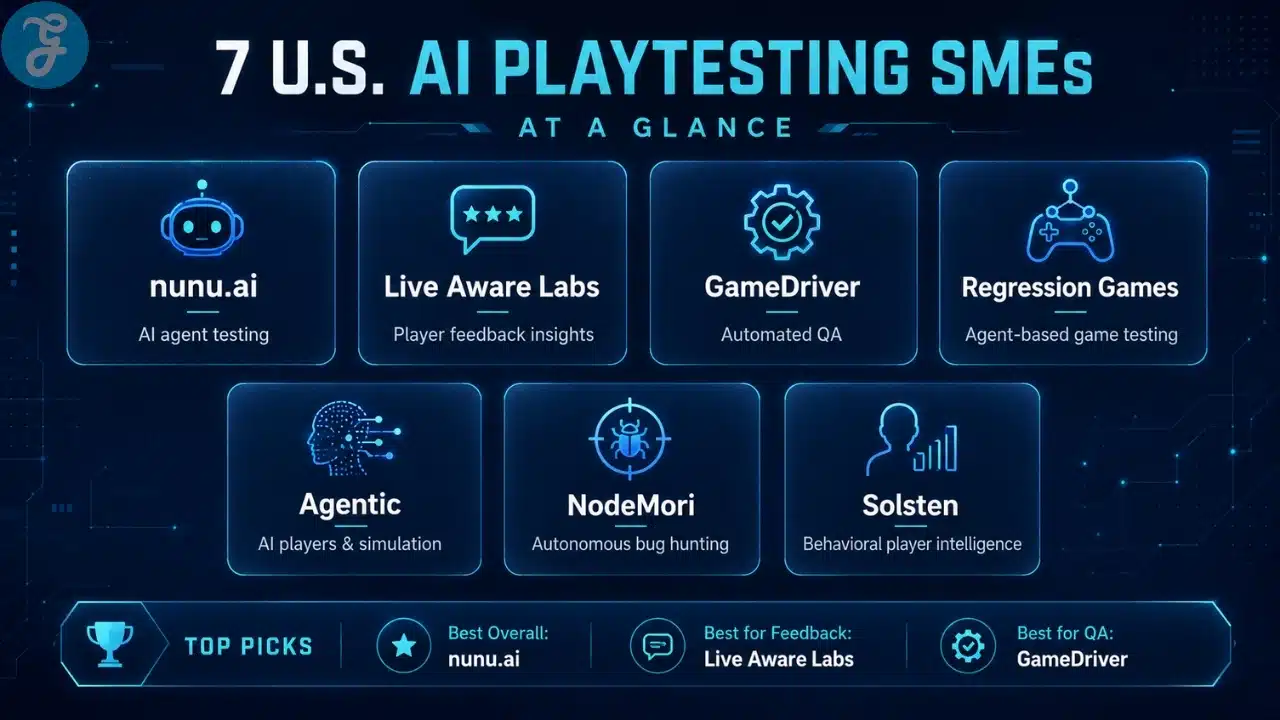
1. Best Overall U.S. AI-Powered Playtesting SME: nunu.ai
nunu.ai is the strongest overall U.S. pick because it directly builds multimodal AI agents to play and test games. It is the cleanest fit for the core meaning of AI-Powered Playtesting.
2. Best For AI-Assisted Player Feedback: Live Aware Labs
Live Aware Labs is the best choice when studios want to understand real player feedback faster. It is especially useful for teams buried under playtest recordings, transcripts, Discord feedback, surveys, and community signals.
3. Best For Automated Game QA: GameDriver
GameDriver is the strongest pick for structured QA automation across game engines. It is more practical for teams that need repeatable test coverage than broad player research.
How To Choose The Right AI-Powered Playtesting Tool By Yourself
Choosing the right tool starts with the problem, not the pitch deck. If the problem is bug discovery, choose AI-agent QA or automated regression tools. If the problem is player confusion, choose AI-assisted feedback analysis. If the problem is audience motivation, choose behavioral intelligence. If the problem is player scarcity, look at trainable AI-player platforms.
The Selection Framework
- Choose AI-agent QA if you need bots to play builds repeatedly.
- Choose AI-assisted player insights if you need to understand real-player reactions.
- Choose automated regression testing if your team needs repeatable technical validation.
- Choose behavioral intelligence if you want to understand motivation, engagement, and retention.
- Check engine support before buying anything.
- Ask whether the tool needs SDKs, code access, or build integration.
- Review whether reports include reproducible steps, logs, video, timestamps, or player quotes.
- Test the tool on your own game, not a demo game that behaves nicely for marketing.
- Keep human testers involved for fun, pacing, confusion, and emotional feedback.
The Final Checklist
- Does the tool solve your actual testing problem?
- Does it support your engine, platform, and build process?
- Does it produce evidence your team can act on?
- Does it reduce repetitive work without removing human judgment?
- Can designers, QA teams, researchers, and producers all understand the output?
The Final Word Before You Let AI Test Your Game
AI-Powered Playtesting is not here to magically replace human testers, designers, or researchers. That fantasy sounds exciting until you remember that games are not spreadsheets with health bars. A bot can find broken paths, repeat test runs, flag crashes, summarize feedback, and expose patterns faster than a tired QA team doing the same route for the 300th time. But it still cannot fully judge tension, humor, pacing, frustration, delight, or that strange little feeling players get when a mechanic finally clicks.
That is why the smartest SMEs will not treat AI-powered tools as replacements. They will treat them as force multipliers. Tools like nunu.ai, Live Aware Labs, GameDriver, Regression Games, Agentic, NodeMori, and Solsten show where the U.S. market is heading: faster testing cycles, better player insight, cleaner bug reports, and fewer launch-day disasters pretending to be “unexpected edge cases.”
The real winner will not be the studio that uses the most AI. It will be the studio that uses AI in the right place. Let machines handle repetition, coverage, synthesis, and early warning signs. Let humans handle taste, judgment, story, emotion, and the painfully important question every game still has to answer: is this actually fun?
So, before choosing a tool, be brutally clear about the problem. Do you need bug detection? Player feedback analysis? Regression testing? AI-player simulation? Behavioral insight? Pick the platform that matches that job. Because buying an AI tool without knowing your testing problem is not innovation. It is just expensive confusion with a dashboard.