The in-house content team vs. agency debate sounds simple until the invoice, salary spreadsheet, missed deadline, content calendar, SEO report, and “quick revision” request all walk into the same meeting and start fighting.
On paper, an in-house team gives you control, brand knowledge, speed, and direct accountability. An agency gives you broader skills, scalable output, outside perspective, and fewer hiring headaches. Lovely. Clean. Very professional. Also wildly incomplete.
The real question is not “which one is cheaper?” That is how companies accidentally make expensive decisions while pretending to be financially responsible. The better question is: which model gives you the best mix of quality, consistency, strategic thinking, execution speed, and measurable business value for your current stage?
Because yes, an agency can look cheaper than hiring three full-time people. And yes, an in-house team can look more expensive until you realize the agency still needs a strong internal person to brief, approve, measure, and stop the whole thing from becoming outsourced content soup.
Why This Debate Matters More In 2026
Content is no longer just “write blogs and hope Google sends traffic.” That version belongs in a museum beside keyword stuffing and stock photos of people pointing at laptops.
In 2026, content has to support SEO, AI search visibility, thought leadership, demand generation, sales enablement, email, social, brand trust, product education, and audience retention. Content Marketing Institute’s 2026 B2B research found that 65% of effective marketing teams credited better content relevance and quality for improved performance, while 53% credited stronger team skills and capabilities. Technology mattered too, but people and quality came first. Rude news for anyone hoping a tool subscription would become a strategy.
That is why the content team model matters. You are not just choosing who writes the article. You are choosing how your company thinks, publishes, learns, measures, and improves.
In-house Content Team Vs Agency: The Basic Difference
Before we get into costs, let’s define the two models properly.
An in-house content team is employed directly by the company. It may include a content manager, strategist, writer, editor, SEO specialist, designer, videographer, social media manager, or marketing operations person. The team lives inside the brand and understands internal priorities, product details, customers, politics, and all the weird little brand preferences that somehow become sacred law.
An agency is an external partner hired to deliver strategy, content creation, SEO, design, distribution, reporting, or campaign execution. A strong agency gives you access to multiple skills without hiring each role separately. A weak agency gives you recycled templates, monthly reports, and the phrase “we’re optimizing” until everyone loses the will to ask follow-up questions.
Here is the clean comparison:
| Factor | In-house Content Team | Agency |
|---|---|---|
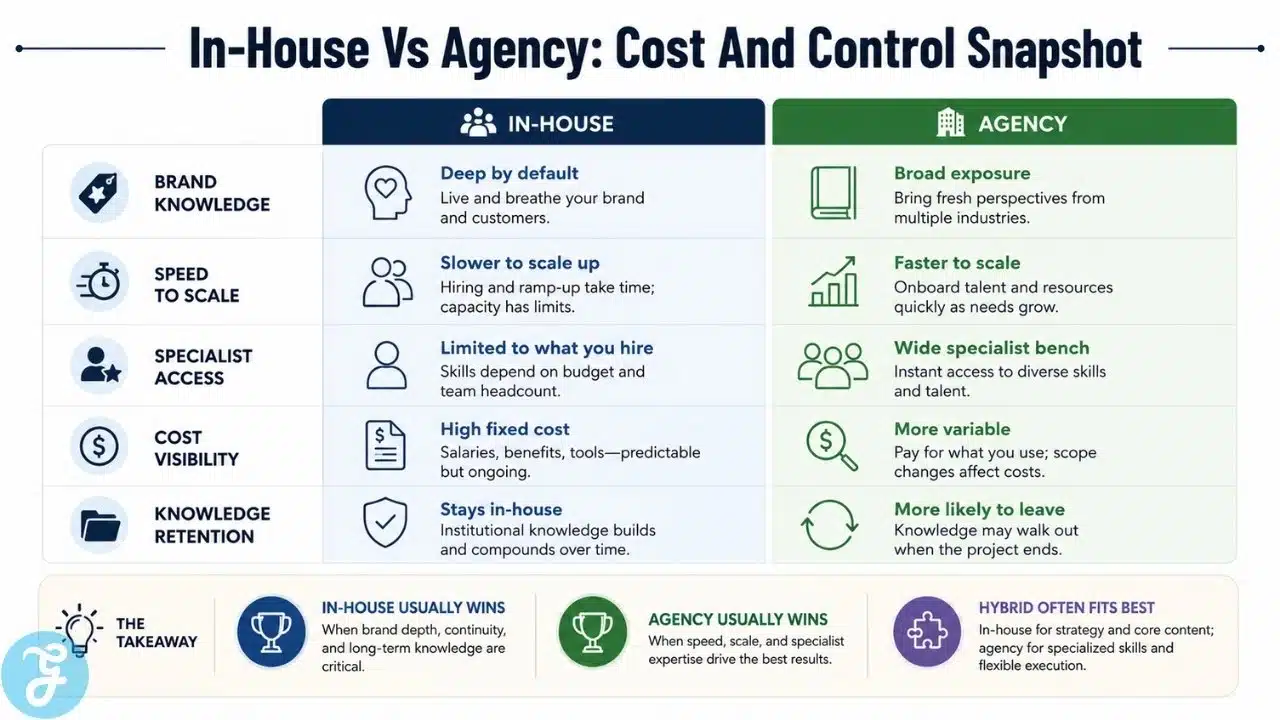
| Brand knowledge | Stronger over time | Needs briefing and onboarding |
| Speed on internal topics | Usually faster | Depends on access and approval flow |
| Specialist access | Limited unless team is large | Broader skill mix available |
| Cost structure | Salaries, benefits, tools, and management | Retainers, projects, scope limits |
| Scalability | Slower because hiring takes time | Faster if agency has capacity |
| Accountability | Direct internal ownership | Contract-based accountability |
| Strategic control | Higher | Shared |
| Fresh perspective | Can become inward-looking | Stronger outside viewpoint |
| Risk | Hiring mistakes are costly | Partner mismatch is costly |
Neither model is automatically better. Anyone who says otherwise is probably selling one of them.
The Real Cost Of Building An In-house Content Team
The in-house model looks expensive because the costs are visible. Salaries are visible. Tools are visible. Hiring is visible. Meetings are painfully visible.
For U.S. context, the Bureau of Labor Statistics reported median annual wages of $72,270 for writers and authors and $75,260 for editors in May 2024. Marketing managers were much higher, with a median annual wage of $161,030. Those are base wage figures before the full employer cost of benefits, payroll taxes, tools, software, training, and management time.
A lean in-house content team might look like this:
| Role | Why It Matters | Approximate U.S. Base Salary Signal |
|---|---|---|
| Content strategist/manager | Owns strategy, calendar, briefs, performance | Often overlaps with marketing manager-level responsibility |
| Writer | Produces articles, pages, emails, scripts, guides | BLS writer median: $72,270 |
| Editor | Improves quality, accuracy, tone, structure | BLS editor median: $75,260 |
| SEO/content analyst | Handles search intent, optimization, reporting | May be separate or part of strategist role |
| Designer/video support | Creates visuals and multimedia assets | Often shared or outsourced |
A realistic in-house setup can easily move from “one content person” to “we accidentally need a department.” One writer alone cannot be the strategist, SEO analyst, editor, designer, subject-matter interviewer, CMS manager, newsletter writer, LinkedIn ghostwriter, and reporting person unless the company is comfortable slowly turning them into a haunted spreadsheet.
The Real Cost Of Hiring An Agency
Agencies look cleaner on paper because the cost is wrapped into one retainer. Very elegant. Very easy to approve. Very easy to misunderstand.
Current pricing ranges vary heavily by scope. Clutch’s 2026 digital marketing pricing guide says digital marketing agency pricing can range from $5,000 to $50,000 per month, based on data across many firms. Column Five’s 2026 content marketing pricing guide says full-service content programs for mid-market B2B companies often run around $5,000 to $15,000 per month, while simpler retainers may be lower.
That gives us a rough annual range:
| Agency Model | Monthly Range | Annual Range | What It Usually Means |
|---|---|---|---|
| Small content retainer | $2,000–$5,000 | $24,000–$60,000 | Limited output, basic execution |
| Mid-market content program | $5,000–$15,000 | $60,000–$180,000 | Strategy, content, SEO, reporting |
| Full-service marketing agency | $15,000–$50,000+ | $180,000–$600,000+ | Multi-channel strategy and execution |
The agency can be cheaper than hiring a full team if the scope is controlled. But once you need strategy, SEO, content, design, video, distribution, analytics, conversion work, and sales enablement, the retainer starts growing teeth.
Where In-house Teams Usually Win
In-house teams win when brand depth matters. If your company has a complex product, a technical audience, a regulated industry, a strong founder’s point of view, or heavy internal knowledge, an in-house team has a real advantage.
This is why established publishing brands like Editorialge often benefit from strong internal content direction, because brand voice, editorial judgment, and topical consistency become harder to outsource completely.
They sit closer to the product. They hear sales objections. They can interview subject-matter experts more easily. They know what the CEO hates. They know which phrases are legal will murder. They understand the internal rhythm of launches, campaigns, and customer questions.
In-house is usually better for:
- Deep brand voice.
- Product-led content.
- Founder-led thought leadership.
- Sales enablement.
- Internal expert interviews.
- Fast reaction to company updates.
- Long-term editorial consistency.
- Sensitive or regulated topics.
- Customer education and onboarding content.
This is especially important because thought leadership is becoming more expertise-driven. CMI’s 2026 research found that 96% of B2B marketers create thought leadership, but only 18% report substantial or widespread participation from employees with specialized knowledge. In other words, many companies are trying to sound expert without involving enough actual experts. That is not thought leadership. That is marketing doing karaoke.
Where Agencies Usually Win
Agencies win when you need speed, range, and external capability. A good agency can bring strategists, writers, editors, SEO people, designers, developers, video people, and analytics support without making you hire each one.
That matters for small teams that need to grow content output but cannot justify a full internal department yet. It also matters when your in-house team is strong on brand but weak on SEO, distribution, design, analytics, or campaign systems.
Agencies are usually better for:
- Scaling production quickly.
- Accessing multiple specialists.
- Launching content programs faster.
- Building SEO systems.
- Creating campaign assets.
- Refreshing old content at scale.
- Producing reports and dashboards.
- Bringing an outside market perspective.
- Covering skill gaps without hiring.
The strongest agency relationships happen when the client has internal clarity. The weakest happens when the client throws vague ideas over the wall and expects the strategy to return wearing a cape.
The Hidden Cost Nobody Wants To Admit
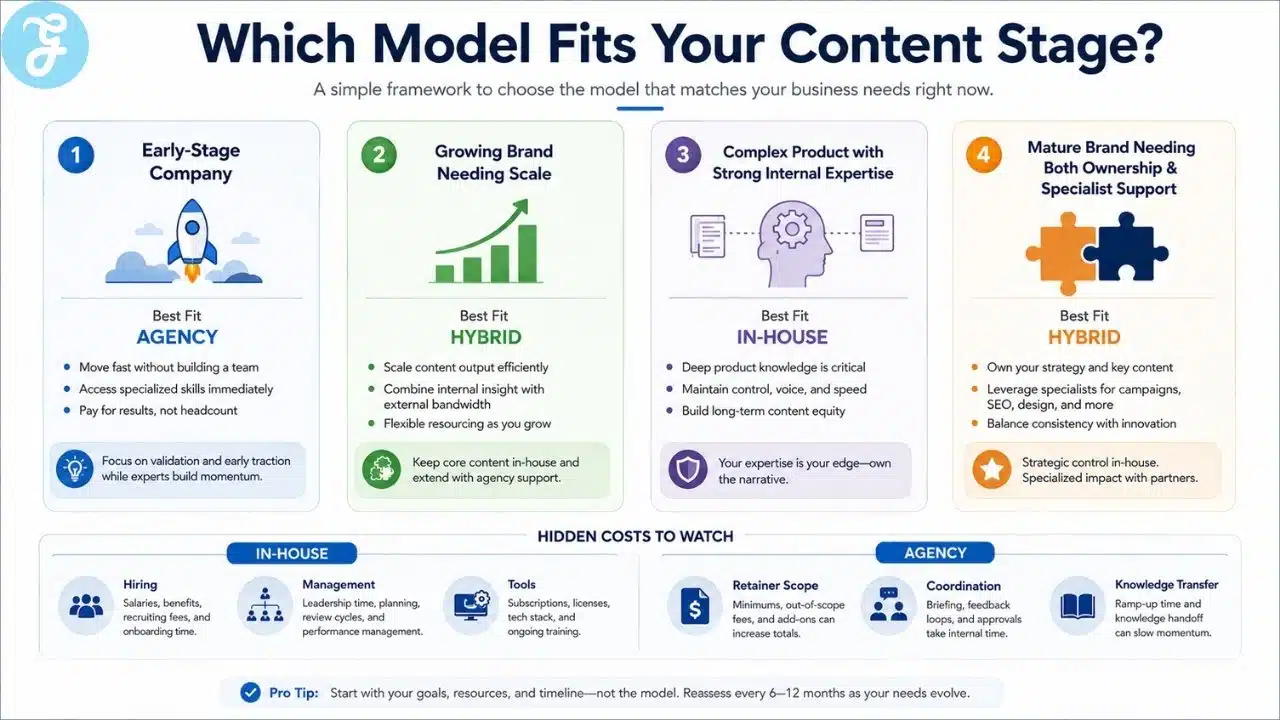
The hidden cost of in-house is management. Someone has to recruit, train, review, coach, plan, measure, and protect the team from random requests disguised as “quick content ideas.”
The hidden cost of agency work is internal coordination. Someone still has to brief the agency, share access, review drafts, explain product nuance, approve strategy, provide feedback, track performance, and make sure the work does not drift into generic marketing fog.
So the real comparison is not “salary versus retainer.” It is:
| Hidden Cost | In-house Team | Agency |
|---|---|---|
| Management time | High | Medium |
| Hiring risk | High | Low to medium |
| Onboarding time | High at first | Medium |
| Brand education | Lower over time | Ongoing |
| Quality control | Internal responsibility | Shared |
| Revision cycles | Internal | Can become slow |
| Strategic ownership | Internal | Must be clearly assigned |
| Knowledge retention | Strong | Risky if agency leaves |
This is where companies fool themselves. They hire an agency because they do not have time, then realize the agency still needs time from them. Apparently, outsourcing does not eliminate thinking. Tragic.
The Real Cost-Benefit Analysis
If we simplify the decision, in-house gives you ownership. Agency gives you leverage.
An in-house content team becomes more valuable the longer it stays, learns, and compounds brand knowledge. An agency becomes more valuable when it brings capabilities the business cannot build fast enough internally.
Here is the practical cost-benefit breakdown:
| Decision Factor | Better Choice | Why |
|---|---|---|
| You need deep brand voice | In-house | Internal context compounds over time |
| You need fast scaling | Agency | Specialists are already available |
| You need technical product knowledge | In-house | Easier access to internal experts |
| You need SEO and content operations | Agency or hybrid | Specialist systems may already exist |
| You need lower upfront commitment | Agency | A retainer can be easier than hiring |
| You need long-term content ownership | In-house | Knowledge stays inside the business |
| You need broad campaign execution | Agency | More disciplines under one roof |
| You need executive thought leadership | Hybrid | Internal ideas plus outside editorial polish |
| You need cost control | Depends | Scope discipline matters more than model |
The answer is annoying because it is true: the best model depends on company stage, content maturity, budget, complexity, and internal capability.
When An In-house Content Team Makes More Sense
Choose in-house when content is core to your company’s growth and voice. If content drives your SEO, sales education, product adoption, brand authority, and customer trust, you probably need internal ownership.
An in-house team makes sense when:
- You publish consistently every month.
- Your product or category is complex.
- Subject-matter expertise is inside the company.
- Brand voice matters deeply.
- Your sales team needs constant enablement assets.
- You need content tied closely to product marketing.
- You want long-term content intelligence inside the business.
- You can afford leadership, not just execution.
The mistake is hiring one junior writer and calling it a content team. That is not a content team. That is one person being slowly buried under strategy, writing, editing, SEO, CMS work, social repurposing, and dashboard requests. Please stop doing this to people.
Where the In-house Content Team vs Agency Usually Tilts Toward In-house
The In-house Content Team vs Agency decision tilts toward in-house when content is not a side channel but a business engine. If your company needs constant product education, original insights, customer stories, internal expert access, and brand-led thought leadership, internal talent will usually create stronger long-term value.
When An Agency Makes More Sense
Choose an agency when you need capability before headcount. This is common for small and mid-sized companies that need SEO, blog production, landing pages, email, social media repurposing, and reporting, but cannot yet hire a full team.
An agency makes sense when:
- You need fast execution.
- You lack SEO or content strategy skills internally.
- You need multiple roles but cannot hire them all.
- Your content program is still being tested.
- You have a clear internal owner to manage the agency.
- You need a content refresh or campaign sprint.
- You want outside perspective.
- You need flexible capacity.
The danger is hiring an agency to replace strategy. Agencies can support the strategy. Good ones can even build it with you. But if nobody inside the company owns positioning, product truth, customer knowledge, and business goals, the agency will eventually produce polished content that says nothing special.
Why The Hybrid Model Often Wins
For many companies, the best answer is not in-house or agency. It is both.
A hybrid model usually works like this:
- Internal team owns strategy, brand voice, subject-matter access, priorities, and approvals.
- Agency supports SEO research, content production, design, distribution, audits, and scaling.
- Freelancers or specialists fill narrow gaps such as technical writing, video, or conversion copy.
This model avoids the two dumb extremes: building a bloated internal team too early or outsourcing the entire brand brain to strangers.
A strong hybrid model might look like this:
| Internal Owner | Agency Support |
|---|---|
| Content strategy | SEO research |
| Brand voice | Draft production |
| Product knowledge | Content refreshes |
| SME interviews | Design and multimedia |
| Final approvals | Reporting dashboards |
| Business goals | Campaign execution |
This is often the most realistic model because it keeps strategic knowledge inside while using outside specialists for scale. It is not glamorous. It is just sensible, which marketing departments occasionally allow.
How To Calculate The Real Cost
Before choosing, calculate the full cost of each model.
For in-house, include:
- Base salaries.
- Benefits and payroll costs.
- Recruiting time.
- Onboarding and training.
- Software and tools.
- Management time.
- Freelance support.
- Design and video resources.
- Paid distribution.
- Analytics and reporting tools.
For agency, include:
- Monthly retainer.
- Setup fees.
- Strategy fees.
- Extra content outside the scope.
- Revision limits.
- Design or video add-ons.
- Paid tools.
- Internal review time.
- Meetings and coordination.
- Contract length and exit terms.
The cheapest option is not always the lowest price. The cheapest option is the one that produces useful content consistently without creating hidden chaos, poor quality, or strategic confusion.
The Decision Framework
Here is the simplest way to choose:
| Your Situation | Best Model |
|---|---|
| Early-stage company testing content | Agency or freelance support |
| Small team with no content leader | Agency plus internal owner |
| Strong brand with complex product | In-house or hybrid |
| Scaling SEO content fast | Hybrid |
| Building thought leadership | In-house-led hybrid |
| Need many formats quickly | Agency |
| Need deep customer education | In-house |
| Need cost flexibility | Agency |
| Need long-term knowledge retention | In-house |
| Need specialist skills without hiring | Agency or hybrid |
One warning: if you choose an agency, appoint an internal owner. If you choose in-house, fund the team properly. The worst model is not in-house or agency. The worst model is underfunded, unmanaged, unclear, and then somehow expected to “drive growth.”
The Real Winner Is The Model You Can Actually Manage
The In-house Content Team vs Agency choice is not a personality quiz. It is an operating model decision.
If content is central to your growth, brand, product education, and customer trust, build internal strength. If you need specialist execution, speed, and flexible capacity, hire an agency. If you need both ownership and scale, use a hybrid model.
But do not pretend an agency will solve an unclear strategy. Do not pretend that one in-house writer can replace an entire content operation. Do not pretend AI will magically fill the gap while everyone else “focuses on strategy,” which often means meetings about strategy.
The real winner is the model that gives you clear ownership, strong execution, useful measurement, and content that actually helps the business. Everything else is just cost comparison theater with a nicer font.