Guest Posting In 2026 is not dead. Lazy guest posting is dead. Or at least it should be, but some people are still dragging it around the internet like a tired SEO zombie with a keyword-rich anchor text in its mouth.
The old version was simple: write a generic article, publish it anywhere with a half-decent domain rating, insert an optimized link, send invoice, repeat until Google notices or the site turns into a content landfill. Very elegant. Very 2014. Very “please penalize me when convenient.”
The smarter version is different. Guest posting can still be worth it when it builds real visibility, audience trust, referral traffic, relationships, and topical authority. It becomes risky when the main goal is manipulating rankings with scaled links, low-quality posts, paid dofollow placements, or irrelevant sites that only exist to sell “high DA guest posts” to people who still think SEO is a vending machine.
Google has said it does not discourage guest posts when they inform users, educate another site’s audience, or bring awareness to a company or cause. The problem starts when the main intent is large-scale link building back to the author’s site. Google’s current spam policy also treats buying or selling links for ranking purposes, including money exchanged for posts with links, as link spam unless those links are properly qualified.
Is Guest Posting In 2026 Still Worth It?
Yes, but only if you stop treating it like a link machine.
Guest posting is worth it when the host site has a real audience, a relevant topic base, editorial standards, and a reason your article should exist there. It is not worth it when the site accepts everything, publishes 50 unrelated guest posts a week, and has categories that look like SEO bingo: casinos, CBD, finance, SaaS, pets, crypto, mattresses, and “best essay writing services.” Truly, the internet’s finest buffet of credibility.
In 2026, the real value of guest posting comes from:
- Getting in front of the right audience.
- Building name and brand recognition.
- Earning referral traffic from relevant readers.
- Supporting topical authority with meaningful mentions.
- Creating relationships with editors, founders, and industry sites.
- Sharing expertise in places where your ideal buyers already pay attention.
The backlink can still matter, but it should not be the entire reason the post exists. If the only value of the article is the link, the article is already weak.
Why Guest Posting Became Riskier
Guest posting became risky because too many people abused it. Shocking development. Give marketers a useful tactic and someone will eventually automate it into a crime scene.
Google’s link spam policy says link spam includes links created mainly to manipulate search rankings. It specifically includes money exchanged for links or posts that contain links, excessive link exchanges, links with optimized anchor text in guest posts, and low-value content created mainly to manipulate linking and ranking signals. Google also says paid or sponsored links are not a violation when they are qualified with rel="nofollow" or rel="sponsored".
That means the issue is not “guest posting exists.” The issue is intent and execution.
A genuine expert article on a relevant publication? Fine.
A paid dofollow post on a random site with exact-match anchor text and no audience? That is not outreach. That is link spam wearing a guest author bio.
The 2026 Guest Posting Reality Check
Before planning guest posts, ask what you are really buying or earning.
| Guest Posting Type | Risk Level | Real Value |
|---|---|---|
| Expert article on a relevant industry site | Low | Brand authority, referral traffic, topical visibility |
| Thought leadership column with editorial review | Low | Trust, awareness, audience access |
| Sponsored article with properly qualified links | Moderate | Brand exposure, not direct link equity |
| Guest post on a generic “write for us” farm | High | Usually weak or risky |
| Paid dofollow post with exact-match anchor | Very high | Short-term link gain, long-term risk |
| Scaled guest posting across irrelevant sites | Very high | Looks manipulative and low-value |
The rule is simple: if you would not want real customers to read the article, do not publish it just for the link.
What Makes A Guest Post Worth Publishing?
A good guest post should pass the “would this help the host site’s audience?” test. Not “can I sneak my link in paragraph four?” Not “does this site have traffic according to a third-party tool?” Not “will the editor accept my AI-written masterpiece about productivity trends in 2026?”
A strong guest post has:
- A clear audience fit.
- A useful, original angle.
- Practical insights from experience.
- Natural brand or author relevance.
- A link that supports the reader, not just the sender.
- Editorial quality good enough to stand on its own.
Google’s March 2024 guidance around spam updates stressed people-first content and warned against practices that manipulate rankings, including scaled content abuse and site reputation abuse. That matters because guest posting now sits in a wider trust environment where low-value third-party content is under much more scrutiny.
What Google’s Site Reputation Abuse Policy Means For Guest Posting
This is where things get interesting.
Google’s site reputation abuse policy targets third-party content published on a host site mainly to exploit that site’s established ranking signals. Google says third-party content itself is not automatically a violation, but it becomes a problem when it is published mainly because the host site’s reputation will help it rank better than it could on its own.
This matters for guest posting because some publishers and SEO vendors have built entire businesses around renting authority. The game is basically: “This site ranks well, so let’s publish unrelated commercial content on it and ride the domain’s reputation.” Charming. Also exactly the sort of thing Google has been cracking down on.
The policy has even attracted regulatory attention in Europe. Reuters reported that EU regulators opened an investigation into Google’s spam policy after publisher complaints, and later reported that Google offered changes to the policy while saying its priority is keeping Search helpful and protecting users from deceptive practices like parasite SEO.
For normal guest posting, the lesson is clear: relevance matters. Editorial purpose matters. Audience value matters. Posting random commercial content on unrelated authority sites is much harder to defend.
How To Do Guest Posting Right In 2026
The best guest posting strategy starts before outreach. It starts with positioning.
You need to know what you want to be known for, which audiences matter, which publications those audiences trust, and what you can say that is actually useful. Otherwise, you are just throwing content at inboxes and hoping an editor is tired enough to say yes.
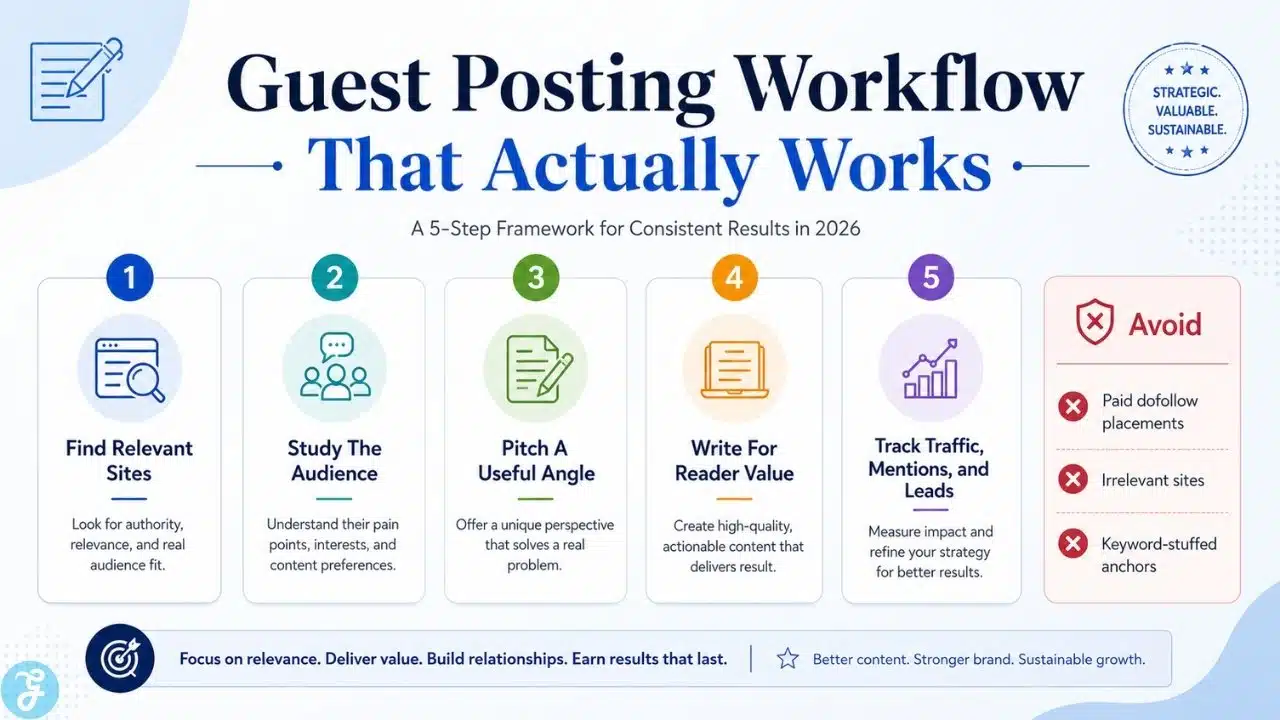
A proper process looks like this:
- Define your authority topics.
- Build a list of relevant publications.
- Check audience fit, not just domain metrics.
- Study the site’s existing content.
- Pitch a useful original angle.
- Write the article for the host audience first.
- Use links naturally and sparingly.
- Qualify sponsored links properly.
- Track referral traffic, mentions, and relationship value.
- Avoid scaled campaigns that look like link manipulation.
This is not complicated. It is just less lazy than buying “50 guest posts on high DA sites” from someone whose email begins with “Dear sir/madam.”
Why Guest Posting In 2026 Must Start With Relevance
Guest Posting In 2026 works best when the topic, host site, audience, and link all make sense together. If the article feels forced, irrelevant, or written only to place a backlink, it is not strategy. It is link manipulation wearing a guest author badge.
How To Choose The Right Sites For Guest Posting
A good guest post placement should feel obvious. If your article appears on the site, readers should not wonder how it got there.
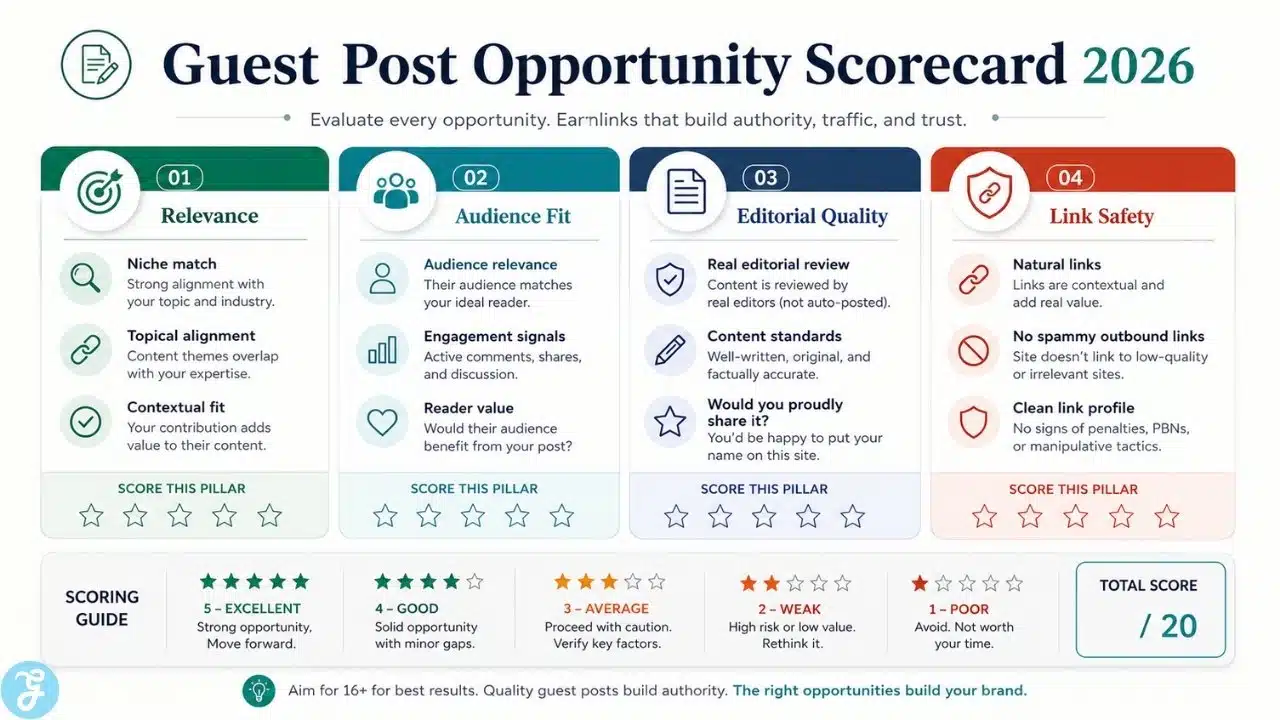
Use this screening framework before pitching:
| Check | What To Look For |
|---|---|
| Topic relevance | The site regularly covers your niche or nearby topics |
| Audience fit | Readers match your buyers, peers, or industry audience |
| Editorial standards | Posts are reviewed, useful, and not obviously paid fluff |
| Author quality | Contributors have real names, credentials, or experience |
| Link behavior | Outbound links look natural, not spammy or overloaded |
| Content mix | The site is not filled with unrelated commercial guest posts |
| Traffic quality | The site appears to have real visibility and engagement |
| Brand safety | You would be comfortable sharing the article publicly |
If the site fails the relevance test, stop. A backlink from an irrelevant site may look pretty in a spreadsheet, but spreadsheets do not buy from you, trust you, or recommend you.
Guest Post Pitch That Works
Editors do not want your autobiography. They want to know whether your article will help their readers.
A good pitch is short, specific, and tied to the publication’s audience. Something like:
Hi [Name],
I noticed your site covers B2B content strategy and search visibility. I’d like to pitch a practical guest article on “How AI Search Is Changing Content Briefs For Small Marketing Teams.”
The piece would cover how briefs need to shift from keyword-only planning to source-worthiness, first-hand input, and clearer expert review.
I can keep it practical, non-promotional, and tailored to your audience.
Would this be a useful fit?
That works because it shows relevance, gives a clear angle, and does not scream “please give me a backlink before my boss checks Ahrefs.”
Guest Posting Mistakes To Avoid
Most guest posting failures are self-inflicted. Wonderful news, because that means they can be avoided.
Avoid these:
- Pitching irrelevant sites just because they have high authority metrics.
- Sending generic pitches to hundreds of editors.
- Using AI to mass-produce guest posts with no original insight.
- Stuffing exact-match anchor text into the article.
- Paying for dofollow links and pretending it is editorial outreach.
- Publishing on sites that clearly exist to sell guest posts.
- Writing articles that are basically ads with subheadings.
- Reusing the same article idea everywhere.
- Ignoring disclosure and link qualification.
- Measuring success only by backlinks.
Google’s current spam policies warn against scaled content abuse, scraping, link spam, and site reputation abuse. Guest posting can touch all of those danger zones when it is scaled, irrelevant, paid, or created mainly to manipulate rankings.
What To Measure Instead Of Just Links
If you judge guest posting only by backlinks, you will eventually make bad decisions. You will choose sites that look powerful in SEO tools but have no audience, no trust, and no editorial value. That is how people end up with links from websites that publish “best VPN,” “best dog food,” and “best crypto casino” in the same afternoon.
Better metrics include:
- Referral traffic.
- Branded search lift.
- Newsletter signups.
- Demo or inquiry assists.
- Social shares from the host audience.
- Relationship value with editors and industry people.
- Mentions in future articles.
- Quality of comments or inbound conversations.
- Whether the article strengthens your topical authority.
The backlink is one signal. The relationship and audience exposure are often the bigger win.
When Guest Posting Is Not Worth It
Guest posting is not worth it when the opportunity is irrelevant, the site looks spammy, the editor demands money for dofollow links, or the article exists only to place an anchor text. At that point, call it what it is: link buying with extra typing.
It is also not worth it if your own site is weak. If your homepage, service pages, content hub, or conversion path are messy, sending guest-post traffic there is like inviting guests into a house where the floor is missing. Fix your base first.
Guest posting should support a real content and authority strategy. It should not be your entire SEO plan. If guest posting is the whole strategy, the strategy is already limping.
The Safe Guest Posting Checklist
Before publishing a guest post, check this:
- Is the host site relevant to your niche?
- Would the audience actually care about this topic?
- Is the content original and useful?
- Is the link natural and necessary?
- Are paid or sponsored links properly qualified?
- Does the article avoid keyword-stuffed anchors?
- Does the site have real editorial standards?
- Would you proudly share the post on your own channels?
- Is the post building authority, not just collecting a link?
If the answer is no to most of these, walk away. There are easier ways to create problems.
The Real Answer: Guest Posting Is Worth It If You Stop Abusing It
Guest Posting in 2026 is worth it when it is treated as authority building, audience access, and relationship building. It is not worth it when it becomes a scaled link scheme with a nicer name.
The old guest posting playbook was built around links first. The better 2026 version is built around usefulness first. Write for sites where your expertise belongs. Pitch ideas that help their audience. Use links naturally. Disclose sponsored relationships. Avoid irrelevant placements. Stop chasing domain metrics like they are sacred numbers carved into stone.
Guest posting still works when it makes sense to humans. Funny how often that is also the safest SEO strategy.
The final rule is simple: if the guest post would still be valuable without the backlink, it is probably worth doing. If the backlink is the only reason it exists, congratulations, you have found the problem.