I have been working in the content industry since 2019, and if there is one thing Google has taught me, it is this: shortcuts always die. Sometimes slowly. Sometimes violently. Sometimes, during a core update, while everyone on SEO Twitter suddenly becomes a prophet and pretends they “saw it coming.”
Over the years, I have worked across different content roles, teams, companies, niches, and publishing setups. I have seen keyword stuffing dressed up as strategy, thin affiliate content pretending to be expertise, AI-written articles acting like they have real opinions, and websites trying to survive Google updates with nothing but author boxes, fake review labels, and prayers. So when I talk about E-E-A-T Signals, I am not speaking from a clean little theory room. I am speaking from years of adapting, fixing, rewriting, auditing, improvising, and watching old SEO tricks become digital fossils.
And that is why we need to be honest about E-E-A-T in 2026. It is not a magic ranking button. It is not a plugin setting. It is not a ranking cheat code or some little SEO vitamin you sprinkle on a weak article and suddenly outrank everyone. Sadly, Google has not created a “trust me bro” ranking factor yet, although half the internet seems to be optimizing for it with heroic confidence.
The real story is less glamorous but far more useful. E-E-A-T is not one direct ranking factor. Google uses many different signals to understand whether content shows experience, expertise, authoritativeness, and trustworthiness. It also pays closer attention to these trust-related signals in YMYL topics, where bad content can affect people’s health, finances, safety, welfare, or major life decisions.
So what actually moves the ranking needle? Not adding an author box and calling it a day. Not writing “reviewed by experts” under a blog post nobody reviewed. Not stuffing “expert-backed” into every heading like a nervous intern holding a thesaurus. What moves rankings in 2026 is building pages, authors, brands, and websites that are visibly useful, verifiable, original, and trustworthy enough for both Google and real readers to take seriously.
Why E-E-A-T Became Harder To Fake After Years Of Google Updates
When I started working in content in 2019, SEO already required quality, but a lot of websites could still survive with formulaic content. You could reverse-engineer competitors, expand the word count, add FAQs, sprinkle keywords, and call it a day. Was it brilliant? No. Did it sometimes work? Annoyingly, yes.
Then Google kept changing the rules. Not in one single dramatic moment, but through years of updates that slowly punished shallow content, weak trust signals, bad user experience, manipulative link tactics, poor product reviews, and content created mainly to rank instead of help. Google’s own Search Status Dashboard lists repeated ranking-related updates from 2021 through 2026, including core updates, spam updates, product review updates, page experience updates, helpful content updates, and Discover updates. That is not a small adjustment. That is Google repeatedly telling publishers, “Please stop feeding the search results garbage with headings.”
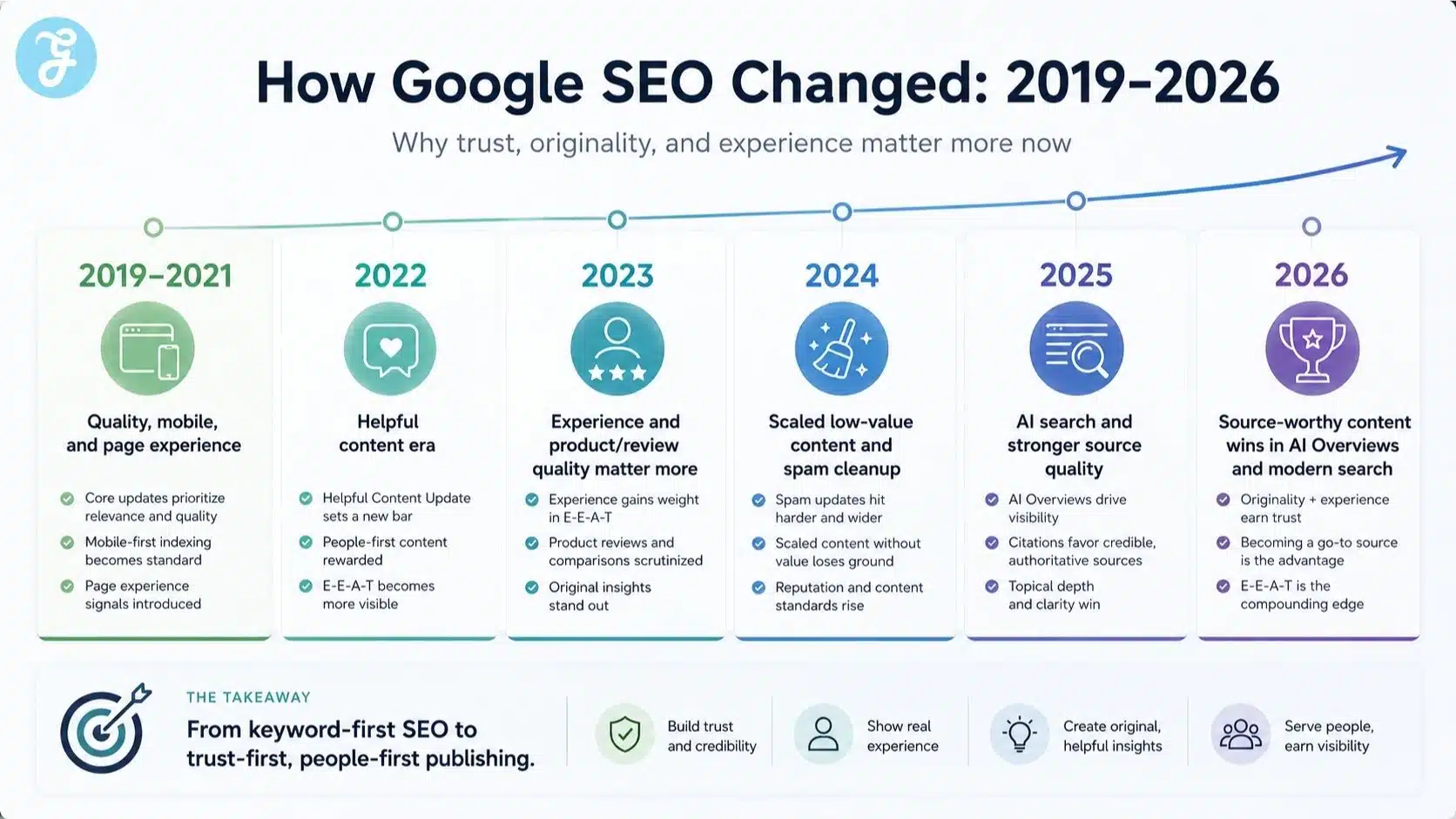
This is why I do not treat E-E-A-T like a checklist. I treat it like survival hygiene. Not glamorous, but very useful when the next update starts rearranging everyone’s traffic like furniture during an earthquake.
What Google Actually Says About E-E-A-T Signals
Before we get carried away, let’s separate reality from SEO folklore. Google says its automated ranking systems use many different factors to prioritize helpful and reliable content. After identifying relevant content, those systems look for signals that help determine whether content demonstrates experience, expertise, authoritativeness, and trustworthiness, or E-E-A-T.
That does not mean E-E-A-T is one direct ranking factor with a neat little score hiding inside Google Search Console. I wish it were that simple. We could all stare at a dashboard, panic professionally, and move on.
Google’s Search Central blog made this clear when it added “Experience” to E-A-T in December 2022. The guidelines help Google’s search raters evaluate whether ranking systems are working well, but the ratings themselves do not directly influence rankings.
So, what does that mean in plain language?
E-E-A-T is not one switch. It is a framework. It describes the kind of content Google wants its systems to reward: content that feels useful, original, credible, experienced, accurate, and trustworthy. The ranking needle moves when the actual page becomes better, not when we decorate weak content with trust-shaped stickers.
The Real Change Since 2019: Google Got Less Patient With Lazy Content
One of the biggest changes I have seen since 2019 is that Google became much less patient with content that only exists because a keyword exists. That kind of content used to be everywhere. To be fair, it still is. The difference is that now it has a much harder time pretending to be useful for long.
Google’s helpful content guidance asks whether content provides original information, reporting, research, or analysis; whether it gives substantial value compared with other search results; and whether it avoids simply copying or rewriting other sources without adding value.
That is the part many publishers still ignore. They do not create content. They create search result summaries with a different title. Then they wonder why their rankings disappear after an update. Truly mysterious. Somebody call the SEO detective.
From my experience, the content that survives better usually has at least one of these things:
| Strong Content Signal | Why It Helps |
|---|---|
| First-hand experience | Shows the writer actually knows the topic |
| Original examples | Gives readers something competitors do not |
| Clear sourcing | Makes claims easier to verify |
| Useful structure | Helps readers solve the problem faster |
| Specific advice | Avoids generic “it depends” fluff |
| Updated facts | Protects trust in fast-changing topics |
| Author credibility | Shows why the writer deserves attention |
| Editorial judgment | Separates helpful content from content sludge |
This is where E-E-A-T starts becoming practical. It is not about pleasing Google like some mysterious search engine deity. It is about making the page more trustworthy to real people.
The AI Boom Made E-E-A-T Signals More Important, Not Less
AI changed the content industry fast. Anyone pretending otherwise is either asleep or selling a course with 14 bonus modules. AI made writing faster, research easier, outlines cleaner, and content production more scalable. It also made lazy content production dangerously easy.
Google’s guidance says using AI or automation is not automatically against its rules. The problem is using automation mainly to manipulate search rankings instead of creating helpful, high-quality, people-first content.
That matches what I have seen in real content work. AI is useful when it supports human thinking. It becomes dangerous when it replaces it. The issue is not “AI content.” The issue is content with no judgment, no experience, no verification, no original value, and no accountability.
The March 2024 update made this even clearer. Google said it was refining core ranking systems to better identify unhelpful content, poor user experience, and pages that feel created for search engines instead of people. Google later said the completed work resulted in 45% less low-quality, unoriginal content in search results, compared with the 40% improvement it expected.
That number matters. It tells content teams something very simple: Google is not just fighting “bad AI.” It is fighting unoriginal content at scale, whether humans, AI, or some cursed combination of both created it.
Where AI Helps And Where It Makes Content Worse
Because I have worked through the rise of AI, I do not believe in the lazy argument that AI is either the future of all content or the death of all content. Both opinions are dramatic. Both usually come from people who enjoy shouting into LinkedIn.
AI is a tool. A powerful one. But it still needs a human editor, strategist, researcher, and subject-aware writer behind it. Otherwise, the output becomes smooth, confident, and empty—the content equivalent of a hotel lobby.
Here is how I separate useful AI from dangerous AI in content work:
| Good Use Of AI | Bad Use Of AI |
|---|---|
| Building article outlines | Publishing generic first drafts |
| Summarizing research notes | Inventing facts or sources |
| Improving readability | Removing the writer’s real voice |
| Creating content briefs | Mass-producing thin pages |
| Finding content gaps | Rewriting competitors with no added value |
| Helping with structure | Faking first-hand experience |
| Drafting social variations | Producing YMYL advice without review |
AI can speed up the boring parts. It should not be trusted with the thinking parts. That is where practical experience still matters.
The E-E-A-T Signals That Actually Matter In 2026
After working through updates, traffic drops, content refreshes, AI changes, and shifting SERPs, I would not start an E-E-A-T audit by asking, “Does this article have an author bio?” That is too shallow.
I would ask: why should anyone trust this page?
That question is more uncomfortable, which is exactly why it works.
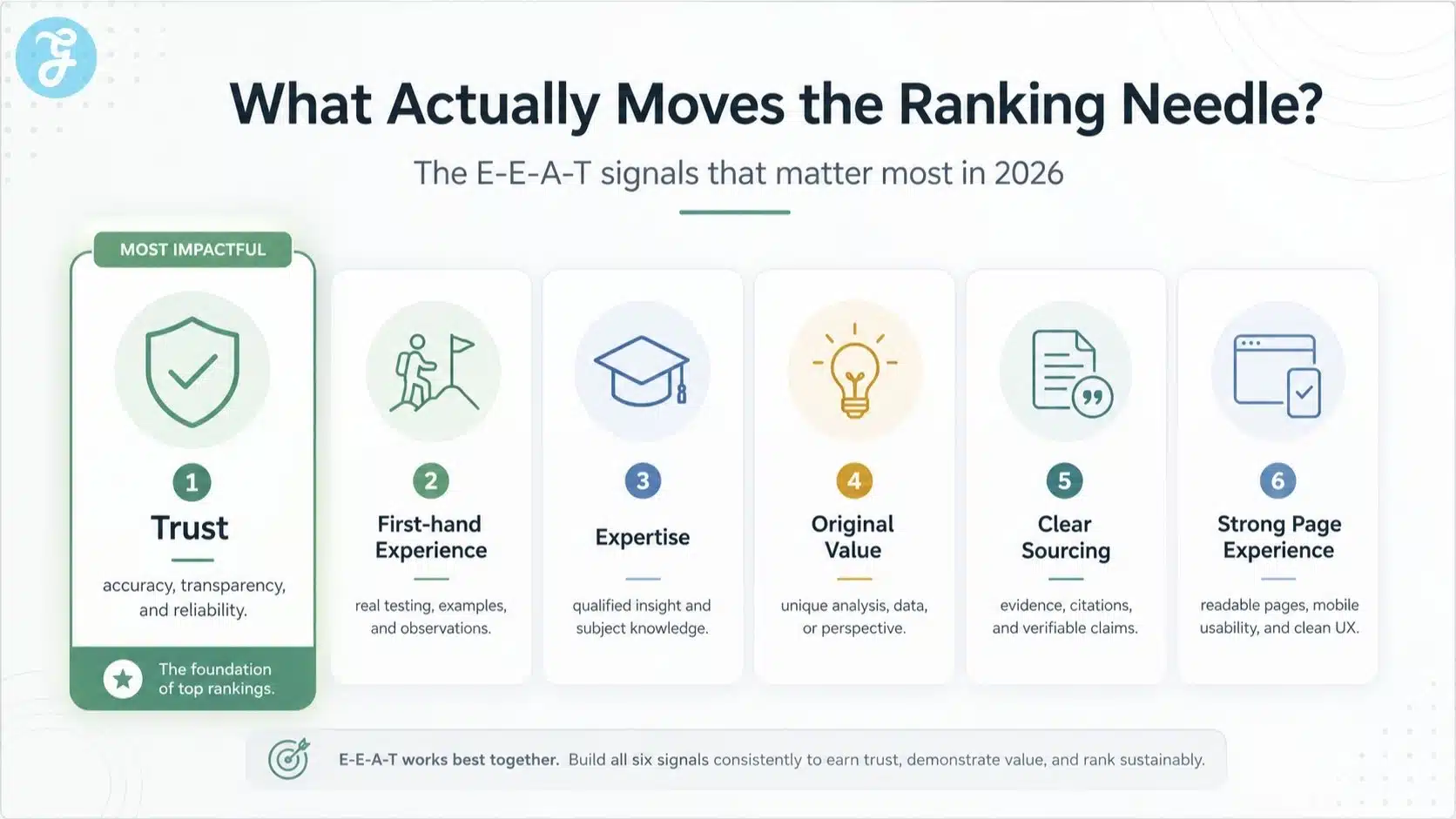
These are the signals I believe actually matter:
| E-E-A-T Signal | What It Looks Like In Real Content |
|---|---|
| Experience | First-hand testing, real examples, personal workflow, screenshots, lived perspective |
| Expertise | Correct advice, technical understanding, expert review where needed |
| Authority | Topical depth, strong internal coverage, external mentions, credible links |
| Trust | Accurate claims, clear sourcing, transparent author/site details, honest limitations |
| Originality | New analysis, better examples, unique data, practical insight |
| Page quality | Clean layout, readable content, no ad chaos, strong UX |
| Freshness | Updated facts, current screenshots, revised recommendations |
| Accountability | Author identity, contact details, editorial policy, correction process |
The point is not to add all of these mechanically. The point is to match the level of trust required by the topic. A recipe article does not need the same proof as a medical article. A SaaS review should not use the same trust signals as a personal essay. Context matters. Shocking concept, I know.
Why First-Hand Experience Is Now Harder To Ignore
The extra “E” for Experience was not added because Google suddenly became sentimental. It was added because first-hand experience helps separate useful content from recycled content. Google explained that content may demonstrate experience when it is created by someone who actually used a product, visited a place, or personally experienced the topic.
This is one area where I strongly agree with Google, even though agreeing with Google too often feels like a professional hazard.
First-hand experience makes content harder to fake. A writer who has actually used a tool can talk about setup issues, pricing surprises, weak features, workflow problems, screenshots, and real use cases. A writer who has only read other articles usually writes vague lines like “this tool is user-friendly and efficient.” Beautiful. Meaningless.
Here is the difference I look for:
| Weak Experience | Strong Experience |
|---|---|
| “This tool is easy to use” | “I tested it on three content briefs and the export feature saved around 20 minutes per brief” |
| “This cleaner works well” | “I used it on bathroom grout and it worked better on soap scum than hard-water stains” |
| “This CRM is good for teams” | “The pipeline view is useful, but reporting setup takes longer than expected” |
| “This destination is beautiful” | “I visited during shoulder season and transport was cheaper, but restaurant hours were limited” |
| “This strategy improves SEO” | “I refreshed 40 articles and saw better results on pages where I added real examples and updated sources” |
This is why I now push harder for screenshots, tests, examples, field notes, personal experience, and real observations. The internet does not need another article that sounds like it was assembled from the top five search results and a prayer.
E-E-A-T Signals For AI Search And Generative Results
SEO in 2026 is not only about blue links. Google is pushing AI Overviewsand AI Mode deeper into Search. Google’s May 2026 documentation update added guidance on optimizing for generative AI features and clarified that spam policies also apply to generative AI responses in Google Search.
That should get every publisher’s attention. If Google is using AI-generated summaries and answer experiences, then content has to be more than keyword-matched. It has to be source-worthy.
The scale is also no joke. At Google I/O 2026, Sundar Pichai said AI Overviews had over 2.5 billion monthly active users, while AI Mode in Search had more than 1 billion monthly active users.
This changes the job of content. Ranking is still important, but being cited, trusted, summarized, and recognized as a strong source matters more than before. A page full of generic advice is easy to ignore. A page with original examples, clear structure, clean sourcing, and a credible author is harder to replace.
How E-E-A-T Signals Help In AI Search
This is where the old “just write more words” strategy starts looking painfully tired. AI search does not need another 3,000 words of recycled background noise. It needs reliable sources that are clear, original, well-structured, and worth summarizing.
Google’s own AI search guidance says the same fundamentals still apply in AI Overviews and AI Mode: focus on visitors, create unique and satisfying content, and add original value instead of publishing commodity content that says what everyone else already said. That sounds simple, but it is exactly where many content teams fall apart.
For AI search, E-E-A-T Signals matter because they help a page become source-worthy, not just keyword-relevant. If a page has clear authorship, real experience, strong sourcing, specific examples, and a trustworthy site identity, it gives search systems more reasons to understand and trust it.
In practical terms, AI search rewards the same things readers reward:
- Clear explanations that do not waste time.
- Original examples, data, screenshots, or observations.
- Strong sourcing for factual claims.
- A writer or brand with visible topic credibility.
- Content that answers the actual question, not just the keyword.
- Honest limitations instead of fake certainty.
- Structure that makes the content easy to scan, quote, and understand.
That does not mean we should write for machines. That is how bad SEO content happened in the first place. It means we should write so clearly and credibly that both people and search systems can tell why the page deserves trust.
What I Learned From Google Updates: Old SEO Tricks Expire
If you work in content long enough, you learn one annoying truth: every shortcut has a shelf life. Exact-match tricks, thin affiliate pages, fake review content, scaled content farms, over-optimized templates, parasite SEO—every few years, someone finds a loophole and proudly calls it a strategy. Then Google adjusts, and suddenly everyone acts personally attacked.
Google’s spam policies are very clear that spam includes tactics designed to deceive users or manipulate Search systems into ranking content highly. Google also says violating those policies can lead to pages or entire sites ranking lower or being omitted from Search. So no, “everyone else is doing it” is not an SEO strategy. It is usually a countdown.
The rise of AI made this even more important. Google says generative AI can be useful for research and structure, but using AI tools to create many pages without adding value can violate its scaled content abuse policy. That is the line many publishers keep pretending not to see.
From my experience, the safest long-term content strategy is boring in the best way:
- Answer real questions.
- Add something original.
- Show actual experience.
- Cite better sources.
- Build topical depth.
- Keep content updated.
- Remove weak pages that only exist because someone once found a keyword.
- Stop publishing content nobody on the team would proudly put their name on.
That is not glamorous. It is also harder to destroy during the next update.
Why Author Bios Alone Do Not Build Authority
I have seen too many websites try to “fix” E-E-A-T by adding author bios. Sometimes that helps. Often, it is just lipstick on thin content.
An author bio matters when the author has relevant experience, expertise, or a real reason to be trusted on the topic. It does not help much if the article itself is weak, unsupported, outdated, or obviously rewritten from competitors. A good author box cannot save bad content. Convenient? No. True? Unfortunately, yes.
A stronger authority setup looks like this:
- The author has a relevant background, not just a name and stock-photo smile.
- The content shows real experience through examples, screenshots, testing, or personal insight.
- Expert review is used when the topic actually needs expert review.
- The site has a clear About page, editorial standards, contact details, and transparency.
- The brand consistently covers the topic instead of randomly jumping across every profitable keyword known to humanity.
- Claims are backed by sources, not confidence.
Authority is not something you declare. It is something readers can verify.
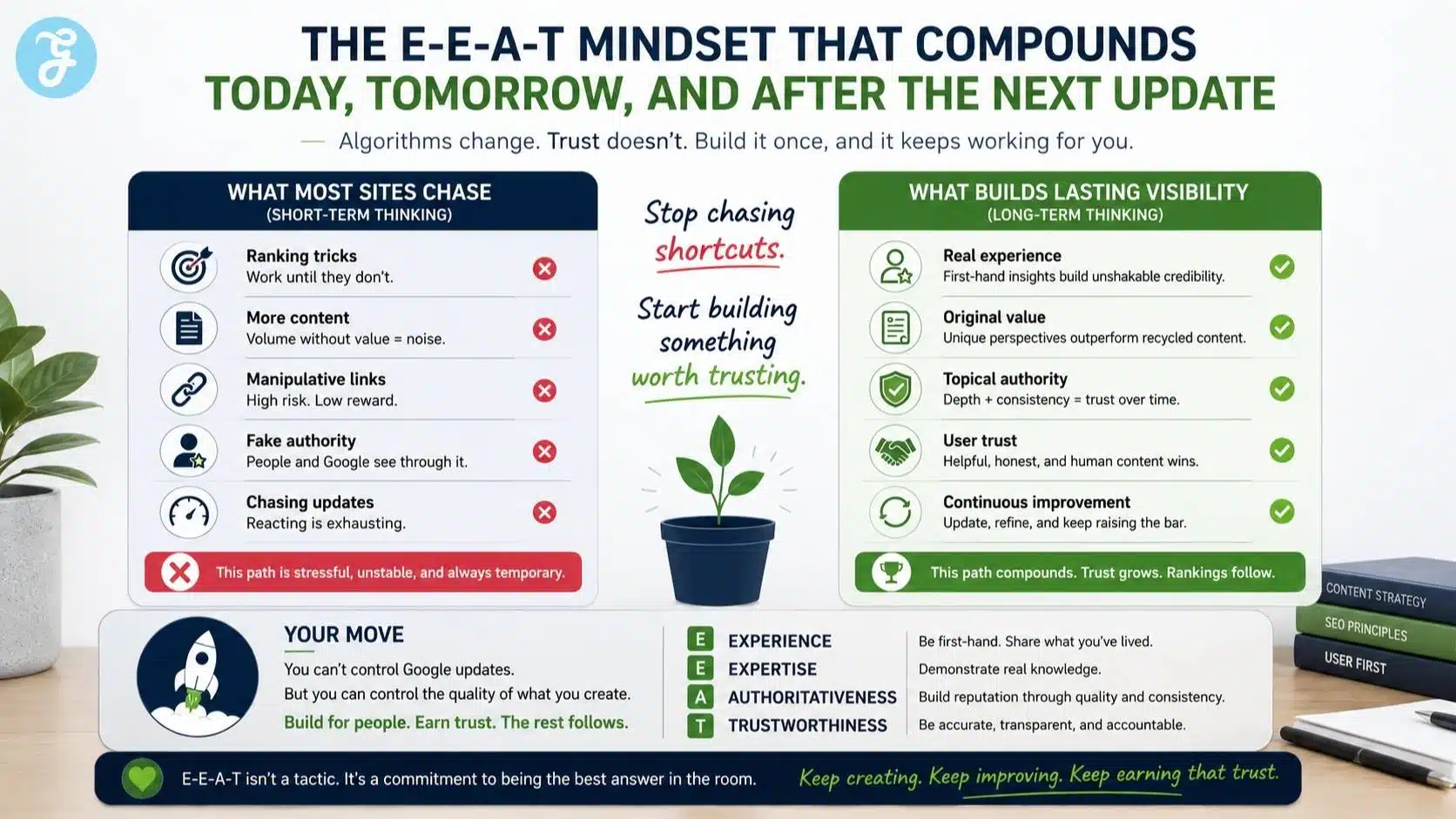
The Content Process I Trust In 2026
My content process has changed a lot since 2019. I still care about keywords, search intent, headings, internal links, and technical SEO. Of course I do. I am not here to throw SEO fundamentals into the sea because someone discovered “brand storytelling.”
But those fundamentals are not enough anymore. A page can be perfectly optimized and still completely forgettable. That is the danger.
Now, before I trust a piece of content, I look at a few things. First, does it match the real search intent? Second, does it add anything the current SERP is missing? Third, does it show experience, expertise, or at least strong editorial judgment? Fourth, are the facts properly supported? And finally, would a real person feel helped after reading it?
That last question matters more than most content teams admit. Google’s helpful content guidance asks creators to think about whether their content provides original information, analysis, or value beyond what is already available. That is the bar. Not “Can we publish this?” but “Does this deserve to exist?”
A practical content process should include:
- Search intent review.
- SERP gap analysis.
- First-hand experience or expert input.
- Source verification.
- Original examples or analysis.
- Readability cleanup.
- Internal linking.
- Update planning.
- Final trust check before publishing.
That is how SEO changed for me. It moved from “Can we rank this?” to “Do we deserve to rank this?” Very annoying question. Very useful question.
The E-E-A-T Signals I Would Prioritize First
If I were improving a site today, I would not try to fix everything at once. That is how teams create 37 spreadsheets, hold six meetings, and somehow publish nothing useful.
I would start with pages that already have impressions, rankings between positions 4 and 20, declining traffic after updates, or clear business value. Then I would strengthen the trust and usefulness of those pages first.
Here is the priority order I would follow:
| Priority | What To Improve First | Why It Matters |
|---|---|---|
| 1 | Search intent match | Relevance still comes before everything |
| 2 | Original experience | Makes the page harder to copy |
| 3 | Accuracy and sourcing | Builds trust and reduces risk |
| 4 | Author credibility | Shows why readers should believe it |
| 5 | Content freshness | Protects pages in changing topics |
| 6 | Topical depth | Helps the site become known for the subject |
| 7 | Internal links | Builds context and authority flow |
| 8 | Page experience | Keeps users from leaving in irritation |
| 9 | Business transparency | Supports trust at site level |
| 10 | Content pruning | Removes weak pages dragging quality down |
The ranking needle rarely moves because of one tiny E-E-A-T tweak. It moves when the whole page becomes more useful, more credible, and more aligned with what users actually need.
Where Publishers Still Get E-E-A-T Wrong
The biggest mistake is treating E-E-A-T like decoration. Add a bio. Add a date. Add a reviewer. Add three external links. Done. Great. The article is still boring, but now it has accessories.
That does not work anymore. At least, not reliably.
The mistakes I would avoid are pretty obvious once you have seen enough content audits. Do not add author bios to weak articles and expect miracles. Do not use AI to mass-produce pages that say nothing new. Do not copy competitors and call it research. Do not publish outside your actual expertise just because the keyword looks profitable.
Also, stop adding fake review claims. Readers are not stupid. Google is not blind. And “reviewed by our editorial team” means very little if nobody can tell who the team is, what they reviewed, or why they are qualified.
The worst habits usually look like this:
- Publishing many similar pages with barely any original value.
- Updating the date without updating the facts.
- Adding generic FAQs only for keywords.
- Using AI to create a fake experience.
- Hiding the business or author identity.
- Linking to sources that do not actually support the claim.
- Treating content volume as a replacement for quality.
The lazy version of SEO is still alive. It is just less safe than it used to be.
The Practical E-E-A-T Checklist I Would Use Before Publishing
Before publishing any serious article in 2026, especially in SEO, finance, health, legal, tech, product reviews, or sustainability topics, I would run it through a simple trust check.
Ask these questions:
- Who wrote this, and is that clear to the reader?
- Why should anyone trust this writer or website on this topic?
- What proof supports the important claims?
- Is there real experience, analysis, or original value here?
- Is the content current enough for the topic?
- Does it answer the user’s real question without wasting time?
- Are the sources credible and properly used?
- Is the page readable on mobile?
- Does the article explain trade-offs, limits, or uncertainty?
- Would I proudly put my name on this?
That last question is the one I care about most. If I would not proudly attach my name to a piece, it probably does not have enough E-E-A-T. Harsh? Maybe. Effective? Definitely.
The Real Ranking Needle Is Earned Trust
After years in content, Google updates, algorithm shifts, and the AI explosion, my view is simple: rankings in 2026 are not only about keywords. Keywords still matter, but they are no longer enough to carry weak content. The real game is trust, originality, usefulness, and proof.
E-E-A-T Signals matter because they force content teams to answer the question that Google and readers are both asking: why should this page be trusted?
If the answer is “because we added an author box,” good luck. If the answer is “because we have real experience, clear sources, practical insight, updated information, and a page that genuinely helps the reader,” then we are finally talking about content that deserves visibility.
The publishers still chasing shortcuts will keep getting surprised by updates that were not actually surprising. The teams investing in real expertise, better research, original value, and honest writing will have a much better chance of surviving whatever Google decides to throw at us next.
And Google will throw something next. It always does.