

Are you thinking about buying an electric car this year? You are definitely not alone right now. The streets are filling up with battery-powered cars as everyday drivers look to ditch petrol and diesel for good. But let us be completely honest because the upfront cost of a brand new electric vehicle can still sting your wallet.
That is exactly why understanding the UK EV Grant Schemes 2026 is so incredibly critical for anyone shopping for a car. The government has completely shuffled the deck this year to make things easier for everyone. They introduced massive new funding pots, tweaked the old rules to be more fair, and expanded financial help for everyday renters and flat owners.
If you want to save thousands on a new car or get your home charger heavily subsidized, you absolutely need the right information before you spend a penny. The landscape of electric vehicles moves incredibly fast, and missing out on a massive cash grant simply because you did not know the current rules is a really tough pill to swallow. Let us dive straight into how these government incentives work, who gets the money, and how you can strategically keep more cash in your own pocket.
What Are the UK EV Grant Schemes for 2026?
The UK EV Grant Schemes 2026 are specialized, government-funded financial incentives purely meant to push drivers toward clean, zero-emission transport. They essentially hand you a backdoor discount on your major purchases. You either get direct help buying the actual vehicle off the showroom floor, or you get hard cash to cover the expensive installation of a charger at your property. The Office for Zero Emission Vehicles oversees all of these specific programs to ensure the taxpayer money goes exactly where it is needed most.
The current grants split into two very specific lanes which are the car itself and the charging infrastructure. Vehicle grants knock the price down before you even sign the initial finance paperwork at the dealership. Infrastructure grants tackle the highly practical hurdle of everyday charging at home or at work. Without a reliable place to plug your car in overnight, owning an electric vehicle easily becomes a frustrating daily headache. The updated 2026 framework heavily targets normal people who traditionally struggled to charge at home, especially flat owners and renters who do not have a private driveway.
| Grant Type | Primary Purpose | Maximum Potential Saving | Target Audience |
| Vehicle Purchase Grant | Direct discount on a new electric vehicle. | Up to £3,750 (Band 1) | Buyers of brand-new eligible EVs. |
| Chargepoint Grant | Subsidy for home charger installation. | Up to £500 per socket | Flat owners, renters, and landlords. |
| Workplace Grant | Subsidy for business charging stations. | Up to £500 per socket | UK businesses and eligible charities. |
12 Essential Facts About EV Grants in the UK
Navigating complicated government incentives often feels like trying to read a completely foreign language. The underlying rules constantly change, old funding schemes quietly close down, and brand new ones pop up out of nowhere. To make this entire process as easy as possible for you, we broke down the current state of electric vehicle subsidies into twelve highly actionable points. You should read through these carefully before you visit a local dealership or call a local electrician for a quote.
1. The Electric Car Grant Relaunch and Extended Funding
The famous plug-in car grant seemed completely dead and buried a few short years ago. Now it is fully back in action with a totally fresh and highly functional structure. The government recently confirmed a massive funding package specifically designed to support electric vehicle buyers through 2026 and well into 2027. This means the money is literally sitting there waiting for you to claim it. You do not have to fill out complex forms, write letters to the council, or wait months for a rebate check to arrive in the mail.
The approved dealership handles the entire administrative process directly through a private government portal. The discount gets sliced right off the retail price on your final invoice. This upfront deduction makes your EV financing instantly cheaper from the very first day. Your monthly lease or loan payments immediately drop because the principal loan amount is significantly lower from the start.
| Feature | Description | Benefit to Buyer |
| Application Process | Handled completely by the dealership. | Zero paperwork or administrative stress. |
| Timing of Discount | Applied instantly at the point of purchase. | Lowers the initial loan or lease amount. |
| Funding Timeline | Guaranteed through 2026 and 2027. | Allows for long-term purchasing decisions. |
2. Maximum Payouts Feature Band 1 vs. Band 2 Discounts
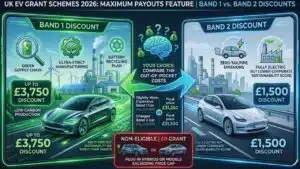
Not all electric cars get the exact same financial treatment under the UK EV Grant Schemes 2026. The government cleverly split the cash payout into two distinct tiers to encourage better manufacturing. They desperately want to reward the specific carmakers who go the extra mile to protect the environment during production. Band 1 represents the greenest cars on the current market that meet incredibly strict manufacturing and battery supply chain targets.
If you buy a Band 1 car, you get a massive discount of up to £3,750. Band 2 covers standard zero-emission electric cars that ditch tailpipe emissions but might not meet the ultra-strict corporate eco-targets set by the government. These Band 2 vehicles still get a very helpful £1,500 discount. This tiered system forces you to look really closely at the fine print when choosing your next model. A slightly more expensive Band 1 car might actually cost you significantly less out-of-pocket than a cheaper Band 2 car once the bigger grant kicks in.
| Discount Tier | Eligibility Criteria | Maximum Grant Amount |
| Band 1 | Meets strictest sustainability and supply chain targets. | £3,750 |
| Band 2 | Fully electric but lower corporate sustainability score. | £1,500 |
| Non-Eligible | Plug-in hybrids or models exceeding the price cap. | £0 |
3. The Strict Price Cap Limits Eligibility
You simply cannot use taxpayer money to buy a high-end luxury electric sports car. The government put a really hard stop on taxpayer-funded luxury purchases by introducing a very strict retail price cap. To get any grant money at all, the vehicle’s absolute base price must sit at £37,000 or below. There is a very helpful loophole here if you like extra features. If the base model qualifies under the cap, you can freely add optional extras up to a total maximum vehicle price of £42,000.
However, these specific extras can only be cosmetic upgrades, fresh paint colors, or fancy interior equipment. If you upgrade the actual battery size or add a second electric motor, and that pushes the base price over £37,000, you lose the entire grant immediately. You must keep a very close eye on the options list when configuring your car online to avoid a nasty surprise.
| Price Factor | Government Rule | Impact on Purchase |
| Base Price Cap | Must be £37,000 or lower. | Excludes luxury brands and premium SUVs. |
| Maximum Price with Extras | Hard cap at £42,000 total. | Allows for personal styling and comfort additions. |
| Prohibited Upgrades | Larger batteries or bigger motors pushing base over £37k. | Forces buyers to stick with standard ranges. |
4. Boosted Chargepoint Grants for Renters and Flat Owners
Living in a rented flat used to mean electric vehicle ownership was practically impossible. The government completely fixed this massive issue by aggressively targeting renters and flat owners with the new 2026 updates. The dedicated home chargepoint grant officially increased from £350 up to £500 per individual socket. This new higher amount comfortably covers up to 75 percent of your total installation costs in most standard homes.
You must have dedicated, private off-street parking to actually qualify for this specific money. You also absolutely need written permission from your private landlord or the building’s main freeholder before the electrician drills any holes into the exterior walls. This extra £150 bump makes a truly huge difference for normal families as the basic cost of raw materials and qualified electrician labor continues to climb every single year.
| Requirement | Details | Allowance |
| Target Group | Renters, flat owners, and landlords. | Up to £500 per active socket. |
| Parking Rule | Must have private, dedicated off-street parking. | Cannot be used for random street parking spots. |
| Permissions | Requires written consent from the property owner. | Ensures no legal disputes over property modification. |
5. Workplace Charging Scheme Increases to Maximize Employee Charging
Local businesses finally get a really big piece of the pie too. The highly popular Workplace Charging Scheme keeps the green momentum going for companies looking to update their fleets or offer amazing perks to their staff. Just like the updated residential grant, the workplace payout jumped to £500 per socket across the board. A single registered business can actively claim this money for up to 40 individual sockets across all of their different physical locations.
That equates to a staggering £20,000 in potential free government cash just to build out charging infrastructure. If your boss is currently hesitant about you buying an electric car, you should point them directly toward this exact scheme. It is an incredibly cheap and highly effective way for smart companies to dramatically boost their environmental credentials while keeping their daily commuters extremely happy.
| Business Benefit | Scheme Details | Maximum Allowance |
| Grant Value | Subsidizes the cost of buying and fitting chargers. | £500 per socket. |
| Capacity Limit | Can be spread across multiple company sites. | Up to 40 sockets (£20,000 total). |
| Employee Perk | Encourages staff to switch to clean commuting. | High staff retention and satisfaction. |
6. New Support for Households with Only On-Street Parking
The absolute biggest hurdle for millions of regular UK drivers is the complete lack of a private driveway. The 2026 rules finally throw a massive lifeline to normal people who have to park out on the public street. You can now actively claim the £500 home charger grant even if you completely lack off-street parking. The one major catch is that you must legally install a local-authority-approved cross-pavement charging solution.
This usually involves a specialized cable channel cut directly into the pavement so nobody trips over your charging wire while walking their dog. You must check with your local council first before doing anything. Some progressive boroughs are highly supportive of this new technology, while others still drag their feet on issuing the necessary digging permits.
| Parking Situation | Solution | Grant Eligibility |
| No Driveway | Approved cross-pavement cable gully. | Eligible for the £500 chargepoint grant. |
| Hazard Prevention | Cable must sit flush within the pavement channel. | Prevents local council fines for trip hazards. |
| Council Role | Must approve the physical alteration to the pavement. | Varies heavily by local authority rules. |
7. Salary Sacrifice Integration Creates Massive Savings
If you genuinely want to hack the financial system legally, you must combine the vehicle grant with a proper salary sacrifice scheme. This is exactly where the daily math gets genuinely exciting for normal workers. Salary sacrifice officially lets you pay for the car lease using your gross income right before the tax man takes his cut. Electric cars currently enjoy incredibly low Benefit-in-Kind tax rates compared to standard petrol cars.
When you stack a £3,750 government grant directly with your monthly income tax savings, the end results are absolutely huge. Many average drivers easily find they can drive a brand-new electric vehicle for hundreds of pounds less per month than an equivalent used petrol car. You should ask your human resources department immediately if they partner with a reliable provider.
| Financial Tool | How It Works | Driver Benefit |
| Salary Sacrifice | Deducts car cost from pre-tax monthly salary. | Massive savings on Income Tax and National Insurance. |
| Benefit-in-Kind | Very low tax percentage applied to zero-emission cars. | Keeps the monthly take-home pay higher. |
| Grant Stacking | Combines the £3,750 discount with tax breaks. | Creates the cheapest possible EV ownership route. |
8. Strict Manufacturer Sustainability Requirements
The government is finally cracking down extremely hard on corporate greenwashing. It is simply no longer enough for a heavy car to just run on a big battery to get public money. Under the updated UK EV Grant Schemes 2026, the massive companies actually building the cars face incredibly tough public scrutiny. Carmakers must clearly prove they have validated targets for deeply reducing their corporate emissions across the globe.
They also need fully transparent supply chains for mining sensitive battery minerals like lithium and cobalt. If a famous brand fails these routine checks, their cars instantly drop to the lower Band 2 or lose their grant eligibility altogether. This strict oversight ensures your tax pounds only support smart companies that genuinely care about their total environmental impact from the dirty factory floor right to your driveway.
| Requirement | Manufacturer Action | Goal |
| Emission Targets | Must adopt validated science-based reductions. | Lowers the carbon footprint of building the car. |
| Supply Chain Audit | Must trace cobalt and lithium to ethical mines. | Prevents human rights abuses in battery production. |
| Grant Penalty | Failing audits drops vehicles to lower funding bands. | Forces the automotive industry to clean up fast. |
9. Several Legacy Grant Schemes Closed in March 2026

Government budgets are obviously not infinite and money has to come from somewhere. To properly fund the new £500 payouts and the generous vehicle discounts, the government unfortunately had to chop some older niche programs. The Commercial Landlord Chargepoint Grant is completely closed to new applications. The SME Staff and Fleet Infrastructure Grant is also permanently closed.
These specific programs officially ended on March 31, 2026 without any extensions. If you were originally planning to use these specific legacy routes to fund your project, you are completely out of luck today. The remaining funds have been permanently redirected by the government to heavily prioritize regular renters, standard flat owners, and basic workplace setups.
| Closed Scheme | End Date | Replacement / Current Focus |
| Commercial Landlord Grant | March 31, 2026 | Funds moved to standard renter and flat owner grants. |
| SME Fleet Infrastructure Grant | March 31, 2026 | Standard Workplace Charging Scheme remains open. |
| Old Renter £350 Limit | March 31, 2026 | Upgraded to the new £500 limit on April 1. |
10. Adjustments to State-Funded Education Institution Grants
Public schools, local nurseries, and major colleges have always enjoyed a very special carve-out in the complex grant rules. The government desperately wants thousands of teachers and educational staff adopting electric vehicles as quickly as possible. The dedicated charging scheme for state-funded schools officially remains open until March 2027 which provides great peace of mind.
However, the maximum cash payout was slightly reduced to balance the national budget. It dropped from a massive £2,500 down to £2,000 per single socket starting in April 2026. Despite this very slight trim, getting £2,000 per socket is still an incredibly generous subsidy for any school. It easily covers the full cost of standard commercial charger installations in almost all normal educational settings.
| Institution Type | Current Grant Limit | Expiry Date |
| State-Funded Schools | £2,000 per socket | March 31, 2027 |
| Nurseries and Colleges | £2,000 per socket | March 31, 2027 |
| Private Businesses | £500 per socket | March 31, 2027 |
11. Battery and Vehicle Warranty Rules Protect Consumers
Absolutely nobody wants to buy an expensive electric car only to face a massive repair bill when the main battery degrades in five years. The strict grant rules actively protect you from this absolute nightmare financial scenario. Any single car eligible for the government grant must legally have a standard vehicle warranty of at least three years or 60,000 miles.
Much more importantly, the incredibly expensive high-voltage battery pack must carry a rock-solid minimum warranty covering eight years or 100,000 miles. This is a truly massive safety net for everyday buyers. It completely guarantees that if the battery drops below a certain health threshold within that timeframe, the manufacturer has to fix it or replace it at zero cost to you.
| Warranty Component | Minimum Required Coverage | Consumer Protection |
| Whole Vehicle | 3 years or 60,000 miles. | Covers basic mechanical and electrical faults. |
| High-Voltage Battery | 8 years or 100,000 miles. | Protects against severe battery degradation and failure. |
| Repair Costs | Covered fully by the manufacturer. | Prevents sudden out-of-pocket expenses for owners. |
12. First-Year Vehicle Excise Duty Benefits Remain
Electric car owners across the country now have to pay standard Vehicle Excise Duty which most people simply call road tax. The long free ride is officially over, but the financial blow is heavily softened for the critical first twelve months. If you actively register a brand new zero-emission car anytime in 2026, your first-year road tax is set at a incredibly tiny fee of just £10.
This is a very tiny fraction of the cost compared to the hefty first-year penalty rates slapped on dirty petrol and diesel cars. After the first year passes, you seamlessly move over to the standard flat rate like everyone else. While paying any tax on an EV is slightly annoying, that £10 first-year rate is still a really solid financial win when calculating the heavy initial costs of putting a new car on the road.
| Tax Type | EV Rate (First Year) | ICE Vehicle Rate (First Year) |
| Vehicle Excise Duty | £10 flat rate. | Highly variable, often hundreds of pounds based on emissions. |
| Year Two Onwards | Standard flat rate applies. | Standard flat rate applies. |
| Zero-Emission Benefit | Massive first-year saving. | Punishes high-polluting vehicles at registration. |
How to Apply for the 2026 UK EV Grants?
Knowing all of the facts is just one thing, but actually getting the money deposited is another hurdle entirely. Thankfully, the government heavily modernized the application flow for the UK EV Grant Schemes 2026. You do not need to mail physical letters, print documents, or wait months for a paper check to arrive. The internal systems are heavily digitized and mostly handled by authorized third parties to speed everything up.
For the vehicle grant, your daily job is basically non-existent. You simply sit down and negotiate the price of the car with the dealer, and they tick a secure box in their system to deduct the grant. For the chargepoint grant, you have to do just a little bit of legwork to get things rolling. You must find an approved installer, get your property properly assessed, and let the electrician handle the digital portal.
| Grant Category | Who Applies? | Process Complexity | Timeframe |
| Vehicle Discount | Dealership / Leasing Company | Zero effort for the buyer | Instant (at purchase) |
| Chargepoint Grant | Approved Installer | Low (requires some property docs) | 1 to 3 weeks |
| Workplace Grant | Business Owner / Fleet Manager | Medium (requires business vetting) | 2 to 4 weeks |
Final Thoughts
Switching to electric transport is obviously a massive financial decision, but the highly updated UK EV Grant Schemes 2026 truly do the heavy lifting to bridge the scary price gap. The government is throwing serious, calculated money at the problem, specifically targeting the exact areas that hold normal people back. They know the upfront cost of the car and the complete lack of driveway charging are the biggest hurdles.
If you rent a property, live in a flat, or simply want a budget-friendly new car, right now is definitely the exact time to act. You need to maximize the £3,750 Band 1 vehicle discounts while they physically last, and quickly lock in your £500 chargepoint subsidy before the funding pot dries up entirely. Stack these awesome perks directly with a workplace salary sacrifice scheme, and you will easily unlock the absolute cheapest possible route into modern, zero-emission driving.
Frequently Asked Questions (FAQs) About UK EV Grant Schemes
1. Can I get an EV grant if I buy a second-hand electric car?
You simply cannot get the upfront vehicle purchase grant on a used car because it strictly applies to brand-new factory registrations. However, you absolutely can use the £500 chargepoint grant for your home if you buy a used car, provided you easily meet the renter or flat-owner criteria.
2. What happens if I change my mind and sell the EV shortly after getting the grant?
The government completely does not force you to repay the vehicle grant if you sell the car later down the line. The grant money permanently stays attached to the car’s initial purchase. However, if you apply for a home chargepoint grant and sell the car before the actual charger is installed on your wall, your grant application will be instantly voided.
3. Does the chargepoint grant cover the cost of upgrading my home’s electrical panel?
The £500 grant strictly goes toward the total combined cost of the physical hardware and the installation labor. If your older home requires a massive fuse board upgrade just to handle the charger, the grant can absorb some of that initial cost, but you are completely responsible for paying anything above the £500 maximum limit.
4. Are fully electric motorbikes or mopeds eligible for any 2026 grants?
Yes they are. While electric cars get almost all the media attention, the government also offers dedicated grants for zero-emission motorcycles and mopeds. The cash discounts are definitely lower, but they follow the exact same straightforward dealership application processes to save you money.
5. Can I claim the home charger grant twice if I own two electric cars?
Generally speaking, no you cannot. The residential chargepoint grant is strictly limited to one per eligible property and one per eligible vehicle. If you live in a massive multi-unit dwelling, your building management might be highly eligible for multiple landlord grants, but individual renters are heavily capped at just one.