Have you ever looked around your office and felt like your best employees are just going through the motions? They show up on time, complete their tasks, and attend meetings. Yet they seem checked out, unmotivated, and distant from the team. This is quiet quitting, and it is happening right under your nose. A recent 2025 Gallup study found that 50% of the US workforce can be classified as quiet quitters. This staggering disengagement costs American businesses roughly $1.9 trillion in lost productivity every single year.
The good news is that you have the power to change this trajectory today. Learning how to prevent quiet quitting before it starts requires practical, actionable steps. I am going to walk you through the exact strategies I use to keep teams actively engaged. So, grab a cup of coffee, and let us go through it together.
What Is Quiet Quitting?
Quiet quitting happens when employees show up to work but mentally check out. They do the bare minimum, stop going the extra mile, and disengage from their jobs without formally resigning.
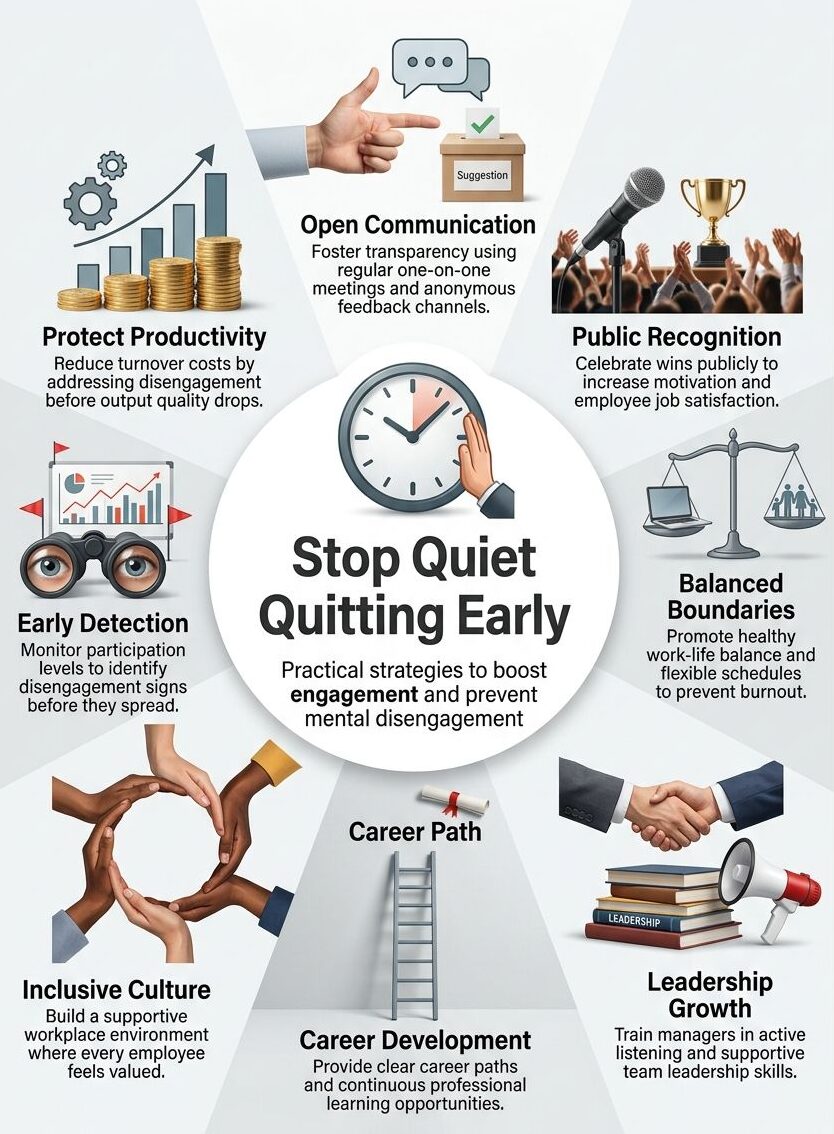
Definition and characteristics
Quiet quitting happens when employees show up physically but check out mentally from their work.
Quiet quitting means doing the bare minimum at your job. A 2025 Gallup study found that 50% of the US workforce fits this profile, choosing to simply meet the basic requirements and nothing more. Gallup officially defines this behavior as “psychological withdrawal” from the workplace.
Workers stay on the payroll, but their hearts are no longer in it. They avoid taking on new projects, skip volunteering for assignments, and maintain strict work hours. Productivity drops, but they technically still hold a job.
You can spot the characteristics of quiet quitting in very specific ways. Disengaged employees often show these warning signs:
- Missing meetings or arriving late without a clear explanation.
- Stopping participation in team discussions and brainstorming sessions.
- Keeping communication minimal and strictly surface-level.
- Refusing stretch assignments that could help their career development.
Burnout often sits at the root of this behavior, leaving people exhausted and emotionally drained. Job satisfaction plummets because they feel undervalued and overlooked. Trust erodes between employees and leadership, creating tension that affects everyone.
Common misconceptions about quiet quitting
Many people think quiet quitting means an employee stops working entirely or plans to leave soon. That is not quite right. Quiet quitting actually describes a shift in mindset where workers do their jobs but stop showing passion.
Recent 2026 Gallup data reveal that only 32% of US employees are actively engaged at work. This disengagement signals a broken connection between the employee and the organization. Many managers mistake this behavior for laziness or a lack of ambition.
The truth is far different. Quiet quitting stems from burnout prevention, poor communication, or unmet career development needs.
Employees are not being lazy. They are protecting their mental health and setting boundaries. Another big misconception is that quiet quitting only affects unmotivated workers. In reality, your top performers often quit first.
High achievers burn out faster when they lack recognition or face a toxic culture. A great pro-tip is to conduct “stay interviews” with your top performers to gauge their job satisfaction before they show signs of burnout. They do not make a dramatic exit; they simply recalibrate their effort.
Causes of Quiet Quitting
Employees check out mentally when their jobs fail to meet their core needs. Several factors push talented workers to disengage, and managers who spot these red flags early can turn things around.
Job dissatisfaction
Job dissatisfaction acts like a slow leak in your company. Employees start checking out mentally long before they walk out the door. A lack of purpose, misaligned values, or roles that ignore their specific skills creates deep frustration.
A 2025 Deloitte study noted that 77% of employees experience burnout at their current jobs. Poor communication from management simply makes things worse. Staff members feel invisible when their concerns fall on deaf ears.
You must actively track goals to keep people aligned. Many successful teams use performance software like Lattice to tie daily tasks directly to larger company goals. This connects their daily grind to a bigger, meaningful purpose.
Burnout prevention starts with addressing the root causes of dissatisfaction early. To catch these issues, watch for these common warning signs in your team:
- A sudden drop in volunteering for new projects.
- Consistent silence during team brainstorming sessions.
- Calling in sick more frequently than usual.
- Taking significantly longer to complete routine tasks.
Lack of recognition and rewards
Employees crave recognition. They want to know their hard work matters. When managers skip praise or fail to reward good performance, workers feel completely invisible.

The 2026 O.C. Tanner State of Employee Recognition Report found that employees who feel appreciated are 156% more likely to report higher engagement.
That same study found that employees with integrated recognition programs are 26 times more likely to stay at their organization for another year. Talented people start doing the bare minimum when they figure nobody notices their extra effort.
Compensation matters, but a simple thank you or a public shoutout shows workers you value them. Many remote teams use platforms like Bonusly or Kudos to make peer-to-peer praise visible and fun. These rewards signal that leadership pays active attention to career development.
Poor work-life balance
Burnout hits hard when work consumes every hour of the day. Your team members skip vacations, answer emails at midnight, and forget what weekends feel like. This constant grind drains their energy and kills their motivation.
Data from FitOn Health in 2025 shows that effective well-being programs can save $359 per engaged employee annually in healthcare and productivity gains. Poor work-life balance destroys job satisfaction at its core.
Many human resources professionals on the r/humanresources Reddit forum note that unlimited paid time off policies actually result in employees taking fewer days off unless managers actively model taking vacations themselves. To fix this, you must build healthy boundaries:
- Set clear expectations about response times for after-hours emails.
- Encourage leaders to take visible, uninterrupted vacations.
- Audit workloads monthly to ensure no single employee is overwhelmed.
- Implement asynchronous communication for non-urgent project updates.
Toxic workplace culture
Beyond scheduling conflicts, a toxic workplace culture stands as one of the most damaging forces driving quiet quitting. A poisoned environment spreads fast, destroying trust and making employees feel undervalued.
A 2026 Speakwise report found that 47% of Gen Z employees admit to coasting at work specifically because of a lack of psychological safety. Disengagement takes deep root when people dread coming to work each day.
Managers who yell, play favorites, or ignore bullying create workplaces where people feel entirely unsafe and unheard.
Using continuous feedback software like 15Five helps you spot these toxic pockets early by creating a safe space for employees to share concerns. Leaders must actively address negativity and hold people accountable for poor behavior.
Impacts of Quiet Quitting on the Workplace
When employees quietly quit, your organization faces serious drops in output, climbing turnover costs, and sinking team spirits. These issues hit your bottom line incredibly fast.
Reduced productivity
Quiet quitting drains your team’s productivity like a slow leak in a tire. Employees who disengage stop putting in their best effort, miss critical deadlines, and produce lower-quality work.
Disengaged workers cost the US economy roughly $1.9 trillion in lost productivity annually, according to 2026 Paycor data. Projects stall, deadlines slip, and your company loses serious money.
Time-tracking tools like Toggl often reveal that routine tasks take twice as long when teams mentally check out. This creates a ripple effect across departments. You will notice productivity dropping in several key areas:
- Customer response times lengthen noticeably.
- Creative problem-solving grinds to a complete halt.
- Basic administrative errors multiply across reports.
- Cross-department collaboration becomes strained and slow.
Higher turnover rates
Quiet quitting leads directly to higher turnover rates, and companies feel the severe pain in their wallets. Employees who disengage mentally often leave their jobs within just a few months.
The Society for Human Resource Management estimates that replacing an employee costs between 50% and 200% of their annual salary.
If a mid-level manager makes $60,000 a year, the replacement cost is $30,000 to $120,000. Retaining them with a clear career path and a $5,000 bonus is a clear financial win. Recruiting, training, and onboarding new staff drains precious time and money from your entire organization.
Lower team morale
Disengaged employees drain the energy from their teams instantly. When one person stops caring, their coworkers notice the lack of effort and the missing enthusiasm right away.
Gallup research highlights that one actively disengaged worker can neutralize the positive engagement of multiple enthusiastic colleagues. This spreads through the workplace like wildfire, leaving remaining team members feeling frustrated and burned out.
You should regularly track your Employee Net Promoter Score (eNPS) to measure team spirit and catch dipping morale early. A low score usually signals these internal problems:
- Trust between coworkers is breaking down.
- Communication practices are falling apart completely.
- People have stopped sharing ideas or helping each other out.
- Your best performers are actively looking for new jobs.
Financial and operational challenges
When quiet quitting takes hold, your bottom line suffers real, measurable damage. Organizations lose money fast when employees check out mentally while still collecting full paychecks.
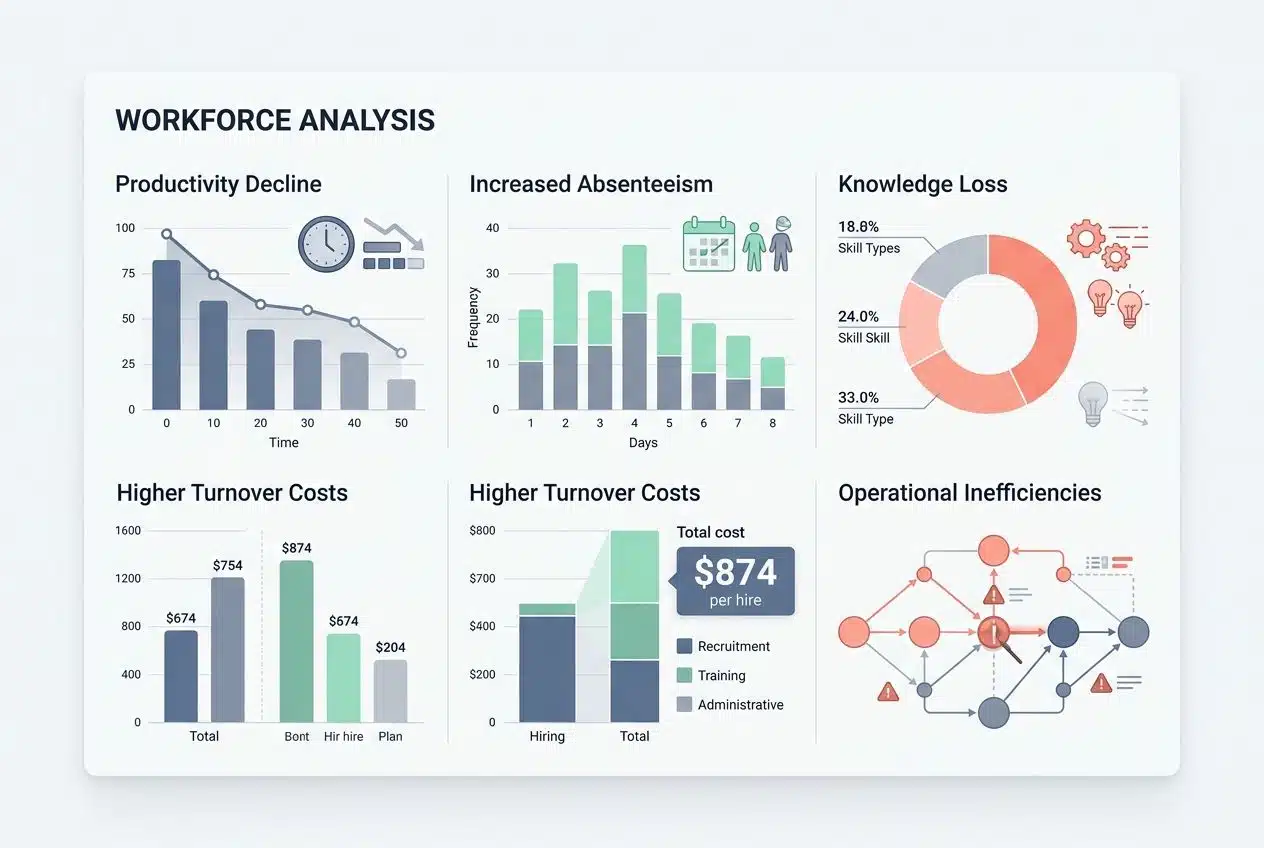
| Challenge Type | What Happens | Real Impact |
|---|---|---|
| Productivity Decline | Disengaged workers slow down output. Tasks take longer, and quality drops noticeably. | Companies waste resources on incomplete work. Profit margins shrink as daily output drops. |
| Increased Absenteeism | Quiet quitters call in sick more often. Presenteeism becomes common, meaning people show up but do not perform. | Operating costs rise. The remaining staff burn out quickly from covering these constant coverage gaps. |
| Knowledge Loss | Unmotivated employees stop sharing expertise. Training becomes minimal as institutional knowledge walks out the door. | New hires struggle without proper mentorship. Mistakes increase, and customer service suffers. |
| Higher Turnover Costs | Quiet quitting often precedes resignation. Replacement hiring kicks in immediately. | Recruiting expenses climb fast. In 2025, the average internal cost just to interview and source a candidate reached $874 per hire. |
| Customer Satisfaction Issues | Apathetic employees deliver poor service. Customers notice the difference right away, and complaints spike. | Brand reputation takes direct hits. Repeat business declines, and negative reviews spread online. |
| Operational Inefficiencies | Processes break down when people stop caring. Communication falters, and mistakes multiply rapidly. | Problem-solving slows to a crawl. Decision-making delays cause projects to stall or fail entirely. |
| Team Coordination Breakdown | Quiet quitters do the minimum work only. They actively avoid any extra responsibilities. | Silos form between departments. Workflow becomes fragmented, and critical deadlines get pushed back. |
Money disappears through multiple channels when quiet quitting spreads across your organization. Operational systems strain under the weight of indifferent workers, and workflows that once hummed smoothly now sputter and stall.
If you are hiring a team of 20, that $874 cost per hire means a $17,000 hit before they even finish their first project. Customers feel the ripple effects immediately, leading to lost revenue and damaged brand reputation.
Strategies on How To Prevent Quiet Quitting Before It Starts
You can stop quiet quitting before it takes root by taking real action today. HR platforms like Workday help centralize engagement efforts, but the true change comes from how you lead.
Foster open communication and employee feedback
Open communication forms the absolute backbone of a strong workplace. Employees who feel truly heard stay engaged and committed to their jobs and their teams.
- Create regular one-on-one meetings. Gallup recommends having one meaningful 15 to 30-minute conversation per week with each team member to discuss goals and challenges.
- Establish an anonymous feedback system using pulse survey platforms like Culture Amp or Glint to measure engagement safely.
- Hold regular town hall meetings where leadership shares updates and answers questions directly from the staff.
- Train managers to listen actively during conversations to focus on what employees say rather than just planning a response.
- Implement skip-level meetings where employees meet with their manager’s boss to provide honest, unfiltered feedback.
These communication practices directly reduce disengagement. Recognizing and rewarding employee contributions comes next as another critical strategy for stopping quiet quitting in its tracks.
Recognize and reward employee contributions
Listening to your team matters, and so does showing them you value their hard work. Recognition fuels job satisfaction and keeps apathy from creeping into the office.
- Celebrate wins publicly during team meetings so employees feel seen and valued for their specific accomplishments.
- Implement peer recognition systems using software like Bonusly to foster a culture of mutual appreciation and teamwork.
- Offer promotions and advancement opportunities to high performers to signal a clear path for career development.
- Tie compensation directly to performance metrics so employees understand the exact financial impact of their work.
- Provide additional responsibilities to engaged employees who show initiative to expand their influence and leadership skills.
Employees with integrated recognition programs are 26 times more likely to stay at their organization for another year. A culture of appreciation changes everything.
Promote a healthy work-life balance
Work-life balance shapes how employees feel about their jobs and their lives outside work. Organizations that prioritize this balance see significantly lower burnout rates.
- Set clear boundaries around work hours so employees know exactly when they can disconnect for the evening.
- Offer flexible scheduling options that let team members adjust start times to fit their personal needs and family commitments.
- Adopt asynchronous communication practices for non-urgent tasks to eliminate the pressure of immediate, late-night replies.
- Provide remote work opportunities when possible to cut commute times and restore personal hours to your team.
- Monitor workload distribution actively to prevent any single person from carrying an unsustainable, heavy burden.
A focused 40-hour workweek always yields better long-term results than a frantic 50-hour schedule. Strong work-life balance practices directly feed into enhancing management skills.
Enhance management practices and leadership skills
Managers shape the entire employee experience. Strong leaders listen to their teams, ask questions, and genuinely care about the answers they receive.
Gallup data reveals a massive insight here: managers account for a staggering 70% of the variance in team engagement levels. This means your leadership training is your absolute best line of defense against turnover.
Training programs help managers learn conflict resolution and how to spot burnout early. Focus on building these specific leadership habits to keep teams thriving:
- Scheduling dedicated time for career mapping conversations.
- Modeling healthy work-life boundaries by logging off at reasonable hours.
- Asking open-ended questions during weekly check-ins.
- Providing specific, actionable praise instead of vague compliments.
When managers genuinely care about well-being, employees respond with deep loyalty. Organizations that prioritize manager training see lower turnover rates and much higher team morale.
Provide growth opportunities through learning and development
Your team members crave chances to grow, learn, and advance their careers. Offering solid learning opportunities keeps employees highly engaged and sharp.
- Create a clear career path that shows employees the exact steps and milestones needed to reach their goals.
- Offer tuition reimbursement programs. In the US, companies can provide up to $5,250 completely tax-free per year for education.
- Establish mentorship programs that pair experienced workers with newer team members for rapid skill development.
- Provide access to online learning platforms like LinkedIn Learning or Coursera to allow flexible, self-paced education.
- Set up skills-based training programs that teach hard skills like data analysis, coding, or project management.
These initiatives transform your workplace culture. They show your team that you are actively investing in their long-term success.
Build a positive and inclusive workplace culture
Growth opportunities matter, but they work best in a place where people feel they truly belong. A positive culture acts as the foundation that helps development seeds grow.
A 2025 Achievers Workforce Institute report found that only 24% of employees feel psychologically safe at work. If your people are afraid to share ideas, they will quickly disengage and look for the exit.
Leaders shape this culture through clear, consistent actions. Consider setting up Employee Resource Groups (ERGs) to give marginalized voices a structured platform to be heard and supported.
Job satisfaction climbs when people work somewhere that makes space for who they really are. This foundation stops quiet quitting cold.
Recognition flows naturally in these safe spaces, preventing people from fading into the background. Team dynamics improve significantly when everyone knows their unique contributions matter.
Wrapping Up
Quiet quitting does not happen overnight, and it does not start with a resignation letter. It creeps in slowly, like water seeping through cracks in a foundation. Managers who stay alert catch the early signs of disengagement before employees mentally check out.
Open lines of communication, consistent recognition, and real support for work-life balance act as your best defense against losing talented people. Your team members want to feel valued, heard, and supported in their career development. When you invest in these areas, you build a stronger workplace culture and keep burnout at bay.
The cost of losing good employees runs deep, affecting productivity, team dynamics, and your bottom line. Taking action now prevents far bigger problems down the road. Start meaningful conversations with your team today, and ask what matters most to them.
Listen to their feedback without judgment. Show them that their daily contributions move the needle. Knowing how to prevent quiet quitting before it starts transforms how people experience their jobs every single day. Your organization thrives when employees feel genuinely connected to their work and their workplace.
Frequently Asked Questions (FAQs) on Quiet Quitting
1. What is quiet quitting, and why should I care about it?
Quiet quitting is when workers do only what their job requires and nothing extra. Gallup found in 2023 that about half of American employees are quiet quitters, which can seriously hurt your team’s energy and results.
2. How can leaders spot early signs of quiet quitting?
Watch for people who used to contribute in meetings but now stay silent, or who stop volunteering for projects. When someone goes from engaged to just going through the motions, that’s your warning sign.
3. What steps help prevent quiet quitting before it starts?
Start by really listening to your team through regular one-on-one check-ins about their goals and concerns. Gallup research shows that employees who feel recognized and heard are much less likely to mentally check out.
4. Can better communication stop quiet quitting from spreading?
Absolutely, honest dialogue makes a huge difference! When you create safe spaces for people to talk about workload and stress without fear, you catch problems early before they turn into quiet quitting.