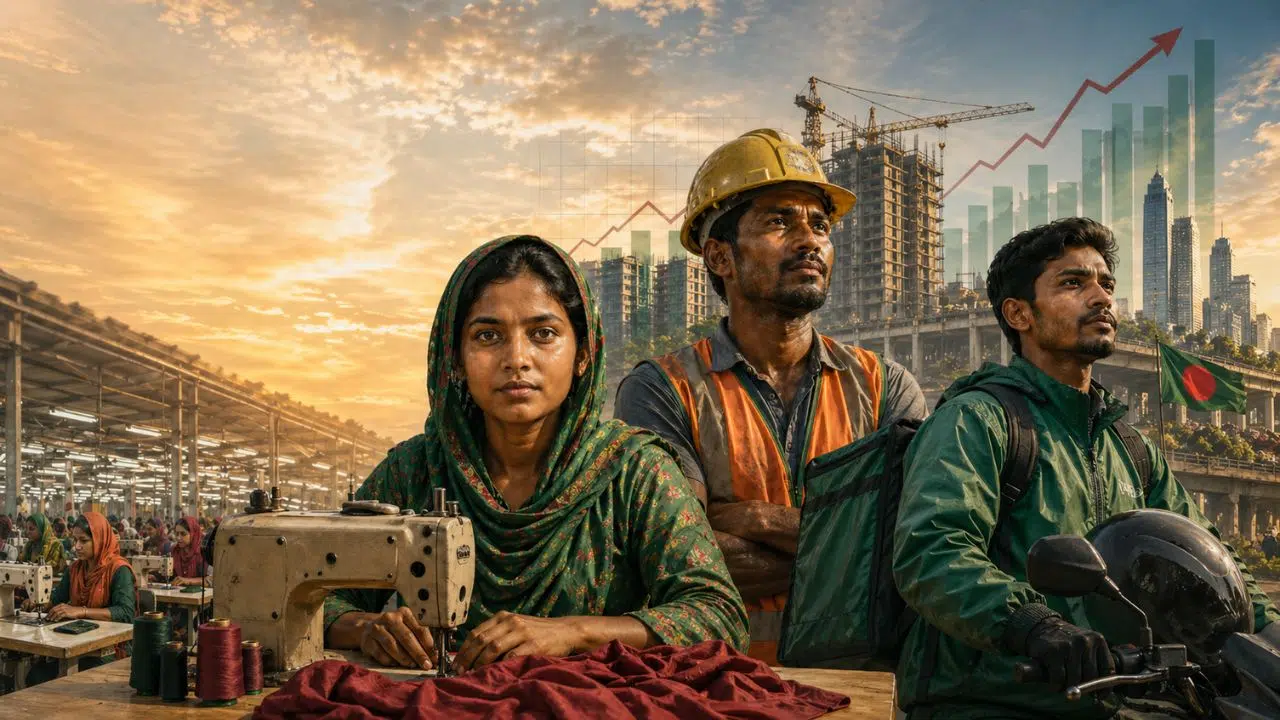
Every May Day (International Workers’ Day), we say the right things. We honor workers. We thank them. We post photos of hard hats, sewing machines, factories, roads, and red flags. Then the next morning, many of the same workers return to jobs where their wages are too low, their safety is uncertain, and their voices are too weak.
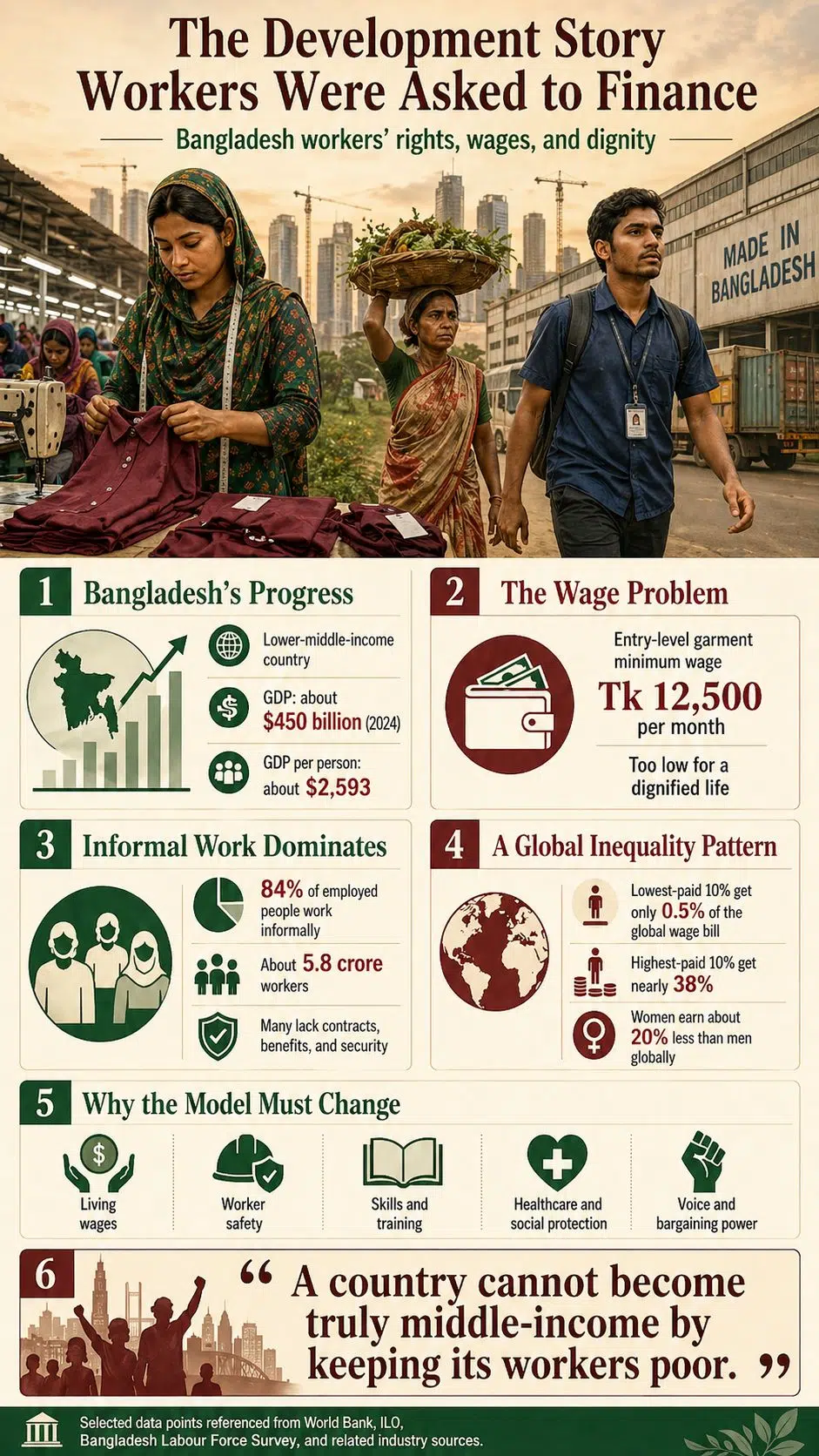
I write this from Bangladesh, a country whose development story is both inspiring and uncomfortable. We have seen real progress. Bangladesh is now a lower-middle-income country, with GDP at about $450 billion in 2024 and GDP per person at around $2,593, according to World Bank data. But from the factory floor to the construction site, from the garment line to the delivery route, one question still remains: have the workers who built this progress received their fair share?
Much of this progress was built on the low-paid labor of millions of workers. They helped finance the national success story with cheap labor, long hours, unsafe work, and limited bargaining power. The question now is not whether this model helped Bangladesh grow. It did. The question is whether Bangladesh can keep growing this way.
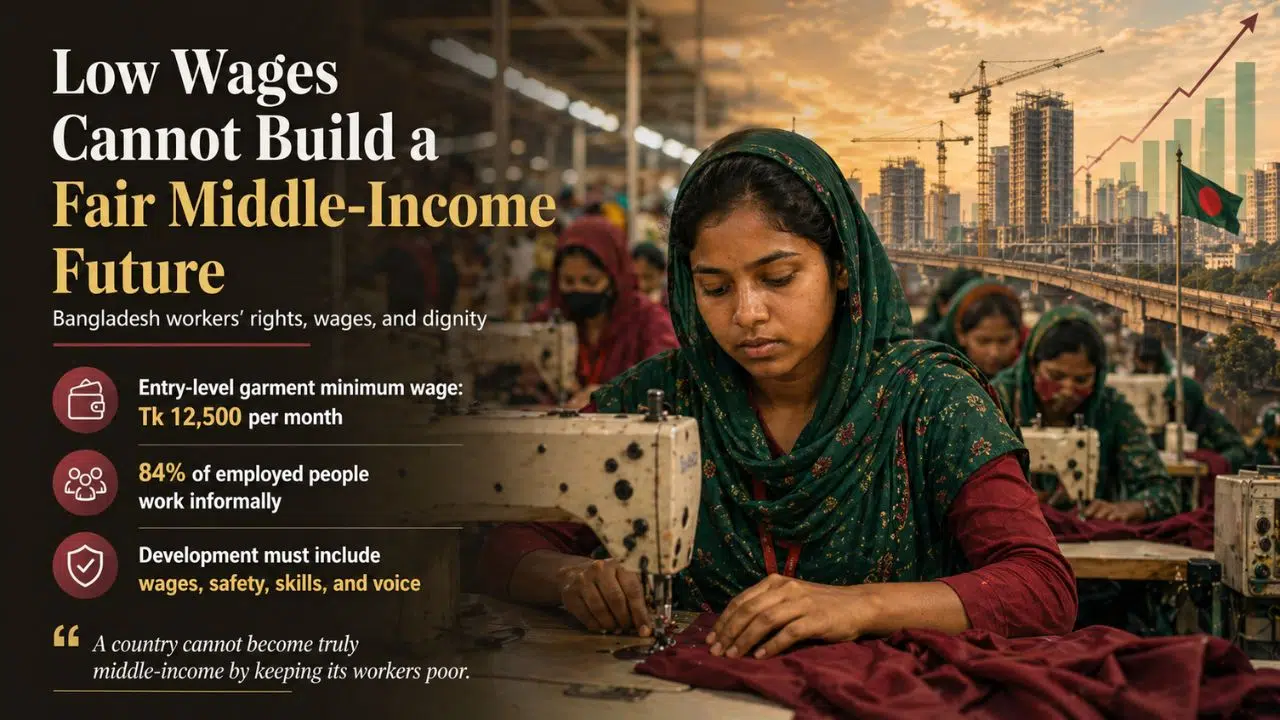
The answer is no. According to Bangladesh’s Labour Force Survey 2024, about 84% of employed people are in informal work, meaning millions of workers still live without the security that formal jobs are supposed to provide. This is why the International Workers’ Day should not be treated only as a symbolic holiday. For Bangladesh, it should be a moment of economic honesty.
Low Wages Helped Build the Economy But Cannot Carry Its Future
The International Labour Organization’s Global Wage Report 2024–25 says wage inequality has decreased in about two-thirds of countries since 2000, but large wage gaps still remain. Globally, the lowest-paid 10% of workers receive only 0.5% of the global wage bill, while the highest-paid 10% receive nearly 38%. Women and informal workers are also more likely to be among the lowest paid. The global gender pay gap remains another form of wage discrimination: women workers still earn about 20% less than men on average.
For years, Bangladesh competed globally by offering low production costs. In the garment sector, this strategy worked in a narrow sense. It brought export earnings, jobs for women, foreign buyers, and global attention. Ready-made garments became one of the main engines of the economy.
But an engine also needs maintenance. If workers remain underpaid, undertrained, and unprotected, the engine will eventually fail.
The minimum monthly wage for an entry-level garment worker was set at Tk 12,500 in late 2023. That includes basic salary, house rent, medical allowance, transport, and food allowance. In today’s Bangladesh, with high food prices, rent pressure, transport costs, and health expenses, that amount is not a path to dignity. It is a monthly survival test.
A country cannot become truly middle-income if its workers live one illness, one rent increase, or one factory closure away from disaster.
Low wages may attract buyers for a time. But they also create low productivity, low morale, poor nutrition, weak health, and constant unrest. When workers cannot afford decent food, safe housing, medicine, or education for their children, the nation pays the price later.
This is not only a labor issue. It is an economic issue.
The Hidden Subsidy Behind Cheap Products
When a shirt is sold cheaply in Europe or America, someone pays the missing cost. Often, it is the Bangladeshi worker.
When a factory keeps wages low to meet buyer pressure, the worker pays. When overtime becomes necessary for survival, the worker pays. When poor housing leads to illness, the worker pays. When a mother cannot afford childcare, her family pays. When a young worker has no savings, no training, and no social protection, the future pays.
This is the hidden subsidy behind cheap production.
Bangladesh’s garment industry remains globally important. BGMEA data show that ready-made garment exports were worth more than $28.5 billion during July–March of FY2025–26, although that was lower than the same period of the previous fiscal year. This shows both the strength and the pressure of the sector. Bangladesh is still a major player, but the old formula is becoming weaker.
The world is changing. Buyers want faster delivery, greener production, better compliance, and more transparency. Automation is rising. Competitor countries are investing in skills, logistics, technology, and better industrial systems. In this world, “cheap labor” is not a long-term strategy. It is a trap.
Informal Work Keeps Millions Unprotected
The garment worker is visible. But many workers in Bangladesh are not.
Domestic workers, construction workers, rickshaw pullers, delivery riders, small shop workers, farm workers, transport workers, and day laborers keep the country moving. Yet many do not have written contracts, paid leave, health insurance, pensions, workplace safety, or real legal protection.
According to Bangladesh’s Labour Force Survey 2024, about 84% of the country’s employed population was in informal work. That means roughly 5.8 crore people were working without the protections that formal jobs usually provide. The ILO’s Bangladesh profile also shows a very high informal employment rate, using the 2024 Labour Force Survey as its latest household survey.
This is not a small gap in the system. This is the system.
A development model that leaves most workers informal cannot produce secure prosperity. It can produce GDP growth. It can produce export numbers. It can produce impressive speeches. But it cannot produce a stable middle class.
The real test of development is not how many towers rise in Dhaka. It is whether a worker can get sick without falling into debt. It is whether a family can eat properly after paying rent. It is whether a young person can work without being trapped in fear. It is whether a woman worker can speak up without losing her job.
Worker Safety Is Also Economic Policy
Bangladesh learned the cost of unsafe workplaces through tragedy. But safety is not only about avoiding disaster. It is also about building a productive economy.
A safe worker is more productive. A healthy worker learns faster. A respected worker stays longer. A trained worker helps a firm move into higher-value production. Worker protection is not charity. It is infrastructure.
We often think infrastructure means bridges, ports, roads, and power plants. Those are important. But workers are infrastructure too. Their health, skills, safety, and confidence carry the economy every day.
Climate change is making this even clearer. Heat is now a workplace issue. Reuters reported on a World Bank study that estimated rising heat cost Bangladesh up to $1.78 billion in 2024, around 0.4% of GDP, through health and productivity losses. The report also said heat-related health conditions caused the loss of 25 million workdays in the country that year.
This means worker protection must include heat safety, clean drinking water, rest breaks, ventilation, medical support, and climate-smart workplaces. A worker fainting in a factory, on a road, or at a construction site is not only a human tragedy. It is a sign of poor planning.
Skills Must Replace Cheapness
Bangladesh’s next development chapter cannot be written by low wages. It must be written by skills.
If workers are trained only to do the lowest-paid tasks, Bangladesh will remain stuck in the lowest-value part of the global economy. If workers learn modern machinery, quality control, design, digital tools, green production, logistics, and management, the country can earn more from each hour of work.
This is where policy must change.
We cannot ask workers to become more productive while denying them decent wages, safe workplaces, and training. Productivity is not created by pressure alone. It is created by investment.
Factories need to invest in technology. The government needs to invest in technical education. Buyers need to pay prices that support better wages and compliance. Workers need access to training that leads to promotion, not just more work.
A low-wage economy treats workers as replaceable. A middle-income economy treats workers as assets.
Workers Need Voice, Not Just Sympathy
On International Workers’ Day, workers do not need only flowers, speeches, or slogans. They need power.
That power comes from fair wage systems, labor law enforcement, safe union activity, social dialogue, and real representation. The ILO has called for stronger wage policy, labor law reform, better dispute resolution, social protection, and occupational safety and health systems in Bangladesh. Its global work on social dialogue also stresses that negotiation among governments, employers, and workers can support fair income distribution and sustainable economic progress.
This is important because silence is expensive. When workers have no safe way to raise concerns, problems grow underground. Then they appear as protests, shutdowns, police clashes, production delays, and reputational damage.
A worker who can speak is not a threat to industry. A worker who cannot speak is a risk to everyone.
The Middle-Income Dream Must Reach the Factory Floor
Bangladesh wants to be a stronger economy. It wants better exports, better investment, and better global status. But the middle-income dream must not remain trapped in policy papers and conference rooms. It must reach the factory floor, the construction site, the farm, the delivery route, the kitchen, and the worker’s home.
The World Bank has warned that despite poverty reduction, nearly 62 million people, about one-third of the population, remain vulnerable to falling back into poverty after shocks such as illness, disasters, or other crises. That is the real danger. A country can move forward on paper while millions remain one emergency away from going backward.
So the policy question is simple: who is development for?
If development means higher GDP but workers cannot afford food, housing, education, and healthcare, then the model is incomplete. If development means export growth but workers cannot organize safely, then the model is unfair. If development means modern factories but old fears, then the model is fragile.
A New Deal for Workers
Bangladesh needs a new development deal. It should be based on a simple idea: workers are not the cost of development; they are the foundation of development.
That means moving toward living wages through evidence-based wage boards and regular reviews. It means expanding social protection beyond the formal sector. It means making workplace safety a national economic priority. It means investing in skills that help workers move up, not just work harder. It means protecting the right to organize. It means making healthcare, childcare, and transport part of the labor policy conversation.
It also means asking global brands to take responsibility. Buyers cannot demand ethical supply chains while pushing prices so low that factories squeeze workers. Shared prosperity requires shared responsibility.
Bangladesh has already proved that it can surprise the world. It has reduced poverty, built export industries, empowered millions of women through work, and kept growing through crises. Now it must prove something harder: that growth can be fair.
On this International Workers’ Day, we should not only thank workers for building Bangladesh. We should ask why so many of them are still waiting to live inside the prosperity they helped create.
A country cannot become truly middle-income by keeping its workers poor. The next chapter of Bangladesh’s development story must not be financed by workers’ sacrifice alone. It must be built with their dignity, their safety, their skills, and their voice.