Shifting away from public school districts often means taking on the roles of teacher, administrator, and guidance counselor simultaneously. Relying on software developed by independent Small and Medium-sized Enterprises (SMEs) provides the necessary infrastructure without forcing families into rigid, corporate data-harvesting ecosystems. These smaller developers understand the distinct flexibility that home education demands, offering tools that adapt to individual family rhythms while maintaining rigorous academic tracking.
How We Selected Our 15 Best SMEs for Homeschooling Software USA
To identify the most effective digital management and learning platforms, we applied strict filtering criteria focusing on developer independence and practical utility. We avoided large publishing conglomerates to highlight studios that respect user privacy and adapt quickly to educator feedback.
-
Geographic Baseline: Operated and headquartered strictly within the United States as independent entities.
-
Scale Limit: Verified as independent SMEs, ensuring responsive customer support and transparent data policies.
-
Functional Utility: Tools that demonstrably reduce administrative fatigue or deliver high-quality, direct instruction.
-
Data Security: Proven track records of protecting minor student data without relying on third-party advertising revenue.
Understanding these foundational criteria establishes why these specific digital tools stand out in the educational market.
Whom This is for
This breakdown serves independent educating families, local co-op leaders, and micro-school administrators seeking secure, customizable digital infrastructure for daily operations and curriculum delivery.
Evaluating the Top 15 Homeschooling Software USA
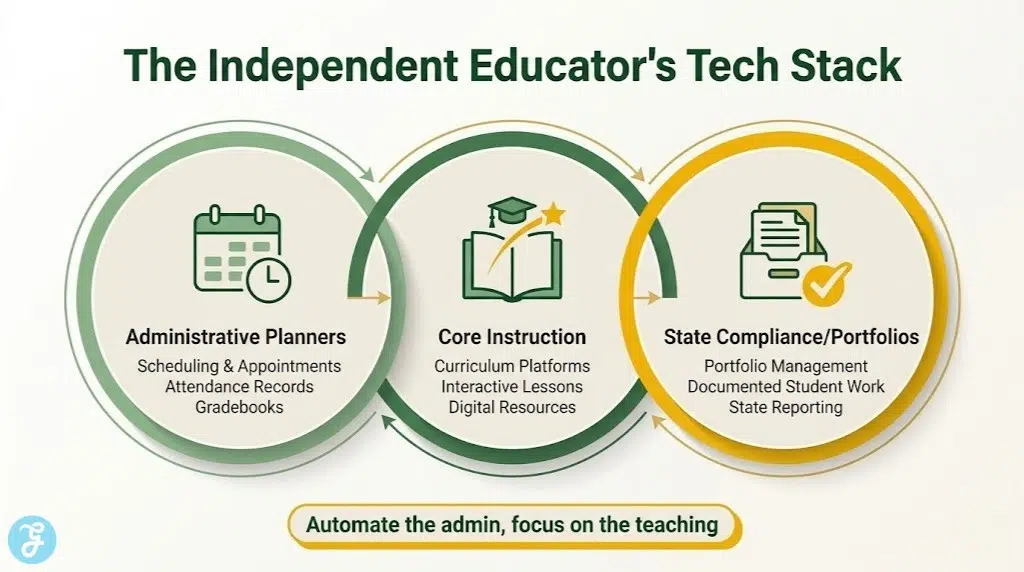
Examining the independent software market reveals a strong division between administrative tracking tools and direct instructional platforms. Here is our curated breakdown of the standout studios empowering home education.
1. Homeschool Planet
Operating out of Fremont, California as a product of the Homeschool Buyers Club, Homeschool Planet functions as a comprehensive digital planner designed specifically for complex household schedules. It allows parents to overlay lesson plans with chore charts, doctor appointments, and extracurricular activities in a unified visual calendar. The platform integrates directly with popular curriculum providers to auto-populate daily assignments.
Best for:
-
Managing complex, multi-student household schedules seamlessly.
Why We Chose It:
-
Provides an automatic rescheduling tool that shifts lessons instantly if a sick day occurs.
-
Deep integration with third-party publishers saves hours of manual data entry.
Things to consider:
-
The interface is highly detailed, which might feel overwhelming for families wanting minimalist planning.
The 2026 Edge:
-
New dynamic calendar syncing that pushes real-time assignment updates directly to a student’s mobile device.
While visual calendars work well for daily scheduling, some states require highly rigid, traditional grade reporting.
2. Homeschool Tracker
Based in the United States, Homeschool Tracker is a robust record-keeping software built for high school transcript generation and state compliance. It strips away flashy graphics to focus entirely on weighting grades, tracking attendance, and generating professional academic reports. It operates similarly to standard public school administrative software but is scaled for individual households.
Best for:
-
Generating professional transcripts and tracking weighted grades for high schoolers.
Why We Chose It:
-
Unmatched capability for creating state-compliant reports and portfolios.
-
Allows for highly customized grading scales and advanced assignment weighting.
Things to consider:
-
The learning curve is steep, requiring parents to invest time into understanding the reporting mechanics.
The 2026 Edge:
-
Streamlined electronic transcript delivery that interfaces directly with university admissions portals.
For parents who find robust databases overwhelming, alternative software provides a much lighter administrative touch.
3. Scholaric
Scholaric is an independent, USA-based planning tool built by a single developer with a focus on absolute minimalism. It removes complex menus and heavy visual elements, functioning primarily as a digital grid where parents can type, drag, and drop daily lessons. The software is designed to get the planner out of the way as quickly as possible so teaching can begin.
Best for:
-
Parents seeking a minimalist, fast, and highly intuitive digital lesson planner.
Why We Chose It:
-
Lightning-fast interface that loads quickly on any device.
-
Zero visual clutter or distracting pop-ups during the planning phase.
Things to consider:
-
Lacks the deep curriculum integrations and automated reporting of heavier platforms.
The 2026 Edge:
-
Enhanced keyboard shortcut support, allowing power users to map out an entire month of lessons without touching a mouse.
When families participate in hybrid schooling or co-ops, tracking hours and community service becomes just as important as tracking grades.
4. My School Year
My School Year is a web-based tracking software that excels at monitoring hourly requirements for specific subjects and extracurriculars. The platform utilizes visual progress bars to show students and parents exactly how close they are to finishing a textbook or completing state-mandated attendance hours. It is highly effective for keeping older, independent learners on pace.
Best for:
-
Tracking state-mandated educational hours and visualizing course progress.
Why We Chose It:
-
Excellent visual dashboard that motivates students through clear progress tracking.
-
Automated email reminders ensure assignments and grading never fall behind.
Things to consider:
-
The user interface relies heavily on list views, which may lack the intuitive feel of drag-and-drop calendars.
The 2026 Edge:
-
Automated portfolio generation that compiles reading logs and activity hours into a single compliance document.
Beyond administration, securing the right digital tools for specialized subject instruction is critical for a well-rounded education.
5. Beast Academy Online
Developed by the independent San Diego studio Art of Problem Solving, Beast Academy Online is a highly rigorous digital math platform. It uses comic-book-style narratives to introduce complex, conceptual mathematics to elementary and middle school students. The platform refuses to teach rote memorization, forcing students to engage in deep problem-solving and critical thinking.
Best for:
-
Gifted learners and students who need highly challenging, conceptual math instruction.
Why We Chose It:
-
Unparalleled rigor that genuinely challenges students rather than simply testing their memory.
-
Engaging graphic novel format prevents math anxiety and builds enthusiasm.
Things to consider:
-
The difficulty level is significantly higher than standard public school curricula, which can cause frustration initially.
The 2026 Edge:
-
Advanced digital manipulatives that allow students to visually construct algebraic models before solving them.
While math requires intense focus, some families prefer a unified platform that handles multiple core subjects simultaneously.
6. Miacademy
Miacademy is an independent digital learning environment offering comprehensive curricula from kindergarten through high school. The platform blends video lessons with adaptive quizzes, covering everything from core subjects to electives like financial literacy and computer programming. It also features a highly moderated, walled-garden social feature where students can safely interact and trade digital currency.
Best for:
-
An all-in-one digital curriculum supplemented by a safe, moderated social environment.
Why We Chose It:
-
Covers a massive array of electives rarely found in independent software.
-
The internal digital economy teaches students basic financial and entrepreneurial skills.
Things to consider:
-
The social features require active parental monitoring to ensure time is spent on academics rather than just gaming.
The 2026 Edge:
-
Adaptive reading difficulty toggles that adjust the text complexity of science and history lessons without changing the core facts.
For high school students preparing for college, specialized online management systems become a necessity.
7. Sycamore Academy
Operating from Fremont, Nebraska, Sycamore Education (often referred to by its product name “Sycamore School”) is a scaled-down version of a full-scale Student Information System (SIS) designed for homeschools, private schools, and local co-ops. Note that Sycamore Education is primarily designed for small to mid-sized private K-12 schools, though larger homeschool co-ops use it as well. It handles complex matrix scheduling, internal family communication, and secure document storage. It is the premier choice for families managing multiple teenagers taking a blend of home, online, and community college courses.
Best for:
-
Large families and homeschool co-ops requiring institutional-grade data management.
Why We Chose It:
-
Bank-level security for storing sensitive health and academic records.
-
Powerful communication portals that keep parents and outside tutors synchronized.
Things to consider:
-
It is significantly more powerful than what a family with a single elementary student would require.
The 2026 Edge:
-
Seamless integration with state department of education portals for direct compliance reporting.
Shifting focus back to specific instruction, science requires a platform that goes beyond textbooks to offer real-world application.
8. Supercharged Science
Created by an independent mechanical engineer in California, Supercharged Science is an e-Science platform that turns the home into a laboratory. The software delivers high-energy instructional videos followed by detailed, step-by-step guides for conducting hands-on experiments using common household items. It bridges the gap between digital delivery and physical discovery.
Best for:
-
Kinesthetic learners who require hands-on experiments to grasp scientific concepts.
Why We Chose It:
-
Exceptional video instruction that makes complex physics and chemistry accessible.
-
Focuses entirely on doing science rather than just reading about it.
Things to consider:
-
Requires parents to regularly purchase physical supplies and supervise experiments.
The 2026 Edge:
-
Interactive video branching that lets students predict experiment outcomes before watching the final result.
When hands-on experiments aren’t feasible, specialized audio-visual tools must fill the gap in higher-level science.
9. Fascinating Education
Silver Spring, Maryland-based Fascinating Education was built by Dr. Sheldon Margulies, a retired neurologist, to teach middle and high school science using an audio-visual method. The platform relies heavily on narrated graphics and visual modeling rather than dense text, breaking down biology and chemistry into digestible visual steps. It is specifically designed to bypass the reading comprehension barrier in science education.
Best for:
-
Visual and auditory learners struggling with dense, textbook-heavy science curricula.
Why We Chose It:
-
Highly effective right-brain teaching approach that simplifies complex molecular concepts.
-
Allows students to focus on scientific mechanics without getting bogged down by reading level.
Things to consider:
-
The interface is highly functional and academic, lacking the gamification found in modern apps.
The 2026 Edge:
-
Refined digital lab simulations that allow students to safely mix volatile chemicals in a virtual environment.
Language arts and literature require a completely different technological approach, focusing on narrative and writing mechanics.
10. Brave Writer
Brave Writer, headquartered in Ohio, functions as an online hub for writing instruction, offering digital curricula and live online classes. The platform focuses heavily on finding a student’s authentic voice, using transcription exercises and literature discussion rather than rigid grammar drilling. The software portal allows for easy submission of essays and provides a space for highly personalized instructor feedback.
Best for:
-
Developing authentic writing voices and overcoming deep-seated writing anxiety.
Why We Chose It:
-
Exceptionally supportive online instructors who provide detailed, encouraging feedback.
-
Shifts the focus from strict rule-following to actual creative expression.
Things to consider:
-
The live online classes fill up extremely quickly and require registration months in advance.
The 2026 Edge:
-
Asynchronous audio feedback tools that allow instructors to leave detailed voice notes directly on student essays.
Similarly, math instruction often benefits from digital tools that simulate physical learning aids.
11. Demme Learning Digital
Lititz, Pennsylvania’s Demme Learning, the independent family-owned publisher behind Math-U-See, provides a powerful digital toolkit to accompany their curriculum. Their software features an interactive digital manipulative block workspace, allowing students to build and solve equations on a tablet exactly as they would with physical blocks. The platform also hosts streaming video lessons to ensure consistent instruction.
Best for:
-
Spatial learners who need manipulative-based math instruction in a digital format.
Why We Chose It:
-
Perfectly replicates the physical block-building experience on a touchscreen.
-
Highly effective sequential videos ensure parents don’t have to teach complex math themselves.
Things to consider:
-
The digital tools are most effective when paired closely with their proprietary physical workbooks.
The 2026 Edge:
-
Auto-grading features built directly into the digital manipulative space, instantly correcting block placement errors.
For families strictly seeking video-led instruction across classical subjects, dedicated streaming platforms are vital.
12. Compass Classroom
Based in Nashville, Tennessee, Compass Classroom is an independent digital platform offering video-based curricula built around a Christian worldview, with strong classical education influences. The software streams high-definition courses in history, economics, Latin, literature, science, and music, featuring engaging instructors who utilize a conversational teaching style. It essentially provides a master teacher on demand for subjects parents may not feel equipped to teach.
Best for:
-
Families seeking a classical education model delivered via high-quality video instruction.
Why We Chose It:
-
Outstanding production values and highly charismatic instructors keep students engaged.
-
Simplifies the teaching of difficult subjects like formal logic and classical languages.
Things to consider:
-
The curriculum represents a specific classical methodology, which may not align with unschooling or eclectic styles.
The 2026 Edge:
-
Offline downloading capabilities built directly into the player, ensuring lessons continue without internet access.
Keeping track of these varied instructional methods requires specialized scheduling that moves away from standard calendars.

13. Lessontrek
Lessontrek is an independent software tool designed for visual planners who prefer the look of a traditional teacher’s plan book digitized. It utilizes a highly responsive drag-and-drop interface, allowing parents to color-code subjects and print beautifully formatted weekly overviews. It strikes a balance between digital efficiency and traditional aesthetics.
Best for:
-
Visual organizers who want a digital replica of a traditional paper lesson planner.
Why We Chose It:
-
Extremely intuitive interface requires zero tutorials to understand.
-
Excellent printing capabilities for families who still want a physical binder on the desk.
Things to consider:
-
Lacks the automated grading and transcript generation found in heavier administrative software.
The 2026 Edge:
-
Expanded color-coding accessibility tools designed specifically to assist neurodivergent parents in organizing their week.
Sometimes, pure academic intervention is required without the bulk of a full curriculum.
14. A+ Interactive Math
Operating in the USA, A+ Interactive Math delivers a highly straightforward software solution designed to close specific mathematical gaps. The platform uses adaptive placement tests to identify exactly what a student is missing, then automatically generates a customized lesson plan to address those specific areas. It is a highly efficient tool for remediation.
Best for:
-
Identifying and quickly remediating specific learning gaps in foundational mathematics.
Why We Chose It:
-
Removes the guesswork for parents trying to figure out why their child is struggling.
-
Highly focused, distraction-free interface ensures maximum time on task.
Things to consider:
-
The visual presentation is highly academic and lacks the high-end animation of game-based platforms.
The 2026 Edge:
-
Improved algorithms that detect exactly when a student has achieved automaticity with a concept, preventing unnecessary repetition.
Finally, ensuring that all this varied digital work is properly archived secures the student’s academic future.
15. Applecore System
The Applecore System is a specialized, web-based portfolio and transcript builder designed specifically to meet state portfolio requirements. It allows users to upload digital samples of student work, log attendance, and track grades in a highly secure environment. The software ensures that if a state evaluator requests proof of progress, the family can generate a comprehensive document instantly.
Best for:
-
Building state-compliant digital portfolios and maintaining secure academic archives.
Why We Chose It:
-
Designed explicitly with state compliance and legal archiving in mind.
-
Clean, utilitarian interface makes uploading photos of projects and essays simple.
Things to consider:
-
It is purely an archiving and reporting tool, offering no scheduling or instructional capabilities.
The 2026 Edge:
-
Direct integration with cloud storage providers, allowing parents to instantly pull work samples from Google Drive or Dropbox.
An Overview of Homeschooling Software in the USA
To quickly compare these administrative and instructional platforms, reviewing their core functions side-by-side clarifies the best approach for your household.
Overview Comparison Table
Reviewing these metrics provides a clear snapshot of the digital options available to independent educators.
| SME Developer | Headquarter Location | Core Focus Area | Pricing Model |
| Homeschool Planet | California | Visual Scheduling | Subscription |
| Homeschool Tracker | USA | Grading & Transcripts | Subscription |
| Scholaric | USA | Minimalist Planning | Subscription |
| My School Year | USA | Hourly Tracking | Subscription |
| Beast Academy Online | California | Rigorous Math | Subscription |
| Miacademy | California | Complete Curriculum | Subscription |
| Sycamore Education | Fremont, NE | SIS Management | Tiered Pricing |
| Supercharged Science | California | Hands-On e-Science | Subscription |
| Fascinating Education | Maryland | Audio-Visual Science | Annual Sub |
| Brave Writer | Ohio | Writing & Literature | Per Course / Tool |
| Demme Learning Digital | Pennsylvania | Math Manipulatives | Paid Product |
| Compass Classroom | Tennessee | Video Curriculum | Subscription / Paid |
| Lessontrek | USA | Visual Plan Book | Subscription |
| A+ Interactive Math | USA | Math Remediation | Tiered Pricing |
| Applecore System | USA | Portfolio Archiving | Freemium / Paid |
Evaluating these administrative and instructional tools brings us to our primary recommendations.
Our Top 3 Picks and Why?
Narrowing down the field, three developers stand out for their exceptional utility in the home environment. Homeschool Planet is the absolute standard for managing the complex, daily scheduling chaos of a multi-student household. Beast Academy Online provides unparalleled, rigorous mathematical instruction that refuses to compromise on conceptual depth. Finally, Homeschool Tracker ensures that when the time comes, parents have the robust data necessary to generate flawless, state-compliant high school transcripts.
How to Choose the Right Homeschooling Software USA by Yourself?
Selecting the right digital infrastructure requires an honest assessment of your family’s organizational style and your state’s legal requirements. Reviewing these factors will ensure a smooth technological implementation.
The Selection Framework:
Identify the Primary Pain Point: Determine if your biggest struggle is scheduling your week, tracking grades for compliance, or teaching a specific subject like higher-level math.
Assess Your Organization Style: If you thrive on detail, heavy database software works well; if you get overwhelmed easily, opt for minimalist, visual planners.
Check State Compliance: Ensure the software can generate the specific hourly logs, portfolios, or weighted transcripts required by your local education department.
Evaluate Integration Needs: Look for planning tools that can directly import lesson plans from the curriculum publishers you already use.
Applying this framework directly to your specific needs allows you to match the right developer to your daily routine using the metrics below.
Decision Matrix
Matching your specific priorities with the right developer ensures a successful digital learning environment.
| Choose This SME… | If You Prioritize… |
| Homeschool Planet or Lessontrek | Visual scheduling and organizing daily household chaos. |
| Homeschool Tracker or Applecore System | Generating high school transcripts and state-compliant portfolios. |
| Beast Academy Online or Fascinating Education | Outsourcing rigorous instruction in higher-level math or science. |
| Miacademy | Securing an all-in-one digital curriculum with integrated social features. |
Before setting up your digital classroom, running through a rapid verification process is essential.
The Final Checklist
Running through this quick verification process guarantees you are utilizing safe, effective software.
-
Verify the platform allows you to completely export your data if you decide to cancel your subscription.
-
Ensure the developer provides a mobile-friendly view or dedicated app for checking assignments on the go.
-
Test the user interface during a free trial to ensure it matches your natural organizational style.
-
Confirm that any instructional software provides dedicated parent dashboards to monitor progress without hovering.
-
Check the privacy policy to guarantee the developer does not share student data with external marketing agencies.
Establishing a Secure Educational Foundation
Taking control of a child’s education requires robust tools, and selecting software from independent American developers ensures your digital infrastructure serves your family rather than corporate data interests. These fifteen SMEs prove that highly effective, secure, and customizable technology is available to support the unique rhythms and rigorous demands of independent education.
Frequently Asked Questions (FAQs) About Homeschooling Software USA
1. Can one software platform handle both my curriculum and my scheduling?
While some all-in-one platforms attempt this, most families find success by pairing a dedicated administrative planner (like Homeschool Planet) with specialized instructional software for core subjects. This prevents you from being locked into a single ecosystem if a specific subject’s curriculum isn’t working.
2. Do I legally need to use tracking software for my homeschool?
Legal requirements vary drastically by state. States with high regulation may require detailed portfolios and hourly logs, making tracking software incredibly valuable. In low-regulation states, software is simply a tool for personal organization rather than legal compliance.
3. Are digital curricula as effective as traditional physical textbooks?
Digital curricula excel in adaptive remediation, instant feedback, and visual modeling (especially in math and science). However, many independent educators advocate for a hybrid approach, using software for tracking and specific skill drilling while maintaining physical books for deep reading and literature.
4. How secure is my child’s data on these independent platforms?
Independent SMEs that rely on subscription revenue models generally have excellent privacy track records because they do not need to monetize user data. Always review the privacy policy to ensure absolute compliance with COPPA regulations regarding minor data.
5. Can I use these platforms if I run a micro-school or local co-op?
Yes, several platforms, particularly Sycamore Education and Homeschool Tracker, are specifically designed to scale up. They allow administrators to manage multiple families, coordinate shared tutors, and generate institutional-level reports for group learning environments.