
Are you tired of paying sky-high taxes on your hard-earned income, especially if you’re an expat dreaming of a sunnier life? You might feel stuck, watching your savings dwindle under heavy tax burdens back home. Envision this: you relocate to Portugal, soak up the beaches and culture, and suddenly your tax worries melt away like ice cream on a hot Lisbon day. That’s the magic of the Portugal NHR Tax Regime, a smart option for foreigners looking to lighten their load.
Did you know that this regime can exempt most foreign income from Portuguese taxes for up to 10 years? Our guide breaks it down step by step, from getting your residency to submitting that key application, so you avoid common pitfalls and get approved fast.
We’ll share tips, like chatting with locals about their experiences, to make the process feel like a friendly adventure. Keep reading for the details.
What Is the Portugal NHR Tax Regime?
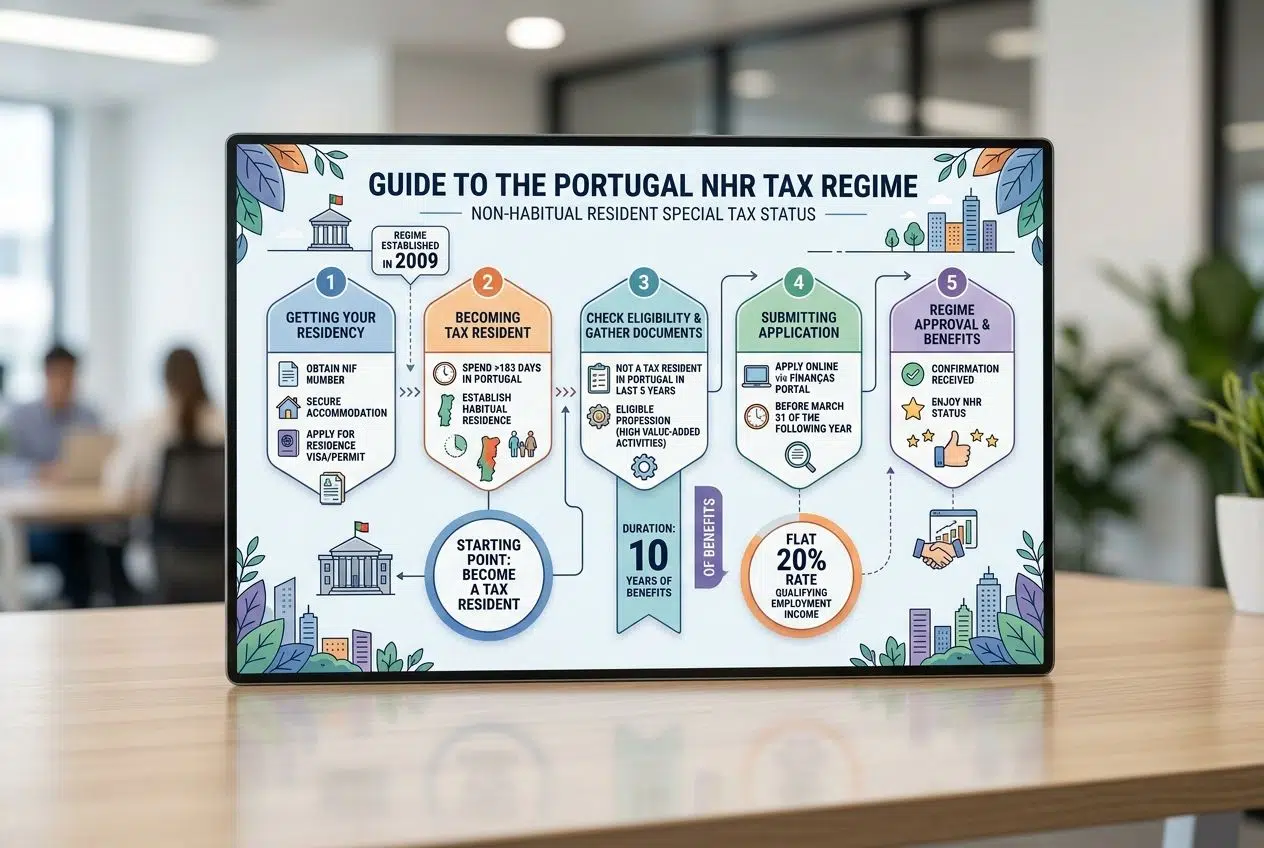
Portugal’s Non-Habitual Resident tax regime, or NHR for short, draws in expats and foreigners with its sweet tax incentives. This fiscal regime started back in 2009 to boost the economy by luring skilled people and retirees.
It offers a decade of tax breaks on income, like exemptions for foreign-sourced income and a flat 20% rate on certain Portugal-earned cash. Think of it as a golden ticket for tax planning, especially if you hail from a high-tax spot and dream of sunny beaches without the hefty bills.
Expats love how it eases income tax burdens, making Portugal a top pick for residency. Foreigners flock here for these financial advantages, blending work and leisure under favorable expat tax regulations.
The setup targets people who haven’t called Portugal home in the past five years, focusing on pension income or employment in high-value fields. Tax benefits shine for those with foreign income, thanks to double taxation agreements that prevent double dips.
Many see it as a smart move for tax residency, dodging full taxes on dividends or royalties from abroad. You might chuckle at how it turns tax headaches into a walk in the park, but hey, who wouldn’t jump at such perks? Now, let’s check if you qualify under the eligibility criteria for the NHR tax regime.
Eligibility Criteria for the NHR Tax Regime
Ever dreamed of slashing your taxes while sipping port wine in Lisbon? You qualify if you haven’t lived in Portugal for the past five years, and can prove your income fits the right categories, like pensions or high-value jobs.
Residency Requirements
You need residency in Portugal to qualify for the NHR tax regime. Expats often start with a visa, like the D7 for passive income or the Golden Visa for investments. Foreigners must prove they live here more than 183 days a year.
Portugal tax residency kicks in if you stay that long or set up your main home base. Envision it: you pack your bags, find a sunny spot in Lisbon, and commit to the lifestyle. That opens doors to tax benefits and exemptions on foreign income.
Officials check your ties to the country. They look at your home, family, or job here. You cannot have been a tax resident in Portugal for the last five years. Income tax rules favor newcomers this way.
Grab that tax number early; it helps with the application process. Many expats share stories of smooth moves, turning paperwork into a Portuguese adventure. Stay put, meet the criteria, and enjoy fiscal perks for up to ten years.
Professional Qualifications
Portugal’s NHR tax regime favors expats in certain jobs. Foreigners often qualify if they work in high-value fields. Think doctors, engineers, artists, or IT experts. The list includes professions like architects, professors, and scientists.
Expats in these roles enjoy a flat 20% income tax on their Portuguese earnings. Picture a software developer moving to Lisbon; they fit right in. Check the official Portuguese tax authority list for your job.
Match it, and you gain those sweet tax benefits. Employment qualifications tie into your work history, too. Show proof of your skills with degrees or certifications. Authorities look for at least five years of experience in your field. This helps with the application process. Many expats find this step straightforward, like fitting a puzzle piece. Now, let’s talk about income source criteria to round out eligibility.
Income Source Criteria
Your income plays a big role in qualifying for the Portugal NHR tax regime. Expats often aim for this setup because it targets specific income sources. Think about foreign income, like pensions or dividends from abroad.
These can snag exemptions under the regime. Employment income from high-value jobs counts too. Envision a tech whiz or doctor moving to Portugal; their skills fit the employment qualifications perfectly. Foreigners with pension income find this especially sweet, as it dodges heavy income tax hits.
Check if your earnings come from approved areas, such as arts, science, or management roles. The regime favors these for tax benefits. Income source criteria focus on non-Portuguese sources to avoid double taxation.
Expats, take note: your foreign income might get full exemptions if it meets the rules. This fiscal regime boosts financial advantages for those who qualify.

The NHR program opens doors for expats with diverse income streams, making Portugal a top spot for tax planning, says tax expert Maria Silva.
Tax Benefits of the NHR Tax Regime
Picture cutting your tax bill, like scoring a jackpot on your favorite game, with Portugal’s NHR offering sweet deals that make expat life a breeze.
Flat 20% Tax on Specific Income
Portugal’s NHR tax regime offers a flat 20% tax rate on specific income for expats. You pay this low rate on earnings from high-value jobs in the country. Think of it as a smart tax break that lightens your load.
Professionals like doctors, engineers, and artists qualify for this deal. Foreigners often see big financial advantages here. This setup beats standard income tax rates that climb much higher. Expats love how it boosts their take-home pay. You can keep more cash from your employment in Portugal.
The regime targets income from approved professions under tax incentives. You get this 20% flat rate instead of progressive taxes. Pension income sometimes falls into this category, too.
Non-habitual residents enjoy these exemptions on certain earnings. Tax planning becomes easier with such perks. Foreign income often stays tax-free abroad due to double taxation agreements. Expats use this fiscal regime to cut costs. Residency in Portugal unlocks these tax benefits for ten years straight.
Exemptions on Foreign-Sourced Income
Beyond that flat 20% tax on specific income, expats love how the NHR tax regime sweetens the deal with exemptions on foreign-sourced income. If you earn pensions, dividends, or royalties from abroad, Portugal often lets them slide tax-free.
This setup applies if the source country could tax them under double taxation agreements, or if they come from blacklisted jurisdictions. Foreigners flock to this for major financial advantages, especially with pension income staying exempt.
Talk about a game-changer for tax planning. The regime exempts most foreign income like interest and capital gains, too, as long as you meet the non-habitual resident rules. Expats, you avoid double hits thanks to those DTAs Portugal holds with over 80 countries.
Employment income from high-value jobs abroad gets a pass if taxed at the source. This fiscal regime boosts your savings for a full 10 years, making Portugal a top spot for tax incentives.
Double Taxation Agreements (DTA)
Portugal signs Double Taxation Agreements with over 80 countries to stop expats from paying taxes twice on the same earnings. These deals act like a fair play rule in the tax game, letting you claim credits or exemptions based on where your income comes from.
For instance, you’re an expat with pension income from abroad; the DTA often keeps that money tax-free in Portugal under the NHR tax regime. Expats love how these agreements boost financial advantages by shielding foreign-sourced income. Say your home country taxes dividends first, the DTA steps in to prevent Portugal from taking another bite.
This setup supports tax planning for non-habitual residents, making the fiscal regime a smart choice for foreigners chasing income tax exemptions.
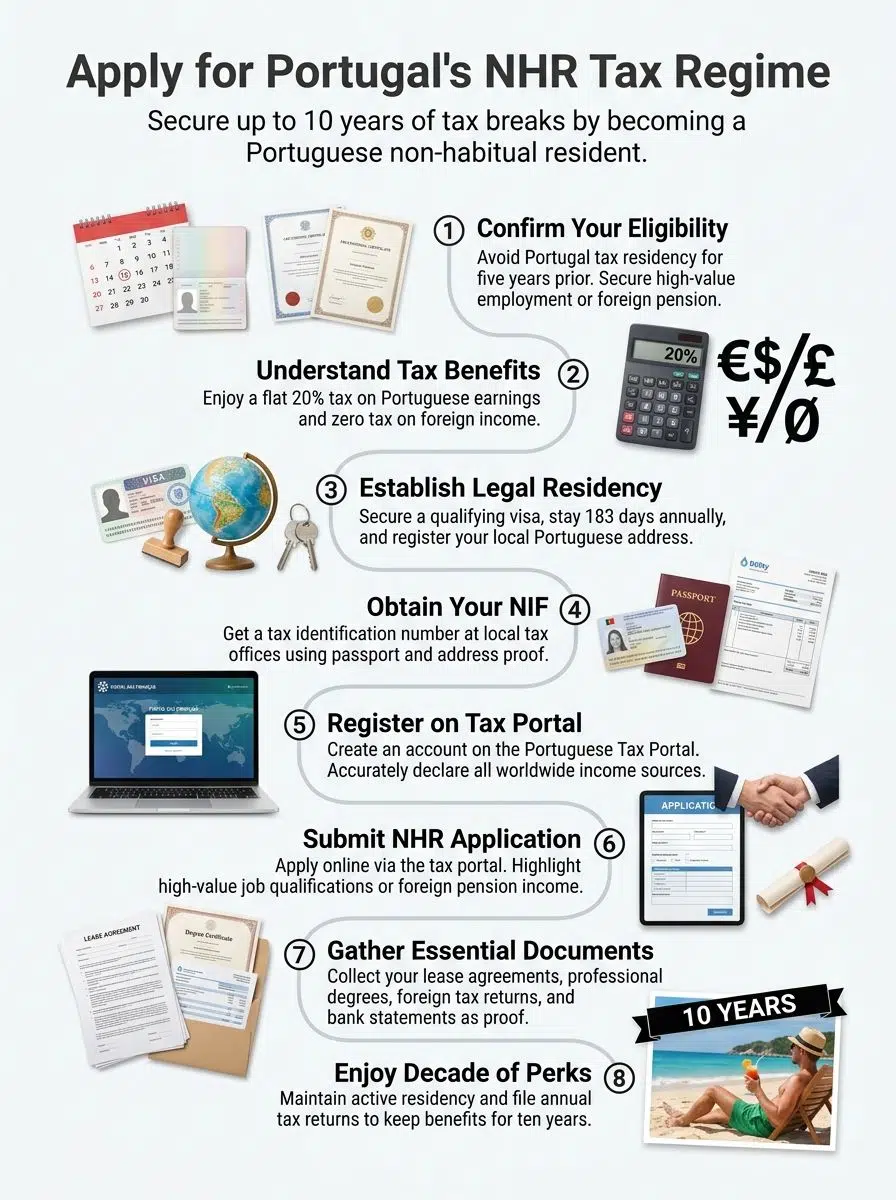
Step-By-Step Guide to Applying for the Portugal NHR Tax Regime
Ready to chase those tax perks in sunny Portugal? Follow these clear moves, and you’ll slide into NHR status like a pro surfer catching a wave.
Step 1: Establish Residency in Portugal
You dream of sunny Portugal as your new home, with its beaches and culture calling your name. Establishing residency kicks off your path to the Portugal NHR tax regime, opening doors for expats and foreigners chasing tax benefits.
- First off, check if you need a visa to enter Portugal as a foreigner; citizens from the EU, EEA, or Switzerland can skip this and move right in, but others might apply for options like the D7 visa for those with pension income or passive earnings, or the Golden Visa tied to real estate investments starting at 280,000 euros in low-density areas.
- Pack your bags and arrive in Portugal, aiming to stay for at least 183 days in a calendar year to qualify as a tax resident, which ties into those sweet income tax exemptions under the NHR program.
- Head to your local town hall or citizens’ shop to register your address; bring your passport, proof of accommodation like a lease agreement, and maybe a utility bill to show you’re truly settling in as an expat.
- If you’re from outside the EU, secure a residence permit from the Immigration and Borders Service (SEF), now part of AIMA, within four months of arrival; this step locks in your status and paves the way for tax incentives on foreign income.
- Consider employment qualifications if you’re planning to work; Portugal welcomes skilled professionals, but for NHR, your residency sets the stage for a flat 20% tax on specific income sources.
- Gather any needed docs early, like health insurance proof for non-EU people, to smooth the application process and avoid hiccups in claiming those fiscal regime perks.
- Chat with locals or join expat groups for tips; one guy I know breezed through by renting first in Lisbon, turning his move into a tax planning adventure with real financial advantages.
Step 2: Obtain a NIF (Tax Identification Number)
Once you’ve nailed down your residency in Portugal, like getting that golden visa or settling in as an expat, it’s time to tackle the next key piece of the puzzle for the NHR tax regime. This step focuses on grabbing your NIF, which stands for Tax Identification Number, and it’s your golden ticket to handling all things tax-related in the country.
Think of the NIF as your personal barcode for the Portuguese tax system; you need it for everything from opening a bank account to filing your NHR application. Foreigners can snag one pretty easily, often in a single visit to a local tax office.
- Head to a Finanças office, that’s the Portuguese tax authority, with your passport and proof of address, like a rental agreement or utility bill, to apply in person; it’s straightforward for expats chasing those tax benefits, and they usually issue it on the spot.
- Bring a friend or translator if Portuguese isn’t your strong suit, since the process involves some forms in the local language, but hey, it’s all part of the adventure in tax planning for non-habitual residents.
- Expect to pay a small fee, around 10 euros, and provide details like your full name, birthdate, and why you’re in Portugal, tying right into your residency application for the fiscal regime.
- Online options exist for some, through the tax portal if you have a digital certificate, making it a breeze for savvy expats dealing with income tax exemptions on foreign income.
- Double-check your documents before you go, as missing one could send you back home empty-handed, and nobody wants that hiccup in their path to those sweet Portugal tax residency perks.
- Once you have your NIF, it opens doors to registering as a tax resident, a must for foreigners eyeing employment qualifications or pension income under the NHR setup.
- Keep in mind, this number sticks with you for life in Portugal, so treat it like a trusty sidekick in your expat tax regulations journey.
Step 3: Register as a Tax Resident on the Portuguese Tax Portal
Now that you’ve got your NIF in hand, it’s time to build on that foundation and move into registering as a tax resident. This step pulls everything together for your application process as an expat chasing those sweet tax benefits. Portugal makes this part straightforward, like turning a key in a well-oiled lock.
- Head over to the official Portuguese Tax Authority website, known as Portal das Finanças, where you’ll find the online platform for tax residency registration; log in using your new NIF and a password you set up, making sure your details match for a smooth ride.
- Fill out the online form with your personal info, including your full name, address in Portugal, and proof of residency like a rental agreement or utility bill, because this confirms you’re truly settling in as a foreigner aiming for income tax exemptions.
- Declare your worldwide income sources right there, highlighting any foreign income or pension income that could qualify under the non-habitual resident rules, which is key for expats planning their tax strategy.
- Upload scanned copies of required docs, such as your passport, visa if applicable, and that NIF certificate, to back up your claims and avoid any hiccups in the residency application.
- Double-check all entries for accuracy before hitting submit, since small errors could delay your path to those fiscal regime perks like flat rates on employment income.
- Expect a confirmation email from the tax portal within a few days, signaling they’ve received your registration and are reviewing it as part of Portugal’s tax incentives for foreigners.
- If needed, visit a local tax office for help, especially if you’re dealing with complex employment qualifications or double taxation agreements that protect your foreign-sourced income.
Step 4: Submit the NHR Application
You’ve set up your residency and grabbed that NIF number. Submitting the NHR application seals the deal for those sweet tax benefits as a non-habitual resident.
- Head to the Portuguese Tax Authority’s online portal, where you log in with your tax identification number to start the application process for foreigners eyeing the tax regime.
- Fill out the official form with details about your income sources, making sure to highlight any employment qualifications or pension income that fit the eligibility for expats.
- Double-check all entries for accuracy, as this step locks in your shot at income tax exemptions on foreign-sourced income under Portugal’s tax incentives.
- Attach any initial proofs like your visa or residency docs, though full documents come next, to show you’re serious about tax planning as a tax resident.
- Submit everything electronically, and expect a confirmation email that kicks off the review for your non-habitual resident status with its financial advantages.
- Wait for the tax authorities to process it, which often takes a few months, but stay on top of any follow-up requests to keep your expat tax regulations smooth.
Once you hit submit on that application, gather up the key documents needed to back it all up.
Documents Required for the Application
Hey, pulling together your paperwork for the NHR application is like packing for a big move, you know, grab your proof of where you live, any pro quals that fit, plus those tax IDs and money docs to keep things smooth—stick around for the full scoop on sealing the deal.
Proof of Residency
You need solid proof of residency to apply for the Portugal NHR tax regime. Gather documents like a lease agreement or property deed that show you live in Portugal. Expats often use a residence permit or golden visa as key evidence.
These items confirm your status as a tax resident, which ties into the application process for those sweet tax benefits and exemptions on foreign-sourced income.
Utility bills in your name work well too, proving you stay there long-term. Foreigners should include bank statements from a Portuguese account. This step helps avoid hiccups in getting that non-habitual resident approval, opening doors to lower income tax rates for up to 10 years.

Proof of Professional Qualification (if applicable)
Gather documents that show your employment qualifications if you work in fields like medicine, engineering, or tech. These prove you fit the Non-Habitual Resident program’s rules for tax benefits.
Think of it as your ticket to that flat 20% rate on certain income. Expats often submit degrees, licenses, or work certificates from their home country. Officials check these during the application process to confirm eligibility for income tax exemptions.
Double-check that your proofs match Portugal’s list of high-value jobs. Foreigners with the right papers unlock financial advantages, like lower taxes on pension income or foreign income.
Chat with a tax advisor to make sure everything lines up for your residency application. This step boosts your chances in the tax regime, keeping things smooth for expat tax regulations.
Tax Identification and Financial Records
You need your tax identification number, or NIF, to prove your fiscal status in Portugal. Officials require this for all tax-related applications. Bring copies of recent tax returns from your home country.
These show your income sources and help verify eligibility for exemptions on foreign income. Think of it like packing your financial backpack for a smooth journey through the process. Expats often forget this step, but it ties everything together for the tax authorities.
Financial records include bank statements or pension income proofs, especially if you qualify under employment qualifications. Authorities check these to confirm your income tax details and ensure you meet the non-habitual resident criteria.
Stay organized with these docs to avoid hiccups. Once you gather these, let’s see what happens after approval.
What Happens After Approval?
You receive NHR status, and those sweet tax breaks last a full ten years, giving you plenty of time to settle in and save big. As a non-habitual resident, you follow simple rules like annual tax filings, which keep everything smooth and compliant.
Duration of NHR Benefits
The Non-Habitual Resident tax regime in Portugal lasts for 10 straight years. You get these tax benefits starting from the year you register as a tax resident. Expats love this setup, as it offers solid financial advantages for a full decade.
Picture locking in those income tax exemptions on foreign-sourced income, like pension income, for that long stretch. Foreigners often plan their moves around this timeline to maximize tax incentives.
Keep your residency status active each year to hold onto the perks. The fiscal regime ends after those 10 years, but you can still enjoy Portugal’s other expat tax regulations if you stay.
Think of it as a golden ticket that runs out, yet opens doors to smart tax planning. Many people use this period to build wealth without heavy burdens from double taxation agreements.
Obligations as a Non-Habitual Resident
You gain tax benefits as a non-habitual resident, but duties come with them. File your income tax return each year in Portugal. Report all your worldwide income to stay compliant. Keep your residency active by spending enough time in the country, usually over half the year.
Expats often forget this, like a friend who lost status after too many trips abroad. Pay taxes on qualifying employment income at the flat 20% rate. Foreigners must update their records if income sources change. Follow double taxation agreements to avoid double payments. This keeps your exemptions intact for foreign-sourced income.
Handle obligations smartly to enjoy the fiscal regime. Renew your tax number as needed for smooth processes. Meet deadlines for submissions on the tax portal. Employment qualifications tie into your ongoing status, so maintain them.
Pension income stays exempt if the rules apply. Tax planning helps, but slip-ups can end benefits early. Portugal tax residency demands attention, yet it rewards careful expats with financial advantages. Stay on top, and the non-habitual resident path feels like a walk in the park.
The Closing Thoughts
Expats often dream of sunny Portugal, with its tax incentives drawing them in. Envision sipping coffee in Lisbon, enjoying those financial advantages from the Non-Habitual Resident status.
Portugal tax residency opens doors to income tax exemptions on foreign income, a real game-changer for tax planning. Foreigners find the fiscal regime appealing, especially with pension income getting special treatment. Tax benefits like the flat 20% rate on specific earnings make it worthwhile. Chat with locals, and they’ll share stories of how this setup boosts their lives.
Explore the application process with confidence; it rewards those who qualify. Employment qualifications matter, but so does proving your residency. Tax number in hand, expats handle exemptions smoothly.
Double taxation agreements protect your foreign-sourced income. Fiscal regime perks extend for a decade, offering stability. Portugal welcomes you with open arms, blending culture and tax advantages seamlessly.
Frequently Asked Questions (FAQs) on Portugal NHR Tax Regime
1. What is the Portugal NHR tax regime, anyway?
Hey, picture this: you’re dreaming of sunny beaches and lower taxes, right? The Portugal NHR tax regime lets folks like you enjoy big tax breaks on foreign income for ten years, if you move there and qualify. It’s like hitting the jackpot for retirees or remote workers, but you gotta play by the rules.
2. Who can apply for the Portugal NHR tax regime?
Anyone from outside the EU, or even EU folks with the right setup, can give it a shot, as long as you haven’t lived in Portugal for five years before. Think of it as an open door for adventurers ready to call Portugal home.
3. How do I start the application process for the Portugal NHR tax regime?
First, get your residency sorted, like with a visa or a golden ticket program. Then, head to the tax office online or in person, fill out the forms with your details, and submit proof of your new address. It’s straightforward, like ordering pizza, but double-check everything to avoid hiccups.
4. What documents do I need to apply for the Portugal NHR tax regime?
You’ll want your passport, proof of income, and a rental agreement or property deed to show you’re settling in. Sometimes they ask for a criminal record check, too, just to keep things on the up and up.