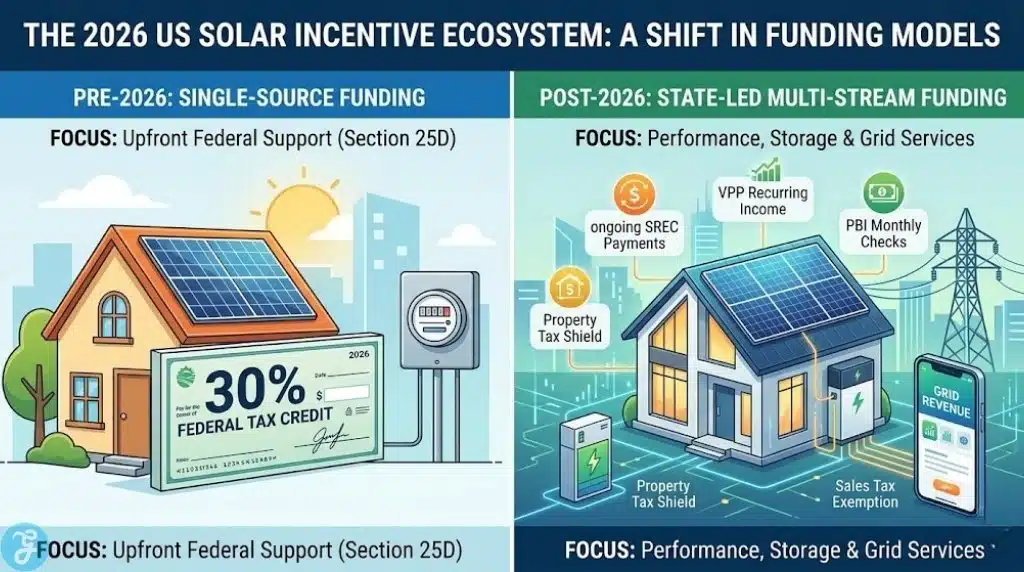
The solar energy landscape in the United States has reached a historic turning point. As of April 2, 2026, the industry has transitioned into a “post-federal credit” era for homeowners, shifting the financial burden and the opportunity entirely onto state-level programs. For the first time in decades, the 30% federal tax credit (Section 25D) is no longer available for those who buy their systems outright. Consequently, mastering Solar Incentives by US State 2026 is no longer a luxury; it is the only way to avoid paying full retail for a residential installation.
How We Selected Our 10 Best Solar Incentive Facts for 2026
To build this comprehensive guide, we analyzed the 2026 state legislative updates and the most recent IRS guidance regarding the Section 48E transition. Our selection criteria prioritized the “shocks” to the system—specifically the sunsetting of the personal tax credit and the rise of performance-based incentives. These 10 points were chosen to provide a 360-degree view of how to replace the “missing” federal credit with a combination of state-level rebates and grid service payments.
10 Essential Truths About Solar Incentives by US State 2026
The following insights break down the technical, fiscal, and behavioral nuances of the US solar market in 2026.
1. The Federal Tax Credit Expiry (Section 25D)
The biggest surprise for homeowners in 2026 is that the 30% federal residential solar tax credit has officially expired for those who purchase their systems with cash or a loan. As of January 1, 2026, homeowners can no longer claim a direct credit on their federal income tax return for personal solar equipment. This has made state-level incentives the only remaining path for direct ownership savings.
Best for: homeowners who were waiting for “the right time” and missed the 2025 deadline.
Why We Chose It:
-
It is the most significant change to solar economics in 20 years.
-
It forces a total re-evaluation of the payback period for new systems.
Things to consider:
-
Your state tax credit (if available) now becomes your primary tool for reducing net cost.
2. The “Third-Party Ownership” (TPO) Loophole
While the tax credit for homeowners is gone, the commercial tax credit (Section 48E) remains active through 2027. In 2026, this has led to a massive resurgence in Solar Leases and Power Purchase Agreements (PPAs). Because the solar company owns the system, they can still claim the 30% credit and pass the savings to you via lower monthly electricity rates.
Best for: individuals who want the benefit of a tax credit without the ability to claim it personally.
Why We Chose It:
-
It is the only way to “recapture” federal support in 2026.
-
It has made leasing more mathematically attractive than buying for the first time in a decade.
Things to consider:
-
You do not own the equipment, which can complicate home sales later.
3. The 10% Domestic Content Bonus (2026 Update)
Starting this year, solar projects (typically via TPO or commercial) can earn an additional 10% “Domestic Content Bonus” if a certain percentage of the equipment is manufactured in the US. In 2026, this threshold is 40%. This can bring the total effective federal support to 40% for leased systems using American-made panels and inverters.
Best for: patriotic consumers and those looking for the absolute lowest lease rates.
Why We Chose It:
-
It is a brand-new 2026 requirement that is reshuffling supply chains.
-
It rewards systems that prioritize domestic resilience over the cheapest imports.
Things to consider:
-
Verify that your installer is using “Domestic Content” certified hardware to trigger the bonus.
4. Virtual Power Plant (VPP) “Passive Income”
In states like California, Illinois, and Massachusetts, your battery storage is now a revenue generator. Through 2026 VPP programs, utilities pay you to “export” your stored power during grid emergencies. California’s Demand Side Grid Support can pay up to $350 per year per battery, effectively creating a “second incentive” after the installation is complete.
Best for: homeowners with battery storage (Tesla Powerwall, Enphase 5P, etc.).
Why We Chose It:
-
It shifts solar from a “saving” tool to an “earning” tool.
-
It helps offset the loss of the federal credit by providing annual cash flow.
Things to consider:
-
You must be enrolled in a specific utility program to receive these payments.
5. The SREC “Gold Mines” (DC and New Jersey)
Solar Renewable Energy Credits (SRECs) remain the most powerful incentive in the Northeast. In 2026, Washington D.C. continues to have the most lucrative market, with SRECs trading near $400 per megawatt-hour. A standard 10kW system in DC could generate $4,000 to $5,000 in annual cash payments, far exceeding any upfront tax credit.
Best for: residents in DC, NJ, MA, MD, and OH.
Why We Chose It:
-
It is a performance-based incentive that pays you for what you produce.
-
In DC and NJ, SREC income can pay for the entire system in under 5 years.
Things to consider:
-
SREC prices are market-based and can fluctuate; use an aggregator to manage sales.
6. The Property Tax Assessment “Shield”
In 36 states, including Florida, Arizona, and Texas, the value added to your home by solar is 100% exempt from property tax assessments. This means if solar adds $20,000 to your home’s value, your property taxes will not increase. However, in California, the “Active Solar Energy System Exclusion” is set to sunset on January 1, 2027, making 2026 the final “safe” year to install without a tax hike.
Best for: homeowners in high-property-tax states.
Why We Chose It:
-
It prevents a “hidden cost” that often discourages other home improvements.
-
It represents a 1-2% annual saving on the total system value for the life of the home.
Things to consider:
-
Always confirm if your specific county requires a “Property Tax Exclusion” form.
7. Sales Tax Exemptions: The “Instant 6%” Discount
While often overlooked, sales tax exemptions provide an immediate “rebate” at the point of sale. States like Colorado, Connecticut, and New York exempt solar equipment from state sales tax. On a $30,000 system, this is an instant $1,800 to $2,400 saving that doesn’t require filing a tax return.
Best for: cash buyers and those looking to minimize the total contract price.
Why We Chose It:
-
It is the only “instant” incentive remaining in 2026 for many states.
-
It reduces the amount of financing needed if taking out a solar loan.
Things to consider:
-
Not all states include battery storage in their sales tax exemptions.
8. Low-Income “Solar Access” Rebates
In 2026, many states have pivoted their funding toward “Environmental Justice” programs. Maryland’s Solar Access Program and California’s DAC-SASH provide massive upfront rebates (sometimes covering 100% of the cost) for households in disadvantaged communities or those meeting specific income requirements.
Best for: low-to-moderate income households and residents in specific “disadvantaged” zip codes.
Why We Chose It:
-
It addresses the biggest barrier to solar: upfront capital.
-
These programs are often “carved out” from general funding, meaning they are still well-funded in 2026.
Things to consider:
-
Eligibility is often determined by your previous year’s tax return.
9. Net Billing vs. Net Metering (The Value Shift)
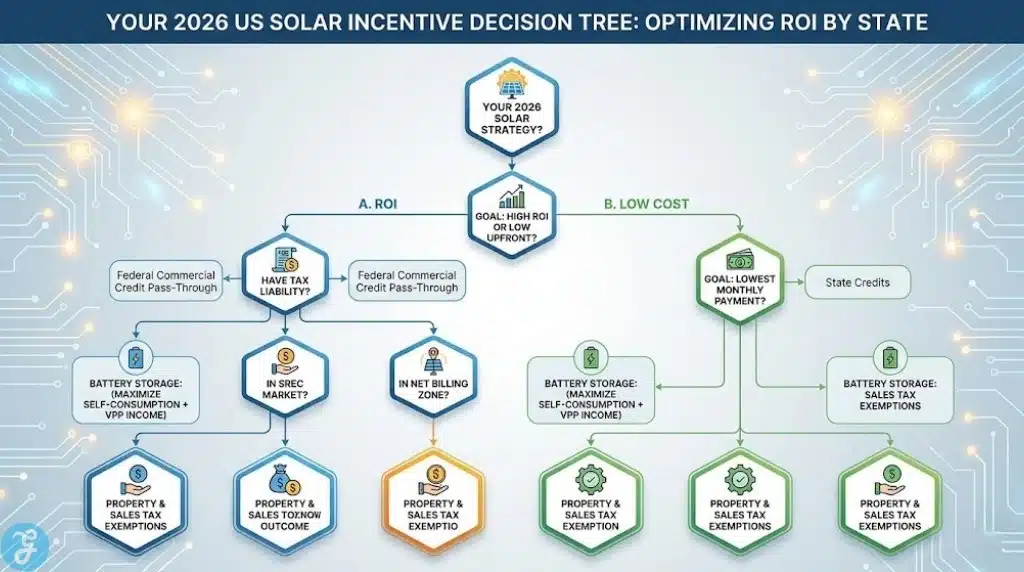
The era of “1-for-1” net metering is dying. In 2026, many states have followed California’s lead into Net Billing (NEM 3.0). Under these rules, the utility pays you much less for the power you send to the grid during the day. This has made “Self-Consumption” via battery storage the only way to maximize your ROI in 2026.
Best for: new solar adopters in CA, ID, and NC.
Why We Chose It:
-
It fundamentally changes the “design” of a solar system (batteries are now mandatory).
-
It underscores why “over-sizing” your solar array is no longer a smart financial move.
Things to consider:
-
Without a battery, your ROI in a Net Billing state could drop by 50%.
10. Performance-Based “Monthly Checks” (SMART & SuSI)
Instead of one big rebate, states like Massachusetts (SMART) and New Jersey (SuSI) provide monthly or quarterly payments based on how much energy your system produces. In 2026, these “PBIs” are the new standard, ensuring that homeowners are rewarded for maintaining a high-performing system over 10 to 15 years.
Best for: investors who prefer consistent cash flow over a one-time tax break.
Why We Chose It:
-
It ensures the long-term health of the solar installation.
-
It provides a predictable “payback” schedule that isn’t dependent on tax liability.
Things to consider:
-
These programs usually have “blocks” that fill up; the earlier you join, the higher your rate.
Strategic Summary of the 2026 Solar Marketplace
The 2026 solar market is defined by the Federal-State Flip. While the easy-to-claim 30% federal credit has vanished for owners, the value has shifted into Performance-Based Incentives and Grid Services. Success in 2026 requires moving away from the “solar only” mindset and embracing “solar + storage.” By enrolling in VPP programs and leveraging sales tax exemptions, homeowners can still achieve a sub-8-year payback period in top-tier states like New Jersey and Massachusetts. The key is to act before the property tax “shields” (like California’s) sunset in 2027.
Visualizing the 2026 Solar Economy: Incentives & ROI
The tables below contrast the “old” 2025 rules with the current 2026 reality to help you calculate your true savings.
2026 Solar Ownership vs. Lease Comparison
This data illustrates the trade-offs between buying and leasing in the current post-Section 25D environment.
| Feature | Cash / Loan Purchase (2026) | Lease / PPA (2026) | Optimization Goal |
| Federal Tax Credit | $0 (Expired) | 30% (Standard) | Choose Lease for Tax Savings |
| Domestic Content Bonus | N/A | +10% Possible | Maximize with US Panels |
| Upfront Cost | High ($25k – $40k) | $0 Down (Typical) | Minimize Capital Outlay |
| Monthly ROI | Max Savings (No Bill) | Moderate (Lower Bill) | Focus on Bill Reduction |
| SREC Ownership | You Keep All Credits | Provider often keeps | Check Contract for SRECs |
| Maintenance | Homeowner Responsibility | Included by Provider | Reduce Long-term Stress |
Our Top 3 Picks and Why?
-
The TPO (Lease/PPA) Loophole: This is our top pick because it is the only way to “save” the 30% federal credit in 2026. For many, this makes leasing the only viable financial path.
-
Virtual Power Plant (VPP) Income: We chose this because it represents the future of the grid. Getting paid annually just for having a battery is a high-leverage “bonus” that didn’t exist for most people five years ago.
-
Property Tax Assessment Shield: This is an essential pick because it preserves your home’s equity. Knowing that your $30,000 investment won’t trigger a tax hike is a vital protection for your long-term net worth.
Buyer’s Guide: How to Optimize Your 2026 Solar System?
Navigating solar today requires a “Battery-First” philosophy. Without a way to store your energy, the new 2026 utility rates will erode your savings.
The Selection Framework
-
Determine Your Tax Status: Since you can’t claim the 25D credit, if you don’t have high state tax liability, a Lease/PPA is almost certainly better than a loan.
-
Audit Your Zip Code’s SREC Market: If you are in DC or NJ, your SRECs are worth more than the panels themselves. Ensure you are registered with an aggregator on day one.
-
Verify “Domestic Content”: If leasing, ask for the “Domestic Content” bonus pass-through. If the provider is using US-made gear, your monthly payment should be 5-10% lower.
-
Check the Property Tax Deadline: If you are in California, you must be under construction by the end of 2026 to lock in your property tax exclusion before the 2027 sunset.
Use the decision matrix below to see which state-level incentive you should prioritize.
Decision Matrix
| If your priority is… | Choose X if… | Choose Y if… |
| Lowest Upfront Cost | Choose a PPA to get the 30% credit via the provider. | Choose a State Rebate (like TX Austin Energy) if buying. |
| Highest Total Lifetime ROI | Buy the System in an SREC state (DC, NJ, MA). | Enroll in VPP to stack annual cash payments. |
| Protection from Tax Hikes | Install in 2026 (CA) to beat the property tax sunset. | Confirm Sales Tax Exemption at the contract signing. |
| Grid Resilience | Add a Second Battery for VPP “export” capacity. | Stick to Solar Only if your state still has 1:1 Net Metering. |
The Final Checklist: 5-Point 2026 Solar Readiness Plan
-
Log into DSIRE (Database of State Incentives) to find every rebate in your specific city and county.
-
Ask your installer for a “Net Billing” analysis (not Net Metering) to see the true impact of battery storage.
-
Confirm if your system qualifies for the 10% Domestic Content Bonus if you are choosing a lease.
-
Verify your state income tax liability to see if a state tax credit (like SC’s 25%) is actually usable for you.
-
Check your property’s “Assessed Value” and ensure your local assessor recognizes the solar exemption.
In 2026, the era of “easy solar” is over, replaced by an era of “smart solar.” The expiration of the federal residential tax credit has forced homeowners to become savvy investors who understand utility tariffs and battery orchestration. While the loss of a 30% upfront credit is a significant hurdle, the rise of VPP income, lucrative SREC markets in the Northeast, and the continued protection of property tax shields offer a robust path forward. Solar remains the single best hedge against rising utility rates, provided you stop looking for federal help and start maximizing the specific, surprising incentives hidden in your own state’s legislation.