Running a business can often feel like juggling flaming torches—especially when inventory starts spiraling out of control. Poor stock management quickly eats into profits. A 2025 IHL Group study revealed that the global retail industry lost $1.73 trillion due to inventory distortion. This staggering figure highlights just how critical effective inventory control really is.
Inventory management does not have to be overwhelming. When broken down into simple, manageable steps, it becomes much easier to handle. This guide walks through practical strategies to track stock levels, reduce waste, and keep customers satisfied—all without unnecessary stress.
What Is Inventory Management?
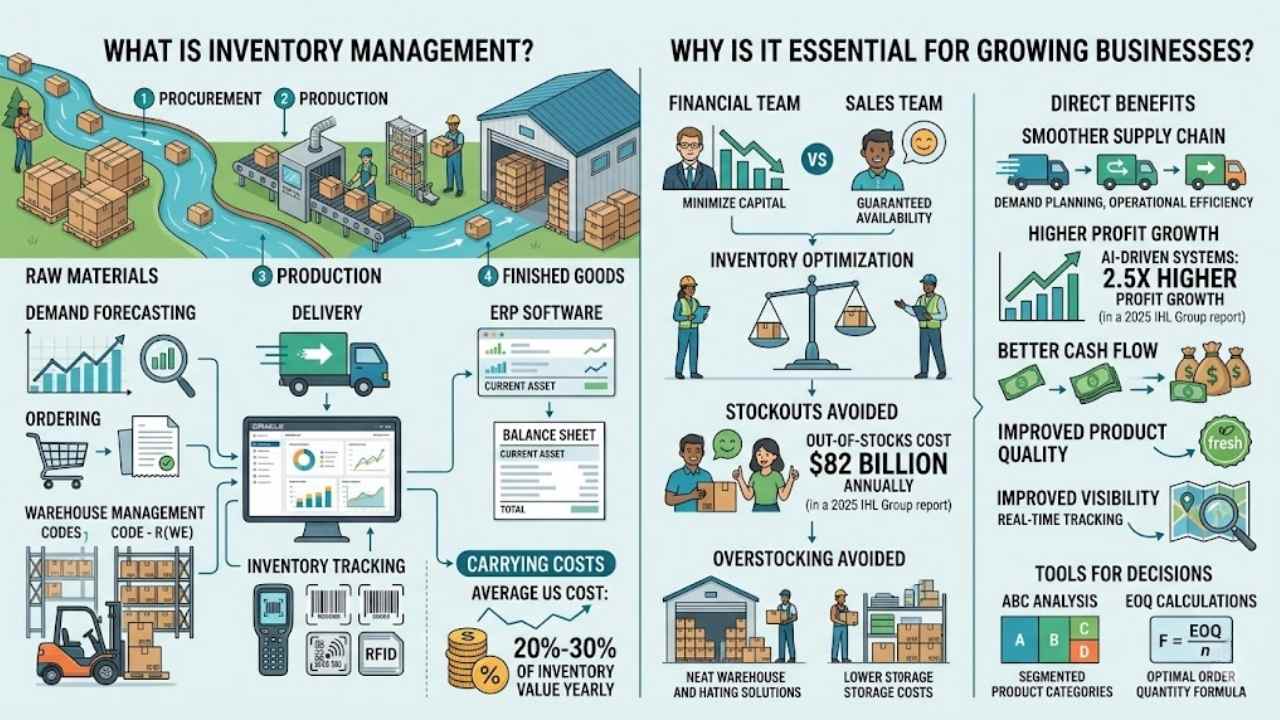
Inventory management tracks and controls the flow of goods through your business. It starts the moment you purchase raw materials and ends the second a customer receives their order. Your inventory includes raw materials waiting to be used, work-in-progress items currently being made, and finished goods sitting in your warehouse.
Think of it like a river. Goods flow in one direction, and your job is to manage that current so nothing gets stuck or lost. This process connects procurement, production, and fulfillment operations across your entire supply chain.
Demand forecasting, ordering, delivery, warehouse management, and inventory tracking all work together as one system. Software solutions now automate many of these tasks. For example, modern ERP software like Oracle NetSuite combines forecasts, purchase orders, production schedules, and warehouse data into one place.
Your inventory appears on the balance sheet as a current asset, reflecting what you paid to acquire or produce those goods.
Inventory is money sitting on a shelf, waiting to become revenue. The average US carrying cost currently sits between 20% and 30% of your total inventory value each year.
Inventory represents potential revenue, but it also ties up your capital and resources. Stock control through barcode scanning, RFID tags, and point of sale systems gives you real-time visibility into what you have and where it lives. Your cost of goods sold depends heavily on how well you manage inventory.
Effective inventory management reduces carrying costs, cuts waste, and keeps customers happy by getting their orders out faster. Small business owners and CFOs alike know that working capital management starts with understanding exactly what stock sits in your warehouse right now. Automated inventory management systems help you count existing inventory through physical counts or digital tracking.
Why Is Inventory Management Essential for Growing Businesses?
Growing businesses face a critical fork in the road. They must balance two competing forces. Financial teams want to minimize capital tied up in unsold inventory, while sales teams prioritize guaranteed product availability.
Inventory optimization solves this tension by maintaining perfect stock levels that satisfy both sides. Your company avoids the pain of stockouts, which disappoint customers and kill sales. A 2025 IHL Group report showed that out-of-stocks cost US retailers $82 billion annually in lost sales alone. At the same time, you dodge overstocking, which locks up cash and inflates carrying costs.
Here are the direct benefits of tracking stock accurately:
- Smoother supply chain management: Demand planning improves, reorder points get set correctly, and your operational efficiency jumps.
- Higher profit growth: The same 2025 IHL Group study found that retailers using AI-driven automated inventory management achieve profit growth 2.5 times higher than competitors.
- Better cash flow: Your money is not sitting idle in warehouses.
- Improved product quality: Stock moves faster, keeping perishable items fresh.
Improved visibility across your business enables informed decisions on supplier relationships and fulfillment strategies. You gain real-time tracking of what you have and where it sits. Tools like ABC analysis reveal which products deserve your attention most, while economic order quantity calculations show you exactly how much to buy.
Types of Inventory
Your business holds three main types of inventory. Understanding each one helps you keep money in your pocket instead of stuck on shelves.
Raw Materials
Raw materials form the foundation of your production process. These are the basic components you purchase before manufacturing starts. Think of them as the building blocks for everything you make, from metal sheets to fabric to packaging supplies.
Tracking these materials matters because they directly impact your cost of goods sold (COGS). When you manage raw materials well, you control expenses from day one. In the US manufacturing sector, raw materials often account for up to 70% to 80% of your total material costs based on recent logistics data.
To keep your raw materials flowing smoothly:
- Use predictive analytics: Modern tools help you forecast exactly how much raw material you will need months in advance.
- Find a secondary supplier: Experienced supply chain pros frequently recommend maintaining a local US backup supplier for your top-tier materials. If your primary source faces a global shipping bottleneck, you can switch instantly without stopping production.
- Calculate your order size: Many growing businesses use the economic order quantity (EOQ) method to balance storage costs against ordering costs.
Raw materials sit in storage until production begins. You need safety stock of critical materials to handle unexpected demand spikes or supply delays.
Work-In-Progress (WIP)
Work-in-progress inventory sits in the middle of your production line. These items are actively being made but are not yet finished goods ready for sale. Think of WIP as products caught between raw materials and the final product.
Your business transforms raw materials into something more valuable at each production step. WIP items move through your factory or workshop, getting closer to completion with every stage. Tracking these items matters because they show you where your production actually stands.
In July 2025, US manufacturers held about $952 billion in total inventories, much of it tied up in work-in-progress on the floor. If you do not track this value, you might miscalculate your true financial health. Your accounting system must track WIP inventory to calculate your cost of goods sold accurately.
Businesses should allocate storage and tracking systems for WIP items to maintain clear sight lines and prevent misplacement. Ford W. Harris, an early inventory pioneer, understood that tracking items in production helped companies cut waste and improve efficiency. Today, many growing businesses use tools like Katana Cloud Inventory to monitor WIP levels in real time. This software tracks production times and assembly costs at each specific stage, helping you catch bottlenecks before they ruin your schedule.
Finished Goods
Finished goods are products your business has made and is ready to sell to customers. These items sit in your warehouse or storage area, waiting for someone to buy them. Your company records finished goods as current assets on the balance sheet until a customer purchases them.
This matters because finished goods represent real money your business can make. The faster you sell these products, the quicker you turn inventory into cash. Inventory turnover measures how fast you move finished goods out the door. High turnover means your products fly off shelves, while low turnover means items gather dust and tie up your money.
A December 2025 industry report highlights that 40% of lost sales for US companies happen because finished goods go out of stock. You need strict systems to prevent this.
To manage your finished goods effectively:
- Integrate your platforms: Connect your e-commerce platform directly with your warehouse system so inventory counts update instantly after every sale.
- Use retail software: Tools like Square for retail help you see your stock in real time across multiple locations.
- Rely on inventory forecasting: Good forecasting tells you how many finished goods to make each month, preventing you from making too much or too little.
Your cost of goods sold stays lower when you manage finished goods smartly. Growing businesses that track these items carefully see better profits and faster delivery times.
Key Principles of Inventory Management
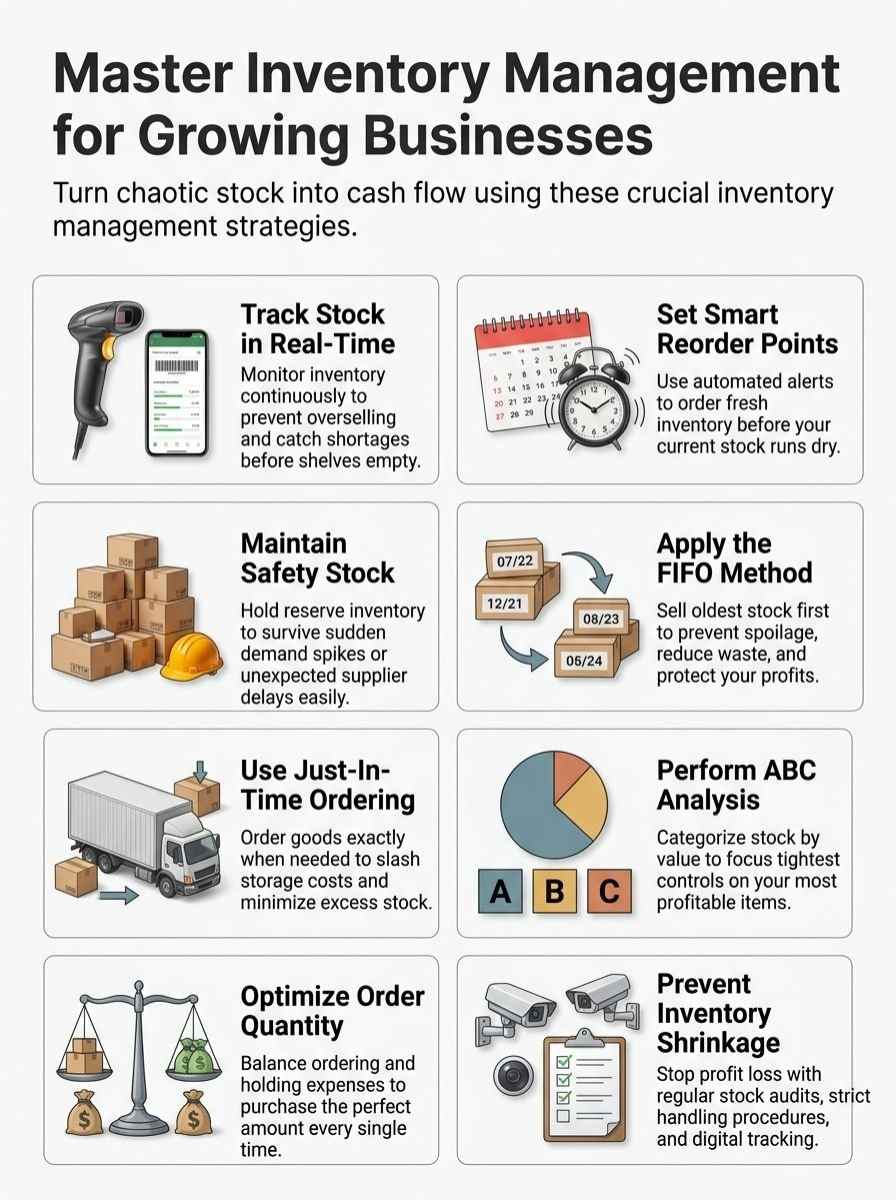
You need three core practices to keep your stock running smoothly. These principles work together like a three-legged stool, and they stop you from running out of products or drowning in excess inventory.
Real-Time Tracking
Real-time tracking keeps your finger on the pulse of your inventory at all times. A recent 2025 industry report showed that 67% of US companies admit they still cannot track stock accurately across multiple locations.
Cloud-based inventory management software fixes this. It provides real-time sales analytics and automatically adjusts stock levels with each sale, so you always know what you have in stock. Perpetual inventory systems use automated scanners and trackers that continuously update item movements.
Square’s retail POS system offers real-time inventory management by integrating both brick-and-mortar and online sales channels into one dashboard. This eliminates confusion and prevents overselling.
Upgrading to RFID tags instead of manual barcodes can reduce your physical inventory counting time by up to 95%. A count that normally takes eight hours can often be finished in thirty minutes.
Modern inventory systems generate alerts in your dashboard for low-stock or sold-out items. These notifications catch problems before they become disasters, letting you reorder products before your shelves run bare. Real-time tracking also supports just-in-time delivery methods, which help you order goods exactly when you need them.
Setting Reorder Points
A reorder point (ROP) acts as your business’s alarm bell for inventory. This threshold tells you exactly when to place a new purchase order before your stock runs dry. Demand shifts constantly, so you need to reassess your reorder points regularly.
Automated inventory systems make this process simple and smart. These tools notify your staff or trigger reordering automatically when stock levels drop below your predetermined thresholds. You no longer need to manually check shelves or spreadsheets constantly. By combining reorder points with techniques like economic order quantity, you optimize how much to order and when to order it.
Here is a simple breakdown of how the standard reorder point works:
| Formula Component | What It Means for Your Business |
|---|---|
| Average Daily Usage | The exact number of units your customers buy on an average day. |
| Average Lead Time | The number of days it takes your supplier to deliver the goods. A pro-tip is to calculate this based on the last 30 to 90 days of actual delivery times, not the supplier’s original promise. |
| Safety Stock | The emergency backup units you keep on hand just in case a delivery is delayed or demand spikes unexpectedly. |
This mathematical approach cuts waste, reduces your cost of goods sold, and keeps your supply chain running like a well-oiled machine.
Safety Stock Management
Safety stock acts as your business’s financial cushion against supply chain surprises. You keep extra inventory on reserve to handle unexpected demand spikes or supplier delays that could otherwise leave your shelves bare.
Turnover rates and lead times shape how much safety stock you actually need. Businesses adjust safety stock levels based on seasonality, historical data, and market conditions to stay ahead of trouble. This principle helps reduce the risk of stockouts that damage customer relationships and hurt your bottom line.
However, holding too much safety stock will skyrocket your expenses. As noted earlier, carrying costs can consume up to 30% of your total inventory value each year. Your cost of goods sold (COGS) changes significantly when you hold too much reserve stock, so calculate this expense carefully.
Smart businesses use ABC inventory analysis to manage this balance. They keep heavy safety stock for their high-value “A” items, but they run very lean on low-value “C” items to free up capital. The right amount of safety stock balances two competing costs. Holding too much ties up cash, while holding too little creates stockouts.
Effective Inventory Management Techniques
You can pick from several proven methods to control your stock levels and keep money flowing smoothly. Each technique works best for different business types, so you will want to find what fits your operation.
First-In, First-Out (FIFO)
FIFO stands for First-In, First-Out, a method that sells your oldest inventory first. This approach works like a line at a coffee shop, where the first person in gets served first.
Businesses that handle perishable items rely on FIFO to prevent spoilage. Products purchased earliest leave your shelves first, which stops items from going bad or becoming outdated. FIFO also acts as a valuation method under both U.S. GAAP and IFRS standards. During times of rising prices, FIFO keeps your cost of goods sold lower, which means higher profits on your books.
Implementing FIFO provides several massive advantages:
- Regulatory compliance: In the food or cosmetic industries, the FDA mandates strict expiry tracking. Automating FIFO batch tracking with tools like NetSuite prevents costly regulatory fines.
- Waste reduction: Your team sells items in the exact order they came in, creating a natural rotation system that cuts unnecessary losses.
- Accuracy: The method pairs well with average cost approaches and other tracking systems to give you complete control over what moves through your warehouse.
Just-In-Time (JIT)
Just-in-time inventory systems work like clockwork, delivering products right when you need them. Your suppliers ship goods precisely to match your demand, cutting waste and slashing carrying costs.
This approach requires accurate demand forecasting and strong supplier relationships that work like a well-oiled machine. A just-in-time (JIT) inventory system minimizes excess inventory sitting on shelves, which means your cash stays in your pocket instead of gathering dust. Companies using just-in-time methods report lower storage expenses and faster product movement through their operations.
Strong integration with suppliers makes or breaks your JIT success. Your suppliers must deliver on time, every time, without fail. Miscommunication or delays create chaos in your warehouse and frustrate customers waiting for orders. Post-pandemic supply chain disruptions have made pure JIT very risky. Today, many experts recommend “JIT with a buffer,” where you maintain a secondary supplier for your most critical materials.
Tools like Orderry help you track shipments and coordinate with partners seamlessly. Businesses with unpredictable demand should think twice before adopting JIT, since late deliveries can leave you scrambling.
ABC Analysis
ABC analysis sorts your inventory into three groups based on value and importance. This method helps you focus your energy exactly where it matters most, rather than spreading yourself thin across every single item.
Think of ABC analysis as sorting your inventory by financial impact, not by physical size. You calculate annual consumption value by multiplying annual demand by an item’s cost. This tiered approach works beautifully with economic order quantity (EOQ) calculations, helping growing businesses cut waste and reduce costs without sacrificing customer satisfaction.
Here is how the groups typically break down:
| Category | Percentage of Total Stock | Percentage of Annual Value | Management Approach |
|---|---|---|---|
| Group A | 10% to 20% | 70% to 80% | Requires real-time tracking, strict security, and careful reorder points to prevent highly damaging stockouts. |
| Group B | About 30% | 15% to 25% | Needs moderate attention and standard ordering practices. |
| Group C | Roughly 50% | Only 5% | Can sit on shelves longer and needs much less frequent monitoring. |
A great tip is to use your ERP software to recalculate these classifications every single quarter. Demand seasonality can quickly turn a quiet “B” item into a high-demand “A” item during the holiday rush.
Economic Order Quantity (EOQ)
Economic order quantity tells you the perfect amount to order each time. This formula balances two costs that fight against each other. It weighs what you spend to place orders against what it costs to hold stock in your warehouse.
EOQ works best for businesses with steady demand and predictable lead times. Your company can adjust EOQ numbers for bulk discounts and storage limits. This smart approach minimizes your total costs, so you keep more money in your pocket. Growing businesses use EOQ to stop ordering too much or too little.
The math behind EOQ requires finding the square root of your annual demand multiplied by ordering costs, divided by your holding costs. That sounds complex, but software platforms calculate EOQ automatically, saving your team hours each week.
Applying EOQ to your operations means you order at just the right moment. You avoid the trap of overstocking, which wastes shelf space. You also dodge the problem of running out of stock, which frustrates customers and kills sales. Many companies pair EOQ with FIFO to move older products out first, while others combine it with dropshipping models to cut storage costs entirely.
Benefits of Implementing Inventory Management Systems
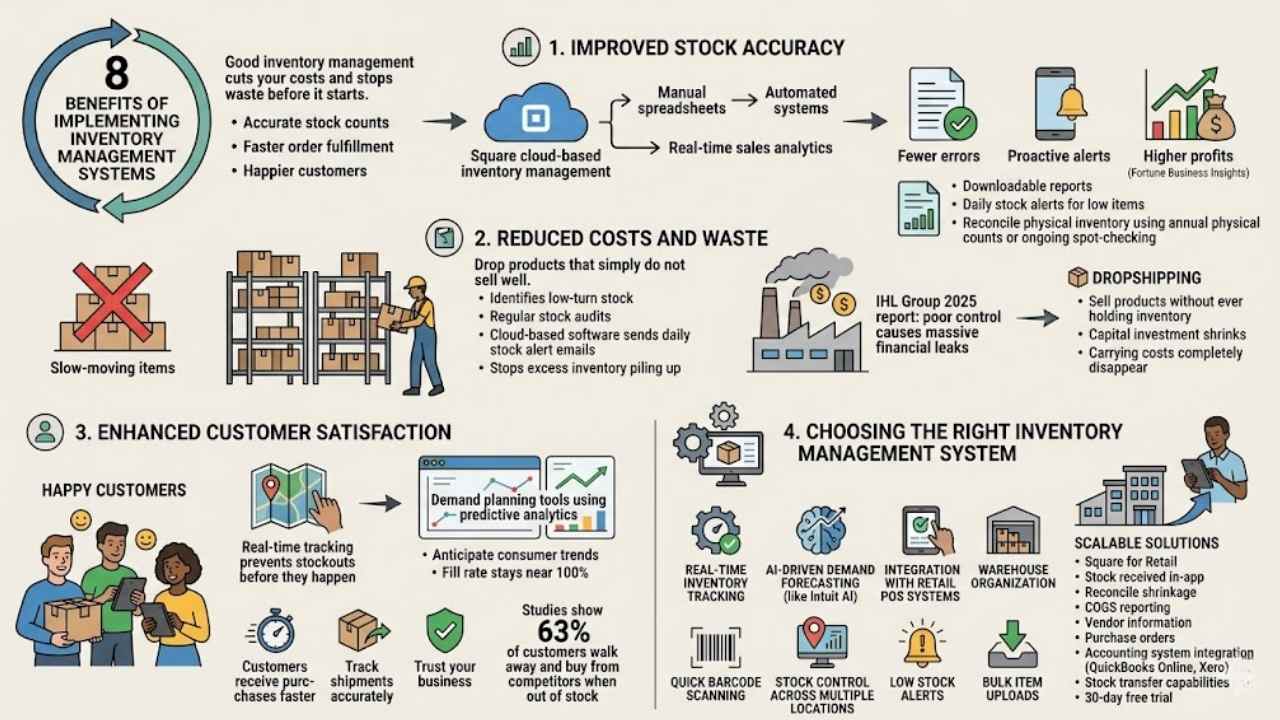
A good inventory management system cuts your costs and stops waste before it starts. You get accurate stock counts, faster order fulfillment, and happier customers who get what they want, exactly when they want it.
Improved Stock Accuracy
Accurate stock levels keep your business running smoothly. Inventory management systems provide real-time sales analytics and automatically adjust stock levels with each sale, so you always know what you have on hand.
When you ditch manual spreadsheets for automated systems, your accuracy jumps dramatically. Square’s cloud-based inventory management software allows tracking by item or in bulk, giving you complete visibility across your entire operation.
Better accuracy provides immediate benefits:
- Fewer errors: Stock audits reconcile physical inventory with recorded inventory levels using techniques like annual physical counts or ongoing spot-checking.
- Proactive alerts: Inventory management software allows for downloadable reports and daily stock alerts for low items, so you never miss a beat.
- Higher profits: Fortune Business Insights reports that companies using proper inventory systems see major improvements in their bottom line.
Your team spends less time hunting for products and more time serving customers. This is exactly what growing businesses need to scale successfully.
Reduced Costs and Waste
Good inventory management cuts your spending fast. You stop buying too much stock that just sits on shelves gathering dust.
Slow-moving items drain your money and your warehouse space. By identifying low-turn stock and running regular stock audits, you can drop products that simply do not sell well. Cloud-based inventory management software sends daily stock alert emails to your team. These alerts stop excess inventory from piling up, which improves your cash flow immediately.
A 2025 report from IHL Group shows that poor inventory control causes massive financial leaks. Retailers lose billions annually just from marking down overstocked items that nobody wants to buy.
Dropshipping offers another path to cut waste and costs entirely. You sell products without ever holding the inventory yourself. Your capital investment shrinks, and your carrying costs completely disappear. This model works great for growing businesses that want to test new products without any upfront financial risk.
Enhanced Customer Satisfaction
Your customers stay happy when you get their orders right. Inventory management systems track stock levels in real time, so you know exactly what you have on hand. Square’s POS system connects your brick-and-mortar store with your online shop, giving customers accurate information about what is currently available.
This means no false promises and no disappointed shoppers waiting for items that do not exist. Your fill rate, which measures the percentage of orders you complete using available inventory, climbs higher when you manage stock well. Studies show that 63% of customers simply walk away and buy from competitors when you run out of stock.
Real-time tracking prevents stockouts before they happen. Demand planning tools that use predictive analytics help you anticipate consumer trends so your fill rate stays near 100%. You spot low inventory levels early and reorder before customers start asking where their items are. Customers receive their purchases faster, track shipments accurately, and trust your business to deliver what you promise.
Choosing the Right Inventory Management System
Your software choice heavily influences your inventory success. You need a system that grows with your business, tracks stock in real time, and fits your budget without breaking the bank.
Features to Look For
Picking the right inventory management system makes or breaks your business growth. You need software that handles real-time tracking, demand forecasting, and connects seamlessly with your retail POS systems.
- Real-time inventory tracking shows you exactly what stock you have at any moment, so you never guess about product levels or miss sales opportunities.
- AI-driven demand forecasting, like Intuit AI, helps you predict what customers will buy next based on local trends, allowing you to stock items before they run out.
- Integration with retail POS systems like Square connects your sales data directly to your inventory counts, eliminating manual entry mistakes and saving hours each week.
- Easy inventory analysis across devices means you can check stock levels from your phone, tablet, or computer wherever you are, making decisions on the fly.
- Warehouse organization features let you arrange products logically so your team finds items faster and picks orders without confusion or delays.
- Quick barcode scanning speeds up receiving, counting, and shipping tasks by letting staff scan items instead of typing product codes by hand.
- Support for multi-location inventory management tracks stock across several warehouses or stores simultaneously, so you see the complete picture of what you have everywhere.
- Bulk item uploads save time when you add hundreds of products at once instead of entering each one individually into the system.
- Stock control across multiple locations prevents overselling and helps you move inventory between warehouses when one location runs low.
- Low stock alerts notify you automatically when items drop below set levels, triggering reorders before customers face empty shelves.
- Integration with platforms like Stitch Labs, Shopventory, and DEAR expands your system’s power by connecting advanced features that Square alone cannot provide.
Scalable Solutions for Growing Businesses
Your business grows fast, and your inventory system needs to grow with it. Square for Retail offers inventory management across multiple locations, so you can track stock everywhere at once.
You receive stock in-app, create and print barcode labels, and reconcile shrinkage without breaking a sweat. The system handles purchase orders and vendor information, keeping everything organized in one single place. Cost of Goods Sold (COGS) reporting shows you exactly where your money goes.
Make sure your chosen software integrates seamlessly with your accounting system. When your inventory talks directly to QuickBooks Online or Xero, CFOs can track working capital in real-time. Stock transfer capabilities between locations mean you move inventory where it sells best. This platform scales up as your business expands, so you do not outgrow it next year.
Square for Retail starts with a 30-day free trial, giving you time to test drive the system risk-free. Businesses with multiple retail locations find this solution especially valuable because it connects all your stores seamlessly. Scalable solutions let you focus on selling more products instead of wrestling with inventory chaos.
Common Challenges in Inventory Management and How to Overcome Them
Inventory management creates real headaches for growing businesses, but smart solutions fix most problems. You can tackle these challenges head-on with the right approach and tools.
- Inventory shrinkage drains your profits incredibly fast. In 2024, global retail shrink jumped to a projected $132 billion, up from $112 billion in 2022. Employee theft, paperwork errors, and supplier fraud create massive losses. Combat this by installing security cameras in storage areas, conducting regular audits, and training staff on proper handling procedures. Implement a real-time tracking system to catch discrepancies immediately.
- Manual spreadsheets fail to keep pace with growing inventory needs. A 2025 industry survey found that 54% of US companies still rely on spreadsheets for inventory tracking, creating massive data gaps. These outdated tools demand constant manual updates that consume hours of your team’s time. Switch to dedicated inventory management software that syncs automatically with your sales channels. Cloud-based platforms update information instantly across all locations.
- Excess stock ties up capital that your business needs elsewhere. Seasonal items pose particular risks, as unsold inventory can become worthless after the season ends. Overstock situations force companies to slash prices or donate products, both cutting into profits. Use ABC analysis to identify which items move quickly and which sit on shelves. Set accurate reorder points based on actual sales velocity.
- Stockouts frustrate customers and push sales to competitors. When items run out, customers shop elsewhere and may never return. Lost sales damage your reputation and revenue simultaneously. Implement just-in-time ordering to receive stock exactly when needed. Maintain safety stock for high-demand items to prevent unexpected shortages. Monitor sales trends closely and adjust ordering quantities accordingly.
- Inaccurate records create chaos throughout your operation. Discrepancies between counted stock and system records lead to wrong decisions. Poor data quality makes forecasting impossible and wastes resources. Conduct regular physical counts and reconcile them with your system records. Train employees on proper data entry procedures and accountability. Automated scanning systems reduce manual entry errors significantly.
- Integration problems plague businesses using multiple disconnected systems. Sales data, accounting software, and inventory platforms often fail to communicate. This fragmentation creates duplicate work and conflicting information. Select inventory management solutions that connect seamlessly with your existing tools. APIs and integrations ensure data flows smoothly between platforms. Unified systems give you one accurate view of your entire operation.
- Casualty and theft losses related to inventory may qualify as tax deductions. Consult a tax advisor to determine if your specific losses qualify. Documentation of these incidents supports your deduction claims. Keep detailed records of all inventory losses, including dates, amounts, and causes. This protects you financially and helps with future loss prevention strategies.
Final Thoughts
You have learned how real-time tracking, safety stock management, and smart reorder points work together to keep your business running smoothly. Techniques like FIFO, Just-In-Time, ABC analysis, and Economic Order Quantity give you practical tools you can start using right away, without needing a business degree.
Getting your inventory right cuts massive costs. The retail industry loses $1.73 trillion yearly to inventory distortion, showing just how much money sits on the table when systems fail.
Cloud-based software and point-of-sale integration make these methods simple to apply, whether you run one location or many. The inventory management market is growing fast, jumping from $2.51 billion in 2025 to a projected $4.79 billion by 2032, which tells you that smart businesses are already making this move. Take action today by picking one technique, testing it for a month, and watching your cash flow improve while your customers smile at faster delivery times.