As the global digital asset market matures, the European Union’s Markets in Crypto-Assets (MiCA) regulation has become the defining framework for institutional growth. For firms operating within the Irish MiCA Launchpad, this shift represents a move away from the “wild west” of unregulated trading toward a professionalised, passportable financial ecosystem. Ireland, with its sophisticated Central Bank and native English-speaking environment, has quickly become the primary entry point for global players looking to capture the 450 million consumers in the EEA.
Understanding the nuances of how Irish companies are leveraging these new rules is essential for any project aiming to lead in the 2026 crypto landscape.
Our Selection Methodology
To compile these essential facts, we analysed the current registry of the European Securities and Markets Authority (ESMA) and the latest supervisory briefings from the Central Bank of Ireland as of March 2026. Our selection focuses on the practical benefits of the Irish jurisdiction, including passporting efficiency, white paper dominance, and the structural advantages of the local fintech ecosystem. Each fact was chosen for its strategic importance to founders and compliance officers who view Ireland not just as a location, but as a long-term regulatory launchpad for the entire European Union.
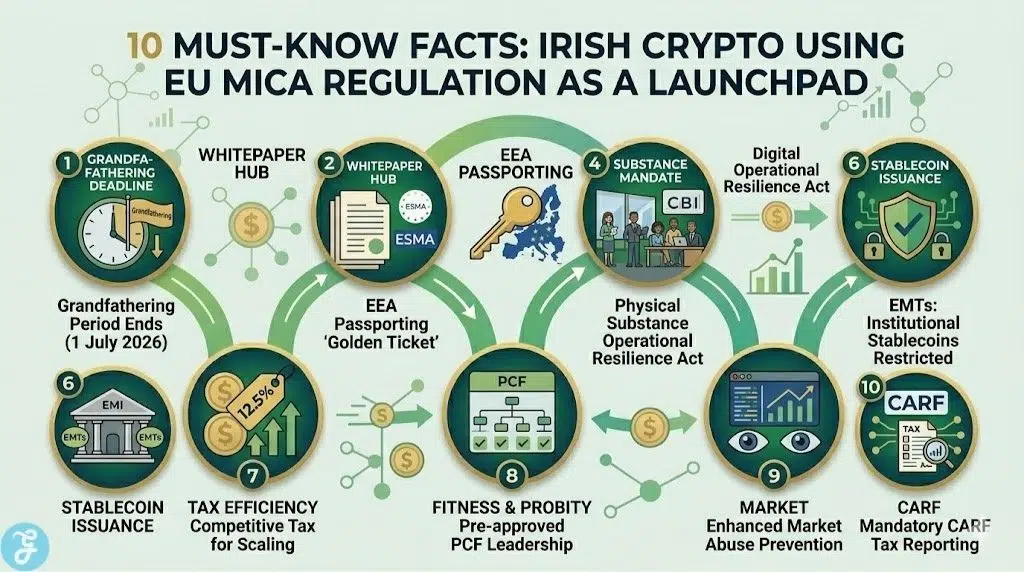
10 Must-Know Facts About How Irish Crypto Companies Are Using EU MiCA Regulation
The implementation of MiCA has fundamentally changed how digital asset businesses operate in Dublin and beyond. The following ten facts illustrate the specific ways in which the Irish regulatory environment is being used to foster innovation while maintaining the high standards of consumer protection required by the EU.
1. The Final Transition Deadline Of July 2026
Under Article 143 of the MiCA regulation, the “grandfathering” period for existing Virtual Asset Service Providers (VASPs) in Ireland is rapidly approaching its end. By 1 July 2026, any firm that has not fully transitioned from a VASP registration to a full Crypto-Asset Service Provider (CASP) authorisation must cease operations. This deadline is driving a massive wave of rigorous applications through the Central Bank of Ireland (CBI) this year.
Best for: Existing Irish crypto firms and compliance officers.
Why:
● It is the single most urgent regulatory milestone for the Irish sector in 2026.
● It separates legacy AML-only firms from those that meet the new, higher financial standards.
Things to consider: The transition is not a simplified process; it requires a full new application with comprehensive operational audits.
2. Ireland As A Global Hub For MiCA White Papers
Recent data from the ESMA registry reveals that Ireland has become one of the top two jurisdictions in Europe for white paper filings. As of early 2026, Ireland hosts over 150 independent white paper filings, covering everything from Layer-1 networks to AI data protocols. This “Whitepaper Go-To” status is largely driven by the English-language process and the clarity of the Irish legal system.
Best for: Project founders and token issuers.
Why:
● It proves that Ireland is a functional point of access for global projects, even those headquartered outside the EU.
● It highlights the efficiency of the Irish notification process for token offerings.
Things to consider: Filing a white paper in Ireland does not require a local head office, but it does require a compliant EU offeror or exchange.
3. The “Golden Ticket” Of EEA Passporting
The most significant advantage for firms on the Irish MiCA Launchpad is the ability to “passport” their services. Once a company is authorised as a CASP by the Central Bank of Ireland, it can legally offer its services in all 27 EU member states plus the three EEA countries without needing further local licences. This makes Ireland a highly efficient hub for cross-border operations.
Best for: International exchanges and wallet providers looking to scale rapidly.
Why:
● It represents the core value proposition of the MiCA framework—regulatory harmony.
● It allows firms to centralise their compliance and management functions in a single location.
Things to consider: Passporting requires a formal notification process to the host-state regulator, though it cannot be denied if the home-state licence is in good standing.
4. Mandatory Substance Over Form Requirements
In 2026, “letterbox” companies are no longer viable under Irish regulation. The Central Bank of Ireland requires that authorised CASPs demonstrate significant “substance” within the country. This means having a physical office, local senior management with crypto expertise, and robust internal controls that are managed directly from the Dublin-based entity.
Best for: CFOs and strategic planners.
Why:
● It protects the integrity of the Irish financial system from “shell” operations.
● It ensures that when issues arise, there is a clear legal entity and management team accountable to the regulator.
Things to consider: The “Real Presence” test involves a detailed review of where key decisions are made and how the firm’s risk is managed.
5. Integration With The Digital Operational Resilience Act (DORA)
Irish crypto companies are not only dealing with MiCA but must also align with the Digital Operational Resilience Act (DORA), which is now fully applicable. In 2026, the CBI is conducting targeted work on CASPs to ensure their IT systems can withstand cyber-attacks and large-scale technical disruptions, making the Irish launchpad one of the most resilient in the world.
Best for: CTOs and security professionals.
Why:
● It elevates the technical standards of the crypto sector to match traditional banking.
● It builds institutional trust by proving that digital asset firms have bank-grade disaster recovery plans.
Things to consider: DORA compliance requires continuous monitoring and mandatory reporting of major ICT-related incidents to the regulator.
6. The Rise Of Institutional Stablecoins (EMTs)
Under MiCA, the issuance of E-Money Tokens (EMTs)—commonly known as stablecoins—is restricted to authorised credit institutions or Electronic Money Institutions (EMIs). Irish firms are leading the way in this sector, with major issuers like Circle using their Irish infrastructure to ensure their USD-pegged tokens fully comply with the new parity and redemption rules.
Best for: Stablecoin issuers and institutional payment providers.
Why:
● It marks the end of unregulated “shadow banking” in the European stablecoin market.
● It ensures that tokens are used as a reliable medium of exchange rather than speculative assets.
Things to consider: Issuers of significant EMTs are subject to higher capital requirements and direct oversight from the European Banking Authority (EBA).
7. Competitive Tax Efficiency For Small-To-Medium Firms
While the global minimum tax has changed the landscape for tech giants, Ireland remains a highly attractive tax jurisdiction for the mid-market crypto sector. Most independent crypto companies benefit from the 12.5% corporate tax rate on trading profits, making the Irish MiCA Launchpad one of the most fiscally efficient bases for growing a Web3 business in Europe.
Best for: Founders and private equity investors.
Why:
● It provides a predictable and competitive fiscal environment for reinvesting profits into R&D.
● It is supported by an extensive network of double tax treaties.
Things to consider: Companies with global revenues exceeding €750 million per year are subject to the higher 15% rate under Pillar Two rules.
8. Rigorous Fitness And Probity Standards
The Central Bank of Ireland has introduced specific pre-approval controlled function (PCF) roles for the crypto sector in early 2026, including a dedicated Head of Safeguarding. This means that individuals in key leadership positions must undergo a thorough “fitness and probity” assessment to ensure they have the reputation and expertise to manage a regulated financial firm.
Best for: Boards of directors and HR departments.
Why:
● It professionalises the management of crypto firms and reduces the risk of bad actors in the sector.
● It ensures that the safeguarding of client assets is treated as a top-priority function.
Things to consider: The application for these roles involves a detailed individual questionnaire (IQ) and due diligence on the person’s professional history.
9. Enhanced Market Abuse And Surveillance Protocols
MiCA introduces strict prohibitions on market abuse, including insider dealing and market manipulation, similar to the rules for traditional stock exchanges. Irish CASPs are now required to have automated surveillance systems to detect and report suspicious activity. This level of oversight has made Dublin a trusted location for institutional investors who require a fair and transparent trading environment.
Best for: Trading platforms and liquidity providers.
Why:
● It levels the playing field for retail investors and prevents “pump and dump” schemes.
● It brings the crypto market into alignment with global standards for financial integrity.
Things to consider: Firms must engage with the Central Bank before making material changes to their listing criteria or trading rules.
10. CARF Registration And Tax Transparency
By 31 December 2026, all reporting Crypto-Asset Service Providers in Ireland must register with the Irish Revenue Commissioners under the Crypto-Asset Reporting Framework (CARF). This ensures that transactions are transparent to tax authorities across the EU, further integrating crypto assets into the mainstream financial system and removing the “anonymity risk” that previously concerned regulators.
Best for: Tax compliance teams and high-net-worth investors.
Why:
● It reflects the global move toward total tax transparency for digital assets.
● It simplifies the reporting process for law-abiding citizens by automating data sharing between exchanges and authorities.
Things to consider: The first returns under this new system are due by 31 May 2027, covering the entire 2026 period.
Strategic Analysis
The following table provides a comparison of how the Irish MiCA Launchpad helps firms navigate the different levels of regulatory complexity as they scale across the European Union.
Planning for these milestones is critical for maintaining a competitive edge in the European market.
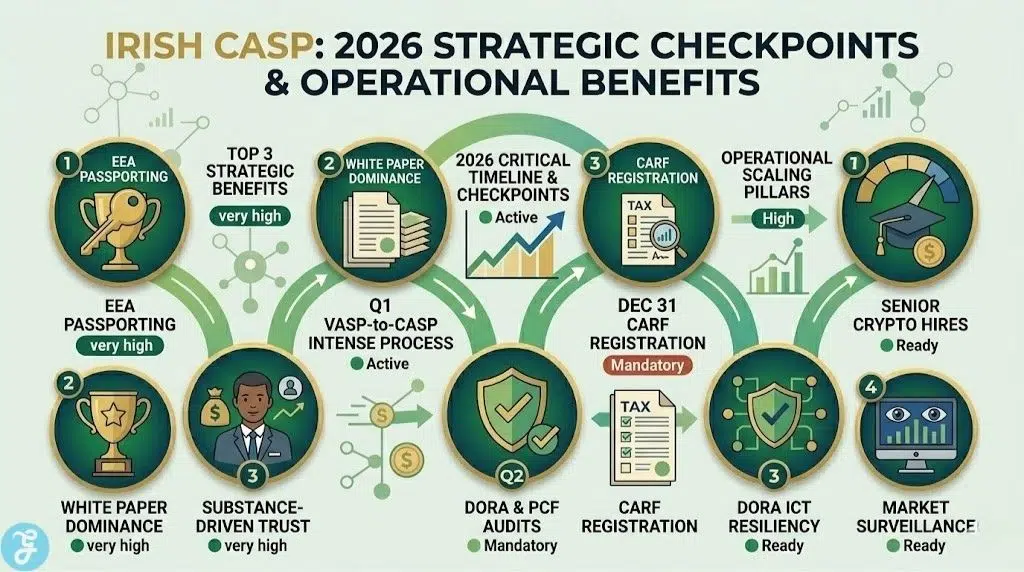
| Regulatory Milestone | Impact On Scaling | 2026 Implementation Status |
| CASP Authorisation | Unlocks EEA Passporting | High (Mandatory by July) |
| DORA Compliance | Ensures Cyber Resilience | Active (Supervisory Focus) |
| CARF Registration | Enables Tax Transparency | Mandatory (By Dec 2026) |
Our Top 3 Picks?
While all ten facts are essential for long-term success, these three represent the most powerful structural advantages of the Irish jurisdiction in 2026.
-
The EEA Passporting System: This is the ultimate “growth hack” for crypto firms, allowing them to serve over 30 countries from a single, English-speaking regulated base.
-
Substance Requirements: By mandating a real presence in Dublin, the regulator ensures that firms have the operational heart needed to survive market volatility.
-
Whitepaper Dominance: Ireland’s status as a hub for token filings proves that it is the most efficient gateway for global projects entering the European market.
Preparation Checklist
To ensure your firm is ready to use Ireland as an effective launchpad in 2026, ensure you have ticked these critical boxes.
● VASP-to-CASP Transition: Confirm that your application is submitted well before the July 2026 grandfathering deadline.
● PCF Appointments: Identify and perform due diligence on your resident directors and Head of Safeguarding.
● DORA Audit: Conduct an independent review of your ICT incident management and business continuity plans.
● CARF Registration: Schedule your registration with the Irish Revenue before the end-of-year deadline.
● White Paper Review: Ensure all tokens admitted to trading have a compliant white paper notified to the Central Bank.
Scaling Your Crypto Future In Ireland
The evolution of the Irish crypto sector under MiCA is a clear indication that digital assets have moved into a new era of regulated maturity. By providing a stable, English-speaking, and sophisticated launchpad, Ireland has given firms the tools they need to transcend the limitations of national borders. As the final transition deadlines of 2026 approach, the companies that embrace this “substance-over-form” approach will be the ones that capture the next wave of institutional and retail growth across the European Union. Your Irish authorised licence is not just a regulatory requirement; it is your gateway to the future of the global digital economy.