
Every digital marketing business claims to deliver outstanding results, but very few provide the concrete evidence needed to back up those claims. Business owners are naturally skeptical of big promises and want absolute certainty before handing over their marketing budget. This is exactly where marketing agency case studies bridge the gap between initial interest and a signed contract. By presenting real examples of the results you have achieved for other companies, prospects begin to believe you can deliver that exact same success for them.
Understanding the psychological triggers behind buyer decisions is crucial for leveraging this strategy effectively. In an era where B2B buyers conduct extensive independent research before ever speaking to a sales representative, your documented wins act as a silent, persuasive salesperson working around the clock.
The Hidden Revenue Engine in Client Success Stories
Most agencies treat success stories as an afterthought, throwing together a quick summary of deliverables when a client leaves a positive review. However, building a deliberate system around capturing these stories turns them into a highly profitable revenue engine. When you document your processes, highlight the challenges, and showcase the final metrics, you shift the conversation from cost to value. Prospective clients stop haggling over hourly rates and start envisioning the return on investment you can provide.
| Key Benefit | How It Drives Agency Revenue | Buyer Psychology Impact |
| Shortens Sales Cycles | Answers objections before the prospect even gets on a discovery call. | Reduces perceived financial risk. |
| Justifies Premium Pricing | Proves your agency delivers measurable ROI, moving focus away from initial cost. | Validates authority and expertise. |
| Attracts Qualified Leads | Niche-specific stories draw in clients looking for exact solutions to their pain points. | Creates instant relatability. |
| Enhances SEO Rankings | Well-structured success stories rank for high-intent, long-tail search queries. | Builds trust through organic discovery. |
Why Trust is the Ultimate B2B Currency
Recent data shows that trust dictates nearly all business-to-business transactions and long-term relationships. B2B buyers are conducting more independent research than ever before, often navigating the majority of the sales journey without speaking to a single sales representative. Providing a detailed client success document acts as a silent salesperson during this critical research phase. It transparently shows how your team approaches challenges, validates your expertise, and dramatically reduces the perceived risk of hiring you.
If an enterprise company is looking for SEO content writing services, they do not just want a list of keywords you ranked. They want to see the strategic thought process that led to those rankings. They need to trust that you understand their specific industry hurdles, whether that involves navigating compliance regulations or outsmarting a deeply entrenched competitor. Trust is built through transparency, and nothing is more transparent than laying out your exact methodology from start to finish.
The Psychology of Social Proof in Agency Sales
Social proof is the concept that people will conform to the actions of others under the assumption that those actions are reflective of the correct behavior. When a prospect reads a story featuring a brand similar to theirs, they instantly feel a sense of alignment. They see the exact transformation they desire, achieved by a company facing the exact same struggles. This emotional and logical connection makes them significantly more receptive to your sales pitch and more likely to view your team as the only logical choice.
When building your portfolio, aim to cover various buyer personas. If you service both local plumbing companies and global SaaS platforms, you need distinct narratives for both. A local service provider wants to see phone calls and foot traffic increase. A SaaS founder wants to see reduced customer acquisition costs and higher monthly recurring revenue. Matching the social proof to the exact prospect you are speaking to drastically increases your conversion rates.
Anatomy of a High-Converting Marketing Agency Case Study
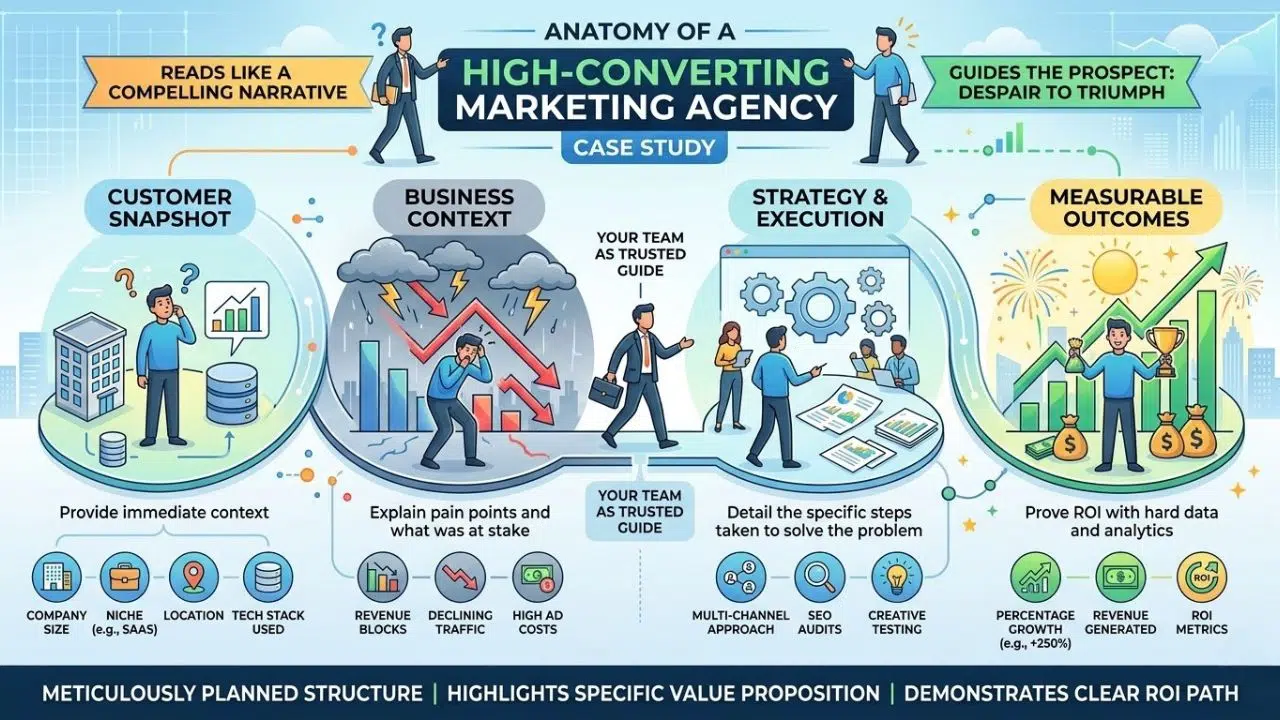
Creating a document that merely lists what you did for a client is a missed opportunity. A high-converting marketing agency case study must read like a compelling narrative that hooks the reader from the very first sentence. It needs to guide the prospect through a logical progression from despair to triumph, with your team acting as the trusted guide. The structure must be meticulously planned to highlight your specific value proposition and demonstrate a clear path to return on investment.
| Case Study Section | Core Objective | Recommended Content Elements |
| Customer Snapshot | Provide immediate context about the client and their industry. | Company size, niche, location, tech stack used. |
| Business Context | Explain the pain points and what was at stake before hiring you. | Revenue blocks, declining traffic, high ad costs. |
| Strategy & Execution | Detail the specific steps your agency took to solve the problem. | Multi-channel approach, SEO audits, creative testing. |
| Measurable Outcomes | Prove the return on investment with hard data and analytics. | Percentage growth, revenue generated, ROI metrics. |
The Problem-Solution-Result Framework
This classic framework remains the gold standard for structuring any success story. You begin by detailing the specific, painful problems your client faced before hiring you, such as declining website traffic or terrible lead quality. Next, you explain the specific strategies and methodologies your digital marketing strategy implemented to fix those exact problems. Finally, you present the measurable outcomes of your work. This clear progression makes it incredibly easy for a prospect to understand exactly what you do and how you do it.
To make the problem section truly effective, agitate the pain. Do not just say organic traffic was low. Explain that low organic traffic was causing the client to overspend on paid search advertising, which was eating into their profit margins and preventing them from hiring new staff. When you frame the problem in terms of actual business impact, the subsequent solution feels significantly more valuable.
Focusing on Client Transformation
Prospects do not care about the technical nuances of your marketing tactics nearly as much as they care about the end result. Your stories must focus heavily on the transformation the client experienced. Did your technical SEO campaign help a struggling local business open a second location? Did your lead generation strategy allow a software startup to secure their next round of funding? Highlighting these massive shifts in business trajectory creates an emotional pull that standard data points simply cannot match.
Connect the dots between your daily marketing activities and the client’s overarching business goals. If you run a social media marketing agency, do not just report on likes and shares. Show how a viral campaign directly correlated to a massive spike in e-commerce sales during a critical holiday weekend. This proves you understand the difference between vanity metrics and actual business growth.
Incorporating Data and Visual Evidence
Business decisions are ultimately justified by logic and numbers. You must support your narrative with hard data, exact percentages, and undeniable visual evidence. Charts, graphs, and before-and-after screenshots break up large walls of text and make complex analytics easy to digest. Visuals are processed much faster than text, meaning a well-placed revenue growth chart can instantly communicate your value before the prospect even reads a single paragraph.
When presenting data, always provide context. Stating that you generated one hundred new leads means nothing if the client normally generates a thousand. Instead, state that you increased lead volume by three hundred percent while simultaneously decreasing the cost per acquisition by half. This type of nuanced reporting demonstrates a sophisticated understanding of data science and campaign economics.
Gathering the Right Data Without Annoying Clients
Many agencies fail to produce these essential assets because they are afraid of bothering their clients for information. Asking for sensitive data or a time-consuming interview can feel intrusive if not handled correctly. The key is to build the data collection process directly into your standard operating procedures from the very beginning of the relationship. When clients know what to expect, they are much more willing to participate and share their success.
| Data Collection Method | Best Time to Execute | Type of Information Gathered |
| Automated Analytics Reporting | Monthly or quarterly review periods. | Traffic growth, conversion rates, cost per click. |
| Client Strategy Calls | After hitting a major campaign milestone. | Anecdotal feedback, shifts in business sentiment. |
| Post-Campaign Video Interview | Upon contract renewal or project completion. | Direct quotes, emotional transformation, video assets. |
| Asynchronous Questionnaires | When a client is too busy for a live call. | Specific numerical validations, approval for public release. |
Timing Your Case Study Requests
The absolute best time to ask a client to participate in documenting their success is immediately after delivering a massive win. If you just hit a record-breaking month of sales or finally ranked their site first for a highly competitive keyword, their enthusiasm will be at its peak. You can also plant the seed during the initial onboarding phase by including a clause in your contract that allows you to share their success story once specific milestones are met. This removes any surprise and sets a collaborative tone.
Do not wait until a client is churning or winding down their contract to ask for a favor. Strike while the iron is hot. If you send a monthly report showing a massive spike in return on ad spend, include a short note asking if they would be open to doing a quick fifteen-minute chat to document the strategy behind the win. Framing it as an opportunity to highlight their smart business decisions also strokes their ego and increases participation.
Conducting the Perfect Client Interview
Your goal during a client interview is to capture their authentic voice and emotional state. Avoid sending over a sterile list of written questions if possible, and opt for a recorded video or audio call instead. Ask open-ended questions about their initial frustrations, their experience working with your team, and how the results have impacted their daily lives or business operations. Transcribe this conversation to pull powerful, direct quotes that will add undeniable authenticity to your final document.
Start the interview by asking them to recall the stress they felt before hiring you. This sets the baseline. Then, ask them to describe the exact moment they realized your strategy was actually working. Finally, ask them what advice they would give to another business owner who is currently sitting on the fence about hiring your agency. These three questions consistently generate the most compelling, conversion-focused soundbites.
Strategic Placement to Maximize Visibility
A brilliant document does absolutely nothing for your pipeline if it just sits hidden in a dusty folder on your desktop. You must treat your marketing agency case studies as premium marketing assets and distribute them across every available channel. Maximum visibility ensures that prospects encounter your proof of success at multiple touchpoints throughout their buying journey, constantly reinforcing your authority and competence in the digital space.
| Distribution Channel | Content Format Adaptation | Primary Goal |
| Agency Website Portfolio | Long-form written article with charts and graphs. | SEO rankings and deep prospect research. |
| LinkedIn and Twitter | Threaded posts summarizing the problem and solution. | Top of funnel brand awareness and engagement. |
| Email Newsletters | Short teaser email linking out to the full article. | Nurturing existing leads into sales calls. |
| Sales Proposals | PDF attachment or embedded video link. | Closing deals and validating pricing models. |
Optimizing Your Website and Landing Pages
Create a dedicated portfolio or success stories page on your website that is incredibly easy to navigate. Categorize the stories by industry, service type, or specific problem solved so prospects can instantly find the most relevant example. Furthermore, embed shorter versions or specific testimonials directly onto your service pages and landing pages. Placing proof directly next to your call to action buttons dramatically increases the likelihood that a visitor will submit their contact information.
Ensure that these pages are technically sound and optimized for search engines. Use proper schema markup for reviews and articles to help Google understand the content. Make sure the pages load incredibly fast, as slow loading times will cause impatient B2B buyers to bounce back to the search results. A well-optimized success story can often outrank traditional blog posts because it satisfies a very specific search intent.
Fueling Social Media and Email Campaigns
Transform your long-form narratives into a dozen different pieces of micro-content for your social media channels. Share a single compelling statistic on a graphic, post a short video clip from the client interview, or write a thread breaking down the specific SEO content writing services you used. You should also weave these stories into your automated email nurture sequences. Sending a highly relevant example to a prospect who has been on your mailing list for months is often the exact trigger needed to finally secure a meeting.
When sharing on platforms like LinkedIn, tag the client and their company. This not only shows appreciation but also exposes your content to their entire professional network. People love celebrating their own wins publicly, and by making them the hero of the story, you encourage them to share your marketing materials organically.
Empowering the Sales Team During Pitches
Sales representatives should be armed with a library of relevant examples before they ever jump on a discovery call. Sending a success story to a prospect before the meeting sets a positive, authoritative tone and handles unspoken objections in advance. During the actual pitch, referencing a specific client who overcame the exact same hurdles makes the proposed strategy feel safe and proven. It shifts the conversation from theoretical promises to historical facts.
Train your sales team to use these documents actively, not passively. Instead of just saying they will send a link after the call, they should screen share the actual performance graphs during the video meeting. Walking a prospect through the exact timeline of another client’s revenue growth is an incredibly persuasive tactic that builds immense credibility on the spot.
Tracking the Return on Investment of Your Success Stories
Creating high-quality content requires a significant investment of time, energy, and sometimes money if you hire external writers or videographers. You need to know that this investment is actually generating a positive return for your business. By tracking specific metrics, you can understand which stories resonate the most with your audience and which formats drive the highest number of qualified leads into your pipeline.
| Metric to Track | Tool to Use | What It Indicates |
| Average Time on Page | Google Analytics | Are visitors actually reading the entire narrative? |
| Form Submissions | CRM Software | Is this specific page driving direct lead generation? |
| Email Click-Through Rate | Email Marketing Platform | Does this topic resonate with your nurtured audience? |
| Win Rate Influence | Sales Pipeline Tracking | Do deals close faster when a case study is shared? |
Measuring Engagement and Conversion Metrics
Pay close attention to the analytics on your dedicated portfolio pages. Look at the average time on page to see if visitors are actually reading the narrative, and monitor the bounce rate to ensure the content is keeping them engaged. Track the conversion rates of the forms placed directly below your success stories. If you use these assets in email outreach, monitor the open rates and click-through rates of those specific campaigns to determine their effectiveness in generating new sales conversations.
Do not ignore qualitative feedback either. Ask your new clients exactly what piece of content convinced them to reach out. Very often, they will mention a specific story that mirrored their exact situation. This anecdotal data is invaluable for guiding your future content creation efforts and deciding which industries to target next.
Final Thoughts
Relying solely on word-of-mouth referrals or cold outreach is a difficult and unpredictable way to scale a business. By systematically creating and distributing powerful marketing agency case studies, you build a self-sustaining engine of trust and authority. These documents work continuously to educate prospects, eliminate objections, and prove your immense value in a crowded marketplace.
Start by identifying your single most successful client today, reach out to capture their story, and watch as that single piece of content begins to attract a steady stream of high-paying, confident clients to your agency.
Frequently Asked Questions (FAQs)
What format works best for documenting client success?
The best format entirely depends on your target audience, but a mix of formats is usually ideal. A detailed written article is great for SEO and deep research, while a highly visual PDF is perfect for email outreach. Video interviews are currently the most engaging format and build the highest level of trust quickly.
How long should the written document be?
It should be as long as necessary to tell a compelling story, but concise enough to hold attention. A written version typically falls between eight hundred and fifteen hundred words. The key is to use clear headings, bullet points, and visual aids so the reader can easily scan for the most important data points.
It is very common for businesses to keep strict financial data private. If a client refuses to share exact revenue, you can use percentages instead to illustrate growth. For example, stating that you increased sales by one hundred and fifty percent is often just as powerful as stating the exact dollar amount.
How many of these documents does my business actually need?
You should aim to have at least one high-quality example for every core service you offer and every primary industry you serve. Having three to five incredibly detailed, impressive stories is far more effective than having twenty mediocre ones that lack real data or emotional impact.
Should I put this content behind an email capture form?
Gating your best proof behind a form can generate leads, but it also severely limits the number of people who will actually read it. Since the primary goal is to build trust and prove your competence, it is generally recommended to keep them ungated and freely accessible to maximize their visibility and impact across the web.