You might feel confused by digital contracts and buzzwords like blockchain, automation, or smart agreements. I completely understand that feeling. Many of us share this exact frustration, especially when our important paperwork gets stuck in slow, outdated processes. But here is something very cool to consider. The subject of smart contracts is a topic that can genuinely change how we handle daily tasks. Businesses across the US are now using these tools for everything from tracking grocery shipments to processing medical records in seconds.
I am going to walk you through exactly how these digital agreements work, show you why they matter so much, and help you see new ways they can make your life simpler. Let’s look at how this technology can save you both time and headaches!
What Are Smart Contracts?
Smart contracts are digital deals that run themselves. They use computer code to check set rules and then act automatically.
Definition of smart contracts
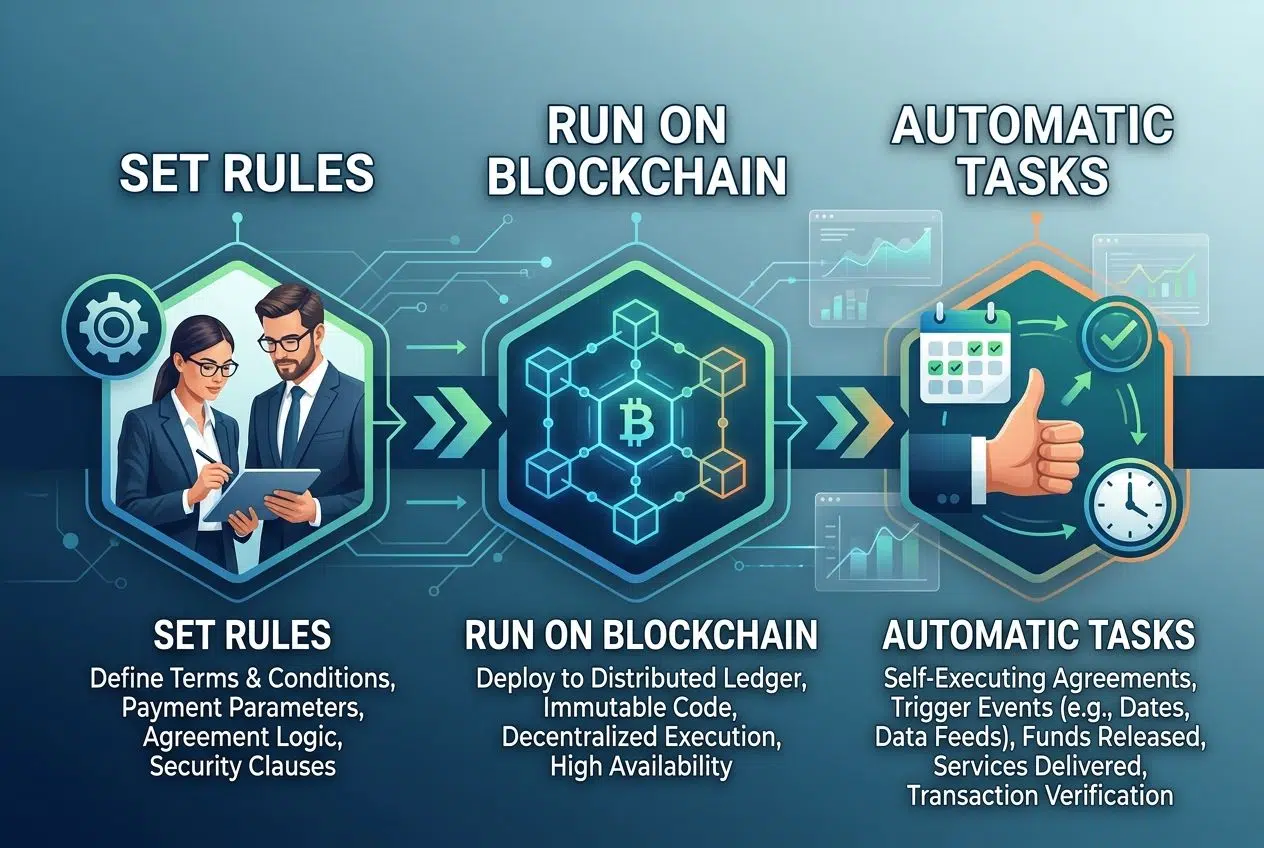
A smart contract acts like a digital agreement written entirely in computer code. It runs directly on a blockchain, which is just a secure, distributed ledger shared across a network. You set the rules and conditions up front, and the tasks get done automatically once those rules are met. You do not need a middleman, a bank, or a lawyer to approve the steps.
As computer scientist Lawrence Lessig famously said back in 2000, “Code is law.” Today, developers build these agreements on platforms like Ethereum using a programming language called Solidity. The code uses cryptography for safe transactions, making peer-to-peer deals much smoother. Everything gets logged publicly on the blockchain, making things open and highly trackable for everyone involved.
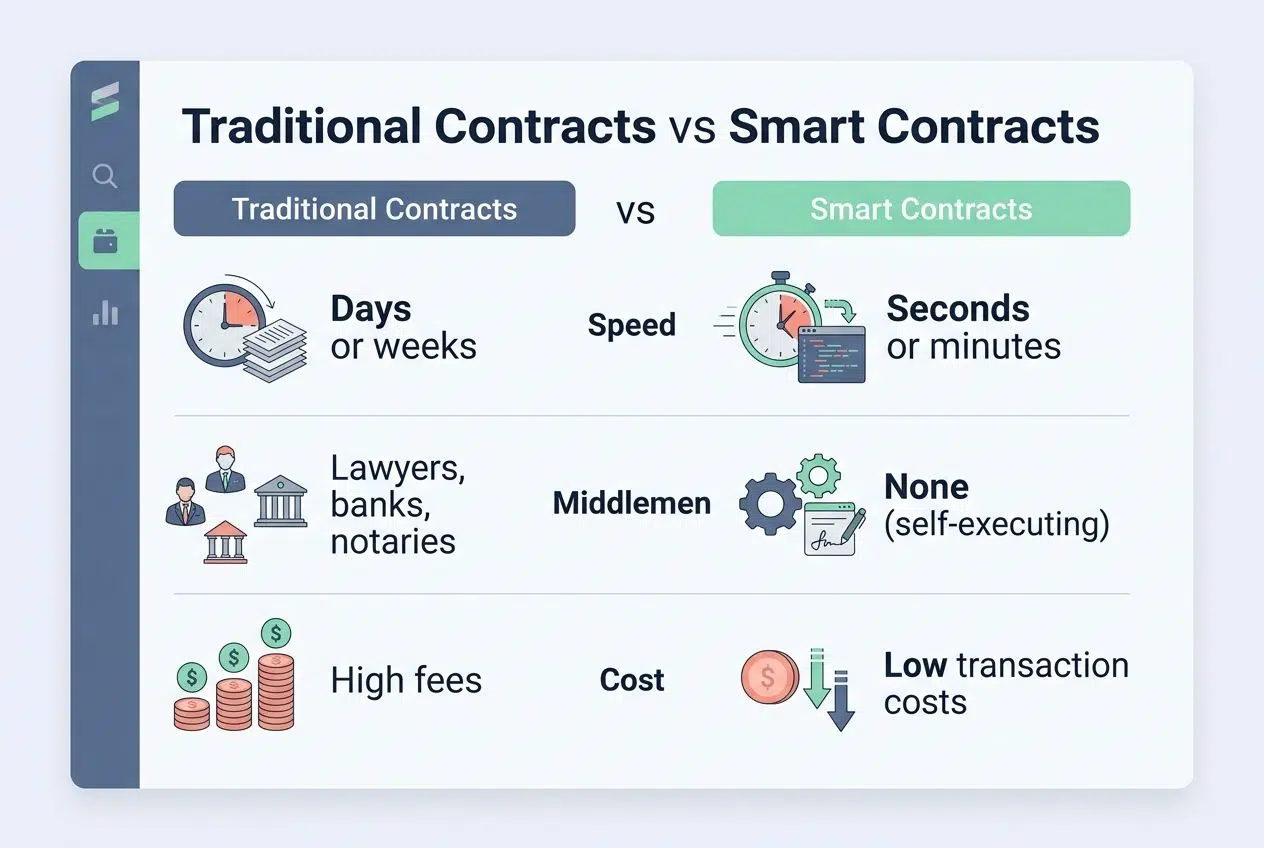
| Feature | Traditional Contracts | Smart Contracts |
|---|---|---|
| Speed | Days or weeks | Seconds or minutes |
| Middlemen | Lawyers, banks, notaries | None (self-executing) |
| Cost | High fees | Low transaction costs |
How smart contracts work
Smart contracts live permanently on the blockchain and follow simple “if-then” rules. Think of a standard vending machine. You put your money in, pick your snack, and the machine hands it to you without needing a cashier.
The smart contract works the exact same way, but for much bigger tasks than buying a candy bar. It runs the moment your set conditions are met. No one can change its code after launch, so fairness is built right into the system.
Sometimes these contracts need outside information to know if a condition was met. For example, US developers use decentralized networks like Chainlink to feed real-world data, like live weather updates or stock prices, straight into the blockchain. Each step gets recorded clearly. This helps strangers complete trustless transactions safely and turns old paperwork into a quick, automated process.
The Evolution of Smart Contracts
Smart contracts started as a clever idea in computer science, but they soon jumped into digital use with real power. Today, these digital agreements are changing how we handle deals and tasks.
Origin and development
Nick Szabo, an inventive computer scientist, first wrote about this idea back in 1994. He dreamed of digital tools that would run by themselves using pure code. Blockchain made his dream real years later, with Bitcoin arriving in 2009 and Ethereum launching programmable agreements in 2015.
People quickly realized these tools could handle way more than just simple financial trades. In fact, Introspective Market Research projects the global smart contract market will reach an impressive $14.23 billion by 2032.
Ethereum founder Vitalik Buterin famously echoed the idea that code is law. That philosophy helped people automate deals across massive industries like supply chain management and insurance.
Transition from traditional contracts to digital automation
Traditional contracts rely heavily on paper, ink, expensive lawyers, and sometimes even courts. You shake hands, sign documents, and then wait days or weeks for papers to move from desk to desk.
Digital automation completely flips this old script. These digital agreements trigger actions right away if your specific rules are met. Here is what you skip when you make the switch:
- Paying expensive notary fees for basic document stamps.
- Waiting on endless phone calls or email threads for approvals.
- Losing important files in messy, disorganized filing cabinets.
- Worrying about hidden edits or sneaky changes to the text.
Distributed ledgers record every single step. Payment releases the second set of goods once they hit the warehouse, making the entire process faster and much more reliable.
Key Features of Smart Contracts
Smart contracts run themselves, cutting out middlemen and guesswork. They keep everything open for all to see, just like leaving the lights on in a dark room.
Automation and self-execution
Digital contracts on a blockchain run entirely by themselves. No middleman has to pause, check, or approve each step of the journey.
Once the set rules are met, the agreement follows through immediately. Think of it as a supercharged vending machine for business deals. You insert the right inputs and get your result instantly.
This automation saves massive amounts of time. Conditional execution means payments, data moves, or document approvals happen only under certain triggers set by the code. All steps are shown clearly on the distributed ledger.
Transparency and traceability
Everyone can view smart contracts on a public blockchain. This means you can check the rules and actions step by step, much like reading an open book.
Each change gets saved in a digital ledger and time-stamped for all to view. You do not need to trust someone blindly because the computers record every move.
Supply chain management uses this power incredibly well in the US. For example, Walmart uses the IBM Food Trust platform to trace the exact origin of a mango in just 2.2 seconds, a process that used to take seven days. Here is why this transparency matters:
- You can spot food safety issues instantly.
- Suppliers prove their quality with verified data.
- Consumers gain confidence in the products they buy.
Immutability
Moving from transparency and traceability, immutability stands tall as a key pillar of smart contracts. In simple terms, once a contract is written onto the blockchain, nobody can alter it. Not even the creator can change the rules. It stays locked tight like a safe.
This permanent data trail helps build incredibly secure systems for financial transactions. In the US real estate market, this immutability prevents wire fraud, a massive problem that costs buyers millions of dollars every single year. Banks, lawyers, or third parties cannot tamper with these programmable agreements after they go live.
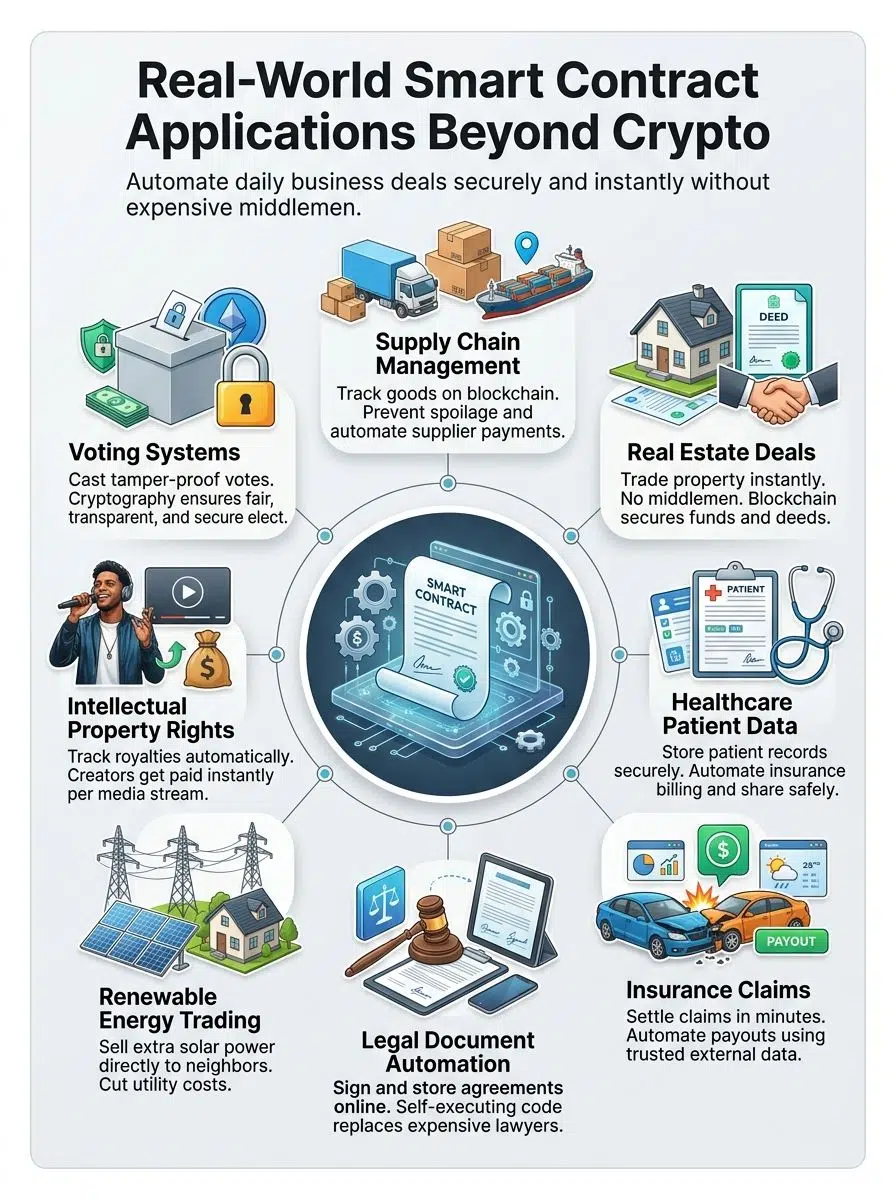
Real-World Applications of Smart Contracts Beyond Crypto
Smart contracts are changing how people do business in many fields. They help cut paperwork and speed up deals everywhere you look.
Supply chain management
Supply chain management gets a massive boost from these tools. Goods move from the factory to the store, and every handoff gets recorded on a distributed ledger.
This record cannot be erased. Everyone can check where a product came from and exactly when it changed hands. Automated execution cuts out the paperwork and the mistakes caused by tired humans.
If connected sensors notice a shipping delay or damage, payments adjust themselves right away based on preset rules. Suppliers get paid fast if they meet the conditions, promoting honesty across the entire network. Buyers gain absolute peace of mind.
Real estate transactions
Smart contracts make buying and selling property much faster and safer. A digital contract holds the money, confirms deeds, and checks ownership in real time.

No middlemen need to shuffle paper documents. US real estate platform Propy uses AI and smart contracts to dramatically shorten the closing process.
“Using AI-driven smart contracts, what once took 30 to 60 days can now complete in under 48 hours.”
The blockchain records everything using cryptography, so no one can change the deal after both sides agree. Buyers no longer wait weeks to close, and funds move as soon as all steps are finished.
Healthcare systems and patient data
Blockchains can store highly sensitive patient records using cryptography. Only doctors with explicit permission can access this data, keeping it private and safe from hackers.
Hospitals face many hurdles when sharing files. Here is how distributed ledger technology improves healthcare:
- It helps share reports quickly without missing critical info.
- It complies easily with strict US privacy laws like HIPAA.
- It stops unauthorized staff from viewing sensitive records.
Automation also cuts out the endless paperwork for billing. A programmable agreement triggers payments right after a doctor visit is logged.
Insurance claims processing
Insurance claims often take weeks or even painful months to resolve. Smart contracts use automation to cut this waiting time down to almost nothing.
If a car breaks down, the smart contract checks repair records and police reports instantly. Once it gets the needed data, it triggers a payment.
A famous US insurtech company named Lemonade actually set a world record by using AI and smart contracts to review, approve, and pay a claim in just three seconds. This open process reduces fraud dramatically. Everyone involved can see the updates at each stage.
Legal agreements and document automation
Smart contracts help make legal agreements much faster and safer to execute. They handle tedious tasks like signing, storing, and checking documents on a blockchain. Rental contracts can start with just a few clicks online. You do not need expensive lawyers watching over every single step.
In 2024, Wyoming even passed the Decentralized Unincorporated Nonprofit Association Act, legally recognizing these blockchain-based organizations as valid entities in the US. If each side meets its part, payments are released without delay. Every change is tracked for full transparency.
Use Cases in Emerging Industries
Fresh tech fields now play with smart contracts in bold new ways. These digital agreements are starting to power tomorrow’s biggest breakthroughs today.
Renewable energy trading
Solar panels on your house or wind turbines in a field can generate extra energy. You can use smart contracts to sell this renewable power right to your neighbors.
Blockchain keeps these trades honest and clear by tracking who sells and who buys each kilowatt-hour. A farmer in Texas could send solar power straight to a shop down the road using only their phone. Platforms like Powerledger integrate with fast networks like Solana to enable true 24/7 energy matching.
“Blockchain enables real-time tracking of energy generation and consumption down to the hourly level.”
Intellectual property rights management
Songwriters, artists, and inventors face massive risks from copycats. A blockchain-based digital contract puts ideas on a distributed ledger to prove exactly who owns what.
Smart contracts use automated execution to track rights for music or art in real time. For example, musicians using modern Web3 platforms get paid each time someone streams their song.
Big brands use blockchain for software copyright protection by storing proof of ownership. Programmable agreements let creators sell licenses online with perfect traceability.
Voting and governance systems
People use smart contracts to make voting safe, fair, and fast. Votes can be placed securely on a blockchain.
Each vote is recorded with cryptography, so absolutely no one can change it later. This keeps elections transparent and helps prevent any tampering or fraud. Here is how programmable agreements help groups make clear decisions:
- Members can vote on new spending plans from anywhere in the world.
- Results tally instantly without manual counting errors.
- The distributed ledger keeps a permanent record for future audits.
Advantages of Smart Contracts
Smart contracts speed things up, cut costs, and keep your deals safe. Let’s look at exactly how far they can go.
Cost savings
Cutting out middlemen saves a huge amount of money. Digital contracts use blockchain to let people deal peer-to-peer, skipping expensive banks or lawyers.
Businesses pay fewer fees, and less paperwork means lower operating costs. A study on the IBM Food Trust platform showed that adopting blockchain in supply chains can increase compliance efficiency by 70 percent and reduce quality risk control costs by 65 percent. Companies can move funds as soon as conditions are met, slashing holding costs.
Increased speed and efficiency
Saving money matters, but gaining time makes an even bigger difference in your daily life. Smart contracts process tasks in seconds or minutes instead of days or weeks. Real estate deals do not crawl through endless paperwork. Insurance claims get settled quickly, cutting out the long wait for approval calls.
A distributed ledger tracks goods at every stop, so shipments move smoothly. These automated systems never get tired, and they work around the clock with constant accuracy.
Enhanced security
Smart contracts use powerful cryptography to lock down your data. Every agreement is stored on a blockchain, making it incredibly hard for hackers to change anything.
A blockchain works like a highly secure public ledger that provides key protections:
- Hackers cannot easily change data secretly.
- Only people with the right digital keys can update details.
- It removes the single point of failure found in standard servers.
Hackers would need to take over most computers in the system at once. This is nearly impossible with large networks like Ethereum or Solana.
Challenges and Limitations of Smart Contracts
Smart contracts sound like magic, but they face real-world bumps and hurdles. Sometimes, what you see on paper does not perfectly match what the machines understand.
Reliance on accurate “off-chain” data
Digital contracts often work with outside information like prices, weather reports, or delivery updates. This outside data is called “off-chain” data.
Blockchains cannot easily check if this off-chain data is actually true. They depend on specialized tools called oracles to bring in the details. US developers frequently rely on the Chainlink network, which uses multiple decentralized data sources to ensure a smart contract does not act on bad information.
Problems happen if a single oracle gives wrong data. Industries need reliable feeds for smooth automated execution.
Legal and regulatory uncertainties
Laws for smart contracts differ wildly from place to place. Some countries accept blockchain-based agreements easily, while others do not have clear rules yet.
Courts sometimes find it hard to decide how to handle unique issues like mistakes in the code. Old laws did not imagine automated execution by software instead of people.
While progressive states like Wyoming have passed friendly legislation, the broader US regulatory landscape remains a complex patchwork. Lawmakers are still trying to keep up with these fast-moving changes.
Potential security vulnerabilities
Legal issues are one side of the coin, but security concerns lie on the other. Hackers constantly target smart contracts, hoping to find weak spots.
In 2016, an attack drained over $60 million from the DAO project by exploiting a flaw no one expected. Today, developers use specialized auditing firms like CertiK to scan their code for bugs before it goes live.
“Even small coding mistakes can open big holes for cyber thieves, which is why professional code audits are now standard practice.”
The Future of Smart Contracts
Smart contracts may soon blend perfectly with smart devices and artificial intelligence. New tools and ideas can spring up any day, so keep your eyes peeled for what comes next.
Integration with AI and IoT
Pair smart contracts with AI, and digital agreements get incredibly smart. AI can check outside data fast, make critical decisions, or spot patterns before triggering an action.
In supply chain management, an Internet of Things sensor on a delivery truck may send real-time location updates. The contract then releases the payment exactly when the goods arrive.
With more devices talking to each other online every single day, these programmable agreements will run many daily tasks for us completely hands-free.
Broader adoption across industries
Many US companies now use blockchain and digital contracts for far more than just finance. Hospitals store patient data securely, making records safe from loss.
Grocery stores track food from the farm to your table, keeping supply chain management perfectly clear. Real estate firms handle property sales faster by automating documents. Insurance groups process claims in minutes instead of weeks. Smart contracts touch everything from voting systems to trading clean energy credits between neighbors.
Final Words
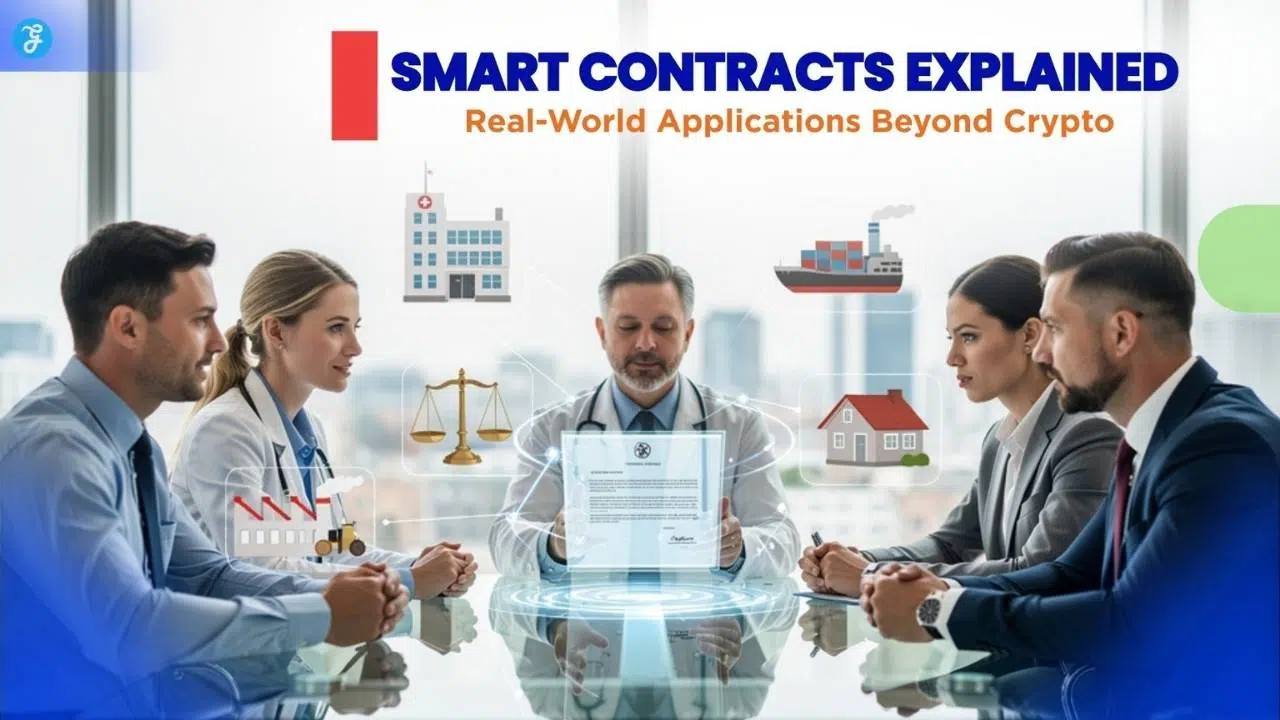
Our guide to Smart Contracts Explained: Real-World Applications Beyond Crypto shows us a future that is faster, safer, and cheaper. These digital agreements do not just live in the financial sector anymore. They actively help in real estate deals, supply chains, health care records, and even local voting systems.
Using automation means more people can trust the process without needing a third party to watch over everything. Mistakes drop significantly when rules run by code, and the final results come quickly as lightning.
If you want to keep learning, free guides and open platforms are all over the internet waiting for you. Changing how we make agreements starts with one simple step, so why not give it a shot?