Have you ever heard about big banks and massive companies buying up Bitcoin and felt completely lost? You are definitely not alone in wondering what it means for your own wallet when these giants step in. Change brings hope for growth, but it also brings new worries about risk. Here is a secret that might change how you see things. In recent years, more financial institutions have moved real money into Bitcoin than ever before. This trend shapes how the market works, affects prices, and could absolutely change your own investments.
I am going to walk you through exactly how the Institutional Adoption Of Bitcoin may impact you as a retail investor. Grab a cup of coffee, and let us go through it together so you can decide if this is an opportunity or just chaos waiting to happen.
Why Institutional Adoption of Bitcoin is Growing
Big players are joining the Bitcoin scene in bigger numbers, and you can almost hear the buzz. Their entry keeps changing how people invest, giving everyone more to talk about at family dinners.
Increased regulatory clarity
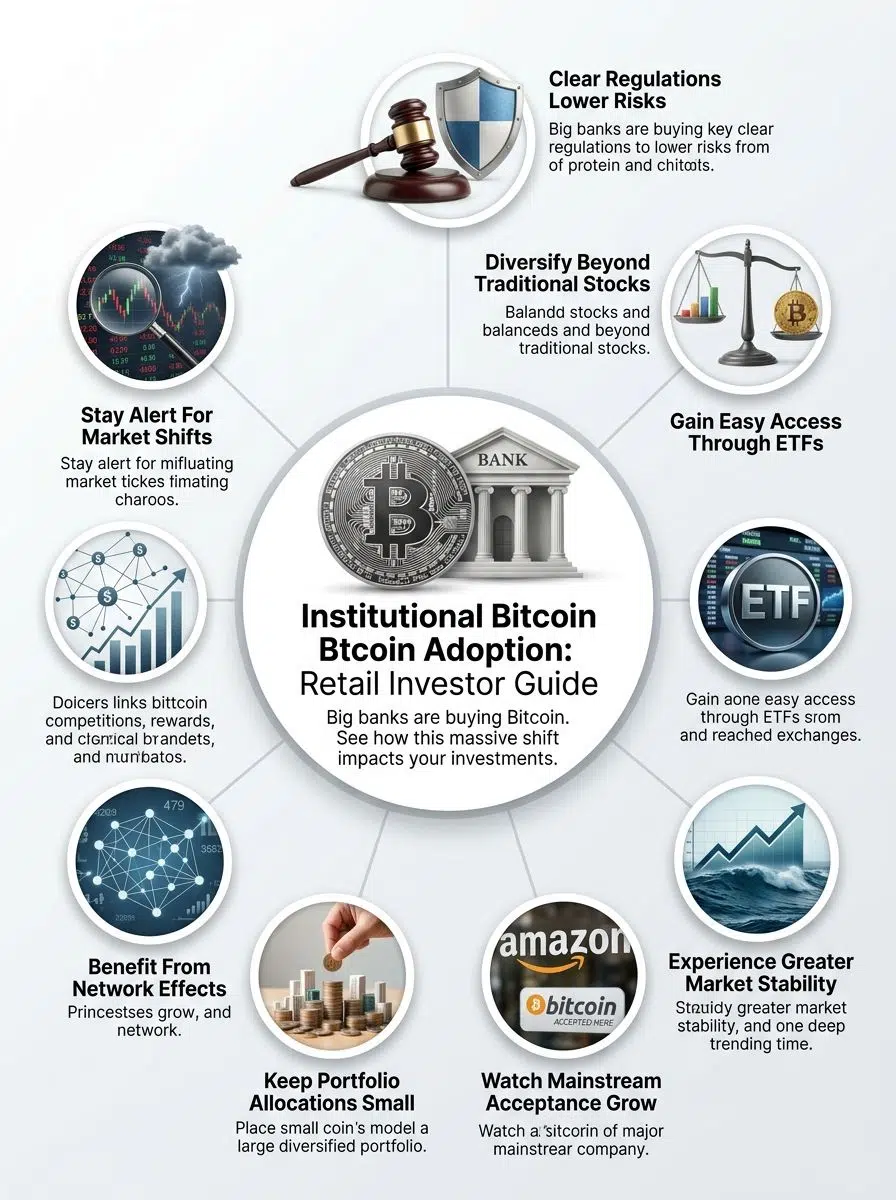
Clear rules help big investors trust Bitcoin more. In 2024, the U.S. Securities and Exchange Commission (SEC) approved spot Bitcoin ETFs, making it incredibly easy for funds to enter the market. These steps give financial institutions confidence that they are acting under official guidelines.
Now, banks and asset managers can bring digital assets into their portfolios without worrying about breaking laws. More governments view cryptocurrency as a real part of finance.
“When the SEC approved spot ETFs, it essentially gave Wall Street the green light to treat Bitcoin like any other traditional asset.”
This shift helps everyday people, too. Stronger regulation lowers risks tied to scams or shady exchanges. Retail investors see safer choices and steadier growth because the path is less foggy than before.
Rising demand for diversification
Big investors want to spread risk across many assets. Growth in cryptocurrency is making more people look at Bitcoin as a powerful tool for diversification. Stocks and bonds can fall together, but Bitcoin often moves on its own path.
Even conservative funds are taking notice. In late 2025, Emory University became the first U.S. university to disclose a significant investment in Bitcoin for its endowment publicly. This shows how institutions seek new types of investment to protect their wealth.
Banks and companies see value in holding digital currency next to cash or stocks. They hope to protect their portfolios if traditional markets drop suddenly. As more financial institutions join the crypto space, everyday investors watch closely to see if they should follow suit.
Bitcoin’s dominance in the digital asset space
Bitcoin stands as the most valuable digital asset today. In early 2026, Bitcoin maintains a massive 56% to 59% dominance over the entire cryptocurrency market. Most people know Bitcoin before any other coin, much like how Coke comes to mind first for soda lovers.
Because it controls so much of the market, major firms focus their energy here. Here are a few ways big names are dominating the space:
- BlackRock’s iShares Bitcoin Trust (IBIT): This fund crossed $95 billion in assets under management (AUM) in late 2025, making it the fastest-growing ETF in history.
- MicroStrategy: As of early 2026, this U.S. software company holds roughly 761,000 Bitcoin, acting as a massive corporate vault.
- Fidelity Digital Assets: They provide the secure storage that makes these massive purchases possible.
Many investors see Bitcoin as “digital gold.” Its limited supply of 21 million coins drives interest from those seeking a hedge against inflation. Other digital assets may offer new features, but none match Bitcoin’s scale and reach.
Expanding use cases for Bitcoin
With Bitcoin leading digital assets, eyes turn to how you can use it in real life. Today, people and companies use this cryptocurrency for much more than just holding or trading.
Big brands like Microsoft accept Bitcoin payments. Some cities let you pay taxes with it. Even charities take donations in digital assets. Smart contracts on the blockchain allow quick deals without paperwork or banks getting involved.
Small businesses can join global trade with fewer fees using Bitcoin for cross-border sales. People send money home across countries faster than ever before, skipping the high costs of traditional banks. Every year brings new ways to use these digital coins, proving that adoption is reshaping finance step by step.
Key Drivers Behind Institutional Bitcoin Investment
Big banks are jumping in, and new doors keep opening. Stick around to see why the buzz is getting louder across Wall Street.

Favorable regulations for digital assets
Strong regulation around digital assets makes big investors breathe easy. The approval of U.S. Bitcoin ETFs sparked a massive wave of capital. By late 2025, total U.S. spot Bitcoin ETF assets reached an astonishing $155 billion.
Clear rules give companies better guidance on how to handle cryptocurrency. Because of these fresh laws, many see less risk in digital asset investment. This sparks trust and brings new players into the market.
Here is what this regulatory shift provides:
- Legal protection: Firms know they are compliant with U.S. laws.
- Standardized reporting: Public companies must disclose their holdings clearly.
- Mainstream auditing: Traditional accounting firms now audit digital asset vaults.
As regulations keep shaping up, even small investors see easier access through regular stock exchanges.
Improved access through ETFs and other vehicles
Big players can now buy Bitcoin easily using Exchange-Traded Funds (ETFs). These funds trade exactly like stocks on major exchanges. You do not need a crypto wallet or tricky passwords to get involved.
Retail investors get a simple way to join the action. Mutual funds and trusts let people add digital assets to retirement accounts with zero fuss.
A pro-tip shared by many financial planners: Watch the daily net inflows into major ETFs like IBIT or FBTC. Heavy institutional buying often acts as a leading indicator for positive price trends.
This growth makes buying Bitcoin feel completely normal for both Wall Street pros and everyday folks.
Maturing market infrastructure
Trading Bitcoin is much safer today than it was five years ago. Big exchanges now offer strong security, clearer rules, and faster trades.
Trusted custody providers like Coinbase Prime give banks the security guarantees they require. Futures contracts protect both retail investors and big firms from hacks or losing access to funds.
As payment networks connect to crypto markets, people can move money quickly. Sometimes transactions clear in seconds instead of days. This shift builds incredible trust among all investors. No magic is needed, just steady progress.
How Institutions Invest in Bitcoin
Big firms use different paths to gain Bitcoin exposure. Their methods shape the market in ways many people do not expect.
Direct access via digital wallets
Some massive financial institutions use direct custody to hold Bitcoin. They use enterprise-grade digital wallets to store large amounts of cryptocurrency securely on the blockchain.
Companies like MicroStrategy prefer this direct ownership model. By holding the actual digital keys, they maintain absolute control over their $57 billion Bitcoin treasury. This allows them to avoid management fees charged by third-party funds.
Direct custody requires heavy security investments, but it cuts out the middlemen. Retail investors can see how seriously big players treat security when they build these digital fortresses.
Exchange-traded products (ETPs) like ETFs and ETNs
For those who want price exposure without the hassle of securing digital keys, ETPs are the perfect solution. These tools trade on stock markets, making it incredibly easy for anyone with a brokerage account to buy in.
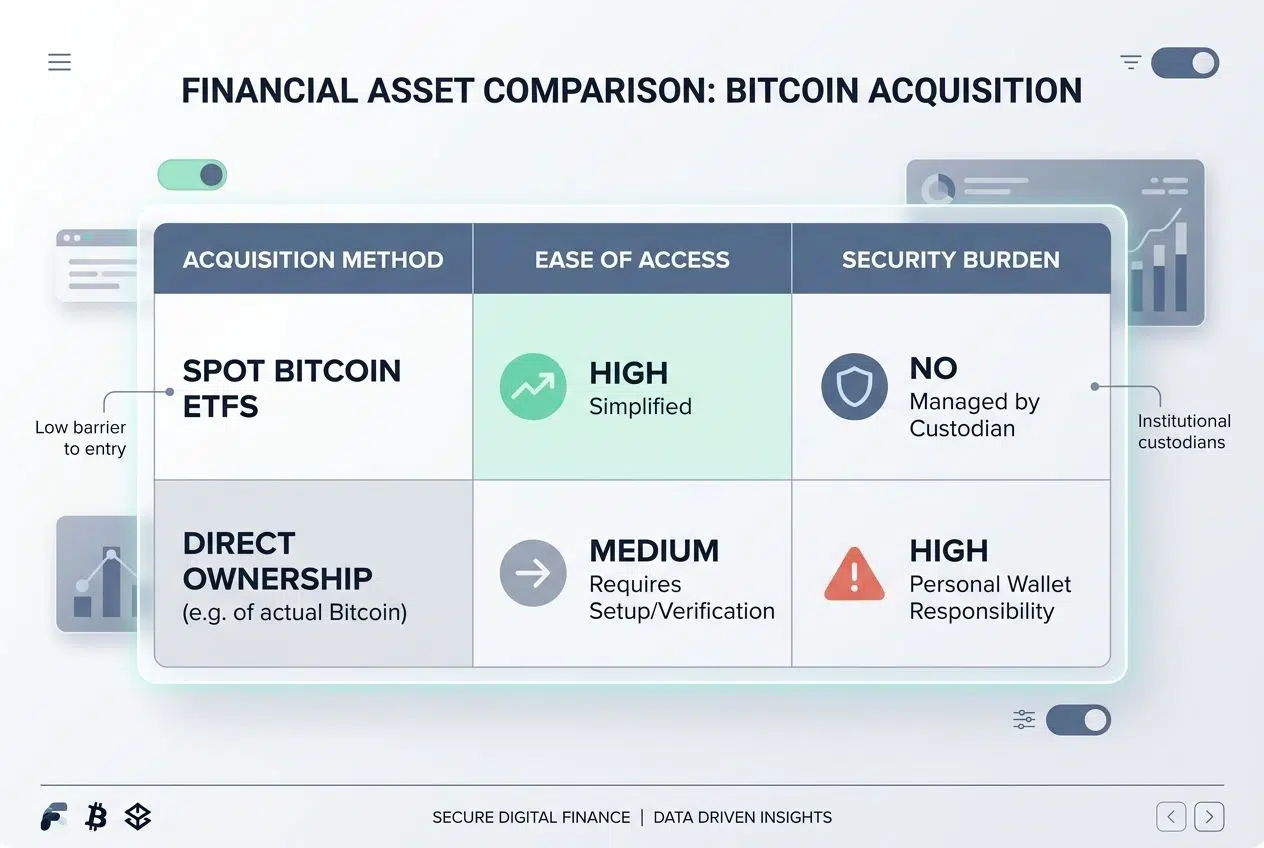
Let us look at a quick comparison of the two main ways people invest today:
| Investment Method | Ease of Access | Security Burden | Best For |
|---|---|---|---|
| Spot Bitcoin ETFs | High (Buy via regular broker) | None (Handled by issuer) | Retirement accounts, traditional investors |
| Direct Ownership | Medium (Requires crypto exchange) | High (You manage your own keys) | Tech-savvy users, long-term self-custody |
Retail investors gain simple access, while financial institutions use these products for quick trades. Prices stay more stable because more money flows through highly regulated markets.
Futures contracts and derivatives
Futures contracts let investors agree on a price for Bitcoin, then buy or sell it later. Institutions trade these heavily on platforms like the Chicago Mercantile Exchange (CME).
These deals help big companies protect themselves against sharp market moves. Big banks often use these tools to manage risk or earn extra profit from short-term price changes.
Derivatives like options give flexible ways to trade based on market expectations. This wave of new investment vehicles pushes up trading volume, adds deep liquidity, and makes prices less jumpy day-to-day.
Implications of Institutional Bitcoin Adoption for Retail Investors
When big players step in, things can change fast for everyone else. If you like to keep your ear to the ground, this wave could mean fresh chances and new rules.
Increased market stability
Big investors like pension funds and university endowments are joining the Bitcoin market. Their massive, long-term trades help make prices less jumpy.
Deeper markets with more buyers and sellers mean prices do not swing as wildly on rumors. Fewer big crashes can keep retail investors from panic-selling during sudden drops.
The SEC’s approval of Bitcoin ETFs drew steady, long-term capital to digital assets. That helps build immense trust. People feel safer investing their own money into cryptocurrency, instead of just guessing on wild price swings. With stability rising, more shops may soon accept Bitcoin in daily life.
Greater mainstream acceptance of Bitcoin
More people and businesses now see Bitcoin as a valid digital asset. Large firms like Tesla added Bitcoin to their balance sheets years ago, paving the way for today’s widespread adoption.
Shops both online and on Main Street accept Bitcoin payments. This brings more eyes to cryptocurrency every single day. As famous investors talk about their holdings, public trust grows significantly stronger.
“When your local bank offers a Bitcoin fund next to a traditional index fund, the asset has officially crossed into the mainstream.”
News outlets cover market updates constantly, making Bitcoin impossible to ignore in daily life.
Opportunities for early retail investors
Greater mainstream acceptance of Bitcoin lights the way for average investors. Big financial institutions entering the market have brought massive attention.
Early retail buyers now have excellent tools. Here is what is available to you today:
- Exchange-traded funds with near-zero fees.
- Apps that make buying fractional shares incredibly simple.
- Regulated digital wallets that offer bank-grade security.
ETFs and digital wallets give small investors access to exactly what the big players use, completely leveling the playing field. Discounts sometimes appear during short-term drops, letting fast-moving investors buy before prices rise again.
Potential for reduced volatility
Big money players, like financial institutions and asset managers, tend to buy or sell with a strict plan. They do not rush in or out because of internet rumors.
Their steady investments can smooth out the sharp ups and downs that often scare off retail investors. Think of it as a giant cruise ship entering a choppy bay; the big boat’s heavy weight calms the rough waves.
As more Institutional Adoption Of Bitcoin takes place, the markets feel less like a roller coaster and more like a fast train. ETFs invite patient capital that is less likely to make sudden moves based purely on fear. This change encourages more everyday people to confidently explore the space.
How to Evaluate Bitcoin’s Value
Measuring Bitcoin’s value can feel like trying to catch lightning in a bottle. There are many ways people size it up, and each method shines a different light on what drives its price.
Valuing Bitcoin as a commodity
Bitcoin acts exactly like gold in many ways. People value it for its limited supply and incredibly high demand. There will never be more than 21 million Bitcoin, just as you cannot create new gold out of thin air.
Investors call Bitcoin “digital gold” because it can protect your money when the stock market shakes. Unlike stocks, Bitcoin does not pay dividends or give you part-ownership in a company. Its price moves with how much people want to hold it and world events.
Unlike oil, no one uses Bitcoin to power machines. Instead, investors treat it as a pure store of value. Traders watch the supply closely to see how rare the asset is becoming.
Supply-side frameworks: Halving and production costs
Like gold, people try to measure Bitcoin’s value by looking at how hard it is to produce. Supply-side frameworks use facts like halving and mining costs. Halving takes place about every four years.
In 2024, the block reward fell from 6.25 BTC to 3.125 BTC per new block mined. This event cuts the number of new coins entering the market, making Bitcoin much more rare over time.
“Miners are the backbone of the network. When the cost to mine a single Bitcoin approaches its market price, it historically creates a strong price floor.”
Production costs give another massive clue about price floors. Miners need electricity and strong computers just to earn rewards. If energy prices go up, some miners exit until profits return. Many investors watch these numbers closely to spot the absolute lowest price the market will tolerate.
Network effects and adoption dynamics
More people buying and using Bitcoin makes it inherently more valuable. This is called a network effect.
Early users saw big price swings, but as financial institutions buy in, the market grows much steadier. Every new investor helps boost trust.
Here is how the network effect builds momentum:
- User Growth: More everyday buyers open digital wallets.
- Merchant Acceptance: Businesses see the users and start accepting payments.
- Institutional Validation: Wall Street sees the volume and launches dedicated funds.
As banks and companies join in, they spark fresh interest from retail investors too. Bigger networks attract even more growth because no one wants to be left behind.
Total addressable market (TAM) approach
Stronger network effects help Bitcoin grow, but gauging how big it can get requires a different lens. The total addressable market, or TAM approach, does exactly that.
It measures the possible value if Bitcoin reaches its full potential across different financial sectors. Think of it like asking, “How much money could flow into Bitcoin if everyone who might use it actually did so?”
TAM for Bitcoin covers many markets. It competes as a store of value like gold, which is worth over $15 trillion. It also competes in cross-border payments. Some investors estimate that if just a tiny percentage of global institutional assets move into Bitcoin, its price could surge dramatically. Understanding TAM makes spotting future upside much easier.
Portfolio Considerations for Bitcoin
Smart investors weigh Bitcoin’s history and risk before choosing how much to add. Stick around to see what might work perfectly for your own strategy.
Historical returns and risk-reward profile
Bitcoin has been a wild ride. This table breaks down how it has performed, what risks came with those gains, and how it compares with classic investments.
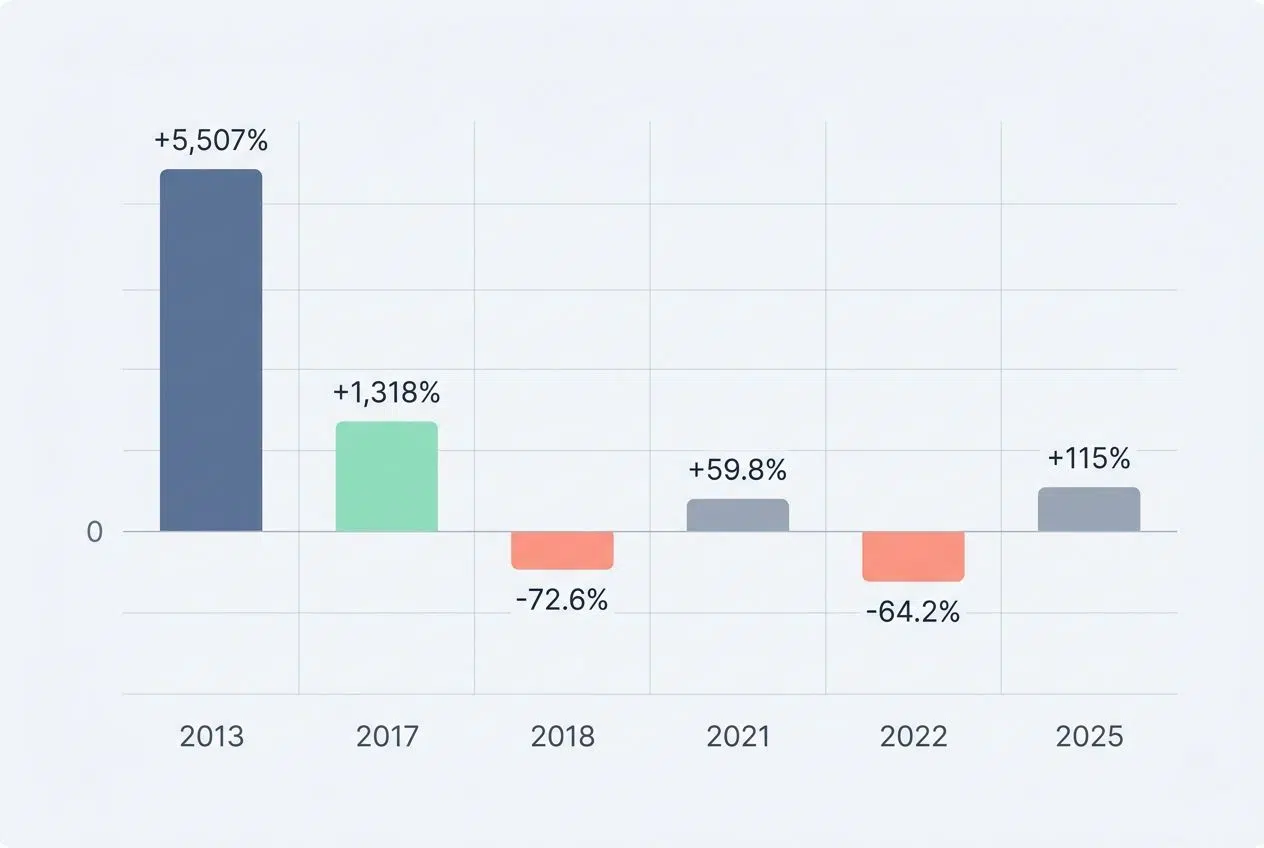
| Year | Bitcoin Annual Return (%) | S&P 500 Annual Return (%) | Max Drawdown (%) | Volatility (%) | Sharpe Ratio | Notes & Examples |
|---|---|---|---|---|---|---|
| 2013 | +5,507 | +29.6 | -75 | ~100 | 4.6 | Bitcoin hit $1,100 from $13. Huge spike. Mt. Gox drama started to unfold. |
| 2017 | +1,318 | +19.4 | -36 | ~71 | 6.1 | Crypto mania. Price peaked near $20,000. Mainstream talked about it everywhere. |
| 2018 | -72.6 | -6.2 | -83 | ~80 | -1.0 | Brutal crypto winter. Bear market tested nerves. Many retail investors left. |
| 2020 | +302 | +16.3 | -50 | ~63 | 3.0 | Institutional buyers like MicroStrategy entered. Pandemic-fueled digital gold story. |
| 2021 | +59.8 | +26.9 | -53 | ~65 | 1.6 | Bitcoin ETF was launched in Canada. Tesla bought BTC. All-time highs reached $69,000. |
| 2022 | -64.2 | -19.4 | -77 | ~65 | -0.7 | Luna crash. FTX collapsed. Market confidence shaken, but not broken. |
| 2023 | +156 | +24.2 | -18 | ~48 | 2.9 | BlackRock, Fidelity ETF filings. Bitcoin hit $44,000 in December. |
| 2025 | +115 | +21.4 | -22 | ~45 | 2.5 | Bitcoin peaks over $120,000 amid massive US spot ETF inflows. |
- Bitcoin’s historical returns are eye-popping, but the ride was never perfectly smooth.
- Volatility often topped 60% to 100%. Some years, losses stacked up fast.
- The Sharpe Ratio measures returns per unit of risk. Even with big swings, Bitcoin’s numbers beat stocks long-term.
- Institutional entry began cooling the chaos. By late 2025, volatility dropped, and drawdowns got noticeably smaller.
- Past performance tempts, but you must manage your risk and keep your eyes open.
Sizing Bitcoin allocation in a portfolio
A small slice can make a massive difference. Many experts suggest keeping your Bitcoin allocation low, usually between 1% and 5% of your whole portfolio.
This helps limit risk, since cryptocurrency markets can still swing quickly. History shows that even a tiny amount can boost your overall returns without putting your entire life savings on the line.
Setting your size depends entirely on your comfort with volatility and your personal goals. If you like to sleep easily, keep it at the lower end. Review your allocations often as prices shift. Keep things simple so you do not end up biting off more than you can chew.
Risk budgeting for retail investors
Risk budgeting keeps your money completely safe. Only invest money you can comfortably afford to lose.
Set a clear limit for Bitcoin, like 2% or 5% of your whole portfolio. Sticking to this helps you avoid panic if prices drop fast. If Bitcoin climbs in value and grows past that set percentage, rebalance by selling a small portion. This ensures your risk stays exactly the same.
A common pitfall for new investors is buying a “proxy stock” like MicroStrategy and assuming it perfectly matches Bitcoin’s price. Because it trades like a stock, it can sometimes trade at a massive premium to the actual Bitcoin it holds. Always check the premium before buying.
Institutions use strict investment guidelines, and retail investors need strong habits too. Simple steps, such as spreading investments, help reduce big losses. Slow and steady growth wins over time.
Challenges and Risks of Institutional Bitcoin Adoption
Bigger investors can shake things up fast, raising some eyebrows among smaller players. New rules or sudden news might send prices on a ride, so keep your eyes wide open.
Market manipulation concerns
Large financial institutions can occasionally move the price of Bitcoin with just a few massive trades. Sometimes, these players cause sudden jumps or drops.
This can unfairly push small retail investors to make rushed, emotional choices. In earlier years, extreme price swings wiped out millions in futures contracts on busy trading days.
To protect yourself from manipulation, keep these tips in mind:
- Avoid the hype: Do not buy just because a coin is trending on social media.
- Watch the volume: Real price moves are backed by high trading volume on major exchanges.
- Use limit orders: Set an exact price you want to pay, rather than buying at market price during a spike.
Retail investors should stay alert and avoid following the herd without doing their own research first.
Regulatory uncertainties in specific regions
Market manipulation concerns often walk hand in hand with shifting laws. Different countries treat Bitcoin in their own unique way, and this can keep investors on edge.
In some nations, strict bans make it tough for both retail and financial institutions to take part at all. The United States changes its tune occasionally, though the recent SEC ETF approvals provided a massive green light. Europe keeps moving forward with clear laws like MiCA, giving companies an excellent playbook to follow.
These mixed signals across the globe can slow down adoption. Institutions sometimes hesitate to grow their holdings overseas until clear laws are written in black and white.
Potential shifts in Bitcoin’s volatility profile
Large financial institutions bring billions of dollars and incredibly steady hands to the Bitcoin market. These big players can actively help smooth out wild price swings.
In 2021, Bitcoin saw huge daily moves, sometimes dropping or rising by over 10 percent in a single day. With massive funds like BlackRock’s IBIT holding over 800,000 BTC by 2026, these sharp jumps are getting noticeably smaller. Trading activity is simply spread out across far more buyers and sellers.
Retail investors could see safer price action instead of shocking overnight drops. Still, sudden news or policy changes may spark fast moves again. Speculation never completely sleeps in cryptocurrency markets.
Wrapping Up
Institutions now see Bitcoin as so much more than just a buzzword. Major banks and university endowments are jumping in, making digital assets a true staple for diversification. ETFs and other simple investment vehicles open doors to regular investors every single day.
With clear regulation, you can watch the market shift from wild speculation to steady, reliable growth. Some folks still worry about sudden changes in volatility, and that risk will not vanish overnight. Fortunately, the massive Wall Street infrastructure helps keep things firmly on track.
Retail investors today have far more tools and insights than ever before. This is all thanks to the rapidly expanding Institutional Adoption Of Bitcoin across the globe. The technology is changing fast, so grab your tools, do your research, and decide if you are ready to join the movement.