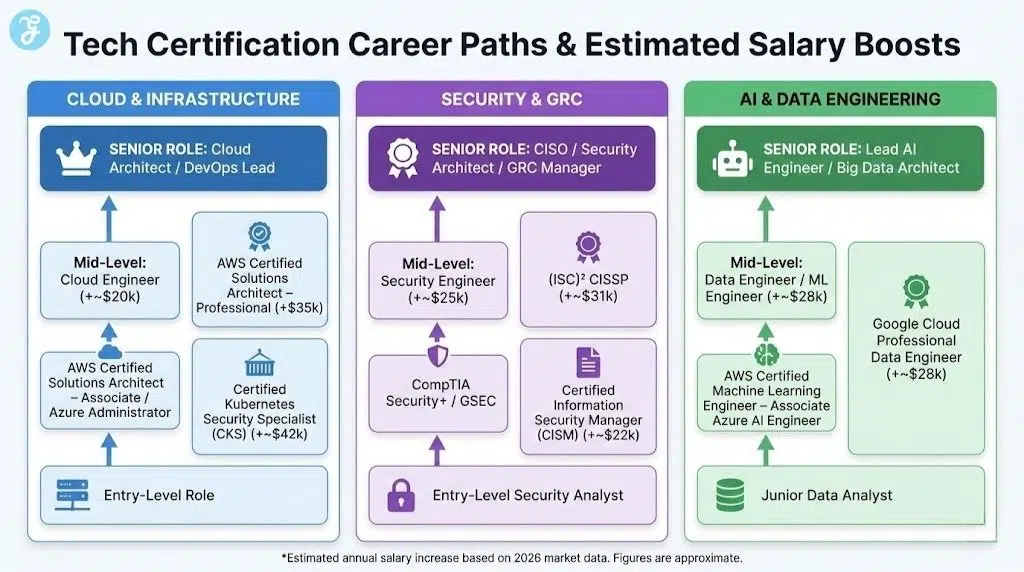
Earning the best IT certifications for salary growth is the most direct way to accelerate your career trajectory in 2026. As the industry shifts toward “skills-based hiring,” a verified credential acts as a financial accelerator that often outweighs years of general experience. Organizations are currently facing a massive talent gap in high-stakes fields like AI deployment, cloud architecture, and Kubernetes security, and they are willing to pay a premium for certified experts. By strategically selecting a certification that aligns with these high-demand sectors, you can command a salary increase ranging from 15% to over 40% in a single year.
How We Selected Our 12 Options For The Best IT Certifications For Salary Growth
Our selection process for 2026 focused on the return on investment (ROI) and the “salary premium”—the average pay increase reported by certified professionals compared to their non-certified peers. We analyzed hiring data from global tech hubs to ensure these certifications reflect the highest-paying roles in the current market.
| Criteria | Evaluation Metric | Why It Matters |
| Salary Premium | Average annual income increase | Directly measures the financial “boost” of the credential. |
| Market Demand | Number of open roles requiring the cert | Ensures the certification leads to immediate job opportunities. |
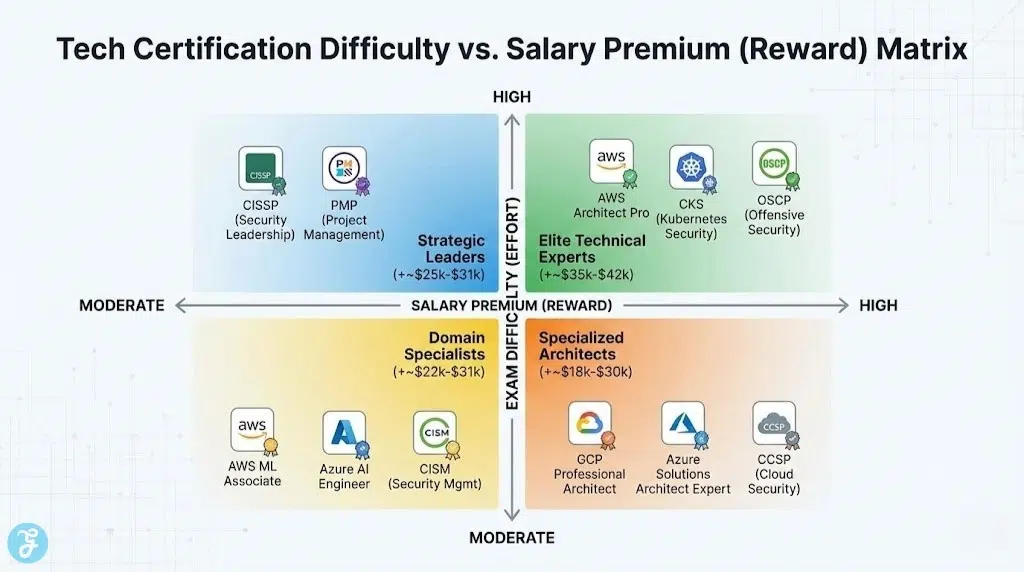
| Exam Difficulty | Pass rate and prerequisite intensity | Higher difficulty typically leads to lower supply and higher pay. |
| Industry Authority | Credibility among Fortune 500 CTOs | Validates that the cert is respected by top-tier employers. |
| AI/Cloud Alignment | Relevance to 2026 tech trends | Future-proofs your skills against automation and shifts. |
The 12 Best Certifications to Boost Your Salary in Tech
The following certifications represent the “heavy hitters” of 2026, offering the most significant impact on your earning potential and long-term career stability.
1. AWS Certified Solutions Architect – Professional
This is widely regarded as the “King of Cloud” certifications in 2026. It goes far beyond basic service knowledge, requiring you to design complex, multi-account architectures that are fault-tolerant and cost-optimized. As companies struggle with skyrocketing cloud bills from AI workloads, the ability to architect for efficiency is highly valued. It is a grueling exam that tests your judgment and deep technical experience.
-
Best features: Covers advanced multi-tier networking and complex migration strategies.
-
Pros: Consistently ranks as one of the highest-paying certifications globally.
-
Things to consider: Requires significant hands-on experience and has a very high failure rate for those who only use “brain dumps.”
2. Certified Kubernetes Security Specialist (CKS)
In 2026, Kubernetes is the standard for container orchestration, but securing these clusters has become a massive pain point for CTOs. The CKS is a performance-based exam, meaning you must actually secure a live cluster during the test. It validates your ability to handle supply chain security, runtime threats, and cluster hardening. Because it is so difficult to “fake” your way through this exam, CKS holders are currently commanding some of the highest niche salaries in DevOps.
-
Best features: Focuses on real-world security primitives like RBAC, OPA, and image scanning.
-
Pros: Performance-based testing proves you have actual hands-on skills to employers.
-
Things to consider: You must already hold a CKA (Certified Kubernetes Administrator) to even attempt this.
3. Google Cloud Professional Data Engineer
Data is the lifeblood of the 2026 AI revolution, and Google Cloud remains the platform of choice for deep analytics and machine learning. This certification proves you can design, build, and operationalize data processing systems. It covers everything from BigQuery architecture to real-time streaming with Dataflow. Companies are desperate for experts who can build the pipelines that feed their AI models.
-
Best features: Deep focus on BigQuery slots, partitioning, and automated data orchestration.
-
Pros: Highly respected in data-heavy industries like AdTech, Fintech, and Media.
-
Things to consider: Requires a strong grasp of both data engineering and basic machine learning concepts.
4. (ISC)² CISSP
The Certified Information Systems Security Professional (CISSP) remains the gold standard for security leadership. In 2026, cybersecurity is no longer just an IT issue; it is a board-level survival priority. The CISSP validates that you have the strategic mindset to build and manage a comprehensive security program. It is particularly valuable for those aiming for C-suite roles like CISO or Security Director.
-
Best features: Covers eight broad domains including Security and Risk Management and Asset Security.
-
Pros: Globally recognized and often a mandatory requirement for senior government and defense roles.
-
Things to consider: Requires five years of verified, paid professional experience in the security field.
5. Project Management Professional (PMP)
The PMP is the universal “Leadership Play” for tech professionals looking to move into management. In 2026, the demand for structured, efficient project execution is at an all-time high as companies try to integrate AI into every department. PMP holders earn significantly more than their non-certified counterparts because the cert proves you can lead cross-functional teams and manage multi-million dollar budgets.
-
Best features: Teaches predictive, agile, and hybrid project management methodologies.
-
Pros: Applicable across any industry, not just tech, providing excellent career pivot options.
-
Things to consider: The application process is rigorous and requires documented project leadership hours.
6. AWS Certified Machine Learning Engineer – Associate
This is the “AI Gold Rush” certification of 2026. While many people “talk” about AI, very few can actually deploy and maintain machine learning models in production. This certification validates your ability to build, train, and deploy models using AWS SageMaker and Bedrock. It is perfect for developers who want to transition into the high-paying field of MLOps.
-
Best features: Focuses on the entire ML lifecycle from data prep to model monitoring.
-
Pros: Bridges the gap between data science and production engineering.
-
Things to consider: Requires a solid foundation in Python and AWS core services.
7. Certified Cloud Security Professional (CCSP)
As organizations move toward multi-cloud environments (using AWS, Azure, and GCP simultaneously), they need security experts who aren’t tied to a single vendor. The CCSP is a vendor-neutral certification that validates your ability to secure data and applications across any cloud platform. It is rising fast in demand as global regulations on data privacy become more complex in 2026.
-
Best features: Covers cloud governance, risk, and compliance in a multi-cloud context.
-
Pros: High ROI because it makes you valuable to almost any cloud-first organization.
-
Things to consider: It is a senior-level cert that assumes you already have a strong security foundation.
8. Microsoft Certified: Azure Solutions Architect Expert
Azure is the dominant cloud platform for large enterprises that rely on Microsoft 365 and Windows. This “Expert” level certification proves you can design cloud and hybrid solutions that include identity, security, and data management. In 2026, as enterprises integrate Copilot and other AI tools, Azure Architects are the ones who make it happen at scale.
-
Best features: Focuses on high-level enterprise architecture trade-offs and governance.
-
Pros: Extremely high demand in the banking, healthcare, and corporate sectors.
-
Things to consider: You must pass the AZ-104 (Administrator) before you can take the Architect exams.
9. Offensive Security Certified Professional (OSCP)
For those in the “Red Team” or ethical hacking space, the OSCP is the ultimate badge of honor. It is a 24-hour practical exam where you must hack into several machines and document your findings. In 2026, with the rise of AI-powered phishing and ransomware, companies are hiring OSCP holders to find their vulnerabilities before the bad guys do.
-
Best features: A purely hands-on, 24-hour exam that tests actual technical skill over theory.
-
Pros: Widely considered the “gold standard” for penetration testing roles.
-
Things to consider: The exam is notoriously difficult and requires a “Try Harder” mindset and deep Linux/Networking knowledge.
10. Google Cloud Professional Cloud Architect
This certification consistently ranks as having one of the highest average salaries in the entire IT industry. It validates your ability to leverage Google Cloud technologies to drive business objectives. In 2026, it is particularly valuable for organizations focused on high-performance computing, large-scale data analytics, and AI-driven applications.
-
Best features: Tests your ability to translate business requirements into technical cloud solutions.
-
Pros: One of the most financially rewarding certifications you can hold.
-
Things to consider: The exam uses complex, paragraph-long case studies that test your logic and strategy.
11. Microsoft Certified: Azure AI Engineer Associate
Since the AI explosion, this has become a must-have for enterprise developers. This certification proves you can build, manage, and deploy AI solutions involving Natural Language Processing (NLP) and Computer Vision. It is specifically designed for engineers who are integrating AI into existing corporate software ecosystems.
-
Best features: Covers the implementation of Generative AI and Azure AI Services.
-
Pros: Very high growth potential as more companies adopt “Agentic AI” workflows.
-
Things to consider: You should be comfortable working with APIs and JSON.
12. Certified Information Security Manager (CISM)
If you are less interested in the “bits and bytes” and more interested in the “boardroom,” the CISM is for you. It is designed for professionals who oversee enterprise security programs and manage risk. In 2026, it is the premier choice for moving into GRC (Governance, Risk, and Compliance) leadership roles, which often come with significant salary bumps.
-
Best features: Focuses on information security governance and incident management.
-
Pros: Ideal for those transitioning from technical roles into senior management.
-
Things to consider: Like the CISSP, it requires several years of verified management experience.
Quick Overview
Comparison Table
| Certification | Primary Domain | Est. Salary Bump | Difficulty |
| AWS Architect Pro | Cloud | +$35,000 | Very High |
| Kubernetes CKS | DevOps/Security | +$42,000 | Very High |
| GCP Data Engineer | AI & Data | +$28,000 | High |
| CISSP | Security Mgmt | +$31,000 | High |
| PMP | Management | +$25,000+ | Moderate |
| AWS ML Associate | AI | +$31,000 | Moderate |
| CCSP | Cloud Security | +$18,000 | High |
| Azure Architect | Enterprise Cloud | +$30,000 | High |
| OSCP | Ethical Hacking | +$25,000 | Extreme |
| GCP Architect | Strategy | +$35,000 | High |
| Azure AI Engineer | Enterprise AI | +$28,000 | Moderate |
| CISM | GRC/Leadership | +$22,000 | High |
Quick Picks
If you are looking for a fast track to a salary increase based on your current role:
-
Best for Senior Engineers: AWS Certified Solutions Architect – Professional
-
Best for Future Leaders: Project Management Professional (PMP)
-
Best for “Hands-On” Security: Offensive Security Certified Professional (OSCP)
-
Best for the AI Revolution: Google Cloud Professional Data Engineer
Concluding Thoughts On Future-Proofing Your Career
Choosing the right certification in 2026 is about more than just adding letters to your resume; it is about signaling to the market that you possess the exact skills needed to solve today’s most expensive problems. We highly recommend mapping out a 6-month study plan and focusing on a “stack” of certifications—for example, combining a Cloud Architect cert with a Security or AI specialty. This combination makes you an indispensable asset to your company and gives you immense leverage in salary negotiations. The investment you make in these credentials today will likely pay for itself in less than a single quarter.