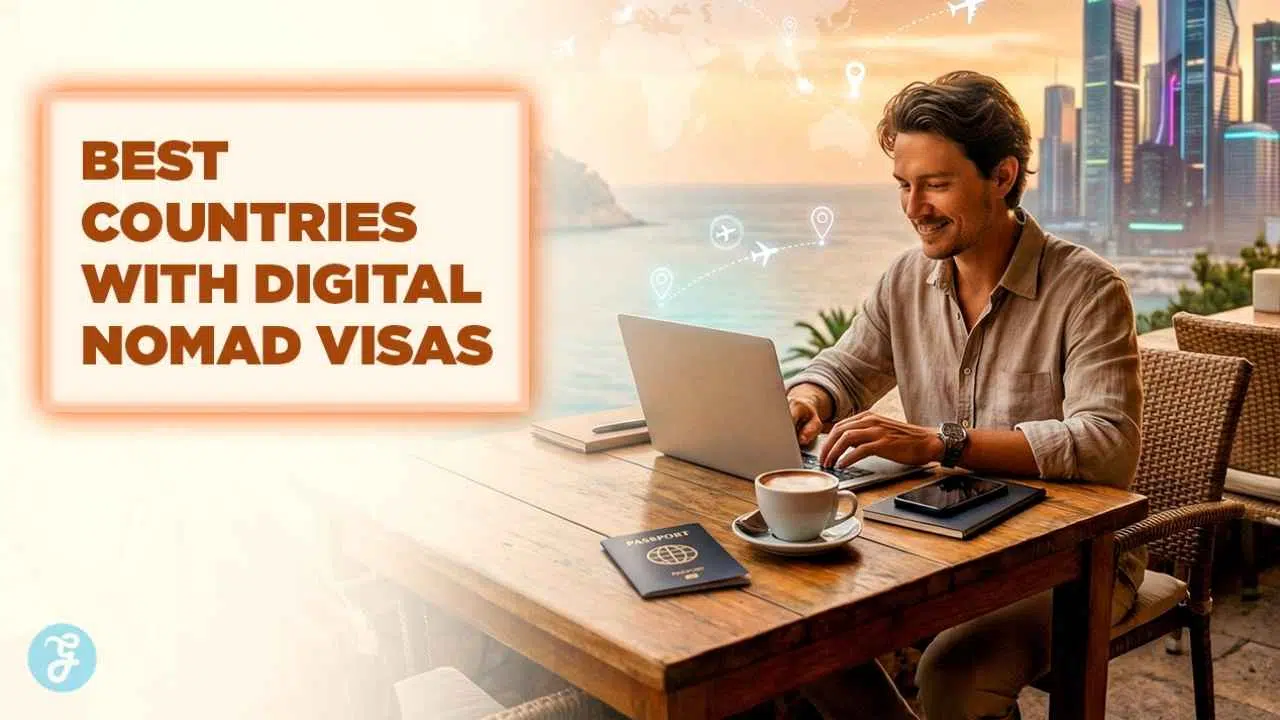
Working from a cramped apartment or the same local coffee shop every day is no longer your only option. If you have a laptop and a decent internet connection, the world is essentially your office. Governments everywhere have caught on to this massive shift in how we work.
Now, dozens of countries have rolled out official programs to attract remote talent, giving you the legal right to live and work abroad. Finding the right spot depends heavily on your monthly income, your tax situation, and your lifestyle preferences. Whether you want a beach in Southeast Asia, a historic European capital, or a timezone that matches your team in New York, there is a program built for you. I will walk you through the absolute best options available right now. Let us look at the top destinations offering digital nomad visas in 2026 so you can pack your bags and set up your remote office anywhere on the map.
Why You Should Consider Digital Nomad Visas in 2026?
Working abroad used to mean hiding your laptop from immigration officers and pretending you were just there to sightsee. A standard tourist visa usually limits your stay to thirty or ninety days, forcing you to constantly cross borders on exhausting visa runs just to reset your passport stamp. A digital nomad visa solves this massive headache by giving you official residency status for a year or more. Having legal status means you can sign long-term apartment leases without getting scammed, open local bank accounts to avoid heavy conversion fees, and sometimes even tap into national healthcare systems.
It gives you incredible peace of mind because you will not have to worry about border agents questioning your frequent visits or your remote work habits. Plus, many of these programs offer incredible tax advantages that leave much more money in your pocket at the end of the year. Choosing one of the many digital nomad visas in 2026 completely legitimizes your status as a global citizen and lets you actually settle into a community instead of just passing through as a temporary guest.
| Benefit | Description |
| Legal Stability | Stay for one to five years without doing stressful border runs. |
| Financial Perks | Open local bank accounts and sign standard long-term apartment leases. |
| Tax Advantages | Many programs offer zero taxes on foreign-earned income or flat local rates. |
| Healthcare Access | Gain access to national healthcare systems or use approved private insurance. |
| Community Integration | Stay long enough to learn the language and make long-term local friends. |
The End of the Visa Run
For years, remote workers relied on the legal gray area of working on tourist waivers. This meant living out of suitcases and crossing into neighboring countries just to stay compliant with local laws. This lifestyle is stressful, expensive, and increasingly scrutinized by immigration authorities worldwide. The new wave of official visas entirely eliminates this anxiety.
You get a local identification card, you pay your fair share where required, and you actually get to integrate into the local culture. You can join a local gym, sign up for a long-term language class, and build a routine without the ticking clock of a tourist visa expiration date hanging over your head.
Top European Countries for Remote Workers
Europe remains the most popular region for remote workers due to its high-speed internet, rich history, and the sheer ease of traveling within the Schengen Area. You get to experience completely different cultures just a short train ride or budget flight away from your home base. Navigating the visa landscape here is straightforward since many European Union nations have standardized their remote work programs to compete for foreign talent. These countries offer a fantastic mix of zero-tax havens for freelancers and fast tracks to permanent residency for eligible applicants who want to stay forever.
When looking at digital nomad visas in 2026, Europe offers the most mature and well-regulated options. You will find massive expat communities, English-speaking coworking spaces, and a lifestyle that perfectly balances productivity with endless afternoon coffees and weekend explorations. Whether you want the sunny coastlines of the Mediterranean or the affordable historic charm of Central Europe, the continent has an official legal pathway waiting for you.
1. Spain

Spain consistently ranks at the top of remote work indexes, offering an unbeatable mix of warm weather, incredible food, and a highly regulated visa process. Cities like Valencia, Barcelona, and Malaga have become massive hubs for remote workers from all over the world. The Spanish visa lets you stay for up to one year initially if you apply as a tourist, or three years if you apply through a consulate, and you can renew it for up to five years.
If you are a freelancer, you are actually allowed to earn up to twenty percent of your income from Spanish clients, which is rare for these types of visas. Under their specific startup laws, approved applicants can pay a flat tax rate of twenty-four percent on their income up to a certain threshold. You need to prove a reliable income of around 2,760 EUR per month and have a perfectly clean criminal record for the past five years.
| Key Fact | Details for Spain |
| Visa Duration | 1 to 3 years initially, renewable up to 5 years |
| Minimum Income | ~2,760 EUR per month |
| Tax Perks | 24% flat tax rate under the Startup Law |
| Best Vibe | Warm Mediterranean climate, fantastic food, huge expat network |
2. Portugal
Portugal has been a pioneer in the remote work movement for a very long time. While the famous D7 visa used to be the go-to option for everyone, Portugal now offers the dedicated D8 Digital Nomad Visa specifically for remote workers. This provides a clear, legal path for remote professionals to live in vibrant hubs like Lisbon, Porto, or the beautiful island of Madeira.
You can choose between a temporary stay visa valid for one year or a residency visa that can eventually lead to a powerful European passport and citizenship after five years. The income requirement is set at 3,480 EUR per month, which reflects the high demand and rising cost of living in the country. The internet speeds are fantastic, the locals are incredibly welcoming, and almost everyone speaks excellent English.
| Key Fact | Details for Portugal |
| Visa Duration | 1 year (temporary) or 2 years (residency track) |
| Minimum Income | ~3,480 EUR per month |
| Long-Term Perk | Direct pathway to EU citizenship after 5 years |
| Best Vibe | Surfing, historic architecture, massive digital nomad community |
3. Malta
If you want an English-speaking country right in the middle of the Mediterranean Sea, Malta is the perfect choice. The Malta Nomad Residence Permit is designed specifically for remote workers and offers one of the absolute best tax setups in all of Europe. Malta does not tax your foreign-sourced income at all as long as you do not remit it to local accounts in a taxable way, making it highly attractive for high-earning freelancers and tech entrepreneurs.
The permit is valid for one year and can be renewed up to three times with minimal hassle. To be eligible, you must prove a monthly income of at least 2,700 EUR and secure a valid, long-term rental agreement on the island. You are never more than a few minutes away from the ocean, making it a paradise for those who love water sports and warm weather.
| Key Fact | Details for Malta |
| Visa Duration | 1 year, renewable up to 3 years maximum |
| Minimum Income | ~2,700 EUR per month |
| Tax Perks | 0% tax on foreign-sourced income |
| Best Vibe | English-speaking locals, constant sunshine, island lifestyle |
4. Croatia
Croatia is famous for its stunning Adriatic coastline, highly affordable cost of living, and historic cities like Split, Zadar, and Dubrovnik. The Croatian program is technically a temporary residence permit that lasts for up to one year rather than a traditional visa. Unlike some other European visas, you cannot renew it immediately when it expires; you have to leave the country for six months before applying again.
However, during your one-year stay, you are entirely exempt from paying any Croatian income tax on your remote earnings. The income threshold is very reasonable at roughly 2,300 EUR per month. It is incredibly safe, the cafe culture is vibrant, and it serves as a great jumping-off point to explore the rest of the Balkans during your weekends.
| Key Fact | Details for Croatia |
| Visa Duration | 1 year (must leave for 6 months before reapplying) |
| Minimum Income | ~2,300 EUR per month |
| Tax Perks | 0% tax on foreign remote income |
| Best Vibe | Pebble beaches, rich history, very affordable living |
5. Italy
Italy introduced its highly anticipated remote work visa recently, and it is a massive draw for highly skilled workers who have always dreamed of living under the Tuscan sun. The visa is valid for one year and can be renewed annually as long as you continue to meet the strict financial and professional requirements. While Italy is certainly not a tax-free haven, it does offer massive tax reductions for new residents under certain regional decrees, especially if you move to the southern parts of the country like Sicily or Puglia.
You must prove an annual income of at least 28,000 EUR, show six months of prior remote work experience, and hold a university degree or equivalent professional credential. The bureaucracy can be slow, but the lifestyle payoff is immense.
| Key Fact | Details for Italy |
| Visa Duration | 1 year, renewable annually |
| Minimum Income | ~28,000 EUR per year (~2,333 EUR per month) |
| Tax Perks | Major tax discounts if settling in southern regions |
| Best Vibe | Unmatched culinary scene, endless art, laid-back southern towns |
6. Greece
Greece offers a fantastic visa for those who want to work from islands like Crete or the vibrant, historic capital of Athens. The Greek visa grants you a one-year stay, which can be easily converted into a two-year residence permit later on if you decide you love the country. The main requirement is a monthly income of at least 3,500 EUR, which is a bit steeper than its neighbors.
However, Greece offers a massive financial incentive for long-term stays. If you decide to shift your tax residency to Greece and commit to staying for at least two years, you can get a fifty percent reduction on your income tax for up to seven years. The food is healthy and cheap, the history is everywhere, and the community of expats is growing rapidly.
| Key Fact | Details for Greece |
| Visa Duration | 1 year initially, converts to a 2-year residence permit |
| Minimum Income | ~3,500 EUR per month |
| Tax Perks | 50% income tax reduction for up to 7 years |
| Best Vibe | Island hopping, ancient ruins, incredible nightlife |
7. Hungary
Hungary offers the White Card, which is currently one of the most affordable ways to live legally in Europe as a remote worker. Budapest is world-famous for its ruin bars, historic thermal baths, and incredible architecture, all at a fraction of the cost of living in Western Europe. The White Card is valid for one year and can be extended for one additional year before you have to figure out a different residency path.
The minimum income requirement is just 3,000 EUR per month, making it highly accessible. A unique and strict aspect of the White Card is that it is only for individuals, meaning you absolutely cannot bring dependent family members or a spouse with you. It is tailored perfectly for solo travelers wanting to explore Central Europe.
| Key Fact | Details for Hungary |
| Visa Duration | 1 year, renewable for 1 more year |
| Minimum Income | ~3,000 EUR per month |
| Family Rules | Strictly solo applicants only (no dependents allowed) |
| Best Vibe | Budget-friendly European city life, great public transport |
Best Digital Nomad Visas in Asia
Asia has always been a major hotspot for backpackers and remote workers due to the incredibly low cost of living, world-renowned street food, and vibrant tropical cultures. Recently, several Asian countries have finally formalized their long-term stay options to capture the booming remote workforce that used to rely entirely on tourist visa exemptions. These new programs range from highly accessible visas with low income thresholds to premium passes designed specifically for high-earning tech professionals.
Whether you want to work from a jungle cafe in Chiang Mai or a futuristic high-rise in Tokyo, Asia finally has a legal pathway for you. Looking closely at digital nomad visas in 2026, Asian countries have created some of the most flexible and generous programs to date. You can live in utter luxury for a fraction of what it costs in the United States or Europe, all while exploring ancient temples and pristine beaches on your days off.
8. Japan
Japan finally opened its doors to remote workers with a dedicated visa that allows a six-month stay. The requirements are quite strict compared to other countries on this list. You must hold a passport from one of the forty-nine countries that have specific tax treaties with Japan. The minimum income threshold is very high, set at ten million Japanese Yen per year, which translates to roughly 66,400 USD depending on exchange rates.
The visa is strictly non-renewable, meaning after your six months are up, you must leave the country and wait another six months before you can even think about applying again. Still, the rare chance to live locally in Tokyo, Kyoto, or Osaka and deeply experience Japanese culture makes this highly sought after.
| Key Fact | Details for Japan |
| Visa Duration | 6 months maximum (non-renewable consecutively) |
| Minimum Income | 10 million JPY per year (~66,400 USD) |
| Eligibility restriction | Must be from a country with a tax treaty |
| Best Vibe | High-tech cities, peaceful temples, world-class culinary scene |
9. Thailand
Thailand has long been the unofficial capital of the remote work world. They recently launched the Destination Thailand Visa, commonly known as the DTV, which entirely revolutionized the way people live in the country. The DTV is an incredibly generous multiple-entry visa valid for five full years. Each time you enter Thailand, you can stay for up to one hundred and eighty days, and you can easily extend that stay for another one hundred and eighty days at any local immigration office.
Instead of proving a strict monthly income, you just need to show proof of at least 500,000 Thai Baht in a bank account, which is roughly 16,000 USD. It is hands down the best option for remote workers in Southeast Asia right now.
| Key Fact | Details for Thailand |
| Visa Duration | 5 years (stays of 180 days per entry, extendable) |
| Financial Proof | ~500,000 THB (~16,000 USD) in a savings account |
| Flexibility | Multiple-entry allows easy travel around Asia |
| Best Vibe | Tropical beaches, amazing street food, extremely low cost of living |
10. Malaysia
Malaysia offers the DE Rantau Nomad Pass, an excellent and highly underrated alternative to crowded spots in Thailand and Indonesia. It allows digital nomads specifically working in the IT and digital marketing sectors to live in Malaysia for up to two years legally. The income requirement is very accessible at just 2,000 USD per month.
You also need to show proof of active work contracts spanning at least three months into the future. Malaysia is a fantastic base because almost everyone speaks English fluently, the infrastructure in Kuala Lumpur is highly modern with blazing fast fiber internet, and it serves as a massive, cheap travel hub for the rest of Southeast Asia.
| Key Fact | Details for Malaysia |
| Visa Duration | 3 to 12 months initially, renewable up to 2 years |
| Minimum Income | 2,000 USD per month |
| Eligible Fields | Primarily for IT, tech, and digital marketing professionals |
| Best Vibe | Modern skyscrapers, incredible multicultural food scene |
11. South Korea
South Korea introduced its Workcation visa to attract high-earning foreign talent to massive, bustling cities like Seoul and coastal retreats like Busan. The visa allows you to stay for up to one year, with the distinct possibility of extending it for a second year if you maintain your income. The financial barrier is relatively high. You need to prove an annual income that is double the South Korean Gross National Income per capita, which currently translates to roughly 66,000 USD per year.
South Korea offers some of the absolute fastest internet speeds on the planet, an incredibly safe environment, and a buzzing culture famous for its food, music, and late-night entertainment.
| Key Fact | Details for South Korea |
| Visa Duration | 1 year, renewable for a 2nd year |
| Minimum Income | ~66,000 USD per year |
| Infrastructure | Among the fastest, most reliable internet globally |
| Best Vibe | 24/7 city life, safe streets, thriving pop culture scene |
Top Digital Nomad Visas in the Americas and Middle East
If you want to stay in time zones closer to the United States or experience the sheer luxury of the Middle East, these countries offer fantastic, well-established programs. Latin America provides a very laid-back lifestyle with gorgeous landscapes, affordable healthcare, and a very warm culture. The Middle East offers zero-tax environments, ultra-modern skylines, and unparalleled networking opportunities with global business leaders.
These specific visas are perfect for North American workers who need to align their daily working hours with their home offices without sacrificing their deep desire to travel and live abroad. When searching for digital nomad visas in 2026, do not overlook these regions, as they offer some of the most straightforward application processes and the most immediate lifestyle upgrades available today.
12. Costa Rica

Costa Rica is the ultimate destination for nature lovers, surfers, and anyone seeking a much slower, peaceful pace of life known locally as Pura Vida. Their remote work visa allows you to stay for one year, with a simple option to extend for another year as long as you have spent at least one hundred and eighty days inside the country during your first year.
The financial requirement is 3,000 USD per month for single individuals or 4,000 USD per month if you are bringing your family along. The absolute biggest advantage is the tax exemption. You do not have to pay local income taxes on your foreign earnings at all, and you can even import your personal computer equipment and cars tax-free.
| Key Fact | Details for Costa Rica |
| Visa Duration | 1 year, renewable for 1 additional year |
| Minimum Income | 3,000 USD (solo) or 4,000 USD (with family) |
| Tax Perks | 0% local tax on foreign income, tax-free tech imports |
| Best Vibe | Jungle exploration, surfing, wellness, and eco-tourism |
13. Mexico
Mexico technically uses its standard Temporary Resident Visa for remote workers, but it functions exactly the same way as a nomad visa. This visa is perfect for Americans and Canadians who want to stay in the exact same time zone as their employers while enjoying a much lower cost of living and incredible cuisine. The visa is initially granted for one year and can be renewed for up to three additional years locally.
You currently need to show a monthly income of around 4,000 USD over the past six months, or you can qualify by showing a high savings bank balance of roughly 65,000 USD over the past year. Cities like Mexico City, Oaxaca, and Playa del Carmen are booming with remote workers.
| Key Fact | Details for Mexico |
| Visa Duration | 1 year, renewable up to 3 additional years |
| Minimum Income | ~4,000 USD per month or ~65,000 USD in savings |
| Timezone Perk | Perfectly aligns with US and Canadian work hours |
| Best Vibe | Vibrant street culture, deep history, vast geographic diversity |
14. United Arab Emirates (Dubai)
Dubai was one of the very first major global cities to fully embrace remote workers with its Virtual Working Programme during the pandemic, and it remains a top choice. It is perfect for those who want a fast-paced cosmopolitan lifestyle, luxury amenities, and absolutely zero personal income tax. The visa is valid for one year and gives you a local Emirates ID.
To qualify, you must show solid proof of employment with a company outside the UAE and a minimum monthly income of 3,500 USD. Dubai offers world-class safety, incredible networking opportunities, and a heavily English-speaking business environment where you get to keep exactly what you earn.
| Key Fact | Details for UAE (Dubai) |
| Visa Duration | 1 year (renewable) |
| Minimum Income | 3,500 USD per month |
| Tax Perks | 0% personal income tax |
| Best Vibe | Luxury living, ultra-modern skyscrapers, high-end networking |
General Requirements and How to Apply
While every single country has its own specific bureaucratic rules, most digital nomad visas in 2026 share a very similar set of baseline requirements. Knowing these ahead of time will help you prepare your paperwork much faster and avoid the common rejection traps that delay applications. Gathering documents is almost always the longest and most frustrating part of the entire process, so starting early is absolutely essential.
You will need to prove your identity, prove your remote income is stable, and prove you have adequate health coverage so you do not burden the local medical system. Below is a detailed breakdown of what you need and how the standard application process generally flows from start to finish.
| Requirement | Details to Prepare Before Applying |
| Proof of Income | 3 to 6 months of stamped bank statements or official pay stubs. |
| Remote Work Proof | Signed employment contract or freelance invoices with foreign clients. |
| Health Insurance | Comprehensive global medical coverage showing hospital limits. |
| Background Check | Apostilled or certified criminal record from your home country. |
| Accommodation | A hotel booking or signed lease for your first few weeks of arrival. |
Common Eligibility Criteria
Proof of remote income is the most critical requirement for any program. You will need to provide official bank statements, pay stubs, or tax returns from the last three to six months to prove you consistently meet the minimum threshold. You must also prove you are fully employed outside the destination country, as taking local jobs is strictly forbidden on these visas. Health insurance is another universal requirement across the board.
Standard travel insurance from a booking site will not cut it; you need comprehensive global health insurance that covers major medical treatments, hospital stays, and sometimes medical repatriation. Finally, almost all countries require a clean background check that has been officially apostilled or legalized by your state department.
Step-by-Step Application Process
First, gather all your necessary documents in one place. Order your local and federal background checks early, as these can take several weeks to process, and get your bank statements officially translated and notarized if the destination country requires it. Next, figure out where to actually apply. Some progressive countries allow you to apply online from your couch in your home country, while others require you to schedule an appointment and visit their local embassy in person to submit your physical paperwork and give your fingerprints.
Once submitted, you pay the application fee, which ranges wildly from 20 USD to over 400 USD. Processing times usually range from a fast three weeks to an agonizing three months, so plan your flights accordingly.
Final Thoughts
Trading your usual office desk for a tropical beach in Thailand, a bustling cafe in Spain, or a sleek high-rise in Dubai has truly never been easier. The sheer variety of digital nomad visas in 2026 means there is a perfect destination out there for every single income bracket and lifestyle preference imaginable. Getting your paperwork sorted, translated, and stamped might take a little patience and a few embassy visits, but the massive payoff of legally living and working in a foreign country is absolutely worth the effort.
You get to keep your career moving forward, save money on taxes, and experience the world completely on your own terms. Pick your favorite destination, gather your documents, and take the leap into a much more exciting way to work.