In today’s complex operational landscape, professionals are often confronted with systems that function adequately in isolation but fail to deliver sustainable value when scaled or interconnected. While many methodologies address immediate performance bottlenecks, few tackle the structural rigidity that prevents long-term adaptability.
Phyreassmeche has emerged as a critical framework for diagnosing and resolving these integration deficits. Far from being a superficial compliance checklist, it represents a strategic approach to ensuring that processes, technologies, and human workflows remain cohesive under pressure. This article provides a comprehensive, practical exploration of phyreassmeche, its core components, and its measurable impact on organizational resilience.
Defining Phyreassmeche in a Professional Context
At its core, phyreassmeche refers to the systematic alignment of structural integrity with functional adaptability. Unlike traditional optimization models that prioritize speed or cost reduction exclusively, this framework focuses on the durability of integrations.
Professionals working in supply chain management, enterprise software deployment, and regulatory compliance are increasingly adopting phyreassmeche principles to bridge the gap between rigid architecture and fluid operational demands. It is not a product to be purchased, but a methodology to be embedded.
The Etymology and Conceptual Shift
While the term itself is technical, the philosophy behind phyreassmeche is rooted in systems theory. It challenges the assumption that “stronger” components automatically lead to “stronger” overall systems. Instead, it emphasizes tensile compatibility—the ability of different segments to stretch, flex, and return to form without fracturing.
The Four Pillars of Phyreassmeche Implementation
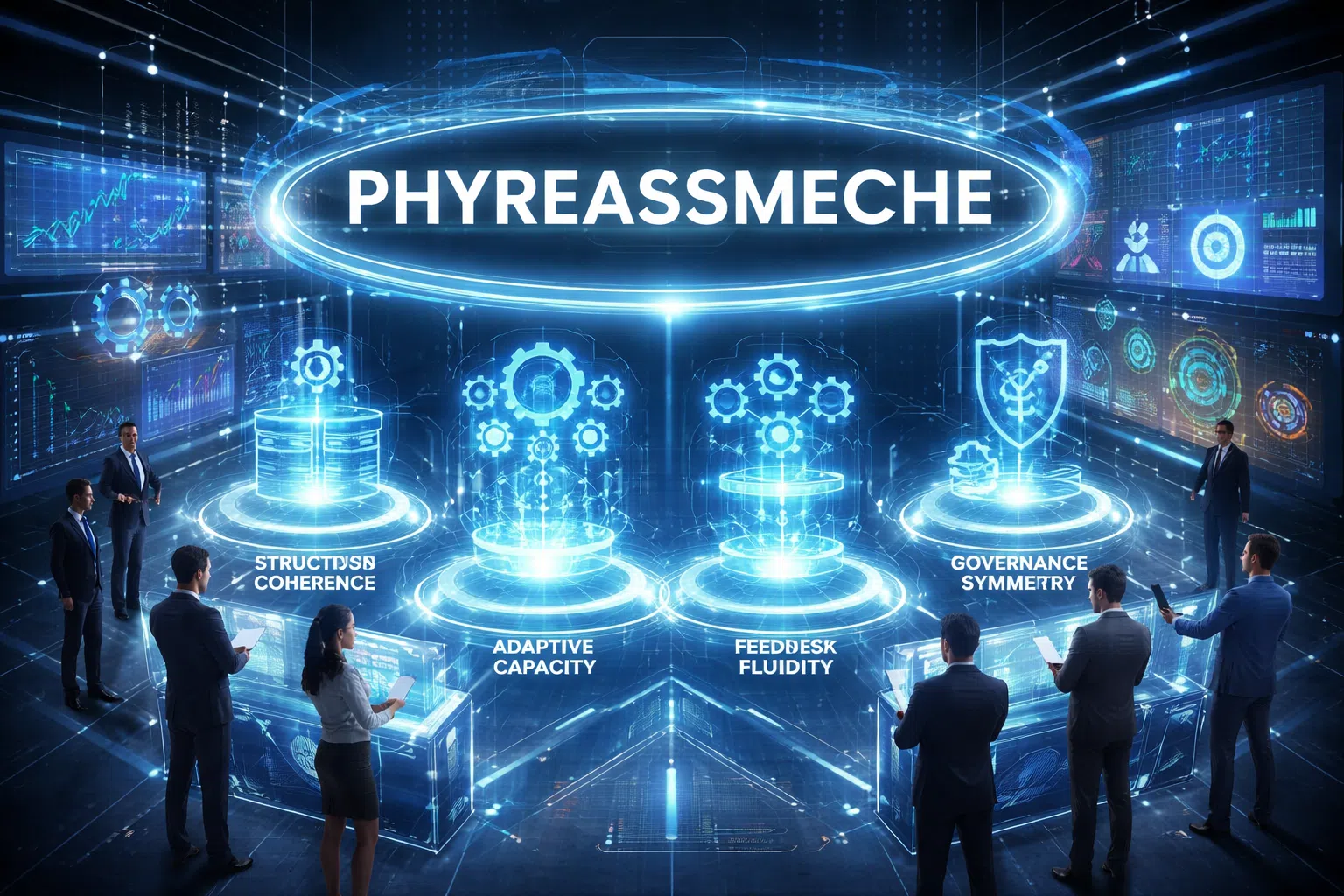
To move from theory to application, phyreassmeche is best understood through four distinct but interdependent pillars. These serve as diagnostic checkpoints for any integration project.
Structural Coherence
Structural coherence examines whether the foundational layers of a system support the weight of added functions. A common failure point in digital transformation, for example, is layering modern analytics tools on legacy data architecture. Phyreassmeche dictates that coherence must be established before capability is expanded.
Practical insight: Before integrating a new CRM with existing ERP software, map the data schema compatibility. If field definitions conflict, the integration will require constant manual intervention—a clear sign of low phyreassmeche alignment.
Adaptive Load Capacity
Systems rarely break under expected stress; they break under variance. Adaptive load capacity measures how well an integration handles deviations from the standard workflow.
Example: In a manufacturing environment, a phyreassmeche-aligned production line does not just perform well at 80% capacity; it maintains quality control during raw material shortages or sudden demand spikes.
Feedback Fluidity
Rigid systems often lack the ability to ingest feedback without shutting down. Feedback fluidity ensures that data from the edge (customer complaints, sensor errors, employee observations) is routed back into the core without requiring a complete system overhaul.
Governance Symmetry
Governance symmetry balances control with autonomy. High phyreassmeche environments do not rely on micromanagement to maintain standards. Instead, they embed governance into the workflow itself, reducing the friction between “doing the work” and “reporting the work.”
Why Phyreassmeche Matters for Long-Term Value
The business case for phyreassmeche extends beyond operational stability. In an era where stakeholders demand both speed and sustainability, organizations that neglect integration durability face significant risk.
Reducing Technical Debt
Every quick fix or siloed implementation adds to technical debt. Phyreassmeche acts as a counterweight by enforcing a minimum standard for how new elements attach to existing ecosystems. This reduces the compounding interest of poor integrations.
Enhancing Cross-Functional Collaboration
When teams operate under a shared understanding of phyreassmeche, the friction between departments decreases. Marketing no longer blames IT for slow campaign deployment, and IT no longer views compliance as a blocker. Instead, both parties work toward a shared structural goal.
Future-Proofing Against Obsolescence
Technologies change, but robust integration logic does not. Organizations that score high on phyreassmeche metrics find it significantly easier to adopt AI, IoT, and automation tools because their base systems are designed to accept new inputs without breaking.
Frequently Asked Questions
The following section is structured to address real-world user queries with concise, factual answers optimized for featured snippets and voice search.
What is phyreassmeche in simple terms?
Phyreassmeche is a professional framework used to ensure that different parts of a system—whether software, hardware, or processes—work together reliably over time, especially when conditions change.
How do you measure phyreassmeche?
Measurement is qualitative and quantitative. Quantitatively, professionals track integration failure rates and recovery time. Qualitatively, they assess how easily new features or policies are adopted without causing system-wide disruption.
Is phyreassmeche only relevant for IT departments?
No. While the terminology is popular in tech sectors, the principles apply to logistics, healthcare administration, construction project management, and financial compliance. Any environment requiring durable integration benefits from it.
What is the difference between phyreassmeche and traditional QA?
Traditional Quality Assurance tests whether a component works. Phyreassmeche tests whether the component works within its intended environment and continues to work as that environment evolves.
Can small businesses implement phyreassmeche?
Yes. Small businesses often implement it informally by choosing flexible software platforms and documenting process dependencies. It is scalable; the complexity of the implementation matches the complexity of the operation.
A Global Perspective on Systems Integration
Despite its technical presentation, the challenge that phyreassmeche addresses is universal. Organizations in Europe, North America, and the Asia-Pacific region all struggle with the tension between standardization and localization.
Neutral Application Example:
A global retailer operating in Brazil, Germany, and Japan cannot use identical inventory software in all three regions due to varying tax codes and shipping infrastructure. However, they can apply phyreassmeche principles to ensure that each regional instance shares a common data structure. This allows headquarters to view global inventory levels while respecting local compliance requirements.
This international applicability reinforces that phyreassmeche is not a regional standard or proprietary method. It is a logic layer that respects local nuance without sacrificing global visibility.
Common Misconceptions About Phyreassmeche
Despite growing awareness, several myths persist regarding this framework. Addressing these misconceptions is essential for accurate implementation.
“It slows down innovation.”
On the contrary, phyreassmeche accelerates sustainable innovation. By preventing fragile integrations, it reduces the time spent firefighting failures, freeing resources for genuine development.
“It is just another name for standardization.”
Standardization seeks uniformity. Phyreassmeche seeks compatibility. Uniformity forces all units to look the same; compatibility allows different units to work together while retaining their unique characteristics.
“It requires heavy documentation.”
While documentation supports transparency, phyreassmeche prioritizes intelligent design over paperwork. A well-designed system requires less documentation because its logic is intuitive and its boundaries are clear.
Practical Steps to Begin Your Phyreassmeche Initiative
For professionals ready to apply this framework, the following roadmap provides a clear starting point.
- Audit Current Integrations: Identify points where two systems or departments touch. Flag any handoff that requires manual data re-entry or generates frequent errors.
- Define Tolerance Levels: Establish what constitutes a “passing” integration. Is it 99.9% uptime? Zero data loss? Sub-second latency? Clarity here is critical.
- Prototype Small Wins: Select one low-risk integration and rebuild it using phyreassmeche principles. Document the before-and-after performance.
- Train for Mindset, Not Mechanics: Educate team leads on the philosophy of structural integrity. If leadership understands why fragile integrations are costly, they will naturally enforce higher standards.
- Review Quarterly: Phyreassmeche is not a one-time certification. Schedule quarterly reviews to assess whether past integrations remain sound under current operational loads.
Building Systems That Last
The professional landscape rewards agility, but true agility is impossible without structural integrity. Phyreassmeche offers a mature, disciplined alternative to the cycle of breaking and fixing that plagues so many modern organizations.
By prioritizing durable integration over temporary performance gains, professionals can build workflows and technologies that do not just function today, but evolve intelligently for the challenges of tomorrow. Whether you are overseeing a multinational supply chain or a single departmental software stack, the principles of phyreassmeche provide the clarity needed to distinguish between complexity and chaos.
Ready to evaluate the integrity of your current integrations? Begin with a simple diagnostic audit of your most critical system handoffs. Identifying friction today is the first step toward building resilience for the future.