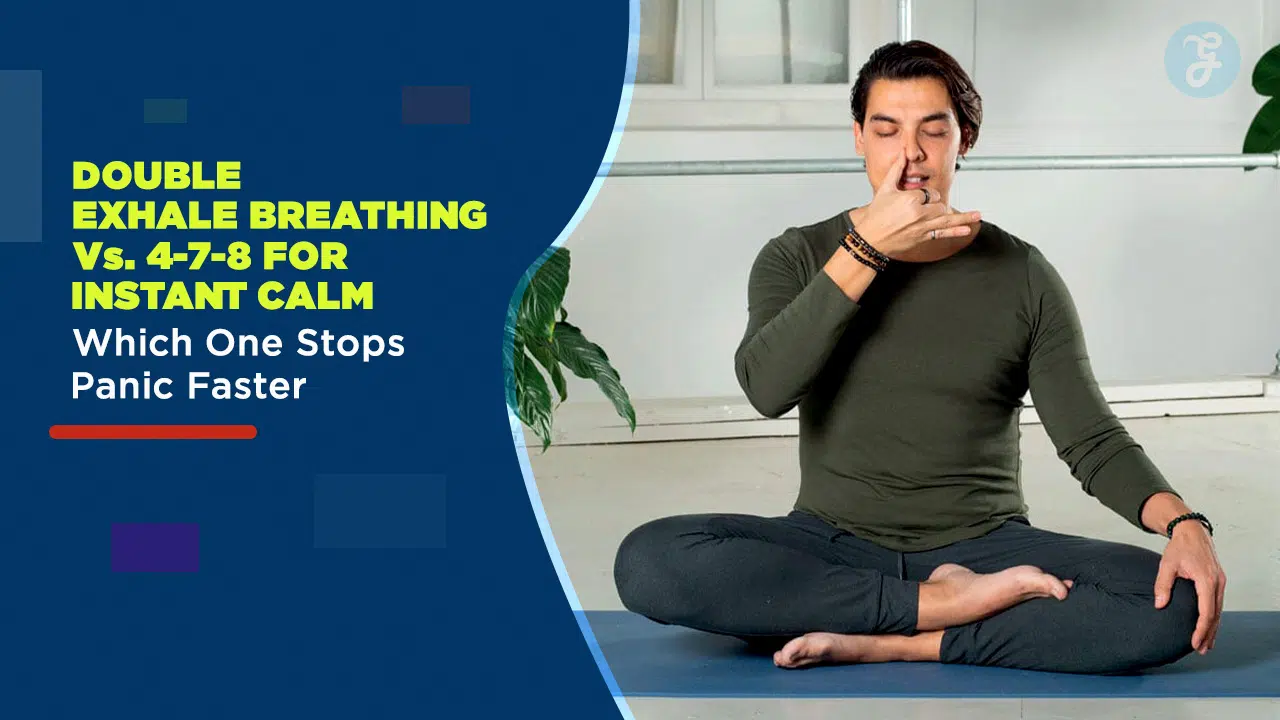
Panic doesn’t give you a heads-up. It doesn’t send an email or a calendar invite. It just hits. One moment, you are fine. The next, your chest feels like it’s being squeezed by a giant fist. Your heart is racing. Your palms are sweaty. The world starts to feel blurry at the edges. When this happens, people always say the same thing: “Just breathe.” But not all breaths are created equal, and knowing the difference between Double Exhale Breathing vs. 4-7-8 for Instant Calm can be the one thing that helps you take your power back when your body feels out of control.
But here is the problem. If you breathe the wrong way during a panic attack, you make it worse. Deep, gasping breaths can lead to hyperventilation. That makes you feel even more dizzy. It’s a vicious cycle.
We have cut through the noise to bring you the two most effective tools for real-life stress. Whether you need an emergency reset or a way to wind down at night, here is how to stop panic in its tracks.
Real Voices: Different Ways We Breathe
From students to CEOs, the modern world is waking up to mental wellness. Yet, even with all this information, many people still don’t know the difference between Double Exhale Breathing vs. 4-7-8 for Instant Calm. These breathing exercises are more than just relaxation techniques; they are biological tools designed to rewire your stress response in real-time.
We all handle pressure in our own way. Ushashi Basu, a student in Kolkata, uses these tools as a quick fix: “I’m well aware of these and I practice whenever I feel anxious.”
Across the globe in the U.S., professional Shagun D Swarup views it as daily maintenance. “Whether I’m anxious or not, I practice it. Life is just stressful these days,” she shares. Then there are people like Delhi-based media professional Yatendra Dixit, who knows the theory but struggles with the routine: “I read about these on the internet, but I hardly find the time to actually practice.”
This guide is for everyone, whether you are a seasoned pro or a total beginner, to help you find what works for you.
Double Exhale Breathing vs. 4-7-8 for Instant Calm
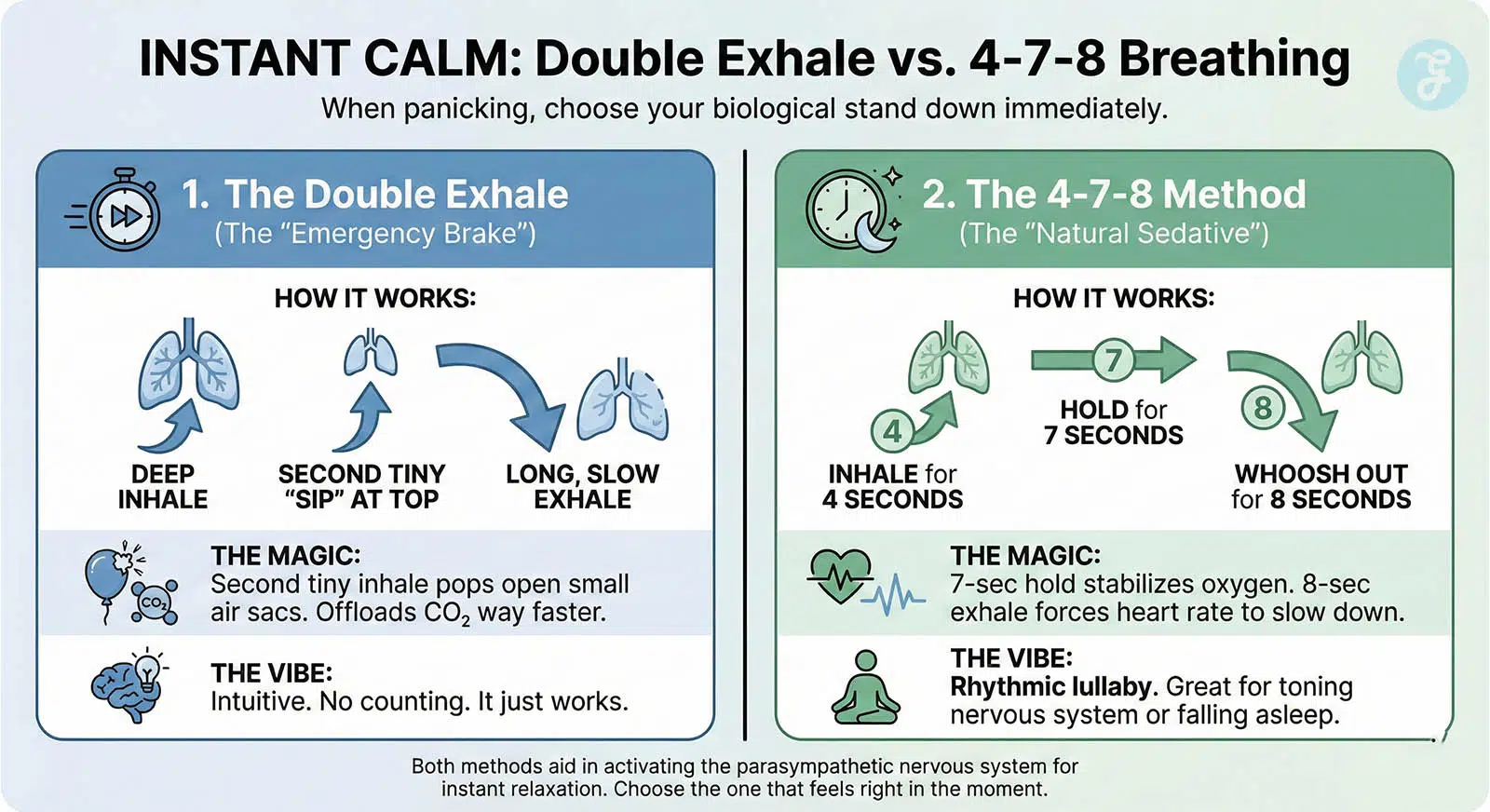
When you are panicking, your brain isn’t in the mood for a math lesson. You need a way to tell your nervous system to “stand down” immediately. Here is the breakdown of the two heavy hitters in the breathing world.
1. The Double Exhale (The “Emergency Brake”)
Think of this as a biological hard reset. Formally known as the Physiological Sigh, it’s the fastest way to dump stress.
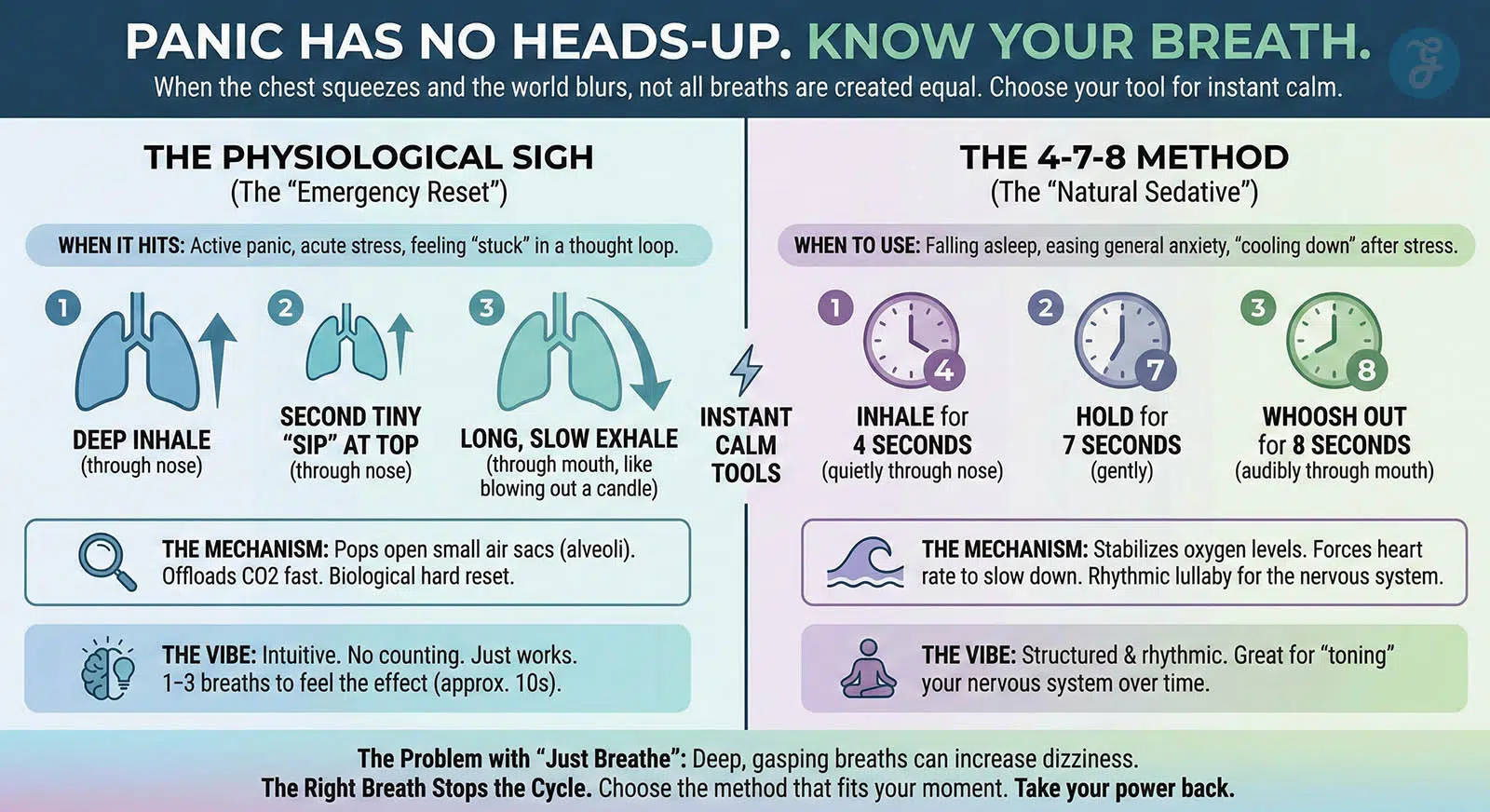
- How it works: You take a deep breath, then sneak in a second tiny “sip” of air at the very top. Then, you let out a long, slow exhale.
- The Magic: That second tiny inhale pops open the small air sacs in your lungs. This helps you offload carbon dioxide way faster than normal breathing.
- The Vibe: It’s intuitive. You don’t have to count. It just works.
2. The 4-7-8 Method (The “Natural Sedative”)
This one is like a rhythmic lullaby for your heart. It was designed to act as a natural tranquilizer for the nervous system.
- How it works: Inhale for 4 seconds, hold for 7, and “whoosh” the air out for 8.
- The Magic: The 7-second hold stabilizes your oxygen levels, while the 8-second exhale forces your heart rate to slow down.
- The Vibe: It’s great for “toning” your nervous system over time or falling asleep.
Why Your Brain Flips the Panic Switch
Before we rank them, you need to understand the “Panic Glitch.” When you get anxious, your body enters Fight or Flight mode. Your amygdala, the brain’s built-in alarm system, starts screaming.
To prepare for a “fight,” your body starts breathing short and shallow. This actually pushes out too much carbon dioxide too fast.
The “Air Hunger” Trap
This creates a strange internal imbalance. Even though you are surrounded by oxygen, your brain starts to think you are suffocating. This is why you feel that terrifying “air hunger,” that sensation where you can’t seem to get a “full” breath no matter how hard you try.
To stop this, we have to hack the Vagus Nerve. Think of this nerve as the secret “off-switch” for stress. It’s the direct line between your lungs and your brain that says, “Hey, the emergency is over. You can stand down now.” Both techniques below target this nerve, but they do it in very different ways.
The Biology of Panic vs. Calm
| Feature | The Panic State (Sympathetic) | The Calm State (Parasympathetic) |
| Heart Rate | Rapid, erratic, “bounding.” | Slow, rhythmic, steady. |
| CO2 Levels | Critically low (hypocapnia). | Balanced/Optimal. |
| Brain Focus | Hyper-vigilant / Tunnel vision. | Expansive / Creative. |
| Breathing Type | Shallow, chest-heavy, fast. | Diaphragmatic, slow, deep. |
The “Nuclear Option”: The Physiological Sigh
If you want the most powerful tool for stopping a panic attack right now, this is it. Popularized by Stanford experts, the Physiological Sigh is actually a built-in reflex you’ve had since birth. You do it in your sleep. Even dogs do it before they settle in for a nap. It is the fastest way to offload built-up carbon dioxide and reset your system.
Why the “Double Inhale” is the Secret
Inside your lungs, you have millions of tiny air sacs called alveoli. When you are stressed, these sacs collapse like deflated balloons. This is why “deep breathing” sometimes feels useless… you can’t get enough air if the sacs are closed. The second “sip” of air at the top of your inhale forces those sacs open, allowing you to breathe fully again.
How to do it (The 10-Second Reset):
- Inhale deeply through your nose.
- At the very top, take a second, tiny “sip” of air.
- Exhale through your mouth very slowly. This is the Double Exhale part. It should be twice as long as the inhale.
Execution Breakdown: Physiological Sigh
| Step | Action | The “Why” |
| Inhale 1 | Deep nasal breath. | Starts the intake of oxygen. |
| Inhale 2 | Short “sip” at the top. | Re-inflates collapsed lung sacs. |
| The Exhale | Slow, audible “sigh.” | Dumps carbon dioxide and slows the heart. |
| Repeat | 1–3 times. | Resets the nervous system instantly. |
Why this beats the rest in a crisis
When comparing Double Exhale Breathing vs. 4-7-8 for Instant Calm, the Sigh wins on speed. In a crisis, you don’t want to count to seven or eight. You just need the carbon dioxide out and the air back in. The Physiological Sigh does exactly that in about ten seconds flat.
The Natural Sedative: The 4-7-8 Method
This is your “Internal Tranquilizer.” Developed by Dr. Andrew Weil, it’s a rhythmic ritual. If the Physiological Sigh is a fire extinguisher used to put out a sudden flame, the 4-7-8 Method is a cooling rain. It is less about “fixing” an immediate crisis and more about “toning” your nervous system so the crisis never starts.
The Power of the 7-Second Hold
Most people are afraid of holding their breath when they feel anxious. However, the 7-second hold creates a brief state of “stasis.” It forces the heart to slow down to accommodate the change in oxygen flow, which stimulates the vagus nerve more intensely than almost any other exercise.
How to do it:
- Inhale quietly through your nose for 4 seconds.
- Hold that breath for 7 seconds.
- Exhale forcefully through your mouth (making a “whoosh” sound) for 8 seconds.
Execution Breakdown: 4-7-8 Method
| Step | Duration | The “Why” |
| Inhale | 4 Seconds | Controlled oxygen intake. |
| Hold | 7 Seconds | Forces heart rate deceleration. |
| Exhale | 8 Seconds | Vagus nerve stimulation & deep relaxation. |
| Practice | 4 Cycles | Cumulative “sedative” effect. |
Why this is your “Maintenance” Tool
When looking at Double Exhale Breathing vs. 4-7-8 for Instant Calm, 4-7-8 is the winner for long-term resilience. While the 7-second hold might feel a bit much during a peak panic attack, practicing this daily builds a “buffer” in your nervous system. It’s the perfect way to wind down before bed or to centre yourself before a high-stakes meeting.
The Right Fit: Which One Should You Use?
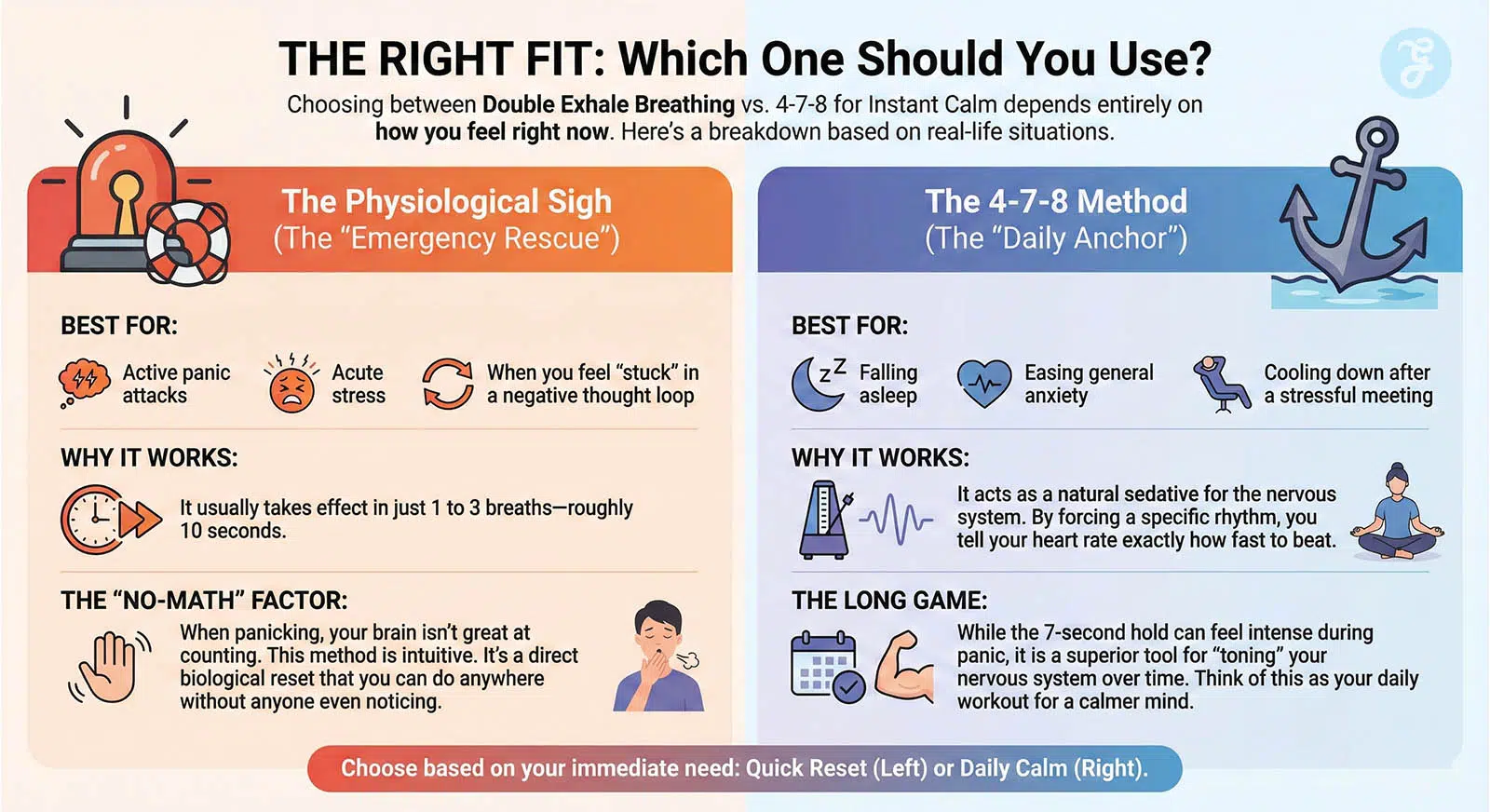
Choosing between Double Exhale Breathing vs. 4-7-8 for Instant Calm depends entirely on how you feel right now. We have broken them down by how they actually work in real-life situations.
The Physiological Sigh (The “Emergency Rescue”)
Best for: Active panic attacks, acute stress, or when you feel “stuck” in a negative thought loop.
- Why it works: It usually takes effect in just 1 to 3 breaths, roughly 10 seconds.
- The “No-Math” Factor: When you are panicking, your brain isn’t great at counting or following complex steps. This method is intuitive. It’s a direct biological reset that you can do anywhere without anyone even noticing.
The 4-7-8 Method (The “Daily Anchor”)
Best for: Falling asleep, easing general anxiety, or “cooling down” after a stressful meeting.
- Why it works: It acts as a natural sedative for the nervous system. By forcing a specific rhythm, you tell your heart rate exactly how fast to beat.
- The Long Game: While the 7-second hold can feel a bit intense during a full-blown panic attack, it is a superior tool for “toning” your nervous system over time. Think of this as your daily workout for a calmer mind.
Strategy: The “Stacking” Method
Don’t wait for a crisis to try these. If you want to master your emotions in 2026, you need a strategy. At Editorialge, we recommend “Breath Stacking.”
- The Break: As soon as you feel the “squeeze” in your chest, do three Physiological Sighs. This stops the panic from escalating.
- The Bridge: Once your heart rate drops, do four cycles of 4-7-8. This locks in the calm and prevents the “rebound” anxiety that often follows a panic attack.
Notice how your shoulders drop? That is you taking the wheel back from your nervous system.
The 2026 Outlook: Mental Health in Real-Time
By the end of 2026, “Breathwork” will no longer be seen as just yoga talk. It is becoming a standard tool for high-performance CEOs and trauma recovery alike. Technology is moving faster than our brains can handle, and these biological “hacks” are the only way to keep up.
What happens next? We predict that wearable tech, like your smartwatch, will soon detect the start of a panic attack before you even feel it, prompting you to perform a Physiological Sigh in real-time. We are moving toward a world where mental wellness is managed in seconds, not months.
Taking Your Power Back
As Ushashi, Shagun, and Yatendra showed us, everyone’s journey with stress is different. You don’t need to be an expert to see results; you just need to start.
If your heart is racing and the world feels loud, lean on the Double Exhale. If you are looking to build a calmer baseline for your life, make the 4-7-8 your daily ritual. Panic might show up without an invite, but now you have the tools to show it the door.
The Final Question
If you can change your entire brain chemistry in just 10 seconds using nothing but your own lungs, why are we still treating stress like it’s a permanent state of being?