For two decades, the “per-seat” license has been the heartbeat of the B2B software industry. If you hired more salespeople, you bought more Salesforce licenses. If you scaled your design team, you bought more Adobe seats. The math was simple: human headcount equaled software value.
But the rise of autonomous AI agents has broken this equation.
We are entering an era where a single AI agent can technically do the work of fifty humans—answering tickets, reconciling invoices, or prospecting leads—without ever “logging in” via a human interface. If a vendor charges $30/month for that agent, they lose massive value. If they charge $30,000 based on output, the buyer carries all the risk.
We are currently in the “messy middle” of this transition. AI agent Pricing models are fragmented, buyers are confused, and CFOs are anxious about uncapped usage bills.
In this guide, you will learn exactly how the software pricing landscape is shifting. We will cover:
- The 6 emerging pricing models replacing the standard seat.
- Pros and cons of usage-based vs. outcome-based billing.
- A decision framework to help you choose the right model for your organization.
- Negotiation tactics to protect your budget from runaway AI costs.
Why Seat-Based Pricing Worked—And Why It’s Under Pressure Now

To understand where we are going, we have to look at why we stayed with seat-based pricing (per-user licensing) for so long. It wasn’t just about greed; it was about stability.
The Original Logic Of Seats (SaaS Era)
In the classic SaaS (Software as a Service) era, the seat was the perfect proxy for value.
- Simplicity: It is incredibly easy to understand. “We have 100 employees, so we need 100 licenses.”
- Forecasting: CFOs love seat-based pricing. It is a fixed, recurring cost. If headcount stays flat, software costs stay flat. There are no surprises at the end of the month.
- Organizational Growth: It aligned vendor revenue with customer growth. If a customer grew successful enough to hire more staff, the vendor got paid more. It was a symbiotic relationship rooted in human scale.
What AI Agents Change
AI agents break the fundamental link between “people” and “software usage.”
Unlike a standard SaaS tool—which waits passively for a human to click a button—an agent is active. It can run 24/7. It can trigger thousands of workflows in an hour. It can scale instantly from processing 10 claims to 10,000 claims without you hiring a single new employee.
In this world, the “user” isn’t a person; the user is a computed entity. Charging for a single “seat” for an AI agent that does the work of an entire department is economically impossible for vendors, and operationally confusing for buyers.
The Core Breakpoint: Value ≠ Human Login Count
The friction point today is that seat pricing actively discourages the efficiency AI promises.
If a company deploys an AI agent that automates 50% of their customer support queries, they might arguably need fewer human seats. In a pure seat-based model, the vendor is penalized for building a better product (automating the work reduces their revenue).
Conversely, buyers face “Seat Hoarding.” To save money, teams might share logins or limit access to the AI tools to only a few “super users,” stifling adoption across the company. The model that fueled the SaaS boom is now the bottleneck for the AI boom.
The New Reality: AI Agents Behave Like Digital Labor
We need a mental shift: AI agents are not software tools; they are digital labor.
Agents As Digital Workers (Not Users)
When you hire an agency to clean your office, you don’t pay for the vacuum cleaner; you pay for the clean floor. Similarly, AI agents are increasingly being viewed through the lens of work units.
- Resolutions: Did the agent resolve the customer ticket?
- Tasks: Did the agent schedule the meeting?
- Workflows: Did the agent process the refund from start to finish?
- Outputs: Did the agent generate the final marketing report?
This shift moves pricing from “access” (paying for the right to use the tool) to “production” (paying for what the tool actually did).
Why Buyers Demand Predictability
Despite the logic of paying for work done, enterprise buyers are terrified of Bill Shock.
In a pure “pay-for-work” model, a misconfigured agent could technically run up a massive bill overnight by engaging in an infinite loop of tasks or token consumption. Furthermore, during the rollout phase, usage patterns are uncertain. Finance teams hate uncertainty. They cannot budget for “maybe $5,000 or maybe $50,000.”
This tension—between the vendor’s need to capture value and the buyer’s need for budget certainty—has birthed six distinct pricing models.
6 Pricing Models Replacing (Or Reshaping) Seat-Based Licensing
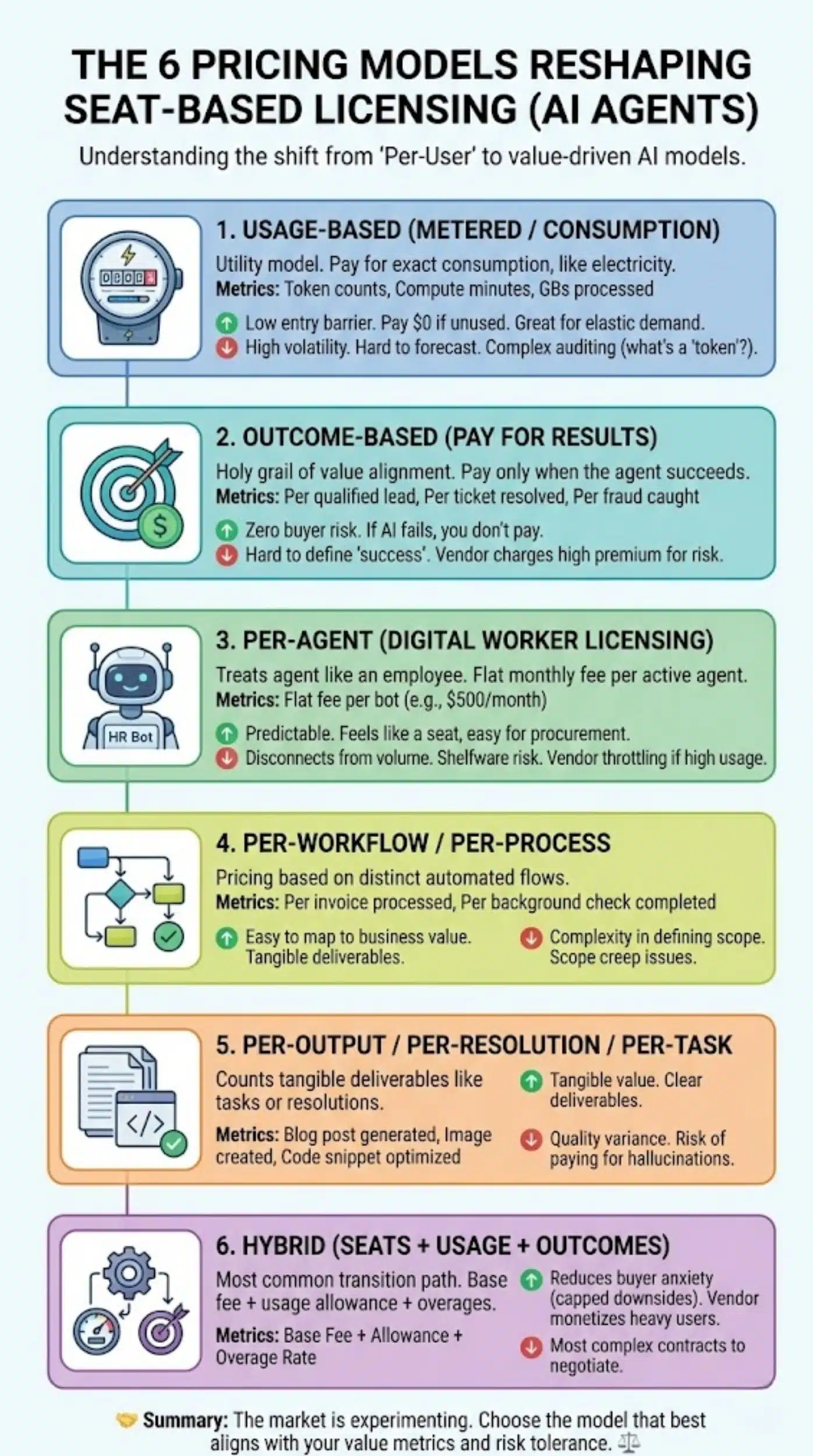
The market is currently experimenting with a mix of these six models. Understanding them is critical for any procurement leader or CTO.
1. Usage-Based (Metered / Consumption)
This is the “utility” model, similar to how you pay for electricity or AWS. You pay for exactly what you consume.
- Metrics: Token counts, compute minutes, or gigabytes processed.
- Pros: Lowest barrier to entry. You pay $0 if you don’t use it. Great for elastic demand.
- Cons: High volatility. It is difficult to forecast costs, and technically complex to audit (what exactly is a “token” to a non-technical CFO?).
2. Outcome-Based (Pay For Results)
This is the “holy grail” of value alignment. You only pay when the agent succeeds.
- Metrics: Per qualified lead generated, per ticket resolved (without human intervention), per fraud attempt caught.
- Pros: Zero risk for the buyer. If the AI is stupid, you don’t pay.
- Cons: Hard to define “success.” (e.g., If the AI answers a ticket but the customer calls back 2 days later, was it resolved?). Vendors often charge a high premium for taking on this risk.
3. Per-Agent (Digital Worker Licensing)
This treats the agent like a bespoke employee. You “hire” an agent for a flat monthly fee.
- Metrics: Flat fee per active agent (e.g., $500/month per “HR Bot”).
- Pros: Predictable. It feels like a seat, so procurement teams understand it easily.
- Cons: Disconnects from volume. If that $500 bot does nothing, you wasted money. If it does a million tasks, the vendor loses money (and may throttle performance).
4. Per-Workflow / Per-Process
Pricing based on distinct automated flows rather than raw inputs or generic agents.
- Metrics: Per invoice processed, per background check completed.
- Pros: easy to map to business value. You know exactly what a “background check” is worth to you.
- Cons: Complexity in defining where a workflow starts and ends.
5. Per-Output / Per-Resolution / Per-Task
Similar to usage, but counting tangible deliverables rather than abstract compute units.
- Metrics: Per blog post generated, per image created, per code snippet optimized.
- Pros: Tangible value.
- Cons: Quality variance. Paying for 100 images is useless if 90 of them are hallucinations.
6. Hybrid (Seats + Usage + Outcomes)
The most common transition path. You pay a base platform fee (Seat/License) which includes a certain allowance of credits (Usage), with overages charged separately.
- Pros: Reduces buyer anxiety (capped downsides) while allowing vendors to monetize heavy users.
- Cons: The most complex contracts to negotiate.
Comparison of AI Agent Pricing Models
| Model | Best Value Metric | Predictability | Vendor Risk | Buyer Risk | Best Fit Use Cases | Common Contract Gotchas |
| Usage-Based | Tokens / Compute Minutes | Low | Low | High (Runaway costs) | Dev tools, APIs, sporadic workloads | undefined overage rates; no spending caps. |
| Outcome-Based | Success / Resolution | Medium | High (Performance risk) | Low | Customer support, Sales development (SDR) | Definition of “Success” (e.g., is a ‘lead’ just an email or a booked meeting?). |
| Per-Agent | Flat Fee per Bot | High | Medium | Medium (Shelfware risk) | Internal employees tools, HR bots, Legal bots | “Throttling” or hidden limits on what the flat-fee agent can actually do. |
| Per-Workflow | Process Completion | High | Low | Medium | Finance (AP/AR), Supply Chain, Ops | scope creep on what constitutes a single workflow. |
| Per-Resolution | Completed Ticket | Medium | Medium | Low | Helpdesk, IT Service Management | Re-opened tickets counting as new resolutions. |
| Hybrid | Base Fee + Overage | Medium-High | Low | Low-Medium | Enterprise-wide deployments | Rollover credits (use it or lose it clauses). |
What Leading Vendors Are Signaling About Agent Pricing
The market is not settled. However, by observing the giants (Microsoft, Salesforce, ServiceNow) and the disruptors (OpenAI, Intercom), we can see two distinct signals.
“Seats Are Back” (Because Enterprises Want Predictability)
Surprisingly, some of the biggest players are doubling down on seats—at least for now. Microsoft Copilot for Microsoft 365, for example, launched with a clear per-user/per-month price tag.
Why? Because large enterprises operate on annual budgets. They cannot issue a blank check for “tokens.” They need a line item. By attaching the AI agent to the human identity (e.g., “Copilot for John”), they make it easy for IT to procure the software using existing channels. This is a defensive move to reduce friction during the early adoption phase.
The Longer-Term Direction: Billing By Agents + Work Done
While “seats” satisfy the accountants today, the product architects are building for a different future.
Industry messaging is increasingly pointing toward “Consumption Credits” (Salesforce’s move with Data Cloud and Einstein). The idea is to sell a “bucket of value.” You might buy 1 million credits a year.
- An email generation costs 1 credit.
- A complex reasoning task costs 10 credits.
- A fully autonomous agent negotiation costs 100 credits.
This abstraction layer allows vendors to keep the “contract” fixed (you buy a bucket) while the “usage” remains variable. It bridges the gap between predictable billing and variable value.
A Practical Framework To Choose The Right AI Agent Pricing Model

If you are buying AI agents today, do not just accept the vendor’s default model. Use this framework to determine what aligns with your business goals.
Step 1 — Define The “Unit Of Value”
Before you look at the price tag, ask: What are we actually buying?
- Are you buying time saved? (e.g., Coding assistants).
- Are you buying outcomes? (e.g., Customer support resolutions).
- Are you buying compute power? (e.g., Raw LLM access).
Tip: If the value is “time saved,” a per-seat model often works well because it maps to the salary of the human saving that time. If the value is “outcomes,” push for outcome-based pricing.
Step 2 — Map Cost Drivers (What Actually Scales Vendor Cost)
Understand the vendor’s margins.
- Tokens/Compute: If the agent uses GPT-4 for complex reasoning, the vendor has high variable costs. They will likely push for usage-based pricing.
- Integrations: If the agent simply queries a database, the cost is low. Flat-fee pricing is safer here.
- Human Oversight: Does the vendor provide “human in the loop” to verify the agent’s work? This usually commands a premium outcome-based fee.
Step 3 — Decide Your Budgeting Priority
You cannot have infinite flexibility and infinite predictability.
- Priority = Predictability: Choose Per-Agent or Per-Seat. You will pay a premium for the certainty, but your CFO will be happy.
- Priority = ROI Alignment: Choose Outcome-Based. You ensure you never pay for shelfware, but monthly bills will fluctuate.
Step 4 — Governance Requirements
- Audit Logs: Usage-based models often provide better granularity on who used the AI and when, which is vital for security and compliance.
- Limits: Can you set hard caps? (e.g., “Stop processing once we hit $5,000”).
Quick Decision Tree
- Are the outcomes clearly measurable (e.g., “Ticket Closed”)?
- Yes $\rightarrow$ Outcome-Based
- Is the usage highly variable and elastic (spiky traffic)?
- Yes $\rightarrow$ Usage-Based (with caps)
- Is governance and budget predictability the #1 concern?
- Yes $\rightarrow$ Per-Agent / Per-Seat
- Is the workflow discrete and repetitive (e.g., invoices)?
- Yes $\rightarrow$ Per-Workflow
Buyer Checklist: How To Avoid Surprises In AI Agent Contracts
AI contracts are new territory for many legal teams. Standard SaaS boilerplate will not protect you.
Contract Clauses To Negotiate
- Usage Caps & Throttling: demand the ability to set “Hard Stops.” If a script goes haywire and consumes 1 million tokens in an hour, who pays? Ensure the contract states you are not liable for usage spikes caused by technical loops or errors.
- Rollover Credits: If you buy a Hybrid model with 10,000 credits/month, do unused credits roll over to the next month? Fight for quarterly or annual buckets rather than monthly “use-it-or-lose-it” terms.
- Included Units (The Definition of “One”): If pricing is per-resolution, define “resolution” rigorously. Does a customer saying “Thank you” re-open the ticket and count as a second charge?
- Overages Pricing: Overage rates are often punitive (2x or 3x the standard rate). Negotiate a pre-agreed “tier” for overages that matches your base rate.
- Data Handling & Training: Ensure a clause exists stating your usage data is not used to train the vendor’s public models unless you explicitly opt-in.
Operational Controls
- Sandbox Testing: Never sign a usage-based contract without a 30-day sandbox period where you can gauge “burn rate” without real billing.
- FinOps Monitoring: Assign a “wallet owner” in your organization. Just like Cloud FinOps, someone needs to review AI agent spend weekly, not annually.
The Future: What “Post-Seat” Pricing Might Look Like
We are moving toward a “Work-as-a-Service” economy.
In the near future, you likely won’t buy “Salesforce seats” or “Customer Support Software.” You will buy “SDR Capacity” or “Support Resolution Capacity.” The pricing will sound less like software licensing and more like outsourcing contracts—except the laborer is digital.
We expect to see:
- Outcome Bundles: “10,000 Resolutions for $5k.”
- Performance Guarantees: Refunds if the agent’s accuracy drops below 95%.
- Hybrid Stickiness: Vendors will cling to the “Platform Fee” (seats) to cover R&D, while using “Usage Fees” to capture the upside of AI scaling.
Final Guidance: Stop tracking headcounts. Start tracking value units. The sooner you map your organization’s costs to outcomes rather than logins, the better prepared you will be for the AI agent revolution.
Final Thoughts
The transition away from seat-based pricing is not just a billing update; it is a fundamental recognition that software is no longer just a tool we use, but a laborer we employ. Clinging to the old “per-head” model in an AI-first world is a strategic error. It incentivizes you to limit the very technology that creates efficiency, or it forces vendors to cap the intelligence of the agents they sell you. To fully leverage AI, your procurement strategy must evolve from counting logins to auditing outcomes.
Ultimately, the companies that thrive in this new era will be those that stop treating AI costs as IT overhead and start treating them as workforce operational expenses. We are witnessing the birth of the digital workforce, and just as you wouldn’t pay a factory worker based on how many times they walked through the front door, you shouldn’t pay for AI agents based on how many humans oversee them. The future belongs to those who can accurately measure—and pay for—results.