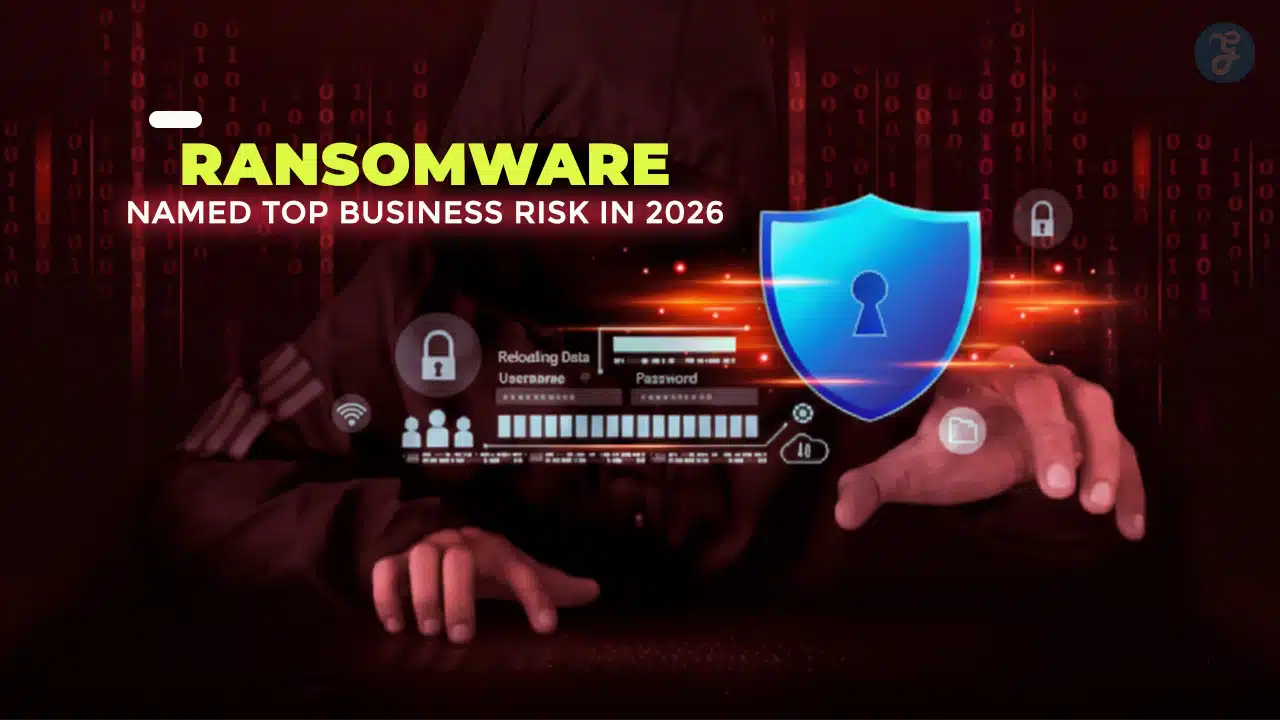
In a landscape defined by “permacrisis,” the 2026 Allianz Risk Barometer has delivered a sobering verdict: for the fifth consecutive year, “Cyber Incidents” dominate the global risk hierarchy. But the headline hides a more volatile shift. While Cyber retains the crown, Artificial Intelligence has surged from #10 to #2—the most dramatic rise in the report’s history. We are no longer facing human hackers; we are facing an automated, self-healing, and “agentic” threat landscape that is rewriting the rules of corporate survival.
Key Takeaways: The 2026 Risk Landscape
The 2026 Allianz Risk Barometer serves as a global bellwether, surveying over 3,000 risk experts. The findings this year signal a definitive shift from “physical” to “algorithmic” volatility.
- Cyber’s 5-Year Reign: “Cyber Incidents” (Ransomware, IT outages, Data breaches) secured the #1 spot (42% of responses) for the fifth consecutive year. It is no longer a fluctuating risk; it is a permanent operational baseline.
- The “AI Shock”: Artificial Intelligence recorded the fastest rise in the report’s history, rocketing from #10 in 2025 to #2 in 2026. This surge reflects corporate anxiety over “Shadow AI,” deepfakes, and the lack of regulatory guardrails.
- Malware Automation: The report cites a 300% increase in AI-driven malware in Q1 2026 alone. Attackers are using “Agentic AI” to automate the hacking lifecycle, reducing the time from “entry” to “encryption” from days to minutes.
- The “Uninsurable” Drift: With the average cost of a data breach stabilizing at a record high of ~$5.08 million, insurers are tightening exclusions. There is a growing fear that critical sectors (healthcare, energy) are becoming effectively uninsurable for cyber risks.
- Supply Chain as a Weapon: Business Interruption (#3) is now inextricably linked to cyber. Attackers are shifting tactics to “Connector Compromise,” targeting the software supply chain to paralyze thousands of downstream companies with a single blow.
Evolution of Cyber Risk: From IT Issue to Existential Threat
To understand the gravity of the 2026 findings, we must look at the trajectory of the last half-decade. Five years ago, cyber risk was largely a technical concern—a “fix-it” ticket for the IT department. Today, it is a solvency crisis. The shift began in earnest during the post-pandemic digital acceleration (2021-2023), where remote work expanded the attack surface. By 2024 and 2025, the “industrialization” of cybercrime took hold, with Ransomware-as-a-Service (RaaS) models lowering the barrier to entry.
Now, in 2026, we have crossed the “AI Rubicon.” The Allianz report highlights that while the category of risk (Cyber) remains the same, the mechanics of the threat have mutated. We have moved from static phishing emails to hyper-personalized, AI-generated campaigns, and from manual hacking to “agentic” attacks where software autonomously probes defenses. The 2026 Barometer isn’t just a list; it is a warning that our digital dependencies have outpaced our defensive maturity.
The Anatomy of a Hyper-Threat
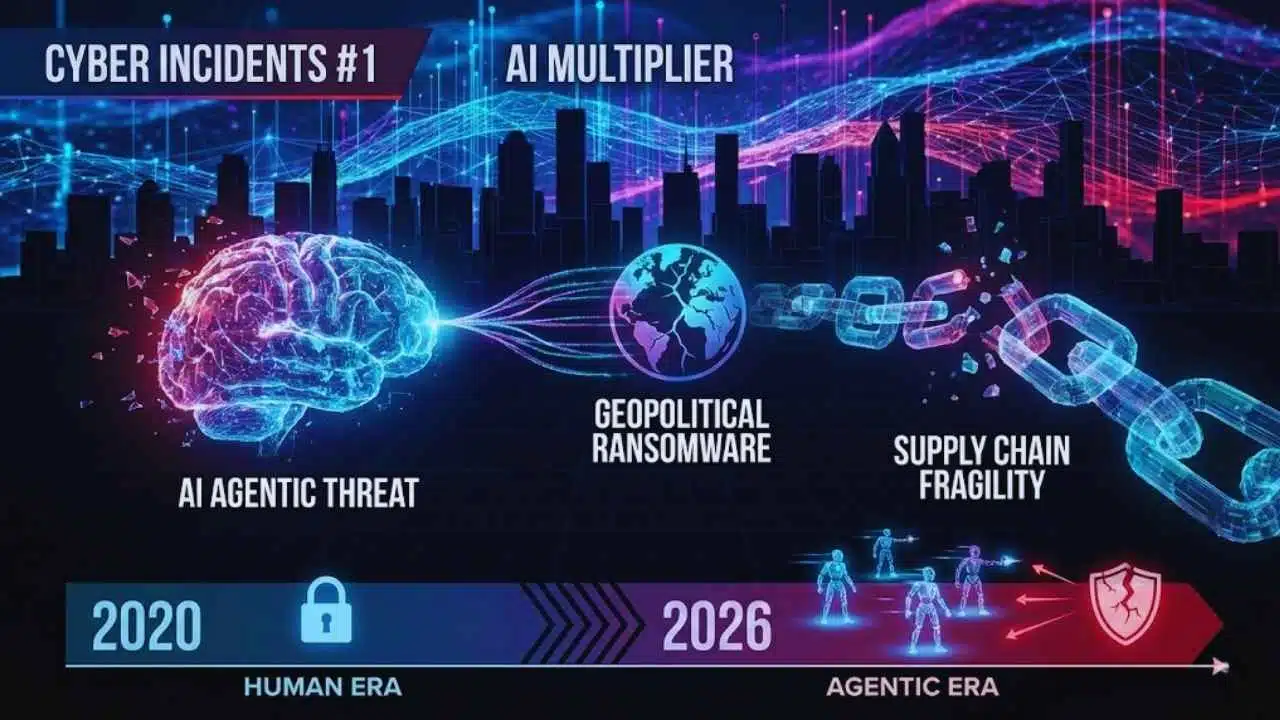
The retention of the top spot by “Cyber Incidents” combined with the meteoric rise of AI signals a new era of “Algorithmic Risk.” Here is why this matters now.
The AI Multiplier: From Script Kiddies to Agentic Threats
The most alarming finding in the 2026 report is the correlation between Risk #1 (Cyber) and Risk #2 (AI). In previous years, attackers used AI merely to polish phishing emails or translate ransom notes. In 2026, we are witnessing the deployment of “Agentic AI”—autonomous malware agents that can reason, adapt, and rewrite their own code to evade detection in real-time.
This “democratization of devastation” means a novice hacker can now deploy distinct, nation-state-caliber attacks simply by prompting a malicious AI model. This volume overwhelms traditional Security Operations Centers (SOCs) that rely on human analysts. The report notes that AI-driven malware attacks surged by nearly 300% in Q1 2026 alone, a direct result of these automated toolkits becoming widely available on the dark web.
The Evolution of Cyber Threats (2020 vs. 2026)
| Feature | 2020 (The Human Era) | 2026 (The Agentic Era) | Impact on Business |
| Attack Origin | Human hacker groups (e.g., REvil, DarkSide) | AI-driven autonomous agents & RaaS affiliates | Speed: Attacks happen in seconds, not days. |
| Phishing Quality | Generic, often riddled with typos | Hyper-personalized, deepfake-enhanced | Trust: Zero-trust verification is now mandatory. |
| Ransomware Strategy | Data Encryption (locking files) | Triple Extortion (Lock + Leak + Harass clients) | Liability: Lawsuits from customers and regulators. |
| Defensive Posture | Reactive (patching after breach) | Predictive (AI vs. AI combat) | Cost: Security budgets must double every 3 years. |
The Geopolitics of Ransomware (G-RaaS)
Ransomware has evolved into a geopolitical weapon. The lines between state-sponsored actors and criminal gangs have blurred, giving rise to Geopolitical Ransomware-as-a-Service (G-RaaS). State actors are increasingly tolerating or even steering cybercriminal groups to target critical infrastructure in rival nations—hiding espionage behind the veil of financial extortion.
This complicates insurance claims and government response: Is a hospital blackout a crime, or is it an act of cyber-warfare? The Allianz report indicates that Business Interruption (#3) is now inextricably linked to these geopolitical cyber-strikes. A single attack on a port or logistics hub can freeze global supply chains for weeks.
The “Truth Layer” Collapse
With AI deepfakes becoming indistinguishable from reality, businesses face a crisis of verification. The “Cyber Incident” category now encompasses synthetic identity fraud. CEO fraud—where an executive’s voice or likeness is cloned to authorize fund transfers—is no longer a novelty; it is a standard attack vector.
This erodes the fundamental trust required for digital commerce. Companies are being forced to implement friction-heavy protocols (e.g., physical callbacks, biometric multi-factor authentication) that slow down operations, effectively creating a “security tax” on productivity.
Supply Chain Fragility: The “Everything” Outage
The report underscores that Business Interruption is rarely a standalone event; it is a byproduct of cyber failure. In 2026, supply chains are digital chains. A single breach in a middleware provider or a cloud service can cascade into a global outage. Attackers are increasingly utilizing “Connector Compromise”—poisoning a single software update or API to infect thousands of downstream users simultaneously.
Top 5 Global Business Risks (Allianz Risk Barometer 2026)
| Rank | Risk Category | % of Responses | 2025 Rank | Trend Analysis |
| #1 | Cyber Incidents | 42% | #1 | Steady: Remains the top concern due to RaaS profitability and high disruption costs. |
| #2 | Artificial Intelligence | 32% | #10 | SURGE: The fastest riser in history. Driven by deepfakes, shadow AI, and regulatory unknowns. |
| #3 | Business Interruption | 25% | #2 | Slight Drop: Still critical, but viewed as a consequence of Cyber and Geopolitics. |
| #4 | Regulatory Changes | 18% | #7 | Rising: New AI laws (EU AI Act) and trade protectionism are creating compliance bottlenecks. |
| #5 | Natural Disasters | 27% | #2 | Variable: While climate risks are high, immediate cyber threats are viewed as more probable. |
(Note: Percentages may overlap as respondents select multiple risks)
Economic Impact & Data Visualization
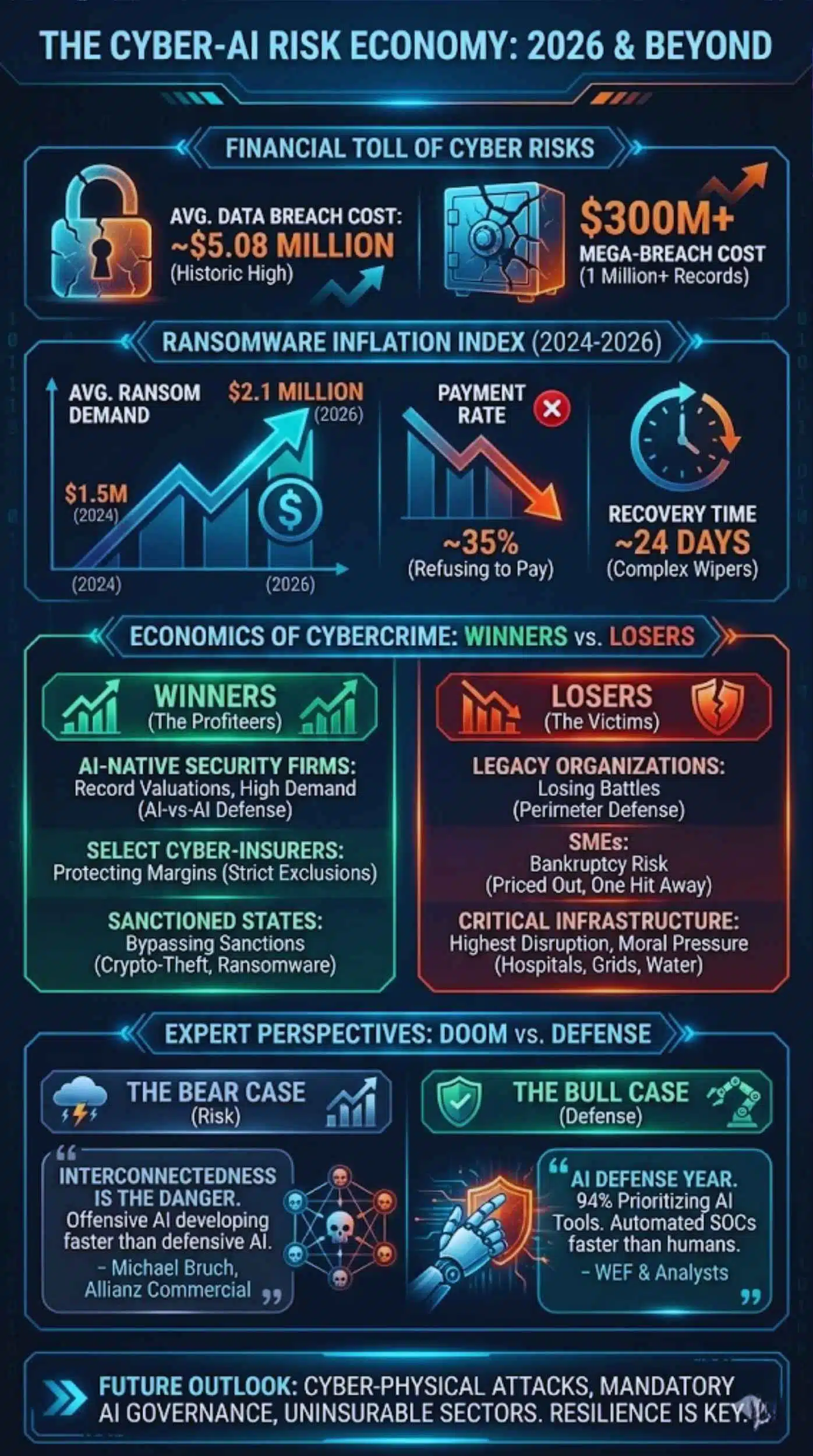
The financial toll of these risks is staggering. The average cost of a data breach has stabilized at a historic high of ~$5.08 million in 2026, but for “mega-breaches” (involving 1 million+ records), costs can exceed $300 million.
The Economics of Cybercrime: Winners vs. Losers
| Category | Winners (The Profiteers) | Losers (The Victims) |
| Technological | AI-Native Security Firms: Vendors offering “AI-vs-AI” defense are seeing record valuations and demand. | Legacy Organizations: Companies relying on perimeter defense (firewalls) rather than Zero Trust are losing battles daily. |
| Operational | Cyber-Insurers (Selectively): Those with strict exclusions and high premiums are protecting margins. | SMEs: Small businesses priced out of cyber insurance are one ransomware hit away from bankruptcy. |
| Geopolitical | Sanctioned States: Using crypto-theft and ransomware to bypass traditional sanctions and fund operations. | Critical Infrastructure: Hospitals, power grids, and water utilities face the highest disruption costs and moral pressure to pay. |
The “Ransomware Inflation” Index
- Average Ransom Demand (2026): $2.1 Million (Up from $1.5M in 2024).
- Payment Rate: Dropping to ~35% (Companies are refusing to pay due to better backups and legal restrictions).
- Recovery Time: Increasing to ~24 days (Due to the complexity of “wipers” used by attackers).
Expert Perspectives
To maintain a balanced view, we must weigh the “Doom” narrative against the “Defense” narrative.
The Bear Case (The Risk)
Michael Bruch, Global Head of Risk Consulting at Allianz Commercial, emphasizes that the “interconnectedness” of risks is the real danger. He notes, “While large corporations benefit from investments in cybersecurity and resilience, threats are constantly evolving. The increasing reliance on third-party suppliers and AI-driven systems expands the attack surface and exacerbates vulnerabilities.” The concern is that offensive AI is currently developing faster than defensive AI.
The Bull Case (The Defense)
The World Economic Forum (WEF) and other analysts suggest that 2026 is also the year of “AI Defense.” 94% of organizations are now prioritizing AI security tools. Automated SOCs can detect anomalies faster than any human. We are not defenseless; we are simply in an arms race. If organizations can survive the initial “AI shock,” defensive capabilities may eventually outpace offensive ones due to superior resource pooling by white-hat vendors.
Future Outlook: What Next?
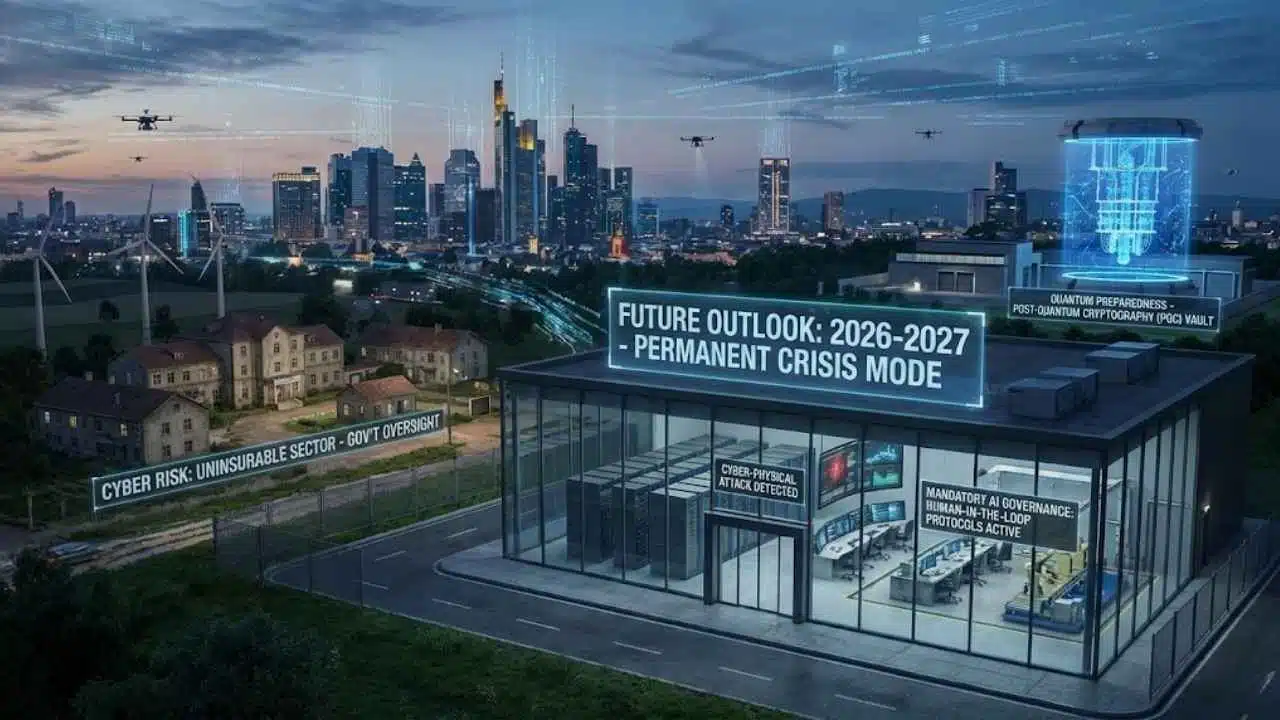
The dominance of cyber risk in the 2026 Allianz barometer signals that we are in a “permanent crisis” mode. Here is what to watch for in the remainder of 2026 and into 2027:
- The Rise of “Cyber-Physical” Attacks: Expect ransomware to move beyond data encryption to controlling physical systems (OT)—shutting down factory floors, manipulating HVAC systems in data centers, or unlocking smart-locks in secure facilities. The bridge between “digital code” and “physical damage” will shorten.
- Mandatory AI Governance: Governments will likely move from “guidelines” to “mandates.” Expect strict liability laws for companies that use AI code without human oversight, effectively forcing a “human-in-the-loop” by law.
- The “Uninsurable” Sector: We may see certain sectors (e.g., rural healthcare or aging municipal energy grids) becoming effectively uninsurable for cyber risk, forcing governments to step in as the “insurer of last resort.”
- Quantum Preparedness: While not in the top 5 yet, the threat of “Harvest Now, Decrypt Later” (where attackers steal encrypted data to unlock it later with quantum computers) will drive a new wave of spending on Post-Quantum Cryptography (PQC).
Final Thoughts
The Allianz Risk Barometer 2026 is a wake-up call that “digital transformation” has a dark twin: “digital risk.” The 300% rise in AI-driven malware is not a statistic to be filed away; it is a signal that the rules of engagement have changed. Businesses can no longer treat cybersecurity as an IT problem—it is now a dynamic, strategic survival imperative. The winners in 2026 will not be those who avoid attacks, but those who can withstand them through resilience, redundancy, and AI-enabled defense.