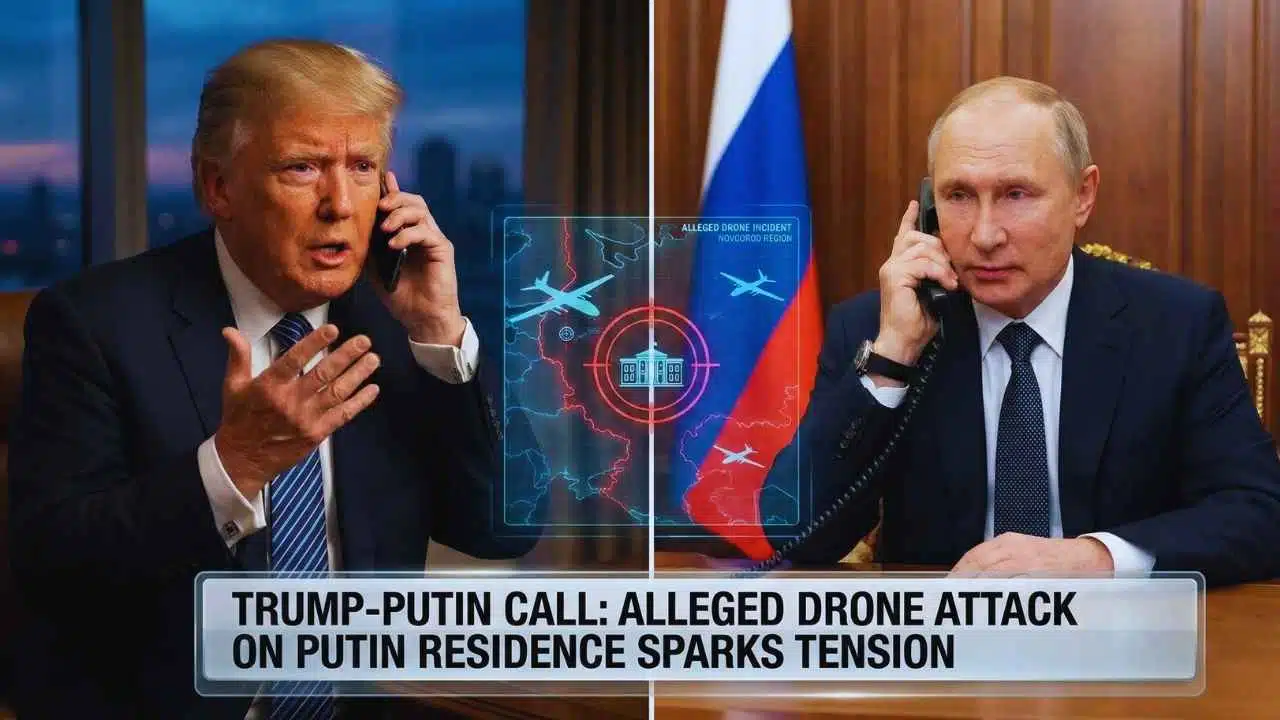
Russia claims Ukraine tried a large drone strike on a Putin-linked state residence in Russia’s Novgorod region; Trump voiced anger after speaking with Putin, while Ukraine called the allegation “a lie” and warned of escalation.
What’s Being Claimed, And What Each Side Says?
Russia says Ukraine attempted to strike a state residence associated with President Vladimir Putin in the Novgorod region using 91 long-range drones. Russian officials say air defenses neutralized the drones and that there were no reported casualties and no confirmed damage released publicly.
Ukraine’s leadership flatly denies trying to attack Putin’s residence. President Volodymyr Zelenskyy described the allegation as false and argued Russia is using it to disrupt diplomacy and create justification for further strikes, including against government buildings in Kyiv.
Trump’s reaction became a key headline because it places the alleged incident directly inside high-level U.S.-Russia contacts. After speaking with Putin, Trump said he was upset about the reported targeting of a leader’s residence and suggested it was especially risky at a moment when the U.S. is pushing for steps toward a settlement. The Russian side also described Trump as “shocked” by the claim, though public U.S. messaging has emphasized the broader goal of moving the war toward negotiations rather than commenting in detail on evidence.
A separate point added to the controversy: Russia’s account of the call included the claim that Trump emphasized the U.S. had not provided Ukraine with Tomahawk missiles. Public U.S. statements have not confirmed that specific exchange, and the missile issue has become part of the wider information battle around what Washington is and is not supplying.
What We Know About The Alleged Drone Attack—And What We Don’t?
The reported target is described as a state residence in the Novgorod region in northwestern Russia—an area that includes sites long linked in open-source reporting to presidential use. Some public references identify the site as the Dolgiye Borody/Valdai/Uzhin presidential residence complex, which is frequently described as heavily guarded and remote.
Russia’s headline figure—91 drones—is significant because it frames the incident as large and coordinated. Yet several key details remain unclear in public reporting:
- Evidence: Russia has not released a detailed, independently verifiable public package of evidence showing the drones’ launch points, routes, and the precise intended impact location inside the residence complex.
- Timing: Russia’s account ties the alleged attempt to the period immediately following high-level political contacts involving Trump and Zelenskyy.
- Presence: It is not publicly confirmed whether Putin was at the residence at the time.
- Scale vs. outcome: Russia’s claim that 91 long-range drones were involved, combined with statements that all were neutralized, leaves a gap that outside observers often focus on: large attacks typically produce some visible debris field, public footage, or local accounts—none of which have been widely verified so far.
Because of those gaps, the story has quickly become less about a single tactical event and more about how both sides are using the allegation politically.
Key Claims And Verified Public Signals
| Issue | Russia’s Position | Ukraine’s Position | Public Verification Status |
| Target | State residence linked to Putin in Novgorod region | Denies any such attempt | Not independently confirmed in full detail |
| Scale | 91 long-range drones | Denies attack occurred | Drone count not independently verified publicly |
| Outcome | Drones neutralized; no injuries reported | Says claim is fabricated | No shared public forensic record |
| Meaning | “State terrorism” framing; warns stance may harden | Says Russia seeks pretext to escalate | Diplomatic impacts visible, facts disputed |
Diplomatic Context: Why This Landed At A Sensitive Moment?
The allegation surfaced alongside intensified political contact involving Washington, Moscow, and Kyiv. That timing matters because diplomatic processes are often fragile, and narratives about “bad faith” can derail even limited confidence-building measures.
In late December, Trump met Zelenskyy at Mar-a-Lago (Florida) and then spoke with Putin by phone. According to accounts released by the Russian side, Trump briefed Putin on the Zelenskyy meeting and the broader negotiating environment. Russia says Putin then raised the alleged drone attempt on the Novgorod residence and warned that Russia’s approach to talks could be reconsidered.
Ukraine, meanwhile, has emphasized that any peace track must include enforceable security guarantees and clear terms. Ukraine’s leadership has also argued that Russia frequently uses information operations to shape international reactions before major strikes or shifts in posture.
Trump’s public reaction matters for two reasons:
- It signals sensitivity to targets that are symbolic or personal (a leader’s residence), which can be framed as escalation even if no damage occurred.
- It increases pressure for verification—because the U.S. is being asked, implicitly or explicitly, to react politically to a claim that remains disputed.
A Timeline Of The Latest Sequence
| Date (2025) | What Happened | Why It Matters |
| Dec 28 | Trump and Zelenskyy meet in Florida | U.S.-Ukraine coordination as diplomacy continues |
| Dec 29 | Putin and Trump speak by phone | Russia raises the alleged residence drone attempt |
| Dec 29 | Russia publicly alleges 91 drones targeted the residence | Frames incident as major escalation |
| Dec 29–30 | Ukraine denies and calls it “a lie” | Warns of pretext for Russian retaliation and pressure tactics |
Potential Military And Political Implications
Even without independent confirmation, allegations like this can shift the conflict environment because leaders react to the narrative as much as the underlying facts.
1) Retaliation Risk And Target Selection
Russia’s officials have indicated the incident would not “go unanswered” and suggested targets had been identified for retaliation. Ukraine has warned that Russia may use the claim to justify strikes on government institutions in Kyiv.
If Russia chooses to retaliate under this framing, the risk is that each side expands its definition of “legitimate targets,” raising the chance of:
- Broader strikes on political or symbolic sites
- Increased attacks on infrastructure
- Higher civilian risk if air-defense saturation tactics intensify
2) Negotiations Could Harden, Not Halt
Russia has signaled it may reassess its negotiating stance while not fully abandoning dialogue. That kind of position can look like a warning shot: talks continue, but terms tighten.
In practice, a hardening stance could appear as:
- Less flexibility on territorial questions
- More conditions attached to ceasefire proposals
- Demands for limits on Western military support to Ukraine
Ukraine is likely to answer by reinforcing its core message: any deal must be enforceable and not simply freeze the war on terms that allow Russia to regroup.
3) The Information War Becomes The Battlefield
This episode shows how quickly the war turns into competing narratives:
- Russia frames the claim as “state terrorism” aimed at leadership.
- Ukraine frames it as a fabricated story meant to sabotage diplomacy.
- Trump’s reaction creates a third dimension: U.S. domestic and diplomatic signaling.
This triangle matters because Washington’s posture influences allied unity, sanctions, and military aid coordination—key levers in the conflict.
4) Symbolic Targets Raise Escalation Sensitivity
A claimed strike on a leader’s residence—especially one publicly linked to the presidency—carries symbolic weight even if no damage occurs. It can be used to justify stronger measures, rally domestic support, or delegitimize the other side’s diplomatic proposals.
That is why verification is central. When claims involve high-profile targets, the political impact often arrives first, and evidence debates come later—sometimes too late to prevent escalation decisions.
What Happens Next To Watch For?
Several near-term signals will indicate whether the dispute becomes a turning point or another episode in the war’s information churn.
Evidence And Independent Corroboration
The most important next step is whether Russia releases verifiable public material—such as radar tracks, drone debris documentation, geolocated imagery, or a clear reconstruction of the alleged attack route. Without that, the allegation will remain contested and politically weaponized.
Russian Follow-Through On Retaliation Language
If Russia escalates with strikes framed as “retaliation,” watch for:
- Target type (military vs. government vs. infrastructure)
- Strike scale (limited vs. mass)
- Messaging (whether Moscow says it is responding directly to the residence allegation)
U.S. Messaging And Diplomatic Pressure
Trump’s anger signals concern, but the practical question is whether Washington uses this moment to push restraint, demand evidence, or accelerate negotiations. If U.S. statements focus on “steps toward settlement,” it suggests Washington wants to prevent the allegation from derailing talks even if the narrative remains disputed.
Ukraine’s Diplomatic Counter-Messaging
Ukraine is likely to keep emphasizing two points: denial of the specific allegation and warnings that Russia may be building justification for larger strikes. Kyiv’s next diplomatic moves will probably focus on keeping U.S. and allied support aligned and preventing a narrative shift that blames Ukraine for sabotaging diplomacy.
The “Putin residence drone attack” claim has become a diplomatic stress test. Russia is presenting it as a major escalation and a reason to reassess its negotiating stance. Ukraine is calling it a fabrication designed to derail peace efforts and justify retaliation. Trump’s visible anger after speaking with Putin adds pressure for clarity, because U.S. signaling can shape what happens next.
Until stronger evidence emerges publicly, the most concrete reality may be the political impact: both sides are using the allegation to frame the other as acting in bad faith—exactly the dynamic that makes negotiations harder and escalation easier.