

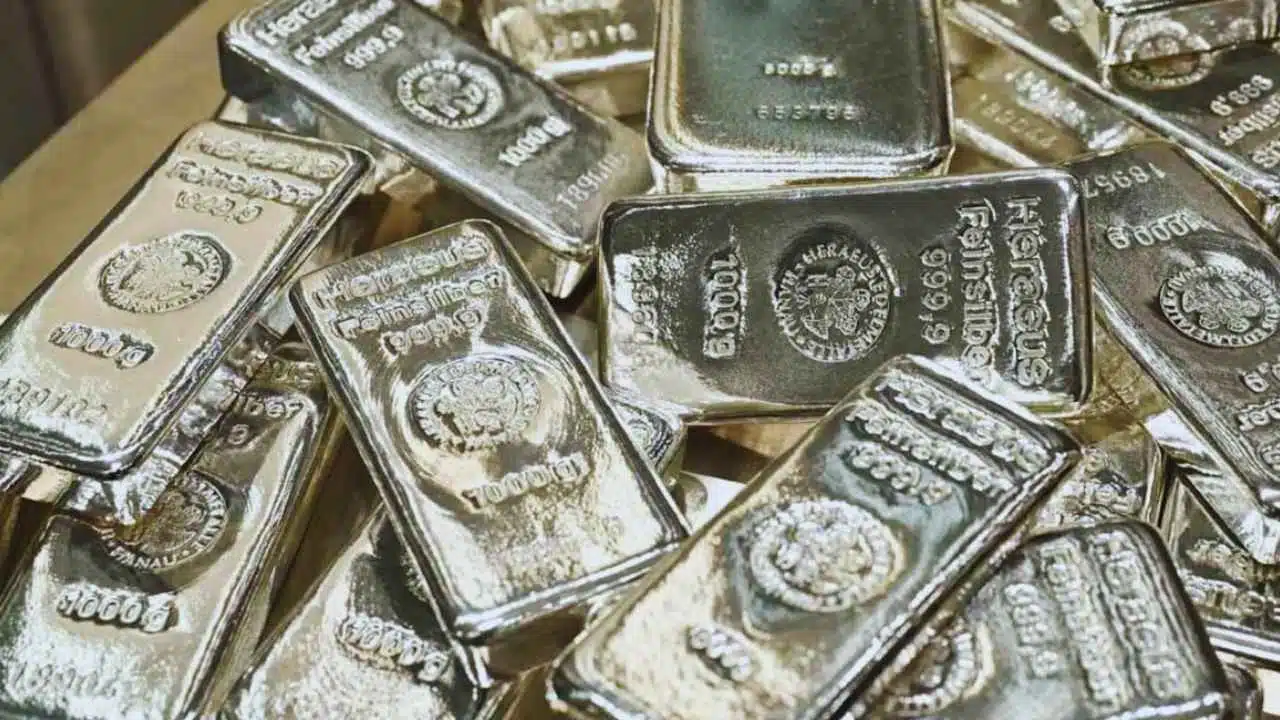
Gold and silver hit record highs in mid-December 2025 as the U.S. Federal Reserve cut rates, inflation cooled, and investors sought safety while tight silver supply and strong industrial demand pushed prices higher.
Market snapshot: where prices hit records and how fast they moved?
Gold and silver surged to fresh records this week, extending a rally that has been building through 2025. While both metals can move on the same macro forces—interest rates, the U.S. dollar, and global risk—silver’s smaller and more thinly traded market often makes its swings sharper.
In trading during the week of December 15–19, 2025, gold hovered near the $4,300 per ounce region and set new records in U.S. futures. Silver surged past $65 and pressed into the mid-$60s, a level that marked a historic breakout for the metal.
Here’s a simplified view of the key reference points investors were watching:
| Metal | Benchmark | Record area reached (mid-Dec 2025) | Why it mattered |
| Gold | Spot (cash market) | Around $4,300/oz | Signals global demand for immediate delivery |
| Gold | U.S. futures (COMEX) | Around $4,347.50/oz (record settle) | “Front-month” contracts are heavily traded and drive hedging |
| Silver | Spot (cash market) | Above $65/oz; highs near $66–$67/oz | Historic level tied to both safe-haven flows and industrial demand |
Spot vs. futures, in plain language: Spot is the price for immediate settlement in the cash market. Futures are standardized contracts for delivery later. Futures can trade above or below spot based on interest-rate expectations, financing costs, and trading demand.
The speed of the move also stood out. Silver’s rise in 2025 has outpaced gold’s, and the gap is one reason analysts have been warning that silver may stay volatile even if the broader trend remains bullish. When momentum traders and hedgers rush into a smaller market at the same time, prices can overshoot in both directions.
The biggest driver: the Fed cut rates and markets priced in easier policy
The clearest near-term catalyst came from U.S. monetary policy.
On December 10, 2025, the Federal Reserve cut its benchmark interest rate by 0.25 percentage point, bringing the federal funds target range to 3.50%–3.75%. The Fed has emphasized that future decisions will depend on incoming data rather than a fixed path.
Why rate cuts tend to support gold and silver?
Gold and silver do not pay interest. That makes their attractiveness highly sensitive to what investors can earn elsewhere, especially in cash and government bonds.
When interest rates fall:
- The opportunity cost drops. Investors give up less yield by holding gold or silver.
- The U.S. dollar can lose momentum. A softer dollar often supports dollar-priced commodities.
- Risk hedging becomes more appealing. Rate cuts can signal that policymakers see slowing growth or rising risks, which often increases demand for “safe haven” assets.
Inflation data added fuel—while also raising questions about measurement
The week’s rally was reinforced by U.S. inflation data released on December 18, 2025, showing:
- Headline CPI: up 2.7% year over year (November 2025)
- Core CPI (excluding food and energy): up 2.6% year over year (November 2025)
Those numbers supported the idea that inflation pressures are cooling, which can give the Fed more room to keep easing over time.
At the same time, investors have been cautious about reading too much into a single report because U.S. government funding disruptions affected the flow and collection of official economic data earlier in the fall. That uncertainty itself can drive demand for gold and silver, because when confidence in the “macro picture” weakens, hedging activity usually rises.
“Data dependence” is now the market’s base case
After the December rate cut, investors shifted their focus to what could change the Fed’s next steps:
- labor-market signals (job growth, unemployment, wages).
- inflation persistence (especially housing and services inflation).
- financial conditions (credit spreads, banking liquidity, market volatility).
This is the environment in which precious metals often thrive: not because every data point is bullish, but because uncertainty keeps hedging demand alive.
Why silver is leading: supply deficits, clean-energy demand, and “critical mineral” status?
Gold is primarily an investment and monetary metal. Silver is both an investment metal and a core industrial input. That dual identity is a major reason silver’s rally can become explosive.
Silver’s structural imbalance: demand has been outrunning supply
Recent industry research has pointed to multiple years of silver market deficits, meaning total demand exceeded total supply. A widely followed annual survey reported that:
- Industrial demand rose 4% in 2024 to a record 680.5 million ounces
- The market recorded a 2024 deficit of 148.9 million ounces
- The combined deficit across 2021–2024 totaled hundreds of millions of ounces
Those deficits matter because they tighten the “buffer” that typically softens price spikes. When inventories are drawn down and demand stays firm, price moves can accelerate quickly when investors pile in.
The industrial engine behind the rally
Silver is essential to many modern systems because it is highly conductive and durable. The biggest demand drivers include:
- Solar power: silver is used in photovoltaic cells and related components.
- Electronics and electrification: switches, contacts, circuit boards, and high-efficiency connectors.
- Data infrastructure: expanding computing needs, including AI-related data-center buildouts.
- Automotive demand: traditional electronics plus expanding electrification systems.
Unlike gold, silver demand can rise even when risk appetite improves—because industrial consumption is linked to production cycles, not just investor fear.
A policy tailwind: silver added to the U.S. critical minerals list
In November 2025, the U.S. government finalized an updated list of minerals considered “critical” to the economy and national security, and silver was included.
That designation does not automatically raise prices. But it can influence long-run market expectations by:
- emphasizing supply-chain security and domestic sourcing,
- shaping permitting and strategic planning priorities,
- increasing attention from policymakers and industrial buyers.
In practical terms, “critical mineral” status can reinforce the idea that silver is not only a tradable commodity but also a strategic material—especially as demand grows from energy transition and technology supply chains.
Why silver can overshoot: it’s smaller and less liquid than gold
Gold’s market is vast, deep, and globally held by central banks. Silver’s market is smaller, and a large portion of demand is industrial, which does not “sell” the way investors do.
That mix can create sudden gaps:
- If investor demand surges, available supply may not respond quickly.
- Mining output is often tied to other metals (copper, lead, zinc), so production can be slow to scale.
- Recycling flows can increase at higher prices, but typically with a delay.
The result is a market that can rally faster than fundamentals alone would suggest—and can also correct sharply if momentum fades.
Gold’s deeper foundation: investment flows, central banks, and global uncertainty
Gold’s rally is not only a December story. Strong demand trends were already visible earlier in 2025, particularly from large, price-sensitive sources like ETFs and central banks.
A major industry report on global gold demand showed:
- Total demand (including OTC) rose 3% year over year to 1,313 tonnes in Q3 2025
- Gold ETFs added 222 tonnes in Q3 2025
- Central bank buying totaled 220 tonnes in Q3 2025
That mix matters because it suggests gold’s support has come from multiple directions, not just short-term traders.
What central-bank demand signals to investors?
Central banks do not trade like hedge funds. Their purchases tend to reflect long-term reserve strategy, currency diversification, and risk management. When central-bank demand stays elevated even at higher prices, it can strengthen market confidence that gold has structural support.
ETF flows: the “fast channel” of demand
ETFs can absorb large volumes quickly when investors shift allocation. In prior cycles, strong ETF inflows have often coincided with:
- falling real yields (inflation-adjusted interest rates),
- rising recession risk,
- increased market volatility.
Even when ETF inflows slow, a higher base of holdings can keep the market tighter than it would be otherwise.
How geopolitics and fiscal worries keep gold bid?
Gold has also benefited from ongoing concerns that tend to flare in headlines and then persist in the background:
- geopolitical tensions and regional conflicts,
- uncertainty about global trade rules and tariffs,
- concerns about government borrowing and fiscal sustainability.
Gold does not need every risk to intensify to rise. It often performs well when risks remain unresolved, because it becomes a default hedge in diversified portfolios.
What comes next: the key signposts to watch and what it means for everyday buyers?
Record highs do not guarantee a straight line upward. They usually signal that markets are repricing risk, growth, and policy expectations—and that process can be volatile.
The next catalysts for gold and silver
| Market driver | What to watch | Why it can move metals fast |
| U.S. rate expectations | Fed guidance, inflation prints, jobs reports | Lower expected rates often lift non-yielding metals |
| U.S. dollar direction | Dollar strength/weakness vs major currencies | A weaker dollar often supports commodity prices |
| Physical tightness (silver) | Signs of inventory strain and industrial buying | Tight supply can amplify rallies and squeezes |
| Investment flows | ETF holdings, futures positioning | Flows can overwhelm short-term fundamentals |
| Geopolitics | Escalations, trade disruptions | Safe-haven demand rises when uncertainty spikes |
What it means for consumers and small investors?
For everyday buyers—especially those purchasing jewelry, coins, or small bars—record highs can cut both ways.
- Costs rise immediately. Retail premiums can widen in fast markets, especially for silver products.
- Volatility increases. Silver tends to swing more than gold; daily moves can feel extreme.
- Timing becomes harder. Record highs can continue, but pullbacks can be sharp and sudden.
For buyers who use gold jewelry as both adornment and savings—common across South Asia and the Middle East—high prices can reduce near-term jewelry demand, even while investment demand stays strong.
Gold and silver’s record highs in December 2025 are being driven by a rare combination: easier U.S. monetary policy, cooling inflation data, persistent uncertainty, and—especially for silver—a fundamental squeeze created by strong industrial demand and constrained supply growth.
Gold’s story is largely macro and portfolio-based: rates, inflation confidence, and central-bank demand. Silver’s story is both macro and industrial: it’s responding not only to fear and hedging, but to the real-world buildout of energy and technology infrastructure.
If the Fed continues to lean toward easing in 2026, gold could remain well supported. Silver may keep leading on the upside in strong risk-off bursts—but it is also likely to remain the more volatile metal, with larger swings whenever sentiment changes.






















