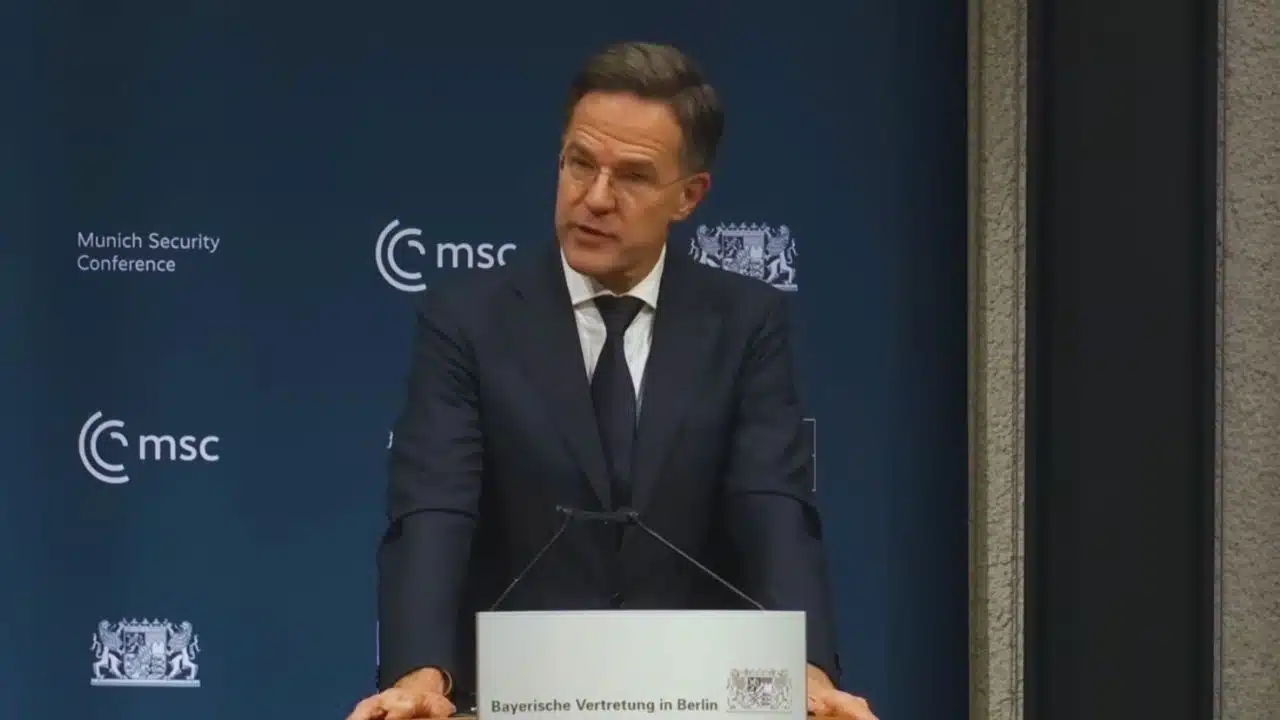
NATO Secretary-General Mark Rutte issued a dire warning on Thursday, stating that Russia could be fully prepared to launch a military attack against the NATO alliance within the next five years. Delivering his keynote address at a high-profile Munich Security Conference event in Berlin, Rutte stood alongside German Foreign Minister Johann Wadephul, driving home the immediacy of the threat posed by Moscow’s rapidly expanding military capabilities. He described Russia’s defense production as reaching “peak” levels, with factories churning out weapons at an unprecedented pace that far exceeds current battlefield needs, allowing for dangerous stockpiling.
We are Russia’s next target, and we are already in harm’s way,” Rutte declared emphatically, his words echoing through the packed venue. He lambasted NATO members for complacency, pointing out that far too many leaders and citizens fail to grasp the gravity of the situation. “Too many don’t feel the urgency, and too many believe that time is on our side. It is not,” he added, underscoring how wishful thinking could prove catastrophic in the face of Moscow’s determined rearmament.
Rutte painted a vivid picture of Russia’s military resurgence, backed by detailed intelligence assessments. Since launching its full-scale invasion of Ukraine in February 2022, Russia has suffered staggering human costs—over 1 million troops killed or severely injured, with an average of about 1,200 casualties every single day so far this year alone. These figures reflect the grinding attrition war in eastern Ukraine, where Russian forces have relied on sheer numbers and relentless assaults to gain incremental ground. Yet, despite these devastating losses, Moscow’s defense industrial base shows no signs of slowing down. In fact, it’s accelerating.
Russia now manufactures thousands of attack drones and missiles each month, including advanced models like the Shahed-136 kamikaze drones and Iskander ballistic missiles, which have become staples in its arsenal. This production surge stems from a wartime economy fully geared toward military output: factories operating around the clock, with shifts extended and civilian industries repurposed to churn out artillery shells, tanks, and armored vehicles. Consumption on the Ukrainian front—while enormous—has been outpaced, leading to massive stockpiles that could sustain a broader conflict. Rutte highlighted how this buildup positions Russia not just to hold ground in Ukraine but to eye NATO’s eastern flank, particularly the Baltic states and Poland, where hybrid threats like cyberattacks and border provocations are already testing alliance resolve.
This isn’t mere speculation; it’s drawn from ongoing monitoring of satellite imagery, economic data, and defectors’ reports showing Russia’s defense budget ballooning to over 6% of GDP. The implications extend beyond Europe: a resurgent Russia could disrupt global energy markets, given its role as a major oil and gas exporter, and embolden authoritarian regimes worldwide by demonstrating that aggression pays off.
Germany Steps Up on Defense Spending
Rutte’s stark message arrives at a pivotal moment as NATO allies scramble to meet ambitious new spending targets, reflecting a sea change in European security thinking. At the alliance’s June 2025 summit in The Hague, leaders committed to elevating defense and security expenditures to 5% of GDP by 2035—a bold leap from the longstanding 2% guideline that many struggled to hit even a decade after its introduction. This escalation acknowledges the transformed threat landscape, where peer competitors like Russia and rising tensions in the Indo-Pacific demand sustained investment in everything from fighter jets to cyber defenses.
Leading this charge is Germany, which has shed its reputation as a defense spending laggard to emerge as a pacesetter. Under Chancellor Friedrich Merz’s government, Berlin now pledges to allocate 3.5% of GDP to core defense by 2029, funneling tens of billions into modernizing the Bundeswehr. This includes procuring next-generation Leopard 3 tanks, F-35 stealth fighters, and advanced Patriot air defense systems to plug longstanding capability gaps exposed by the Ukraine war.
“Germany is leading by example and sending an important signal,” Rutte praised, noting how Berlin’s commitments inspire smaller allies like the Netherlands and the Nordics. The turnaround traces back to 2022’s Zeitenwende (“turning point”) announced by then-Chancellor Olaf Scholz, which unlocked a €100 billion special fund. That initiative has already delivered tangible results: new artillery brigades deployed to Lithuania, naval frigates patrolling the Baltic Sea, and recruitment drives swelling the ranks of a once-atrophied army. Economically, this boom benefits Germany’s industrial heavyweights like Rheinmetall and Airbus, creating jobs and spurring innovation in areas like hypersonic weapons and AI-driven logistics.
Yet challenges persist. Critics argue that bureaucratic hurdles and supply chain bottlenecks—exacerbated by global chip shortages—could delay deliveries. Still, Germany’s trajectory sets a template: by prioritizing defense, it not only bolsters NATO’s collective shield but also stimulates growth in a post-pandemic economy hungry for high-tech exports.
Europe’s Wake-Up Call Amid U.S. Shifts
Rutte’s urgency is amplified by seismic shifts across the Atlantic, particularly the Trump administration’s freshly unveiled national security strategy. Released just last month, the document paints a grim picture for Europe, warning of potential “civilizational erasure” if the continent fails to shoulder more of its own defense burden. It explicitly calls for European nations to assume “primary responsibility,” signaling Washington’s intent to pivot resources toward China and the Middle East while expecting NATO partners to handle Russia.
Rutte sought to calm jittery allies by dismissing viral rumors of a hard 2027 deadline for U.S. forces to withdraw from Europe as “not right.” Nonetheless, he candidly admitted that “Europe will have to step up,” urging a mindset shift from dependence to partnership. This comes amid broader anxieties over the durability of U.S. nuclear assurances, a cornerstone of NATO’s deterrence since the Cold War. Voices like Danish parliamentarian Rasmus Jarlov have amplified calls for Europe to pursue independent nuclear capabilities, perhaps through a Franco-German consortium building on France’s arsenal of 300 warheads.
Rutte firmly pushed back, insisting there’s no evidence of Washington retreating from its ironclad NATO pledges. The nuclear-sharing arrangements—where U.S. B61 gravity bombs are hosted at bases in Germany, Belgium, Italy, and the Netherlands under American control—remain operational and were reaffirmed in NATO’s 2024 Washington Summit declaration. Drills like Steadfast Noon continue annually, simulating nuclear scenarios to keep skills sharp.
Compounding these debates are Russia’s own escalatory moves: deploying tactical nukes to Belarus, modernizing its strategic triad of land, sea, and air-based missiles, and amassing 1,500 new tanks plus 3,000 armored vehicles since 2022. NATO’s response includes ramping up troop rotations in the Baltics to 300,000 on high alert, fortifying supply lines from Poland to Romania, and investing in long-range strikes like the U.S. Dark Eagle missile. For ordinary Europeans, this means higher taxes and conscription debates in countries like Latvia and Sweden, but also a safer future if acted upon decisively. Rutte’s speech, in essence, serves as a clarion call to bridge rhetoric with resources before the window closes.