Television and streaming are now part of our daily routines. People binge-watch at home, keep a series running in the background, or follow long story arcs for years. That constant presence makes TV an underrated tool in the fight against climate change.
Used well, TV series can help build a greener future, can help shift public attitudes, normalize sustainable choices, and even change how the entertainment industry itself operates.
Why TV Series Matter in the Climate Conversation
Television has reach, repetition, and emotional power. Audiences spend hours with familiar characters. Viewers see what they wear, how they travel, what they eat, and what they care about. That is exactly where environmental TV shows and climate-aware storytelling can make a difference.
Unlike one-off campaigns, TV series build emotional bonds over time. When a beloved character chooses public transport, worries about extreme heat, or works in a green job, these moments help normalize sustainable behaviour. Media and climate change awareness grow quietly, episode by episode.
At the same time, the entertainment industry is a real-world emitter. Productions use energy, materials, and travel. Streaming relies on energy-intensive data centres. That is why eco-friendly TV production and sustainable streaming matter as much as on-screen messages. Both sides of the screen must move together.
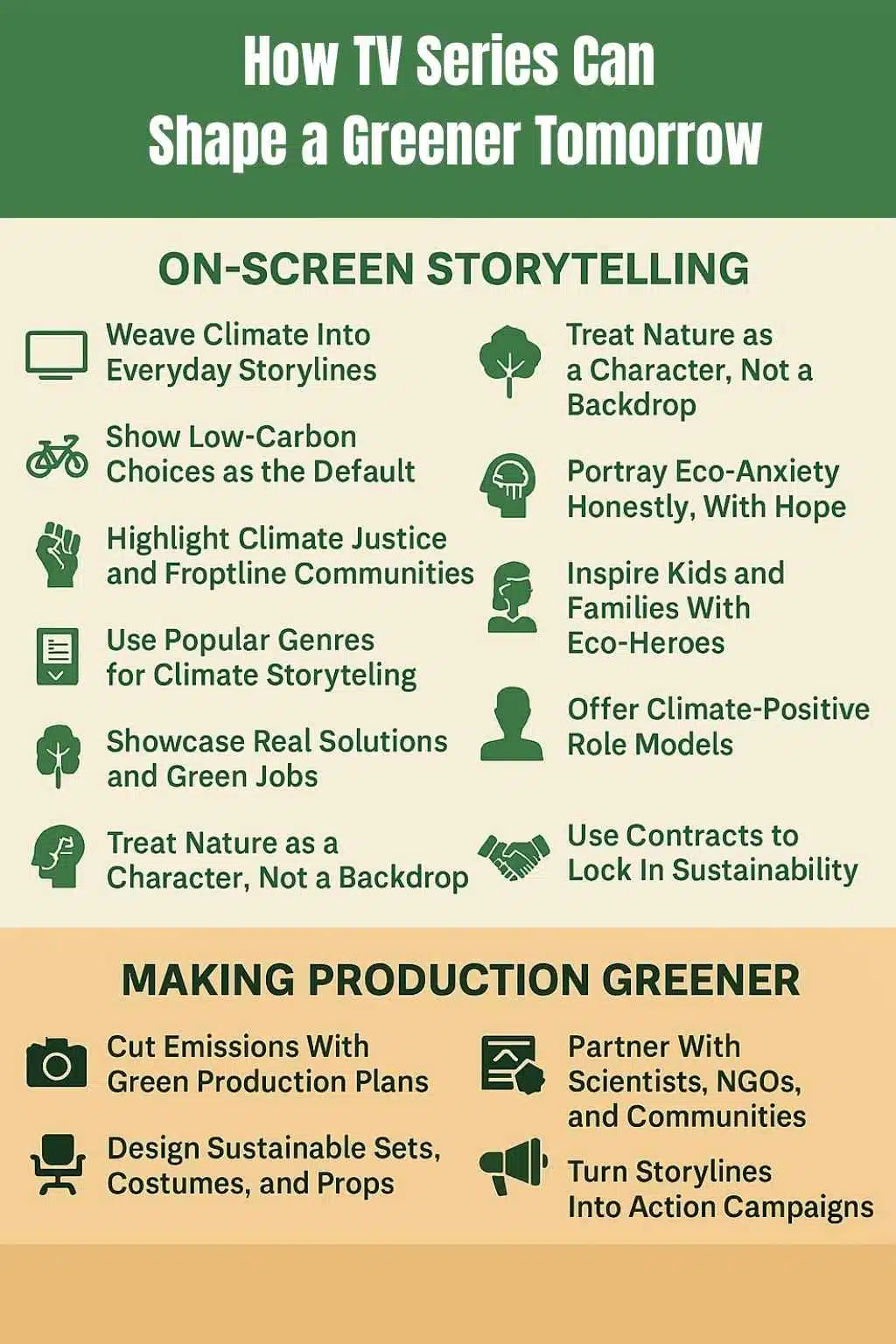
20 Ways TV Series Can Help Build a Greener Future
What audiences see on screen becomes part of their everyday expectations. By weaving climate themes into plots, character choices, and visual details, TV shows can make sustainability feel relatable, achievable, and relevant to real life.

1. Weave Climate Into Everyday Storylines
The most effective climate change TV series do not treat the environment as a one-off “special episode”.
Instead, they integrate climate themes into everyday plots:
- A flood affects a character’s hometown.
- Heatwaves disrupt daily routines.
- A family worries about rising energy bills and upgrades to efficient appliances.
These details mirror real life. They show that climate change is not abstract. It is woven into the economy, health, relationships, and security. When audience members see this often, climate realism becomes the norm.
2. Show Low-Carbon Choices as the Default
Visual habits matter. Characters can:
- Take public transport or cycle instead of driving everywhere.
- Carry reusable bottles, bags, and cups.
- Choose plant-rich meals at home and in restaurants.
When these actions appear regularly, the audience absorbs them as part of everyday life. This subtle, sustainable storytelling in television is more powerful than long speeches. It shows that sustainable living is normal, not extreme.
3. Highlight Climate Justice and Frontline Communities
Climate change does not affect everyone equally. Coastal communities, farmers, low-income neighbourhoods, and Indigenous peoples often face the worst impacts.
Climate justice in popular culture can:
- Tell nuanced stories from frontline communities.
- Show how pollution, heat, or storms connect to inequality.
- Present local leaders and activists as smart, relatable problem-solvers.
By doing this, TV moves beyond generic “save the planet” slogans and shows who is most affected, why it matters, and how fair solutions can look.
4. Use Popular Genres for Climate Storytelling
Not every series that can help build a greener future needs to be a documentary.
Climate themes can live inside:
- Romantic comedies that explore eco-conscious dating and lifestyle choices.
- Police or legal dramas dealing with environmental crime and corporate negligence.
- Sci-fi that imagines climate-resilient cities or failed adaptation.
- Sitcoms that joke about recycling habits, eco-anxiety, or chaotic family attempts to “go green”.
By embedding climate storytelling into familiar genres, writers reach audiences who might never click on a traditional climate show.
5. Showcase Real Solutions and Green Jobs
Doom alone does not move people.
TV can highlight solutions:
- Characters working in renewable energy, sustainable finance, urban farming, or conservation.
- Storylines about retrofitting homes, restoring wetlands, or cleaning up rivers.
- Startup founders building climate tech, circular fashion, or zero-waste businesses.
When audiences see green jobs and climate solutions as exciting, smart, and respected, they begin to view climate action as an opportunity, not a sacrifice.
6. Treat Nature as a Character, Not a Backdrop
Many environmental TV shows treat landscapes, forests, oceans, and wildlife as living characters.
Even in fictional series, simple choices help:
- Opening shots that linger on local ecosystems.
- Story arcs that revolve around a beloved tree, a community garden, or a shoreline.
- Visual contrasts between damaged and restored environments.
This approach builds emotional connection. If viewers care about a place, they care more about what happens to it.
7. Portray Eco-Anxiety Honestly, With Hope
Younger audiences increasingly feel eco-anxiety.
Series can:
- Show characters who are worried or overwhelmed.
- Avoid mocking them as “overreacting”.
- Highlight moments of community, activism, and small wins to balance fear with agency.
The goal is not to erase worry, but to pair it with realistic hope. That is how pro-environmental behavior change through media becomes possible: when people feel both urgency and possibility.
8. Inspire Kids and Families With Eco-Heroes
Family and children’s shows are a powerful space for TV shows promoting sustainability.
- Young protagonists who start school recycling programmes or tree-planting campaigns.
- Families who experiment with cutting waste or saving energy.
- Friendly, funny characters who explain complex topics like pollution or biodiversity.
These stories help children see themselves as capable problem-solvers, not passive victims of a crisis.
9. Offer Climate-Positive Role Models
Characters who are admired, leaders, influencers, and celebrities within the story can model climate-positive behaviour.
- A famous musician in the show chooses low-carbon tours.
- A successful entrepreneur invests in clean technology.
- A beloved mentor teaches students about local environmental issues.
This turns climate action into something aspirational. It aligns sustainability with status, competence, and success.
10. Avoid Greenwashing With Fact-Checked Plots
Audiences quickly lose trust if they sense greenwashing.
Writers and producers can:
- Consult scientists and environmental experts for major climate storylines.
- Avoid oversimplified “magic fix” technologies with no trade-offs.
- Present multiple perspectives, including community voices, workers, and policymakers.
When climate storytelling is honest and accurate, viewers are more likely to believe and act on it.
Behind the Camera – Making Production Greener
The impact of TV series can help build a greener future is not just in the scripts. Real change happens when production itself becomes more sustainable.
11. Cut Emissions With Green Production Plans
Productions often involve flights, large crews, and energy-heavy lighting.
Low-carbon film and TV sets can:
- Use local crews and locations where possible.
- Swap diesel generators for cleaner power sources.
- Plan travel more carefully, reducing unnecessary flights.
- Adopt energy-efficient lighting and equipment.
These changes reduce emissions and can also lower costs over time.
12. Design Sustainable Sets, Costumes, and Props
Set building and costume design are perfect places for eco-friendly TV production.
- Rent or reuse sets and props instead of building everything from scratch.
- Choose materials with recycled content or low environmental impact.
- Donate or resell costumes and furniture after production.
- Avoid single-use plastics during shoots.
Viewers rarely notice these decisions, but the planet does.
13. Green Post-Production and Digital Workflows
Post-production and streaming contribute to the footprint, too.
Sustainable teams can:
- Use energy-efficient servers and cloud services.
- Manage data more carefully, avoiding unnecessary duplication.
- Work with vendors who invest in renewable energy.
This aligns with the broader idea of sustainable streaming and digital media, where the digital shift supports climate goals instead of undermining them.
14. Follow Industry Standards for Sustainable Production
The entertainment industry is developing practical toolkits for green entertainment industry practices.
Series producers can:
- Follow established sustainability guidelines from recognised initiatives.
- Use carbon calculators to estimate and reduce on-set emissions.
- Track waste, energy use, and travel impacts throughout production.
- Aim for recognised sustainability certifications where available.
Standards make it easier to compare efforts and share what works.
15. Use Contracts to Lock In Sustainability
Change becomes durable when it is contractual.
Productions can:
- Include sustainability clauses in contracts with suppliers and partners.
- Encourage or require greener transport, accommodation, and catering.
- Create “green riders” for high-profile talent, requesting low-waste sets or plant-based catering.
These steps bring eco-friendly TV production into everyday business decisions, not just voluntary gestures.
Beyond the Screen – Turning Viewers Into Climate Actors
TV series are powerful, but they cannot act alone. Their greatest impact may be in how they connect audiences to real-world action.
16. Partner With Scientists, NGOs, and Communities
To tell grounded stories and support real change, productions can:
- Work with climate scientists to ensure accuracy.
- Partner with environmental NGOs to design campaigns around episodes.
- Consult local communities when telling stories set in their regions.
This strengthens trust and connects climate storytelling on screen with everyday activism.
17. Turn Storylines Into Action Campaigns
After impactful episodes, platforms and producers can:
- Encourage viewers to join climate challenges or community clean-ups.
- Provide simple actions at the end of episodes, such as “three things you can do this week”.
- Use in-app banners or post-episode cards to highlight campaigns.
This is where entertainment-education and climate action meet: the story opens the heart, and the call-to-action offers a next step.
18. Use Second-Screen Experiences for Deeper Learning
Second screens are now part of how people watch. Producers can create:
- Behind-the-scenes videos about how sets were made more sustainable.
- Short explainers on climate science linked to key episodes.
- Interactive tools, quizzes, or carbon footprint calculators.
Such features help transform passive watching into engaged learning.
19. Localise Climate Stories for Global Audiences
Climate impacts look different in Dhaka, Lagos, Berlin, or Los Angeles.
A climate change TV series with a global audience should:
- Include local story arcs that reflect regional realities.
- Use local writers, actors, and directors who understand the context.
- Offer dubbed and subtitled versions, so more people can see their realities reflected.
This improves representation and makes climate storytelling more relevant, especially for communities that are often portrayed only as victims.
To know if TV series can help build a greener future, creators and platforms need feedback.
- Track viewer responses, social media discussions, and campaign participation.
- Commission or collaborate on studies measuring shifts in awareness and attitudes.
- Share success stories and failures at industry events and in reports.
As the industry learns what works, it can scale those approaches, making each new series more effective than the last.
What Creators, Platforms, and Viewers Can Do – Together
Building a greener entertainment ecosystem requires collaboration. Writers, studios, streaming platforms, and viewers all play distinct but interconnected roles in advancing sustainable storytelling and supporting climate-conscious productions.
For Writers and Showrunners
- Treat climate as a lens, not a separate genre.
- Make sustainability part of characters’ personalities and everyday decisions.
- Blend humour, drama, and romance with climate storytelling on screen, instead of preaching.
For Producers and Studios
- Commit to clear sustainability goals for every production.
- Use carbon budgets and track actual performance.
- Encourage innovation in set design, logistics, and waste reduction.
- Share best practices openly instead of keeping them as competitive advantages.
For Streaming Platforms and Broadcasters
- Create dedicated collections of environmental TV shows and climate-focused episodes.
- Promote climate-aware content on homepages and in recommendations.
- Invest in infrastructure and data centres that support sustainable streaming and digital media.
For Viewers
Viewers are not passive. They can:
- Choose to watch and support TV shows promoting sustainability.
- Talk about climate storylines on social media and with friends.
- Give feedback to platforms, asking for more climate-aware content.
- Take small actions inspired by what they see on screen.
When audiences reward climate-positive content, the industry pays attention.
Frequently Asked Questions
1. Can TV Series Really Change Climate Behaviour?
TV series cannot solve climate change alone. But they shape what people talk about, how they think, and what they consider normal. When viewers see repeated examples of sustainable choices, fair climate policies, and resilient communities, media and climate change awareness grow. That culture shift supports policy change, consumer choices, and activism.
2. What Makes a TV Show Truly “Green”?
A genuinely green show usually combines:
- Honest, realistic climate or environmental themes in the story.
- Visible everyday sustainable habits by characters.
- Efforts behind the scenes to cut emissions and waste.
- Collaboration with experts to avoid misinformation.
Both content and production matter. A series that only talks about sustainability but ignores its own footprint sends mixed signals.
3. Isn’t the Entertainment Industry Too Polluting to Be Credible?
The industry does have a large footprint. That is why change is urgent. The good news is that eco-friendly TV production is now technically and financially feasible. Energy-efficient lighting, low-waste sets, and smarter travel planning can save money as well as emissions. As more companies adopt standards and share data, credibility improves.
4. How Can Viewers Support a Greener TV Ecosystem?
Viewers can:
- Watch and recommend environmental TV shows and climate change TV series.
- Follow campaigns linked to episodes and take part in simple actions.
- Support public broadcasters and platforms that invest in climate storytelling.
- Be critical of obvious greenwashing and reward genuine efforts.
Every view, subscription, and social media conversation sends signals back to the industry.
5. Are Documentaries More Important Than Fiction for Climate Issues?
Documentaries are vital. They inform, expose, and explain. But scripted shows reach different audiences and tap into emotion and identification.
The ideal media ecosystem includes both:
- Documentaries that provide deep dives.
- Fictional series that weave climate issues into everyday life and popular genres.
Together, they create a richer, more persuasive climate conversation.
Final Words
The climate crisis is already reshaping our world. Policy, technology, and finance all matter—but so does culture. TV series shape how billions of people imagine the future, who they admire, and what they consider normal. Used wisely, TV series can help build a greener future.
For example:
- Make sustainable lifestyles feel familiar and attractive.
- Highlight frontline communities and climate justice.
- Showcase real solutions and green jobs.
- Cut emissions from production and streaming.
- Turn viewers into active participants in climate action.
The small screen will not save the world on its own. Yet every storyline, every character choice, and every production decision can nudge us toward a fairer, greener future. The question is no longer whether TV has that power—it is whether writers, producers, platforms, and viewers are ready to use it.